Questões Militares
Comentadas sobre vocabulário | vocabulary em inglês
Foram encontradas 469 questões


The “Freshman Fifteen”
A freshman is a first-year college student. “Fifteen” refers to fifteen pounds – the fifteen pounds added to a student’s weight in his or her first year. There are a number of reasons why first-year university students gain weight; but it’s encouraging to know that freshmen don’t have to add these harmful fifteen pounds.
(Taken from Active Skills for Reading)
GLOSSARY pound – libra (unidade monetária e medida de peso equivalente a 454 gramas)
EXTRACT 1
Japan’s shipyards remain intact after quake
Japan’s major shipyards escaped the full impact of the March 11 earthquake and tsunami that struck the northeastern coast of the country with full force. An official at the Japan Ship Exporters’ Association said the devastating natural disaster “will have no impact on future export ship orders at all”. Although several small shipyards in the quake-hit areas were affected, major Japanese shipyards that build large vessels for exports are concentrated in western Japan and remain intact, the official said. Mitsui Engineering & Shipbuilding sustained “slight material damages” in the company’s Kasai Center and Chiba Works but did not consider such slight damages would cause serious impact on operations. “The rotational schedule of interruption of power supply due to the earthquake may affect our operation at our works and subsidiaries. However, the degree of the impact is not known now,” the company said in a statement. Japanese export ship orders rose for the 15th consecutive month in February o a year-on-year basis. Japanese shipbuilders received orders for 277 export vessels – 259 bulk carriers, 10 oil tankers and eight general cargo vessels – in the April-February period.
(Adapted from: www.australianmerchantnavy.com, March 2011)
EXTRACT 2
Tsnunami Debris Expected on U.S. Shores in 3 Years
The powerful tsunami triggered by the 9.0 Japanese earthquake destroyed coastal towns near Sendai, washing such things as houses and cars into the ocean. Projections of where this debris might head have been made at the international Pacific Research Center, university of Hawaii at Manoa. What their model predicts about the tsunami debris is that they first spread out eastward from the Japan Coast in the North Pacific Subtropical Gyre. In a year, the Papahanaumokuakea Marine National Monument will see pieces washing up on its shores; in two years, the remaining Hawaiian islands will see some effects; in three years, the plume will reach the US West Coast, dumping debris on Californian beaches and the beaches of British Columbia, Alaska, and Baja California. The debris will then drift into the famous floating junk yard, the North Pacific Garbage Patch, where it will wander around and break into smaller and smaller pieces. In five years, Hawaii shores can expect to see another barrage of debris that is stronger and longer-lasting than the first one. Much of the debris leaving the North Pacific Garbage Patch ends up on Hawaii’s reefs and beaches. These model projections will help to guide clean-up and tracking operations.
(Adapted from: www.geog.ucsb.edu, April 2011)
EXTRACT 1
Japan’s shipyards remain intact after quake
Japan’s major shipyards escaped the full impact of the March 11 earthquake and tsunami that struck the northeastern coast of the country with full force. An official at the Japan Ship Exporters’ Association said the devastating natural disaster “will have no impact on future export ship orders at all”. Although several small shipyards in the quake-hit areas were affected, major Japanese shipyards that build large vessels for exports are concentrated in western Japan and remain intact, the official said. Mitsui Engineering & Shipbuilding sustained “slight material damages” in the company’s Kasai Center and Chiba Works but did not consider such slight damages would cause serious impact on operations. “The rotational schedule of interruption of power supply due to the earthquake may affect our operation at our works and subsidiaries. However, the degree of the impact is not known now,” the company said in a statement. Japanese export ship orders rose for the 15th consecutive month in February o a year-on-year basis. Japanese shipbuilders received orders for 277 export vessels – 259 bulk carriers, 10 oil tankers and eight general cargo vessels – in the April-February period.
(Adapted from: www.australianmerchantnavy.com, March 2011)
EXTRACT 2
Tsnunami Debris Expected on U.S. Shores in 3 Years
The powerful tsunami triggered by the 9.0 Japanese earthquake destroyed coastal towns near Sendai, washing such things as houses and cars into the ocean. Projections of where this debris might head have been made at the international Pacific Research Center, university of Hawaii at Manoa. What their model predicts about the tsunami debris is that they first spread out eastward from the Japan Coast in the North Pacific Subtropical Gyre. In a year, the Papahanaumokuakea Marine National Monument will see pieces washing up on its shores; in two years, the remaining Hawaiian islands will see some effects; in three years, the plume will reach the US West Coast, dumping debris on Californian beaches and the beaches of British Columbia, Alaska, and Baja California. The debris will then drift into the famous floating junk yard, the North Pacific Garbage Patch, where it will wander around and break into smaller and smaller pieces. In five years, Hawaii shores can expect to see another barrage of debris that is stronger and longer-lasting than the first one. Much of the debris leaving the North Pacific Garbage Patch ends up on Hawaii’s reefs and beaches. These model projections will help to guide clean-up and tracking operations.
(Adapted from: www.geog.ucsb.edu, April 2011)
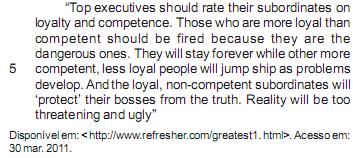
The expression “jump ship” (l. 5) should be understood as
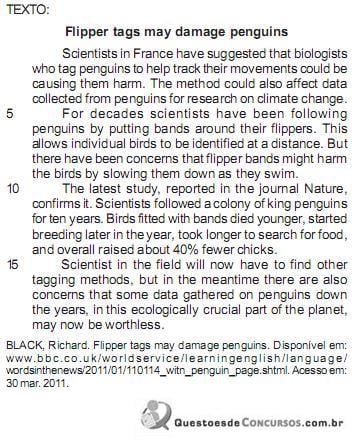
The only alternative in which the word from the text, on the left, is not suitably defined is
"The kids had an argument about who does the most cleaning in their room. I was careful not to__________, as I want to stay good friends with them both".
She speaks English with a (n)_________ American accent.
I. The Simple Aspect refers to events which are seen, in concept, as complete wholes.
II. The Progressive Aspect refers to events which are incomplete or imperfective.
III. The meaning of the Perfect Aspect refers to a time prior to now, retrospectively.
"__________ (appear) we humans share 98% of our genes with chimpanzees; indeed they are our closest relative in the animal _________ (king). This TV _________ (document) follows a family of chimpanzees which live in the forest of Tanzania. Set in __________ (spectacle) scenary it gives us a fascinating insight into the life and social ________ (action) of these creatures".

Dayse: I haven't seen The King's Speech yet. You: (1).

“hand over” (l.6) is the same as hand off.
Instrução: Leia o texto para responder a questão.
The Big Destructiveness Of The Tiny Bribe
Alexandra Wrage 03.01.2010
The smallest bribes can be the most vexing. Not suitcases full of money and transfers to offshore accounts, but the thousands of everyday payments people make to Indian building inspectors, Chinese customs officials and Nigerian airport functionaries, just to get things done. They’re payments for routine government services that a government official is legally obliged to perform but for which he’s hoping to skim off a little extra.
Unlike more serious bribes, these very modest payouts, formally known as “facilitating payments”, are not against the laws of the U.S., Canada, Australia, New Zealand or South Korea, when made abroad. They’re illegal for Great Britain, but the Serious Fraud Office there has taken the extraordinary public position that they’re unlikely to give rise to a prosecution.
Why don’t governments that lead the fight against large-scale bribery fall in line with what is already the practice of many major companies? They don’t want to outlaw such small-scale graft in foreign places, they say, because they don’t have the manpower to prosecute violators. By that logic, communities with just enough resources to handle murder and armed robbery would give a green light to shoplifting. You’d think a government could at least go after a few high-profile cases to set an example and a precedent. Permitting these smaller payments has to impede the effort to crack down on the larger ones. Companies know this.
“Facilitating” bribes are not tips. Tipping is voluntary, and you decide to do it after a service has been rendered. You don’t pay it at the outset to induce the waiter to bring the food, and you can always go somewhere else to eat next time should the service be bad.
Nor are they welfare for underpaid civil servants. If government workers are underpaid, we should compensate them for the cost of customs inspections or airport security by aboveboard means, through taxation and so forth. Payment to individuals not only slows service but also encourages entrepreneurial civil servants to increase their income by creating more and greater obstacles.
Nor are they a mere distraction from the fight against bigger bribes. Rather, they fuel the problem. Junior officials who look for small bribes rise to higher positions by paying off those above them. Corruption creates pyramids of illegal payments flowing upward. Legalizing the base of the pyramid gives it a strong and lasting foundation.
Nor are these payments legal where they’re made. They may not be banned by the wealthy countries mentioned above, but they are outlawed in the countries where they’re actually a problem. Do developed countries want to say they wouldn’t tolerate such payments at home but don’t care if they’re made abroad? And since they’re illegal in the countries where they’re paid, companies can’t put them on their books. The classic cover for a bribe is to call it a “consulting fee”, but that is a books and records violation that is illegal in any country.
(www.forbes.com. Adaptado.)
Instrução: Leia o texto para responder a questão.
The Big Destructiveness Of The Tiny Bribe
Alexandra Wrage 03.01.2010
The smallest bribes can be the most vexing. Not suitcases full of money and transfers to offshore accounts, but the thousands of everyday payments people make to Indian building inspectors, Chinese customs officials and Nigerian airport functionaries, just to get things done. They’re payments for routine government services that a government official is legally obliged to perform but for which he’s hoping to skim off a little extra.
Unlike more serious bribes, these very modest payouts, formally known as “facilitating payments”, are not against the laws of the U.S., Canada, Australia, New Zealand or South Korea, when made abroad. They’re illegal for Great Britain, but the Serious Fraud Office there has taken the extraordinary public position that they’re unlikely to give rise to a prosecution.
Why don’t governments that lead the fight against large-scale bribery fall in line with what is already the practice of many major companies? They don’t want to outlaw such small-scale graft in foreign places, they say, because they don’t have the manpower to prosecute violators. By that logic, communities with just enough resources to handle murder and armed robbery would give a green light to shoplifting. You’d think a government could at least go after a few high-profile cases to set an example and a precedent. Permitting these smaller payments has to impede the effort to crack down on the larger ones. Companies know this.
“Facilitating” bribes are not tips. Tipping is voluntary, and you decide to do it after a service has been rendered. You don’t pay it at the outset to induce the waiter to bring the food, and you can always go somewhere else to eat next time should the service be bad.
Nor are they welfare for underpaid civil servants. If government workers are underpaid, we should compensate them for the cost of customs inspections or airport security by aboveboard means, through taxation and so forth. Payment to individuals not only slows service but also encourages entrepreneurial civil servants to increase their income by creating more and greater obstacles.
Nor are they a mere distraction from the fight against bigger bribes. Rather, they fuel the problem. Junior officials who look for small bribes rise to higher positions by paying off those above them. Corruption creates pyramids of illegal payments flowing upward. Legalizing the base of the pyramid gives it a strong and lasting foundation.
Nor are these payments legal where they’re made. They may not be banned by the wealthy countries mentioned above, but they are outlawed in the countries where they’re actually a problem. Do developed countries want to say they wouldn’t tolerate such payments at home but don’t care if they’re made abroad? And since they’re illegal in the countries where they’re paid, companies can’t put them on their books. The classic cover for a bribe is to call it a “consulting fee”, but that is a books and records violation that is illegal in any country.
(www.forbes.com. Adaptado.)

“Both have been reieved of their duties” (/. 23-24)
This sentence means that both the controller and the supervisor have_______________
The only alternative that does not complete this sentence correctly is
The U.S. Department of Homeland Security (DHS), which operates airport security checkpoints in the United States, is spending upward of US$ 7 million a year trying to develop technology that can detect the evil intent of the terrorists among us. Yes, you read that correctly: They plan to find the bad guys by reading their minds.
Dozens of researchers across the country are in the middle of a five year program contracted primarily to the Charles Stark Draper Laboratory, in Cambridge, Mass. They’ve developed a psycho-physiological theory of ‘malintent’ – basically, a hodgepodge of behaviorism and biometrics according to which physiological chances can give away a terrorist’s intention to do immediate harm. So far, they’ve spent US$ 20 million on biometric research, sensors, and a series of tests and demonstrations. This technology is called the Future Attribute Screening Technology (FAST).
The underlying theory is that your body reacts, in measurable and largely involuntary ways, to reveal the nature of your intentions. So as you wait in line at the airport checkpoint, thermal and other types of cameras and laser- and radar-based sensors will try to get a fix on the baseline parameters of your autonomic nervous system – your body temperature, your heart rate and respiration, your skin’s moistness, and the very look in your eyes. Then, as a security officer asks you a few questions, the sensors will remeasure those parameters so that the FAST algorithms can figure out whether you’re naughty or nice, all on the spot, without knowing anything else about you.

 Conheça nossos planos