Questões Militares
Sobre sinônimos | synonyms em inglês
Foram encontradas 363 questões


Six things I learned from riding in a Google self-driving car
1 - Human beings are terrible drivers.
We drink. We doze. We text. In the US, 30,000 people die from automobile accidents every year. Traffic crashes are the primary cause of death worldwide for people aged 15-24, and during a crash, 40% of drivers never even hit the brakes. We’re flawed organisms, barreling around at high speeds in vessels covered in glass, metal, distraction, and death. This is one of Google’s “moonshots” – to remove human error from a job which, for the past hundred years, has been entirely human.
2 - Google self-driving cars are timid.
The car we rode in did not strike me as dangerous. It drove slowly and deliberately, and I got the impression that it’s more likely to annoy other drivers than to harm them. In the early versions they tested on closed courses, the vehicles were programmed to be highly aggressive. Apparently during these tests, which involved obstacle courses full of traffic cones and inflatable crash-test objects, there were a lot of screeching brakes, roaring engines and terrified interns.
3 - They’re cute.
Google’s new fleet was intentionally designed to look adorable. Our brains are hardwired to treat inanimate (or animate) objects with greater care, caution, and reverence when they resemble a living thing. By turning self-driving cars into an adorable Skynet Marshmallow Bumper Bots, Google hopes to spiritually disarm other drivers. I also suspect the cuteness is used to quell some of the road rage that might emerge from being stuck behind one of these things. They’re intended as moderate-distance couriers, not openroad warriors, so their max speed is 25 miles per hour.
4 - It’s not done and it’s not perfect.
Some of the scenarios autonomous vehicles have the most trouble with are the same human beings have the most trouble with, such as traversing four-way stops or handling a yellow light. The cars use a mixture of 3D laser-mapping, GPS, and radar to analyze and interpret their surroundings, and the latest versions are fully electric with a range of about 100 miles. Despite the advantages over a human being in certain scenarios, however, these cars still aren’t ready for the real world. They can’t drive in the snow or heavy rain, and there’s a variety of complex situations they do not process well, such as passing through a construction zone. Google is hoping that, eventually, the cars will be able to handle all of this as well (or better) than a human could.
5 - I want this technology to succeed, like… yesterday.
I’m biased. Earlier this year my mom had a stroke. It damaged the visual cortex of her brain, and her vision was impaired to the point that she’ll probably never drive again. This reduced her from a fully-functional, independent human being with a career and a buzzing social life into someone who is homebound, disabled, and powerless. When discussing self-driving cars, people tend to ask many superficial questions. They ignore that 45% of disabled people in the US still work. They ignore that 95% of a car’s lifetime is spent parked. They ignore how this technology could transform the lives of the elderly, or eradicate the need for parking lots or garages or gas stations. They dismiss the entire concept because they don’t think a computer could ever be as good at merging on the freeway as they are. They ignore the great, big, beautiful picture: that this technology could make our lives so much better.
6 - It wasn’t an exhilarating ride, and that’s a good thing.
Riding in a self-driving car is not the cybernetic thrill ride one might expect. The car drives like a person, and after a few minutes you forget that you’re being driven autonomously. You forget that a robot is differentiating cars from pedestrians from mopeds from raccoons. You forget that millions of photons are being fired from a laser and interpreting, processing, and reacting to the hand signals of a cyclist. You forget that instead of an organic brain, which has had millions of years to evolve the cognitive ability to fumble its way through a four-way stop, you’re being piloted by an artificial one, which was birthed in less than a decade. The unfortunate part of something this transformative is the inevitable, ardent stupidity which is going to erupt from the general public. Even if in a few years self-driving cars are proven to be ten times safer than human-operated cars, all it’s going to take is one tragic accident and the public is going to lose their minds. There will be outrage. There will be politicizing. There will be hashtags. I say look at the bigger picture. All the self-driving cars currently on the road learn from one another, and possess 40 years of driving experience. And this technology is still in its infancy.
(Adapted from:: <http://theoatmeal.com/blog/google_self_driving_car>
Leia o texto para responder à questão.
Police in England and Wales consider making
misogyny a hate crime

September 10, 2016
Police forces across England and Wales are considering expanding their definition of hate crime to include misogyny (hatred, dislike, or mistrust of women, or prejudice against women) after an experiment in one city that saw more than 20 investigations launched in two months.
The initial success of Nottingham’s crackdown against sexist abuse has drawn national interest after the city’s police revealed that they investigated a case of misogyny every three days during July and August, the first months to see specially trained officers targeting behaviour ranging from street harassment to unwanted physical approaches.
Several other forces have confirmed they are sending representatives to Nottingham this month to discuss the introduction of misogyny as a hate crime. Police and campaigners said the initial figures were broadly in line with other categories of hate crime such as Islamophobia and antisemitism but were likely to rise significantly as awareness increased.
Dave Alton, the hate crime manager for Nottingham police, said: “The number of reports we are receiving is comparable with other, more established, categories of hate crime. We have received numerous reports and have been able to provide a service to women in Nottinghamshire who perhaps would not have approached us six months ago. The reality is that all of the reports so far have required some form of police action.”
(www.theguardian.com. Adaptado)
A questão refere-se ao texto a seguir:
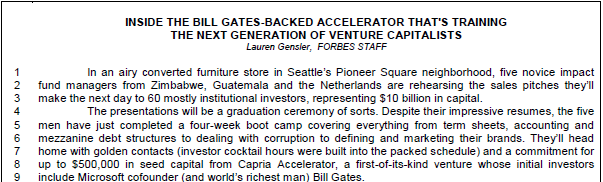
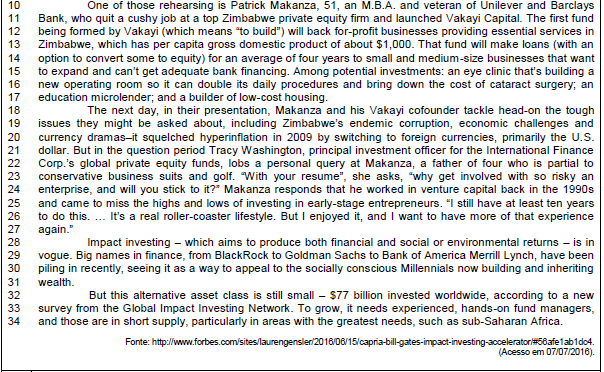
Marque a opção que substitui o trecho sublinhado, mantendo o mesmo sentido.
“Despite their impressive resumes, the five men have just completed a four-week boot camp covering
everything from term sheets, [...]”
Read the text and answer the question.
Olympic Sports
The first modern Olympic Games took place in Athens, Greece, in the year 1896. Athletes from only 13 countries participated in the Games that year. They competed in 43 different events in just 9 sports (track and field, swimming, cycling, fencing, gymnastics, shooting, tennis, weight lifting, and wrestling). In 2004, the Olympic Games took place once again in Athens. This time athletes from 202 countries competed in 300 events in 28 sports. Only five sports have been in every Olympic Games.
Fonte: adapted from Thoughts and Notions.
Texto 5
HIGH-TECH EAVESDROPPING ON THE GANGES RIVER DOLPHIN
SONAR SIGNALS HOLD CLUES THAT COULD SAVE AN ENDANGERED SPECIES
The Ganges river dolphin is one of only two remaining freshwater dolphin species on Earth. But pollution, fishing, and dams threaten to wipe it out entirely.
So acoustical engineer Harumi Sugimatsu and her team have deployed an experimental sonar monitoring system just under the surface of the murky water. The hope is to track the dolphins by the high-frequency clicks they use to navigate and hunt. By eavesdropping on their underwater lives, Sugimatsu believes she can gather data about their behavior and geographical range—data that conservationists can use in their struggle to keep the species from going extinct.
IEEE Spectrum. High-tech eavesdropping on the ganges river dolphin. In: IEEE Spectrum,
2016. Disponível em:<http://spectrum.ieee.org/video/green-tech/conservation/hightech-eavesdropping-on-the-ganges-river-dolphin>
What's the meaning of the underlined word in the following sentence: “(…) her team have deployed an experimental sonar monitoring system just under the surface of the murky water”?
Operation Desert Storm Was Not Won By Smart Weaponry Alone
Technology has long been a deciding factor on the battlefield, from powerful artillery to new weaponry to innovations in the seas and the skies. Twenty-five years ago, it was no different, as the United States and its allies proved overwhelmingly successful in the Persian Gulf War. A coalition of U.S. Army Apache attack helicopters, cruise missiles from naval vessels, and Lockheed F-117 Nighthawk “stealth fighters” soundly broke through Saddam Hussein’s army defenses in Kuwait during Operation Desert Storm, which became known as the “100-hour war”.
But for all the possibilities that this “Computer War” offered, Operation Desert Storm was not won by smart weaponry, alone. Despite the “science fiction”-like technology deployed, 90 percent of the pieces of ammunition used in Desert Storm were actually “dumb weapons”. The bombs, which weren’t guided by lasers or satellites, were lucky to get within half a kilometer of their targets after they were dumped from planes. While dumb bombs might not have been exciting enough to make the headlines during the attack, they were cheaper to produce and could be counted on to work. But frequency of use doesn’t change why history will remember Desert Storm for its smart weapons, rather than its dumb ones.
Adapted from http://www.smithsonianmag.com/history/ operation-desert-storm-was-not-won-smart-weaponry-alone- 180957879/
Choose the alternative that correctly substitutes the expression rather than in the sentence “... history will remember Desert Storm for its smart weapons, rather than its dumb ones.” (paragraph 2).
How Brazil Crowdsourced a Pioneering Law
The passage of the Marco Civil da Internet, an “Internet bill of rights” commonly referred to in English as the Brazilian Civil Rights Framework for the Internet, demonstrates how the Internet can be used to rejuvenate democratic governance in the digital age. The law is important not only for its content, but for the innovative and participatory way it was written, bypassing traditional modes of legislation-making to go directly to the country’s citizens. At a moment when governments of all kinds are viewed as increasingly distant from ordinary people, Brazil’s example makes an argument that democracy offers a way forward.
The pioneering law was signed in 2014 and has three components. First, it safeguards privacy by restricting the ability of private corporations and the government to store Internet users’ browsing histories. Second, it mandates a judicial review of requests to remove potentially offensive or illegal material, including content that infringes copyrights. And third, it prohibits Internet service providers from manipulating data transfer speeds for commercial purposes. The bill was acclaimed by activists as an example the rest of the world should follow.
What makes this law even more interesting is that it became one of the largest-ever experiments in crowdsourcing legislation. The law’s original text was written through a website that allowed individual citizens and organizations — including NGOs, businesses, and political parties — to interact with one another and publicly debate the law’s content. This process was markedly different from the traditional method of writing bills “behind closed doors” in the halls of Congress, a process that favored well-connected families and large corporations.
Policymakers in other countries have tried to capture citizen input using social media before, but never on this scale, in a country of roughly 200 million people. Whether it would succeed was far from certain. During the website’s public launch, in 2009, one of the government lawyers summed up the organizers’ high hopes: “This experience could transform the way we discuss not just legislation about the Internet, but also the way we discuss other bills in Brazil, and, in so doing, reconfigure our democracy.”
Adapted from http://foreignpolicy.com/2016/01/19/how-brazil-crowdsourced-a-landmark-law/
Choose the alternative that correctly substitutes the word bypassing in the sentence “... bypassing traditional modes of legislation-making ...” (paragraph 1).
This migrant crisis is different from all others
2015 was unquestionably the year of the migrant. The news was dominated for months by pictures of vast crowds shuffling through the borders of yet another European country, being treated with brutality in some places and given a reluctant welcome in others.
When researching a report for radio and television about the migrant phenomenon, it is possible to realize that there was nothing new about it. For many years, waves of displaced and frightened people have broken over Europe again and again and the images have been strikingly similar each time.
In 1945, __________ (1) the ethnic Germans, forced out of their homes in Poland, Czechoslovakia and Russia and obliged to seek shelter in a shattered and divided Germany. More recently, we can see floods of Albanian refugees escaping from the ethnic cleansing of the Serbian forces in Kosovo in 1998 and 1999.
Yet there is one major difference between these waves of migrants in the past and the one we saw in 2015. Professor Alex Betts, director of the Refugee Studies Centre at Oxford University says that it was the first time Europe faced people coming in from the outside in large numbers as refugees. He explains: “The fact that many are Muslims is perceived as challenging Europe’s identity.” European societies are changing very fast, indeed, as a result of immigration. In London, for instance, more than 300 languages are now spoken, according to a recent academic study. The influx of migrants reinforces people’s sense that their identity is under threat.
But how can the world deal conclusively with the problem? The former UN under-secretary-general for humanitarian affairs, Sir John Holmes, blames global governance. “Other powers are rising,” he says - Syria is an example of this. “And the United States doesn’t have the influence it once did, so the problem’s not being fixed, no-one’s waving the big stick and we’re having to pick up the pieces.” We have endured an entire century of exile and homelessness and the cause is always the same - conflict and bad government. Unless these are dealt with, the flow of migrants will never be stopped.
Adapted from http://www.bbc.com/news/world-35091772

Hard Lesson in Sleep for Teenagers
By Jane E. Brody October 20, 2014
Few Americans these days get the hours of sleep optimal for their age, but experts agree that teenagers are more likely to fall short than anyone else.
Researchers report that the average adolescent needs eight and a half to nine and a half hours of sleep each night. However, in a poll taken in 2006 by the National Sleep Foundation, less than 20 percent reported getting that much rest on school nights. With the profusion of personal electronics, the current percentage is believed to be even worse. A study in Fairfax, Va., found that only 6 percent of children in the 10th grade and only 3 percent in the 12th grade get the recommended amount of sleep. Two in three teens were found to be severely sleep-deprived, losing two or more hours of sleep every night. The causes can be biological, behavioral or environmental. The effect on the well-being of adolescents — on their health and academic potential — can be profound.
Insufficient sleep in adolescence increases the risks of high blood pressure and heart disease, Type 2 diabetes and obesity, said Dr. Owens, pediatric sleep specialist at Children's National Health System in Washington. Sleeplessness is also linked to risk-taking behavior, depression, suicidal ideation and car accidents. Insufficient sleep also impairs judgment, decision-making skills and the ability to curb impulses, which are "in a critical stage of development in adolescence," Dr. Owens said. With the current intense concern about raising academic achievement, it is worth noting that a study by Kyla Wahlstrom of 9,000 students in eight Minnesota public high schools showed that starting school a half-hour later resulted in an hour's more sleep a night and an increase in the students' grade point averages and standardized test scores.
When children reach puberty, a shift in circadian rhythm makes it harder for them to fall asleep early enough to get the requisite number of hours and still make it to school on time. A teenager’s sleep-wake cycle can shift as much as two hours, making it difficult to fall asleep before 11 p.m. If school starts at 8 or 8:30, it is not possible to get enough sleep. Based on biological sleep needs, a teenager who goes to sleep at 11 p.m, should be getting up around 8 a.m.
Adding to the adolescent shift in circadian rhythm are myriad electronic distractions that cut further into sleep time, like smartphones, iPods, computers and televisions. A stream of text messages, tweets, and postings on Facebook and Instagram keep many awake long into the night.
Parents should consider instituting an electronic curfew and perhaps even forbid sleep-distracting devices in the bedroom, Dr . Owens said. Beyond the bedroom, many teenagers lead overscheduled lives that can lead to short nights.
Also at risk are many teenagers from low-income and minority families, where overcrowding, excessive noise and safety concerns can make it difficult to get enough restful sleep, the academy statement said. Trying to compensate for sleep deprivation on weekends can further compromise an adolescent's sleep-wake cycle by inducing permanent jet lag. Sleeping late on weekends shifts their internal clock, making it even harder to get to sleep Sunday night and wake up on time for school Monday morning.
(Adapted and abridged from http://www.nytimes.com)
Additional Factors That Affect Sleep Comfort
By Richard A. Staehler, MD
The type of mattress one uses is not the only factor for patients with pain and sleep difficulty. Many other factors need to be considered that may affect sleep, including;
- medication side effects;
- irregular sleep patterns;
- caffeine/alcohol/tobacco use;
- sleep apnea;
- anxiety/stress.
If comfort is not the only thing making sleep difficult, it is advisable for the patient to consult his or her family physician to discuss other possible causes and treatments for sleeplessness.
If anyone experiences significant or persistent back pain, there may be an underlying back condition that has nothing to do with the mattress. It is always advisable for people with back pain to consult with a health care provider for a thorough exam, diagnosis, and treatment program.
As a reminder, sleep comfort is first and foremost a matter of personal preference. No one should expect that switching mattresses or beds will cure their lower back pain, and changes in the type of bed or mattress used should be made solely for the sake of comfort,
(Adapted from http;//www.spine-health,com/wellness/sleep/additional-factors -affect -sleep-comfort )


Mark the option that shows synonyms for the underlined expressions in “it’s high time to relieve my pain and to set the record straight” (lines 28 and 29).

Leonardo da Vinci
Known as the greatest artist in the history of mankind, Leonardo da Vinci was also a great philosopher and scientist. Leonardo is the most influential figure in the Italian Renaissance and he is considered to be an inventive multi-genius.
Leonardo was born in 1452 in Vinci, Italy, as the child of Piero da Vinci, a notary, and Caterina, a country girl. He stayed with his father's family and they moved to Florence when he was just 12. At the age of 14, Leonardo started out his artist's apprenticeship at the studio of Andrea del Verrocchio (1435-1488), an Italian sculptor, goldsmith and painter.
The art of painting made Leonardo knowledgeable about anatomy and perspective. In addition to painting, Verrocchio's studio also offered technical and mechanical arts and sculpture. Leonardo had developed an interest in architecture so he went on to study engineering.
After a decade of highly original work as an artist, Leonardo wrote to several wealthy men to help finance his projects. The Duke of Milan, Ludovico Sforza (1452-1508), accepted his offer as Leonardo told him that he could design war weapons like guns and mines, and also structures like collapsible bridges. He lived in Milan with the Duke from 1482 to 1508, reportedly creating very innovational war machines. He also did painting and sculpture, as well as urban planning for large-scale water projects. There, he also wrote about making a telescope to view the moon.
Available at: <http://www.famousscientists.org/leonardo-da-vinc> (Edited).
Read this sentence from the text and analyze it:
“After a decade of highly original work as an artist, Leonardo wrote to several wealthy men to help finance his projects.”
The word “wealthy” could be replaced without change of meaning by
The X-Files is an American science fiction horror drama television series created by Chris Carter. The program originally aired from September 10, 1993 to May 19, 2002 on Fox, spanning nine seasons and 202 episodes. The series revolves around FBI Special Agents Fox Mulder (David Duchovny) and Dana Scully (Gillian Anderson) investigating X-Files: marginalized, unsolved cases involving paranormal phenomena. Mulder believes in the existence of aliens and the paranormal while Scully, a skeptic, is assigned to make scientific analyses of Mulder’s discoveries to debunk his work and thus return him to mainstream cases. Early in the series, both agents become pawns in a larger conflict and come to trust only each other. They develop a close relationship, which begins as a platonic friendship, but becomes a romance by series end. In 2002 a movie was released with the following plot. When a group of women are abducted in the wintry hills of rural Virginia, the only clues to their disappearance are the grotesque human remains that begin to turn up in snow banks along the highway. With officials desperate for any lead, a disgraced priest’s questionable visions send local police on a wild goose chase and straight to a bizarre secret medical experiment that may or may not be connected to the women’s disappearance. It’s a case right out of The X-Files. But the FBI closed down its investigations into the paranormal years ago. And the best team for the job is ex-agents Fox Mulder and Dr. Dana Scully, who have no desire to revisit their dark past. Still, the truth of these horrific crimes is out there somewhere...and it will take Mulder and Scully to find it! This television 90´s series follows the adventures and lives of FBI agents investigating those cases that involve the paranormal or previously unsolved (especially by conventional means). FBI Special Agents Mulder, Scully, Doggett and Reyes work to uncover forces within the United States of America government that would violate people’s rights, alien creatures and monsters alike that attack and other mysteries.
Written by Lee Jamilkowski http://filmymp4.com/hollywood-mobile-movies/The-X-Files-I-Want-to-Believe

 Conheça nossos planos