Questões Militares Sobre inglês
Foram encontradas 4.500 questões


TEXT I
Robotic Cars
The year is 2020, and it’s 7;45 on a rainy Monday morning, and you are in your car on your way to work. You turn right, and you turn left. A few minutes later, you stop at a traffic light. When the light turns green and there are no other cars in the intersection, you continue on your way. Ten minutes later you get to work and stop reading the morning paper. Then, you get out of your car and you say, “Thank you!". Your car replies, “You’re welcome!’’. This possibie future may sound unreai, but in fact many car companies are aiready testing robotic cars, or driverless cars, on the roads today, although the cars don't speak very much yet.
In the 1980s, Germany and the United States tested the first driverless cars, and by 2020 companies such as Volvo, GM, Nissan and BMW plan to seil driverless cars. Driverless cars are not really ‘driverless - the drivers are computers that use radar, Computer maps and other modern technology. They offer many advantages. Perhaps the most important of these is fewer deaths caused by road accidents. For example, in 1968 more than 53.000 people lost their lives in car accidents in the USA. This number has fallen to less than 33.000 but it’s still a high number. In addition, people will spend iess time stuck in traffic jams and there will be no need for people to have a driving license. One of the major disadvantages of this new technology, however, is the cost. It’s not free. U$5.000 to U$10.000 is added to the price of the new car. Nevertheless, at some time in your life, you will probably be sitting in a robotic, ;driverless car on your way to work or school. The future is almost here. Are you ready for it?
<https://www.aHthinastoDics.eom/uploads/2/3/2/9/23290220/lesson-drivina-robo ticcars2.pdf>
Read the extract from the text.
'They offer many advantages.’
The subject pronoun ‘they’ refers to:
TEXT I
Robotic Cars
The year is 2020, and it’s 7;45 on a rainy Monday morning, and you are in your car on your way to work. You turn right, and you turn left. A few minutes later, you stop at a traffic light. When the light turns green and there are no other cars in the intersection, you continue on your way. Ten minutes later you get to work and stop reading the morning paper. Then, you get out of your car and you say, “Thank you!". Your car replies, “You’re welcome!’’. This possibie future may sound unreai, but in fact many car companies are aiready testing robotic cars, or driverless cars, on the roads today, although the cars don't speak very much yet.
In the 1980s, Germany and the United States tested the first driverless cars, and by 2020 companies such as Volvo, GM, Nissan and BMW plan to seil driverless cars. Driverless cars are not really ‘driverless - the drivers are computers that use radar, Computer maps and other modern technology. They offer many advantages. Perhaps the most important of these is fewer deaths caused by road accidents. For example, in 1968 more than 53.000 people lost their lives in car accidents in the USA. This number has fallen to less than 33.000 but it’s still a high number. In addition, people will spend iess time stuck in traffic jams and there will be no need for people to have a driving license. One of the major disadvantages of this new technology, however, is the cost. It’s not free. U$5.000 to U$10.000 is added to the price of the new car. Nevertheless, at some time in your life, you will probably be sitting in a robotic, ;driverless car on your way to work or school. The future is almost here. Are you ready for it?
<https://www.aHthinastoDics.eom/uploads/2/3/2/9/23290220/lesson-drivina-robo ticcars2.pdf>
Read the extract from the text
'The year is 2020, and it’s 7:45 on a rainy Monday morning, (...)’
What’s the correct question referring to the underiined information?
TEXT I
Robotic Cars
The year is 2020, and it’s 7;45 on a rainy Monday morning, and you are in your car on your way to work. You turn right, and you turn left. A few minutes later, you stop at a traffic light. When the light turns green and there are no other cars in the intersection, you continue on your way. Ten minutes later you get to work and stop reading the morning paper. Then, you get out of your car and you say, “Thank you!". Your car replies, “You’re welcome!’’. This possibie future may sound unreai, but in fact many car companies are aiready testing robotic cars, or driverless cars, on the roads today, although the cars don't speak very much yet.
In the 1980s, Germany and the United States tested the first driverless cars, and by 2020 companies such as Volvo, GM, Nissan and BMW plan to seil driverless cars. Driverless cars are not really ‘driverless - the drivers are computers that use radar, Computer maps and other modern technology. They offer many advantages. Perhaps the most important of these is fewer deaths caused by road accidents. For example, in 1968 more than 53.000 people lost their lives in car accidents in the USA. This number has fallen to less than 33.000 but it’s still a high number. In addition, people will spend iess time stuck in traffic jams and there will be no need for people to have a driving license. One of the major disadvantages of this new technology, however, is the cost. It’s not free. U$5.000 to U$10.000 is added to the price of the new car. Nevertheless, at some time in your life, you will probably be sitting in a robotic, ;driverless car on your way to work or school. The future is almost here. Are you ready for it?
<https://www.aHthinastoDics.eom/uploads/2/3/2/9/23290220/lesson-drivina-robo ticcars2.pdf>
Read the extract from the text.
'Ten minutes iater you get to work and stop reading the morning paper.’
Mark the option that can replace the expression get to.
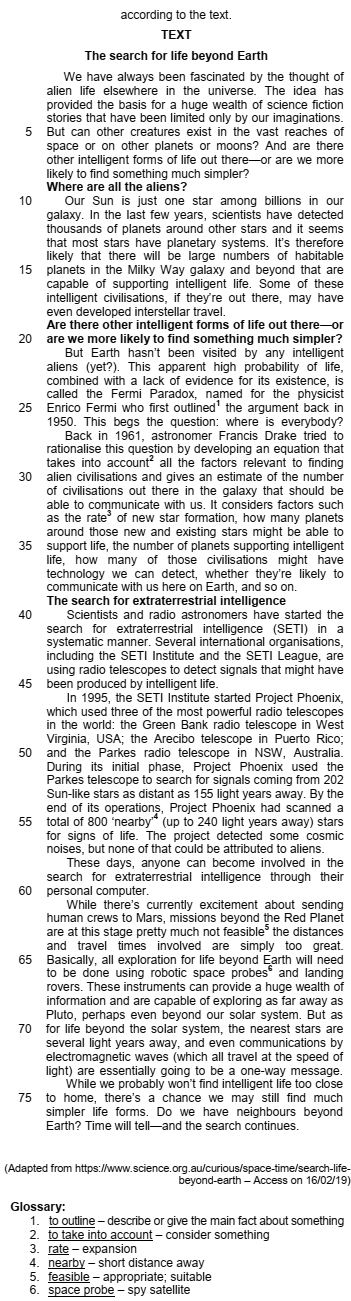
“Project Phoenix, which used three of the most powerful radio telescopes in the world:” (lines 46 to 48).
“there’s a chance we may still find much simpler life forms.” (lines 75 and 76).
“Do we have neighbours beyond Earth?” (lines 76 and 77).
One of the alternatives DOESN’T answer the question. Mark it.
All exploration will happen if they ___ robotic space probes.
Where are all the aliens? (line 9)
“We have always been fascinated by the thought of alien life elsewhere in the universe.” (lines 1 and 2)
Paul: Mary, the party is tomorrow! Do we have everything we need? Mary: We have _____ juice, but we should buy more. Pau: Do we need to buy bread? Mary: Well, we have _____, I don’t know if it’s enough. Paul: So let’s talk to Jen and ask for ____ advice.
Choose the alternative that best completes the text:

 Conheça nossos planos