Questões Militares Sobre inglês
Foram encontradas 4.500 questões


Ano: 2015
Banca:
Marinha
Órgão:
ESCOLA NAVAL
Prova:
Marinha - 2015 - ESCOLA NAVAL - Aspirante - 2° Dia |
Q572914
Inglês
Texto associado
Based on the text below, answer question.
The Future of Libraries Has Little to Do with Books
On a Monday morning between Christmas and New Year's Eve in Paris, the line for modern art museum Centre Georges Pompidou winds around the block. But the patrons waiting in the cold aren't there to catch a glimpse of a Magritte —they're young locais queueing for access through the museum’s back door to another attraction: the public library.
In a digital age that has left book publishers reeling, libraries in the world's major cities seem poised for a comeback, though it1s one that has very little to do with books. The Independent Library Report — published in December by the U.K.'s Department for Culture, Media, and Sport — found that libraries across the nation are reinventing themseives by increasingly becoming "vibrant and attractive community hubs", focusing on the "need to create digital literacy, and in an ideal world, digital fluency.”
Taking into account the proliferation of freelancing, the gig economy, and remote working (also known as 'technomadism'), the rise of library as community hub begins to make sense. Cities are increasingly attracting location independent workers, and those workers need space and amenities that expensive and unreliable coffee shops simply cannot provide enough of.
Furthermore, when one considers that the most vulnerable and underserved city dwellers are also those who generally do not have access to the Internet, the need for a free and publicly connected space becomes even clearer.
According to a 2013 Pew poli, 90 percent in the U.S. said their community would be negatively impacted if their local library closed. But if libraries are going to survive the digital age, they need to be more about helping patrons filter vast quantities of digital Information rather than access to analog materiais. Good news carne for U.S. libraries in November, when Federal Communications Commission Chairman Tom Wheeler announced a 62 percent increase in spending on high-speed Internet for schools and public libraries.
When it comes to this need for connectivity, Britainfs library report stated a "Wi-Fi connection should be delivered in a comfortable, retail standard environment with the usual amenities of coffee, sofas and etc." The report suggested that libraries focus less on loaning physical books and more on widening access via loaning of e-books, which the report noted was up by 80 percent in Britain from 2013.
Also in 2013, the first bookless public library in the United States opened in San Antonio, Texas. The cityTs BiblioTech offers an all-digital, cloud-based collection of more than 10,000 e-books, plus e-readers available for checkout. Located in San Antonio’s underserved South Side, the BiblioTech provides an important digital hub in a city with a population that still struggles to connect to wireless Internet, Last month saw the opening of Canada's Halifax Central Library, designed by a world-leading Danish design firm. With its auditorium, meeting space for entrepreneurs, multiple cafes, adult literacy classes and gaming facilities, actual books seemed like an afterthought.
(Abridged from http://magazine.good.is/articles/public-libraries-reimagined).
The word "unreliable" in " [...] those workers need space and amenities that expensive and unreliable coffee shops simply cannot provide enough of." is the opposite of.
Ano: 2015
Banca:
Marinha
Órgão:
ESCOLA NAVAL
Prova:
Marinha - 2015 - ESCOLA NAVAL - Aspirante - 2° Dia |
Q572913
Inglês
Texto associado
Based on the text below, answer question.
The Future of Libraries Has Little to Do with Books
On a Monday morning between Christmas and New Year's Eve in Paris, the line for modern art museum Centre Georges Pompidou winds around the block. But the patrons waiting in the cold aren't there to catch a glimpse of a Magritte —they're young locais queueing for access through the museum’s back door to another attraction: the public library.
In a digital age that has left book publishers reeling, libraries in the world's major cities seem poised for a comeback, though it1s one that has very little to do with books. The Independent Library Report — published in December by the U.K.'s Department for Culture, Media, and Sport — found that libraries across the nation are reinventing themseives by increasingly becoming "vibrant and attractive community hubs", focusing on the "need to create digital literacy, and in an ideal world, digital fluency.”
Taking into account the proliferation of freelancing, the gig economy, and remote working (also known as 'technomadism'), the rise of library as community hub begins to make sense. Cities are increasingly attracting location independent workers, and those workers need space and amenities that expensive and unreliable coffee shops simply cannot provide enough of.
Furthermore, when one considers that the most vulnerable and underserved city dwellers are also those who generally do not have access to the Internet, the need for a free and publicly connected space becomes even clearer.
According to a 2013 Pew poli, 90 percent in the U.S. said their community would be negatively impacted if their local library closed. But if libraries are going to survive the digital age, they need to be more about helping patrons filter vast quantities of digital Information rather than access to analog materiais. Good news carne for U.S. libraries in November, when Federal Communications Commission Chairman Tom Wheeler announced a 62 percent increase in spending on high-speed Internet for schools and public libraries.
When it comes to this need for connectivity, Britainfs library report stated a "Wi-Fi connection should be delivered in a comfortable, retail standard environment with the usual amenities of coffee, sofas and etc." The report suggested that libraries focus less on loaning physical books and more on widening access via loaning of e-books, which the report noted was up by 80 percent in Britain from 2013.
Also in 2013, the first bookless public library in the United States opened in San Antonio, Texas. The cityTs BiblioTech offers an all-digital, cloud-based collection of more than 10,000 e-books, plus e-readers available for checkout. Located in San Antonio’s underserved South Side, the BiblioTech provides an important digital hub in a city with a population that still struggles to connect to wireless Internet, Last month saw the opening of Canada's Halifax Central Library, designed by a world-leading Danish design firm. With its auditorium, meeting space for entrepreneurs, multiple cafes, adult literacy classes and gaming facilities, actual books seemed like an afterthought.
(Abridged from http://magazine.good.is/articles/public-libraries-reimagined).
Mark the only option that is FALSE according to the text.
Ano: 2015
Banca:
Marinha
Órgão:
ESCOLA NAVAL
Prova:
Marinha - 2015 - ESCOLA NAVAL - Aspirante - 2° Dia |
Q572912
Inglês
Texto associado
Based on the text below, answer question.
How to Become a USNA Midshipman
Posted by: Jacqui Murray j December 8, 2010 There are lots of how-to books on getting in the Naval Academy, but they1re quite dry and impersonal. Mine - Buildinq a Midshipman - is from the perspective of a woman who did it (my daughter!) and how she accomplished such a lofty goal. It's down-to-earth and should give confidence to any teen, male or female, considering a military academy as their college of choice.
I wrote this because there was a need for a book like this. When my daughter wanted a step-by-step on how to get into the Naval Academy, ali she could find were books that told her how hard it was, how selective they were, how very few could achieve it. My daughter brushed the negativity off, but I wondered how many kids were discouraged by that approach.
I decided to write a book (a) explaining how to achieve the goal, not why kids couldnTt; (b) showing how teens can solve the problems that stand in their way rather than why they can't, and (c) sharing the many but predictable steps that will take a motivated, committed applicant where they want to go rather than why they can't get there. That approach worked for my daughter and I had no doubt it would work for others. From what I hear from readers, it1s true. I hope you find it useful. .
(MURRAY, Jacqui. Building a USNA Midshipman. How to crack the United States Naval Academy Application, 2n edition, 2008. Adapted from https:// usnaorbust.wordpress.com)
Considering the text, the words "lofty" in how she accomplished such a lofty goal.n and "brushed off" in "[...] she brushed the negativity off [...] ." mean respectively.
Ano: 2015
Banca:
Marinha
Órgão:
ESCOLA NAVAL
Prova:
Marinha - 2015 - ESCOLA NAVAL - Aspirante - 2° Dia |
Q572911
Inglês
Texto associado
Based on the text below, answer question.
How to Become a USNA Midshipman
Posted by: Jacqui Murray j December 8, 2010 There are lots of how-to books on getting in the Naval Academy, but they1re quite dry and impersonal. Mine - Buildinq a Midshipman - is from the perspective of a woman who did it (my daughter!) and how she accomplished such a lofty goal. It's down-to-earth and should give confidence to any teen, male or female, considering a military academy as their college of choice.
I wrote this because there was a need for a book like this. When my daughter wanted a step-by-step on how to get into the Naval Academy, ali she could find were books that told her how hard it was, how selective they were, how very few could achieve it. My daughter brushed the negativity off, but I wondered how many kids were discouraged by that approach.
I decided to write a book (a) explaining how to achieve the goal, not why kids couldnTt; (b) showing how teens can solve the problems that stand in their way rather than why they can't, and (c) sharing the many but predictable steps that will take a motivated, committed applicant where they want to go rather than why they can't get there. That approach worked for my daughter and I had no doubt it would work for others. From what I hear from readers, it1s true. I hope you find it useful. .
(MURRAY, Jacqui. Building a USNA Midshipman. How to crack the United States Naval Academy Application, 2n edition, 2008. Adapted from https:// usnaorbust.wordpress.com)
According to the text, which statement is correct?
Ano: 2015
Banca:
Marinha
Órgão:
ESCOLA NAVAL
Prova:
Marinha - 2015 - ESCOLA NAVAL - Aspirante - 2° Dia |
Q572910
Inglês
Texto associado
Baseei on the text below, answer question.
Top Tips for Safe Travei
The world isn ’ t dangerous or unsafe. Quite the opposite. There are some desperate places and people, even in your home town, but these are a minority. In fact, you're more likely to get into trouble at home than travelling if you follow these common sense tips on your trips:
1) Scan ali your major documents. Scan your travei documents and email them to yourself - that way your documents won't go missing even if your bags do.
2) Get travei Insurance. This is mainly for health costs if you get ill or injured while abroad. Hospital costs can quickly get into the tens of thousands of dollars, even for a minor injury.
3) Get vaccinated. Visit your doctor before you leave to get ali the relevant vaccinations/immunizations for the destinations you're visiting, and to learn what health precautions you should follow.
(Adapted from http://www.lonelyplanet.com)
According to the text, which statement is correct ?
Ano: 2015
Banca:
Marinha
Órgão:
ESCOLA NAVAL
Prova:
Marinha - 2015 - ESCOLA NAVAL - Aspirante - 2° Dia |
Q572909
Inglês
Texto associado
Based on the text below, answer question.
Life in the Navy - Frequently Asked Questions.
Many of your questions about the Navy have been asked and answered before. See if you can find your question in the list below. Or, to get the most complete picture of the Navy, locate your nearest recruiter and set up a meeting.
(I) ________
It depends. Normally ships will go to sea for 10 days to 2 weeks each month for training operations. Extended operations away from home port can last up to 6 months, and ships deploy every 18-24 months. This varies depending on the mission and type of ship. Ships on 6-month deployments spend time visiting ports throughout the world. If you are on a shore duty tour, you will likely spend no time at sea during the course of the duty assignment {usually 2 to 3 years).
(II) _______
There are plenty of activities available to sailors in their off-duty time. Depending on the size of the ship, you'll have areas for exercise, watching movies, playing cards, emailing friends, and purchasing snacks and other items. Many ships also provide college classes.
(III) _______
The tempo of operations will dictate actual length. While in home port or on shore duty, it is very similar to that of civilian jobs. While out to sea, it is often longer because of the workload needed to keep the ship, aircraft and other machinery working properly and efficiently.
(IV) _______
Onder normal circumstances, you will be eligible for a promotion from E-l to E-2 in 9 months, from E-2 to E-3 in 9 months, and from E-3 to E-4 in 6 months. Advancements on the basis of merit can occur in basic training to E-2 without waiting the 9 months. By referring friends who join the Navy, you can be promoted even faster!
(V) _______
Once you have completed basic training and any followup schooling, you will probably move just once to your first permanent duty station. Naturally, if you stay in the Navy past your first enlistment (or if you request a specific deployment) you may have to move again.
(Adapted from https://www.navy.eom/faq.html#section-4)
The words and expressions that can replace "picture", "locate" and "set up" in the extract " [...] to get the most complete picture of the Navy, locate your nearest recruiter and set up a meeting." while keeping the same meaning are.
Ano: 2015
Banca:
Marinha
Órgão:
ESCOLA NAVAL
Prova:
Marinha - 2015 - ESCOLA NAVAL - Aspirante - 2° Dia |
Q572908
Inglês
Texto associado
Based on the text below, answer question.
Life in the Navy - Frequently Asked Questions.
Many of your questions about the Navy have been asked and answered before. See if you can find your question in the list below. Or, to get the most complete picture of the Navy, locate your nearest recruiter and set up a meeting.
(I) ________
It depends. Normally ships will go to sea for 10 days to 2 weeks each month for training operations. Extended operations away from home port can last up to 6 months, and ships deploy every 18-24 months. This varies depending on the mission and type of ship. Ships on 6-month deployments spend time visiting ports throughout the world. If you are on a shore duty tour, you will likely spend no time at sea during the course of the duty assignment {usually 2 to 3 years).
(II) _______
There are plenty of activities available to sailors in their off-duty time. Depending on the size of the ship, you'll have areas for exercise, watching movies, playing cards, emailing friends, and purchasing snacks and other items. Many ships also provide college classes.
(III) _______
The tempo of operations will dictate actual length. While in home port or on shore duty, it is very similar to that of civilian jobs. While out to sea, it is often longer because of the workload needed to keep the ship, aircraft and other machinery working properly and efficiently.
(IV) _______
Onder normal circumstances, you will be eligible for a promotion from E-l to E-2 in 9 months, from E-2 to E-3 in 9 months, and from E-3 to E-4 in 6 months. Advancements on the basis of merit can occur in basic training to E-2 without waiting the 9 months. By referring friends who join the Navy, you can be promoted even faster!
(V) _______
Once you have completed basic training and any followup schooling, you will probably move just once to your first permanent duty station. Naturally, if you stay in the Navy past your first enlistment (or if you request a specific deployment) you may have to move again.
(Adapted from https://www.navy.eom/faq.html#section-4)
The following headings have been removed from the text and replaced by (I), (II), (III), (IV) and (V). Number them to indicate the correct order and choose the corresponding option.
( ) What things are there for me to do on a ship?
( ) How often will I have to live in another place? ( ) How long is the normal workday? ( ) How much time will I spend at sea? ( ) What is the career plan like?
( ) What things are there for me to do on a ship?
( ) How often will I have to live in another place? ( ) How long is the normal workday? ( ) How much time will I spend at sea? ( ) What is the career plan like?
Ano: 2015
Banca:
Marinha
Órgão:
ESCOLA NAVAL
Prova:
Marinha - 2015 - ESCOLA NAVAL - Aspirante - 2° Dia |
Q572907
Inglês
Read this sign and answer the question.

(Taken from http://blog.stocksigns.co.uk)
By reading the sign, we CANNOT infer that.
Ano: 2015
Banca:
Marinha
Órgão:
Quadro Complementar
Prova:
Marinha - 2015 - Quadro Complementar - Segundo Tenente - Máquinas - Ciências Náuticas |
Q572744
Inglês


The four-stroke cycle begins when the piston is in its Top Dead Center. According to Taylor in Introduction to Marine Engineering, "The four-stroke cycle is completed in four strokes of the piston, or two revolutions of the crankshaft." (op.cit., p. 8).
Consider the piston at the top of its stroke, a position known as Top Dead Center, followed by A, B, C, D cycles and choose the option in which the four-stroke cycle is correctly described respectively.
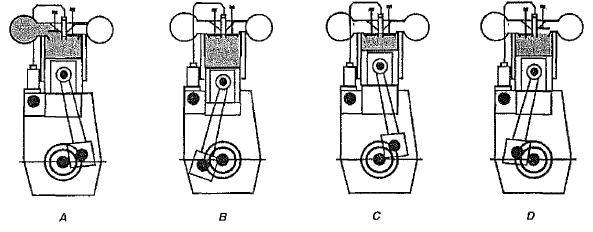
(Source: International Maritime Language Programme)
(Source: International Maritime Language Programme)
Ano: 2015
Banca:
Marinha
Órgão:
Quadro Complementar
Prova:
Marinha - 2015 - Quadro Complementar - Segundo Tenente - Máquinas - Ciências Náuticas |
Q572743
Inglês
Choose the option that correctly completes the blank in the sentence below.
Fuel oils have various properties which determine their performance and are quoted in specifications. The various fuel properties have different effects on performance of the engine and the storage and handling requirements of the system.
The _______________ indicates the lowest temperature at which a fuel can still be handled.
Ano: 2015
Banca:
Marinha
Órgão:
Quadro Complementar
Prova:
Marinha - 2015 - Quadro Complementar - Segundo Tenente - Máquinas - Ciências Náuticas |
Q572742
Inglês
Nouns can be countable or uncountable. Choose the correct option.
Ano: 2015
Banca:
Marinha
Órgão:
Quadro Complementar
Prova:
Marinha - 2015 - Quadro Complementar - Segundo Tenente - Máquinas - Ciências Náuticas |
Q572741
Inglês
Choose the grammatically correct option.
Ano: 2015
Banca:
Marinha
Órgão:
Quadro Complementar
Prova:
Marinha - 2015 - Quadro Complementar - Segundo Tenente - Máquinas - Ciências Náuticas |
Q572740
Inglês
A Chief engineer was reading a manual in order to confirm the procedures for reaction to an oil mist alarm, or other alarms that could lead to the oil mist situation and he found the following instruction:
Reduce engine power/pitch down to slow-down levei, if this is not an automatic function. This will drastically reduce the load on the engine bearings, and hence the production of oil mist.
The word underlined can be replaced by:
Ano: 2015
Banca:
Marinha
Órgão:
Quadro Complementar
Prova:
Marinha - 2015 - Quadro Complementar - Segundo Tenente - Máquinas - Ciências Náuticas |
Q572739
Inglês
Choose the option in which the word underlined is an adjective:
Ano: 2015
Banca:
Marinha
Órgão:
Quadro Complementar
Prova:
Marinha - 2015 - Quadro Complementar - Segundo Tenente - Máquinas - Ciências Náuticas |
Q572738
Inglês
Which of the following options CAN NOT be inferred from the text?
Ano: 2015
Banca:
Marinha
Órgão:
Quadro Complementar
Prova:
Marinha - 2015 - Quadro Complementar - Segundo Tenente - Máquinas - Ciências Náuticas |
Q572737
Inglês
According to the text, the phrasal verb ruled out {line 14) is closest in meaning to
Ano: 2015
Banca:
Marinha
Órgão:
Quadro Complementar
Prova:
Marinha - 2015 - Quadro Complementar - Segundo Tenente - Eletrônica e Sistemas de Armas - Ciências Náuticas |
Q572712
Inglês
According to IMO Standard Marine Communication Phrases - IMO
SMCP, a vessel restricted by her ability to manouvre by the
nature of her work is a
Ano: 2015
Banca:
Marinha
Órgão:
Quadro Complementar
Prova:
Marinha - 2015 - Quadro Complementar - Segundo Tenente - Eletrônica e Sistemas de Armas - Ciências Náuticas |
Q572708
Inglês
According to IMO Standard Marine Communication Phrases - IMO SMCP, when a message is not properly heard, say
Ano: 2015
Banca:
Marinha
Órgão:
Quadro Complementar
Prova:
Marinha - 2015 - Quadro Complementar - Segundo Tenente - Eletrônica e Sistemas de Armas - Ciências Náuticas |
Q572707
Inglês
According to IMO Standard Marine Communication Phrases - IMO
SMCP, what is the correct answer for the question: "Are you
dragging anchor?"
Ano: 2015
Banca:
Marinha
Órgão:
EFOMM
Prova:
Marinha - 2015 - EFOMM - Oficial da Marinha Mercante - Primeiro Dia |
Q543145
Inglês
Choose the option that contains only nouns.

 Conheça nossos planos