Questões Militares Comentadas sobre inglês
Foram encontradas 3.295 questões


Survivors say Canadian tall ship sank in minutes
Students and crew rescued from the sinking of a Canadia nowned tal ship in the South Atlantic were back on solid and Saturday after spending up to 40 hours in life rafts after their ship capsized.
The first of 64 people on board the three-masted SV Concordia were ferried into Rio de Janeiro aboard Brazilian Navy and merchant vessels, exhausted but relieved after their long ordeal.
Wearing navy caps and borrowed clothing, 12 of those rescued held an emotional news conference in Rio. The rest were to arrive later in the afternoon on two merchant vessels.
CTV producer Ana Pereira said survivors indicated that the ship went down very quickly, slipping beneath the waves. The ship’s captain said that his vessel sank Wednesday afternoon-a day earlier than previously reported - after being flipped on its side by a powerful gust of wind. He and his passengers and crew were rescued by merchant ships early Friday.
Capt. William Curry told reporters he was below deck when the ship suddenly keeled, banking over at a sharp, angle in the strong wind. Curry said that was normal, but when the vessel immediately went over a second time, he knew the vessel was in great danger.
The captain blamed the wreck on a “microburst”, a sudden, vertical downdraft that struck the entire surf ace area of the Concordia’s sails as it was angled over to one side. Within seconds, the boat went from sailing upright to lying on its side and beginning to sink.
Thirty minutes later it was completely underwater, Curry said.
“The boat started keeling a lot”, said 16-year-old passenger Lauren Unsworth, a Dutch-Canadian who lives in Amsterdam. “It came back up, keeled again, was basically lying on its side and all the windows began to break. That’s when we knew it was time to flee.”
Curry said that they abandoned ship and took to their life rafts in high winds and heavy seas, spending more than a day adrift in the Atlantic before spotting their rescuers.
“We had been in the life raft for about 30 hours when we saw a search plane for the first time”, Unsworth added. “That’s when we knew we were not alone and that help was on the way.” Toronto-native Keaton Farwell said her biggest fear was that no one was aware the group needed to be rescued.
“We thought our signal had failed and nobody knew and it could be weeks before we were saved”, she told a news conference. “The worst life-and-death thoughts were going through our heads, and everybody was panicking.”
The Navy said the distress signal was picked up about 5 p.m. Thursday. An Air Force plane later spotted life rafts in the ocean about 500 kilometers from Rio and a Navy ship and nearby merchant vessels moved in to aid in the rescue.
The first 12 crew and students came into port aboard a Brazilian Navy frigate. The rest were heading into Rio aboard slower merchant vessels and were expected to arrive later Saturday afternoon.
The Concordia was five days out from Montevideo, Uruguay, when it sank.
The Federal Transportations Safety Board says it will assist in an investigation to be led by the ship’s flag state country, Barbados.
The Concordia is owned by West Island College International with offices in Lunenburg, N.S. Forty-two of those onboard were identified as Canadians, mostly high school and university students, said Kate Knight, head of West Island College International of Lunenburg, which operates the Class Afloat program.
Prime Minister Stephen Harper issued a statement thanking the Brazilian Navy and the merchant ships “for their swift and heroic response.”
(Adapted from: www.ctv.ca, www.ap.com, Feb. 2010)
Survivors say Canadian tall ship sank in minutes
Students and crew rescued from the sinking of a Canadia nowned tal ship in the South Atlantic were back on solid and Saturday after spending up to 40 hours in life rafts after their ship capsized.
The first of 64 people on board the three-masted SV Concordia were ferried into Rio de Janeiro aboard Brazilian Navy and merchant vessels, exhausted but relieved after their long ordeal.
Wearing navy caps and borrowed clothing, 12 of those rescued held an emotional news conference in Rio. The rest were to arrive later in the afternoon on two merchant vessels.
CTV producer Ana Pereira said survivors indicated that the ship went down very quickly, slipping beneath the waves. The ship’s captain said that his vessel sank Wednesday afternoon-a day earlier than previously reported - after being flipped on its side by a powerful gust of wind. He and his passengers and crew were rescued by merchant ships early Friday.
Capt. William Curry told reporters he was below deck when the ship suddenly keeled, banking over at a sharp, angle in the strong wind. Curry said that was normal, but when the vessel immediately went over a second time, he knew the vessel was in great danger.
The captain blamed the wreck on a “microburst”, a sudden, vertical downdraft that struck the entire surf ace area of the Concordia’s sails as it was angled over to one side. Within seconds, the boat went from sailing upright to lying on its side and beginning to sink.
Thirty minutes later it was completely underwater, Curry said.
“The boat started keeling a lot”, said 16-year-old passenger Lauren Unsworth, a Dutch-Canadian who lives in Amsterdam. “It came back up, keeled again, was basically lying on its side and all the windows began to break. That’s when we knew it was time to flee.”
Curry said that they abandoned ship and took to their life rafts in high winds and heavy seas, spending more than a day adrift in the Atlantic before spotting their rescuers.
“We had been in the life raft for about 30 hours when we saw a search plane for the first time”, Unsworth added. “That’s when we knew we were not alone and that help was on the way.” Toronto-native Keaton Farwell said her biggest fear was that no one was aware the group needed to be rescued.
“We thought our signal had failed and nobody knew and it could be weeks before we were saved”, she told a news conference. “The worst life-and-death thoughts were going through our heads, and everybody was panicking.”
The Navy said the distress signal was picked up about 5 p.m. Thursday. An Air Force plane later spotted life rafts in the ocean about 500 kilometers from Rio and a Navy ship and nearby merchant vessels moved in to aid in the rescue.
The first 12 crew and students came into port aboard a Brazilian Navy frigate. The rest were heading into Rio aboard slower merchant vessels and were expected to arrive later Saturday afternoon.
The Concordia was five days out from Montevideo, Uruguay, when it sank.
The Federal Transportations Safety Board says it will assist in an investigation to be led by the ship’s flag state country, Barbados.
The Concordia is owned by West Island College International with offices in Lunenburg, N.S. Forty-two of those onboard were identified as Canadians, mostly high school and university students, said Kate Knight, head of West Island College International of Lunenburg, which operates the Class Afloat program.
Prime Minister Stephen Harper issued a statement thanking the Brazilian Navy and the merchant ships “for their swift and heroic response.”
(Adapted from: www.ctv.ca, www.ap.com, Feb. 2010)
The Big Destructiveness Of The Tiny Bribe
Alexandra Wrage 03.01.2010
The smallest bribes can be the most vexing. Not suitcases full of money and transfers to offshore accounts, but the thousands of everyday payments people make to Indian building inspectors, Chinese customs officials and Nigerian airport functionaries, just to get things done. They’re payments for routine government services that a government official is legally obliged to perform but for which he’s hoping to skim off a little extra.
Unlike more serious bribes, these very modest payouts, formally known as “facilitating payments”, are not against the laws of the U.S., Canada, Australia, New Zealand or South Korea, when made abroad. They’re illegal for Great Britain, but the Serious Fraud Office there has taken the extraordinary public position that they’re unlikely to give rise to a prosecution.
Why don’t governments that lead the fight against large-scale bribery fall in line with what is already the practice of many major companies? They don’t want to outlaw such small-scale graft in foreign places, they say, because they don’t have the manpower to prosecute violators. By that logic, communities with just enough resources to handle murder and armed robbery would give a green light to shoplifting. You’d think a government could at least go after a few high-profile cases to set an example and a precedent. Permitting these smaller payments has to impede the effort to crack down on the larger ones. Companies know this.
“Facilitating” bribes are not tips. Tipping is voluntary, and you decide to do it after a service has been rendered. You don’t pay it at the outset to induce the waiter to bring the food, and you can always go somewhere else to eat next time should the service be bad. Nor are they welfare for underpaid civil servants. If government workers are underpaid, we should compensate them for the cost of customs inspections or airport security by aboveboard means, through taxation and so forth. Payment to individuals not only slows service but also encourages entrepreneurial civil servants to increase their income by creating more and greater obstacles.
Nor are they a mere distraction from the fight against bigger bribes. Rather, they fuel the problem. Junior officials who look for small bribes rise to higher positions by paying off those above them. Corruption creates pyramids of illegal payments flowing upward. Legalizing the base of the pyramid gives it a strong and lasting foundation.
Nor are these payments legal where they’re made. They may not be banned by the wealthy countries mentioned above, but they are outlawed in the countries where they’re actually a problem. Do developed countries want to say they wouldn’t tolerate such payments at home but don’t care if they’re made abroad? And since they’re illegal in the countries where they’re paid, companies can’t put them on their books. The classic cover for a bribe is to call it a “consulting fee”, but that is a books and records violation that is illegal in any country.
(www.forbes.com. Adaptado.)
No trecho do quinto parágrafo – Nor are they welfare for underpaid civil servants. – a palavra they refere-se a
The Big Destructiveness Of The Tiny Bribe
Alexandra Wrage 03.01.2010
The smallest bribes can be the most vexing. Not suitcases full of money and transfers to offshore accounts, but the thousands of everyday payments people make to Indian building inspectors, Chinese customs officials and Nigerian airport functionaries, just to get things done. They’re payments for routine government services that a government official is legally obliged to perform but for which he’s hoping to skim off a little extra.
Unlike more serious bribes, these very modest payouts, formally known as “facilitating payments”, are not against the laws of the U.S., Canada, Australia, New Zealand or South Korea, when made abroad. They’re illegal for Great Britain, but the Serious Fraud Office there has taken the extraordinary public position that they’re unlikely to give rise to a prosecution.
Why don’t governments that lead the fight against large-scale bribery fall in line with what is already the practice of many major companies? They don’t want to outlaw such small-scale graft in foreign places, they say, because they don’t have the manpower to prosecute violators. By that logic, communities with just enough resources to handle murder and armed robbery would give a green light to shoplifting. You’d think a government could at least go after a few high-profile cases to set an example and a precedent. Permitting these smaller payments has to impede the effort to crack down on the larger ones. Companies know this.
“Facilitating” bribes are not tips. Tipping is voluntary, and you decide to do it after a service has been rendered. You don’t pay it at the outset to induce the waiter to bring the food, and you can always go somewhere else to eat next time should the service be bad. Nor are they welfare for underpaid civil servants. If government workers are underpaid, we should compensate them for the cost of customs inspections or airport security by aboveboard means, through taxation and so forth. Payment to individuals not only slows service but also encourages entrepreneurial civil servants to increase their income by creating more and greater obstacles.
Nor are they a mere distraction from the fight against bigger bribes. Rather, they fuel the problem. Junior officials who look for small bribes rise to higher positions by paying off those above them. Corruption creates pyramids of illegal payments flowing upward. Legalizing the base of the pyramid gives it a strong and lasting foundation.
Nor are these payments legal where they’re made. They may not be banned by the wealthy countries mentioned above, but they are outlawed in the countries where they’re actually a problem. Do developed countries want to say they wouldn’t tolerate such payments at home but don’t care if they’re made abroad? And since they’re illegal in the countries where they’re paid, companies can’t put them on their books. The classic cover for a bribe is to call it a “consulting fee”, but that is a books and records violation that is illegal in any country.
(www.forbes.com. Adaptado.)
Instrução: Leia o artigo 11 da Declaração Universal dos Direitos Humanos, em inglês, para responder a questão, assinalando a alternativa que completa corretamente as respectivas lacunas.
The Universal Declaration of Human Rights
Article 11
(1) Everyone charged with a penal offence has the right to be presumed innocent —— 71 proved guilty according to law in a public trial at which he —— 72 all the guarantees necessary for his defence.
(2) No one shall be held guilty of any penal offence on account of any act or omission — 73 — did not constitute a penal offence, under national or international law, at the time when it was committed. Nor shall a heavier penalty be imposed than the one that was applicable at the time the penal offence was committed.
(www.un.org. Adaptado.)
Instrução: Leia o artigo 11 da Declaração Universal dos Direitos Humanos, em inglês, para responder a questão, assinalando a alternativa que completa corretamente as respectivas lacunas.
The Universal Declaration of Human Rights
Article 11
(1) Everyone charged with a penal offence has the right to be presumed innocent —— 71 proved guilty according to law in a public trial at which he —— 72 all the guarantees necessary for his defence.
(2) No one shall be held guilty of any penal offence on account of any act or omission — 73 — did not constitute a penal offence, under national or international law, at the time when it was committed. Nor shall a heavier penalty be imposed than the one that was applicable at the time the penal offence was committed.
(www.un.org. Adaptado.)
Match the technique for encouraging motivation with the general advice on motivation, Then choose the altemative that shows the correct sequence,
TECHNIQUES
1. Encourage leamer autonomy
2. Find out what students think
3. Make your feedback positive and constructive.
4. Build variety into your teaching.
GENERAL ADVICE
( ) Give comments on students work which are helpful and enable them to feel a sense of progress.
( ) Choose activities that different students can respond to in different ways, for example, making posters or writing poems.
( ) Train students to use reference
resources to help them study
successfully on their own.
( ) Don't explain grammar using terms like "relative clause" or " present perfect".
( ) Context-reduced language can be used temporarily.
( ) Certain more difficult concepts or pattern require more repetition.
( ) Activities should be designed to capture their immediate interest.
( ) Use a variety of activities to keep interest and attention alive.
Match each school of thought in second language acquisition to its corresponding themes. Then, choose the alternative that shows the right sequence.
SCHOOLS OF THOUGHT
1. Structuralism and Behaviorism
2. Rationalism and Cognitive psychology
3. Constructivism
THEMES
( ) Innateness.
( ) Observable performance.
( ) Conditioning.
( ) Universal grammar.
( ) Interlanguage variability.
( ) Interactive discourse.
Match the learning strategy types with an example and choose the alternative that shows the correct sequence.
LEARNING STRATEGY
1. Memory strategy
2. Compensation strategy
3. Affective strategy
4. Social strategy
EXAMPLE
( ) Asking for correction.
( ) Making positive statements.
( ) Coining words.
( ) Using imagery.
( ) Grouping.
( ) Using mime or gesture.
( ) Taking risks wisely.
( ) Cooperating with others.
Say whether the following statements are true "T" or false "F" about English as lingua franca ELF and then choose the alternative that shows the correct sequence.
( ) When English is used as a lingua franca, the speakers share the same LI
and English is not their mother tongue.
( ) The non-use of the third person present simple tense -s is one of the characteristics of ELF.
( ) Non-native speakers of English seem to be better at ELF communication
than native speakers are.
Match the type of syllabus on the left to a syllabus item on the right. Then, choose the correct alternative.
TYPE OF SYLLABUS
1. Grammatical
2. Notional-functional
3. Content-based
4. Task-based
SYLLABUS ITEM
( ) Express likes and dislikes.
( ) Simple present.
( ) Say hello formally and informally.
( ) Listen to the weather forecast and decide what to wear.
( ) Addition and subtraction.
( ) Answer a phone call and take a message.
I. Use techniques that focus on form only.
II. Provide extrinsically motivating techniques.
III. Encourage the use of authentic language.
IV. Provide appropriate feedback and correction.
V. Encourage the development of listening strategies.
( ) It increases the amount of speaking time any one student gets in the class.
( ) It does not allow teacher time to work with one or two pairs while the others continue working.
( ) It is not always popular with students.
( ) It is relatively difficult to organize.
( ) Students in pairs can often veer away from the point of the exercise.
Complete the statement below with the words from the box. Then, mark the correct alternative.
"In order to ensure a positive class atmosphere teachers should________ and_________."
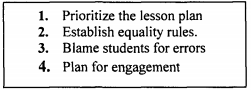
Match the background elements of a lesson plan on the left to the examples on the right. Choose the alternative that shows the correct sequence.
ELEMENTS OF A PLAN
1. Aims
2. Class profile
3. Language focus
4. Assumptions
5. Anticipated problems
6. Timetable fit
EXAMPLES
( ) In the past lesson students dealt with the irregular past tense of the verbs. Next week we will be reviewing modais.
( ) Students might not be able to use the contracted form of ‘ should not have’.
( ) Based on previous lessons, students might not have problems with the new vocabulary.
( ) Students will be able to use the simple present to talk about daily routines.
( ) To give students practice in reading for
both gist and for detail.
( ) Students can hear a variety of different voices.
( ) Audio material is portable and readily available.
( ) The audibility of recorded material often gives cause for concern.
( ) Everyone has to listen at the same speed.

 Conheça nossos planos