Questões Militares Comentadas sobre inglês
Foram encontradas 3.295 questões


Ano: 2015
Banca:
Aeronáutica
Órgão:
EEAR
Prova:
Aeronáutica - 2015 - EEAR - Sargento - Controlador de Tráfego Aéreo (Turma 1) |
Q537360
Inglês
Choose the alternative that corresponds to the right form of the reported speech for what the boy said.
BOY: The teacher sent me an email with my grades, but I deleted it.
The boy said that his teacher
Ano: 2015
Banca:
Aeronáutica
Órgão:
EEAR
Prova:
Aeronáutica - 2015 - EEAR - Sargento - Controlador de Tráfego Aéreo (Turma 1) |
Q537359
Inglês

According to the cartoon, all the sentences are correct,
except:
Ano: 2015
Banca:
Aeronáutica
Órgão:
EEAR
Prova:
Aeronáutica - 2015 - EEAR - Sargento - Controlador de Tráfego Aéreo (Turma 1) |
Q537346
Inglês

Fill in the blank in lines 3 and 6 with the right words:
Ano: 2015
Banca:
Aeronáutica
Órgão:
EEAR
Prova:
Aeronáutica - 2015 - EEAR - Sargento - Controlador de Tráfego Aéreo (Turma 1) |
Q537345
Inglês
In the sentence “Beware of the dog. He bites really hard;
however, he can be bribed”, which word can replace “however”
without interfering in the meaning?
Ano: 2015
Banca:
Aeronáutica
Órgão:
EEAR
Prova:
Aeronáutica - 2015 - EEAR - Sargento - Controlador de Tráfego Aéreo (Turma 1) |
Q537344
Inglês
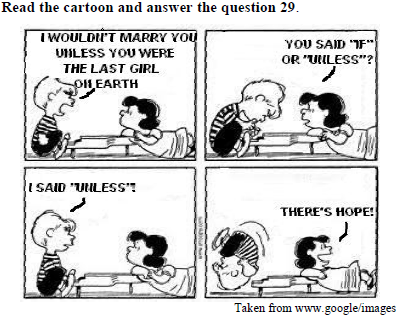
According to the cartoon, we can affirm that
Ano: 2015
Banca:
BIO-RIO
Órgão:
ETAM
Prova:
BIO-RIO - 2015 - ETAM - Curso de Formação de Técnicos - 2º Semestre |
Q519813
Inglês
Texto associado
Is blue growth the beginning or
end of a healthier ocean?
March 17th 2015
Across the globe, countries are increasingly looking seaward in search of new economic opportunities, including oil, gas, and mineral extraction from the sea floor, renewable energy development, and biotechnology.
The push to expand this so-called “blue economy" comes at a time when the ecological health of the oceans is seriously degraded. Last year, the Economist's World Ocean Summit concluded with a resounding consensus that more needs to be done to protect and restore the world's seas, especially the high seas. Will blue growth help or harm efforts to achieve a healthier ocean ecosystem?
The U.N. has proposed ambitious sustainable development goals relating to ocean health. They include reducing pollution from agriculture run-off, decreasing untreated sewage and solid waste, rebuilding depleted fish stocks, and protecting and restoring natural habitats.
A healthy ocean ecosystem is a public good—both locally and globally. Mangroves, corals, and salt marshes protect coastal towns from storms. Oceans store carbon and produce oxygen that benefits us all. And areas of high biodiversity support global fisheries and are essential for resilient and productive oceans.
These natural benefits can remain intact if nations encourage—and even require—participants in the blue economy to reinvest the economic capital created from that economy in the natural capital of marine and coastal ecosystems; namely by restoring degraded habitats, protecting healthy ones, and financing blue economy “greening" efforts.
Channeling the new wealth of a growing blue economy into projects that will build a healthier ocean will require new financial tools. For instance, a global ocean trust fund, eco taxes, or user fees could be managed at the global level (say the U.N., World Bank, or the Global Environmental Facility) or even at a regional level, perhaps through existing regional seas organisations.
But for now the blue economy needs to aim higher than merely to do no harm. Converting blue economic capital into blue natural capital can raise all boats and produce a healthier, more sustainable blue economy.
(http://www.economistinsights.com/opinion/blue-growth-beginning-or-endhealthier-ocean)
A expressão “for instance” em “For instance, a global ocean trust fund, eco taxes, or user fees could be managed at the global level” é usada para:
Ano: 2015
Banca:
BIO-RIO
Órgão:
ETAM
Prova:
BIO-RIO - 2015 - ETAM - Curso de Formação de Técnicos - 2º Semestre |
Q519812
Inglês
Texto associado
Is blue growth the beginning or
end of a healthier ocean?
March 17th 2015
Across the globe, countries are increasingly looking seaward in search of new economic opportunities, including oil, gas, and mineral extraction from the sea floor, renewable energy development, and biotechnology.
The push to expand this so-called “blue economy" comes at a time when the ecological health of the oceans is seriously degraded. Last year, the Economist's World Ocean Summit concluded with a resounding consensus that more needs to be done to protect and restore the world's seas, especially the high seas. Will blue growth help or harm efforts to achieve a healthier ocean ecosystem?
The U.N. has proposed ambitious sustainable development goals relating to ocean health. They include reducing pollution from agriculture run-off, decreasing untreated sewage and solid waste, rebuilding depleted fish stocks, and protecting and restoring natural habitats.
A healthy ocean ecosystem is a public good—both locally and globally. Mangroves, corals, and salt marshes protect coastal towns from storms. Oceans store carbon and produce oxygen that benefits us all. And areas of high biodiversity support global fisheries and are essential for resilient and productive oceans.
These natural benefits can remain intact if nations encourage—and even require—participants in the blue economy to reinvest the economic capital created from that economy in the natural capital of marine and coastal ecosystems; namely by restoring degraded habitats, protecting healthy ones, and financing blue economy “greening" efforts.
Channeling the new wealth of a growing blue economy into projects that will build a healthier ocean will require new financial tools. For instance, a global ocean trust fund, eco taxes, or user fees could be managed at the global level (say the U.N., World Bank, or the Global Environmental Facility) or even at a regional level, perhaps through existing regional seas organisations.
But for now the blue economy needs to aim higher than merely to do no harm. Converting blue economic capital into blue natural capital can raise all boats and produce a healthier, more sustainable blue economy.
(http://www.economistinsights.com/opinion/blue-growth-beginning-or-endhealthier-ocean)
“Ones” em “protecting healthy ones” substitui a palavra:
Ano: 2015
Banca:
BIO-RIO
Órgão:
ETAM
Prova:
BIO-RIO - 2015 - ETAM - Curso de Formação de Técnicos - 2º Semestre |
Q519811
Inglês
Texto associado
Is blue growth the beginning or
end of a healthier ocean?
March 17th 2015
Across the globe, countries are increasingly looking seaward in search of new economic opportunities, including oil, gas, and mineral extraction from the sea floor, renewable energy development, and biotechnology.
The push to expand this so-called “blue economy" comes at a time when the ecological health of the oceans is seriously degraded. Last year, the Economist's World Ocean Summit concluded with a resounding consensus that more needs to be done to protect and restore the world's seas, especially the high seas. Will blue growth help or harm efforts to achieve a healthier ocean ecosystem?
The U.N. has proposed ambitious sustainable development goals relating to ocean health. They include reducing pollution from agriculture run-off, decreasing untreated sewage and solid waste, rebuilding depleted fish stocks, and protecting and restoring natural habitats.
A healthy ocean ecosystem is a public good—both locally and globally. Mangroves, corals, and salt marshes protect coastal towns from storms. Oceans store carbon and produce oxygen that benefits us all. And areas of high biodiversity support global fisheries and are essential for resilient and productive oceans.
These natural benefits can remain intact if nations encourage—and even require—participants in the blue economy to reinvest the economic capital created from that economy in the natural capital of marine and coastal ecosystems; namely by restoring degraded habitats, protecting healthy ones, and financing blue economy “greening" efforts.
Channeling the new wealth of a growing blue economy into projects that will build a healthier ocean will require new financial tools. For instance, a global ocean trust fund, eco taxes, or user fees could be managed at the global level (say the U.N., World Bank, or the Global Environmental Facility) or even at a regional level, perhaps through existing regional seas organisations.
But for now the blue economy needs to aim higher than merely to do no harm. Converting blue economic capital into blue natural capital can raise all boats and produce a healthier, more sustainable blue economy.
(http://www.economistinsights.com/opinion/blue-growth-beginning-or-endhealthier-ocean)
A palavra “good” em “A healthy ocean ecosystem is a public good” significa:
Ano: 2015
Banca:
BIO-RIO
Órgão:
ETAM
Prova:
BIO-RIO - 2015 - ETAM - Curso de Formação de Técnicos - 2º Semestre |
Q519810
Inglês
Texto associado
Is blue growth the beginning or
end of a healthier ocean?
March 17th 2015
Across the globe, countries are increasingly looking seaward in search of new economic opportunities, including oil, gas, and mineral extraction from the sea floor, renewable energy development, and biotechnology.
The push to expand this so-called “blue economy" comes at a time when the ecological health of the oceans is seriously degraded. Last year, the Economist's World Ocean Summit concluded with a resounding consensus that more needs to be done to protect and restore the world's seas, especially the high seas. Will blue growth help or harm efforts to achieve a healthier ocean ecosystem?
The U.N. has proposed ambitious sustainable development goals relating to ocean health. They include reducing pollution from agriculture run-off, decreasing untreated sewage and solid waste, rebuilding depleted fish stocks, and protecting and restoring natural habitats.
A healthy ocean ecosystem is a public good—both locally and globally. Mangroves, corals, and salt marshes protect coastal towns from storms. Oceans store carbon and produce oxygen that benefits us all. And areas of high biodiversity support global fisheries and are essential for resilient and productive oceans.
These natural benefits can remain intact if nations encourage—and even require—participants in the blue economy to reinvest the economic capital created from that economy in the natural capital of marine and coastal ecosystems; namely by restoring degraded habitats, protecting healthy ones, and financing blue economy “greening" efforts.
Channeling the new wealth of a growing blue economy into projects that will build a healthier ocean will require new financial tools. For instance, a global ocean trust fund, eco taxes, or user fees could be managed at the global level (say the U.N., World Bank, or the Global Environmental Facility) or even at a regional level, perhaps through existing regional seas organisations.
But for now the blue economy needs to aim higher than merely to do no harm. Converting blue economic capital into blue natural capital can raise all boats and produce a healthier, more sustainable blue economy.
(http://www.economistinsights.com/opinion/blue-growth-beginning-or-endhealthier-ocean)
Com relação ao texto, assinale V para a afirmativa verdadeira e F para a falsa.
✓ Concluiu-se em uma reunião que mais deve ser feito com relação à proteção e à recuperação dos oceanos.
✓ A economia azul se refere ao controle do ecossistema global como um todo.
✓ Participantes da economia azul devem reinvestir seu capital econômico no capital natural dos ecossistemas marinhos.
As afirmativas são respectivamente:
✓ Concluiu-se em uma reunião que mais deve ser feito com relação à proteção e à recuperação dos oceanos.
✓ A economia azul se refere ao controle do ecossistema global como um todo.
✓ Participantes da economia azul devem reinvestir seu capital econômico no capital natural dos ecossistemas marinhos.
As afirmativas são respectivamente:
Ano: 2015
Banca:
BIO-RIO
Órgão:
ETAM
Prova:
BIO-RIO - 2015 - ETAM - Curso de Formação de Técnicos - 2º Semestre |
Q519809
Inglês
Texto associado
Is blue growth the beginning or
end of a healthier ocean?
March 17th 2015
Across the globe, countries are increasingly looking seaward in search of new economic opportunities, including oil, gas, and mineral extraction from the sea floor, renewable energy development, and biotechnology.
The push to expand this so-called “blue economy" comes at a time when the ecological health of the oceans is seriously degraded. Last year, the Economist's World Ocean Summit concluded with a resounding consensus that more needs to be done to protect and restore the world's seas, especially the high seas. Will blue growth help or harm efforts to achieve a healthier ocean ecosystem?
The U.N. has proposed ambitious sustainable development goals relating to ocean health. They include reducing pollution from agriculture run-off, decreasing untreated sewage and solid waste, rebuilding depleted fish stocks, and protecting and restoring natural habitats.
A healthy ocean ecosystem is a public good—both locally and globally. Mangroves, corals, and salt marshes protect coastal towns from storms. Oceans store carbon and produce oxygen that benefits us all. And areas of high biodiversity support global fisheries and are essential for resilient and productive oceans.
These natural benefits can remain intact if nations encourage—and even require—participants in the blue economy to reinvest the economic capital created from that economy in the natural capital of marine and coastal ecosystems; namely by restoring degraded habitats, protecting healthy ones, and financing blue economy “greening" efforts.
Channeling the new wealth of a growing blue economy into projects that will build a healthier ocean will require new financial tools. For instance, a global ocean trust fund, eco taxes, or user fees could be managed at the global level (say the U.N., World Bank, or the Global Environmental Facility) or even at a regional level, perhaps through existing regional seas organisations.
But for now the blue economy needs to aim higher than merely to do no harm. Converting blue economic capital into blue natural capital can raise all boats and produce a healthier, more sustainable blue economy.
(http://www.economistinsights.com/opinion/blue-growth-beginning-or-endhealthier-ocean)
O texto tem como foco principal uma:
Ano: 2015
Banca:
IDECAN
Órgão:
CBM-MG
Prova:
IDECAN - 2015 - CBM-MG - Aspirante do Corpo de Bombeiro |
Q490609
Inglês
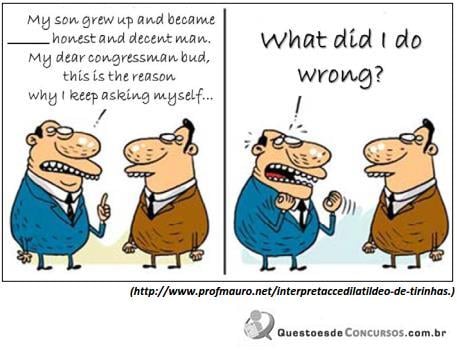
The word myself refers back to
Ano: 2015
Banca:
IDECAN
Órgão:
CBM-MG
Prova:
IDECAN - 2015 - CBM-MG - Aspirante do Corpo de Bombeiro |
Q490608
Inglês
The item that completes the comic strip is
Ano: 2015
Banca:
IDECAN
Órgão:
CBM-MG
Prova:
IDECAN - 2015 - CBM-MG - Aspirante do Corpo de Bombeiro |
Q490607
Inglês
Texto associado
Mysterious ancient cemetery in Egypt could contain a million mummies
A mysterious ancient cemetery in Egypt could contain more than a million mummified human remains, archaeologists have claimed.
Around 1,700 bodies have so far been uncovered at the Fag el-Gamous (Way of the Water Buffalo) site, around 60 miles south of Cairo. But experts believe that countless more are contained in the burial ground.
“We are fairly certain we have over a million burials within this cemetery. It's large, and it's dense,” said project director Kerry Muhlestein, an associate professor in the Department of Ancient Scripture at Brigham Young University (BYU), which has been examining the site for around 30 years. They were placed there between the 1st and the 7th centuries AD, but the scale of the site has left many baffled. A nearby village has been deemed too small to warrant such a large cemetery, while the closest major settlements had their own burial grounds.
“It's hard to know where all these people were coming from,” Professor Muhlestein told Live Science.
Another interesting find was that the corpses appeared to be grouped together by hair colour, with one section containing the remains of those with blonde hair and another for those with red hair. The bodies, which included a man of more than seven feet in height, are thought to be of ordinary citizens, rather than the royalty found at many famous Egyptian sites. They were not buried in coffins, according to Muhlestein, and were in fact mummified not by design but by the arid natural environment.
“The people in the cemetery represent the common man. They are the average people who are usually hard to learn about because they are not very visible in written sources. A lot of their wealth, or the little that they had, was poured into these burials.”
His team discovered objects including glassware, jewellery and linen. The findings were presented to the Scholars Colloquim at the Society for the Study of Egyptian Antiquities in Toronto last month.
The Telegraph, London.
(http://www.traveller.com.au/mysterious-ancient-cemetery-in-egypt-could-contain-a-
million-mummies-12aaq7.)
A mysterious ancient cemetery in Egypt could contain more than a million mummified human remains, archaeologists have claimed.
Around 1,700 bodies have so far been uncovered at the Fag el-Gamous (Way of the Water Buffalo) site, around 60 miles south of Cairo. But experts believe that countless more are contained in the burial ground.
“We are fairly certain we have over a million burials within this cemetery. It's large, and it's dense,” said project director Kerry Muhlestein, an associate professor in the Department of Ancient Scripture at Brigham Young University (BYU), which has been examining the site for around 30 years. They were placed there between the 1st and the 7th centuries AD, but the scale of the site has left many baffled. A nearby village has been deemed too small to warrant such a large cemetery, while the closest major settlements had their own burial grounds.
“It's hard to know where all these people were coming from,” Professor Muhlestein told Live Science.
Another interesting find was that the corpses appeared to be grouped together by hair colour, with one section containing the remains of those with blonde hair and another for those with red hair. The bodies, which included a man of more than seven feet in height, are thought to be of ordinary citizens, rather than the royalty found at many famous Egyptian sites. They were not buried in coffins, according to Muhlestein, and were in fact mummified not by design but by the arid natural environment.
“The people in the cemetery represent the common man. They are the average people who are usually hard to learn about because they are not very visible in written sources. A lot of their wealth, or the little that they had, was poured into these burials.”
His team discovered objects including glassware, jewellery and linen. The findings were presented to the Scholars Colloquim at the Society for the Study of Egyptian Antiquities in Toronto last month.
The Telegraph, London.
(http://www.traveller.com.au/mysterious-ancient-cemetery-in-egypt-could-contain-a-
million-mummies-12aaq7.)
According to the text, it is true that:
Ano: 2015
Banca:
IDECAN
Órgão:
CBM-MG
Prova:
IDECAN - 2015 - CBM-MG - Aspirante do Corpo de Bombeiro |
Q490606
Inglês
Texto associado
Mysterious ancient cemetery in Egypt could contain a million mummies
A mysterious ancient cemetery in Egypt could contain more than a million mummified human remains, archaeologists have claimed.
Around 1,700 bodies have so far been uncovered at the Fag el-Gamous (Way of the Water Buffalo) site, around 60 miles south of Cairo. But experts believe that countless more are contained in the burial ground.
“We are fairly certain we have over a million burials within this cemetery. It's large, and it's dense,” said project director Kerry Muhlestein, an associate professor in the Department of Ancient Scripture at Brigham Young University (BYU), which has been examining the site for around 30 years. They were placed there between the 1st and the 7th centuries AD, but the scale of the site has left many baffled. A nearby village has been deemed too small to warrant such a large cemetery, while the closest major settlements had their own burial grounds.
“It's hard to know where all these people were coming from,” Professor Muhlestein told Live Science.
Another interesting find was that the corpses appeared to be grouped together by hair colour, with one section containing the remains of those with blonde hair and another for those with red hair. The bodies, which included a man of more than seven feet in height, are thought to be of ordinary citizens, rather than the royalty found at many famous Egyptian sites. They were not buried in coffins, according to Muhlestein, and were in fact mummified not by design but by the arid natural environment.
“The people in the cemetery represent the common man. They are the average people who are usually hard to learn about because they are not very visible in written sources. A lot of their wealth, or the little that they had, was poured into these burials.”
His team discovered objects including glassware, jewellery and linen. The findings were presented to the Scholars Colloquim at the Society for the Study of Egyptian Antiquities in Toronto last month.
The Telegraph, London.
(http://www.traveller.com.au/mysterious-ancient-cemetery-in-egypt-could-contain-a-
million-mummies-12aaq7.)
A mysterious ancient cemetery in Egypt could contain more than a million mummified human remains, archaeologists have claimed.
Around 1,700 bodies have so far been uncovered at the Fag el-Gamous (Way of the Water Buffalo) site, around 60 miles south of Cairo. But experts believe that countless more are contained in the burial ground.
“We are fairly certain we have over a million burials within this cemetery. It's large, and it's dense,” said project director Kerry Muhlestein, an associate professor in the Department of Ancient Scripture at Brigham Young University (BYU), which has been examining the site for around 30 years. They were placed there between the 1st and the 7th centuries AD, but the scale of the site has left many baffled. A nearby village has been deemed too small to warrant such a large cemetery, while the closest major settlements had their own burial grounds.
“It's hard to know where all these people were coming from,” Professor Muhlestein told Live Science.
Another interesting find was that the corpses appeared to be grouped together by hair colour, with one section containing the remains of those with blonde hair and another for those with red hair. The bodies, which included a man of more than seven feet in height, are thought to be of ordinary citizens, rather than the royalty found at many famous Egyptian sites. They were not buried in coffins, according to Muhlestein, and were in fact mummified not by design but by the arid natural environment.
“The people in the cemetery represent the common man. They are the average people who are usually hard to learn about because they are not very visible in written sources. A lot of their wealth, or the little that they had, was poured into these burials.”
His team discovered objects including glassware, jewellery and linen. The findings were presented to the Scholars Colloquim at the Society for the Study of Egyptian Antiquities in Toronto last month.
The Telegraph, London.
(http://www.traveller.com.au/mysterious-ancient-cemetery-in-egypt-could-contain-a-
million-mummies-12aaq7.)
In “... the scale of the site has left many baffled.”, the verb tense used is a
Ano: 2015
Banca:
IDECAN
Órgão:
CBM-MG
Prova:
IDECAN - 2015 - CBM-MG - Aspirante do Corpo de Bombeiro |
Q490605
Inglês
Texto associado
Mysterious ancient cemetery in Egypt could contain a million mummies
A mysterious ancient cemetery in Egypt could contain more than a million mummified human remains, archaeologists have claimed.
Around 1,700 bodies have so far been uncovered at the Fag el-Gamous (Way of the Water Buffalo) site, around 60 miles south of Cairo. But experts believe that countless more are contained in the burial ground.
“We are fairly certain we have over a million burials within this cemetery. It's large, and it's dense,” said project director Kerry Muhlestein, an associate professor in the Department of Ancient Scripture at Brigham Young University (BYU), which has been examining the site for around 30 years. They were placed there between the 1st and the 7th centuries AD, but the scale of the site has left many baffled. A nearby village has been deemed too small to warrant such a large cemetery, while the closest major settlements had their own burial grounds.
“It's hard to know where all these people were coming from,” Professor Muhlestein told Live Science.
Another interesting find was that the corpses appeared to be grouped together by hair colour, with one section containing the remains of those with blonde hair and another for those with red hair. The bodies, which included a man of more than seven feet in height, are thought to be of ordinary citizens, rather than the royalty found at many famous Egyptian sites. They were not buried in coffins, according to Muhlestein, and were in fact mummified not by design but by the arid natural environment.
“The people in the cemetery represent the common man. They are the average people who are usually hard to learn about because they are not very visible in written sources. A lot of their wealth, or the little that they had, was poured into these burials.”
His team discovered objects including glassware, jewellery and linen. The findings were presented to the Scholars Colloquim at the Society for the Study of Egyptian Antiquities in Toronto last month.
The Telegraph, London.
(http://www.traveller.com.au/mysterious-ancient-cemetery-in-egypt-could-contain-a-
million-mummies-12aaq7.)
A mysterious ancient cemetery in Egypt could contain more than a million mummified human remains, archaeologists have claimed.
Around 1,700 bodies have so far been uncovered at the Fag el-Gamous (Way of the Water Buffalo) site, around 60 miles south of Cairo. But experts believe that countless more are contained in the burial ground.
“We are fairly certain we have over a million burials within this cemetery. It's large, and it's dense,” said project director Kerry Muhlestein, an associate professor in the Department of Ancient Scripture at Brigham Young University (BYU), which has been examining the site for around 30 years. They were placed there between the 1st and the 7th centuries AD, but the scale of the site has left many baffled. A nearby village has been deemed too small to warrant such a large cemetery, while the closest major settlements had their own burial grounds.
“It's hard to know where all these people were coming from,” Professor Muhlestein told Live Science.
Another interesting find was that the corpses appeared to be grouped together by hair colour, with one section containing the remains of those with blonde hair and another for those with red hair. The bodies, which included a man of more than seven feet in height, are thought to be of ordinary citizens, rather than the royalty found at many famous Egyptian sites. They were not buried in coffins, according to Muhlestein, and were in fact mummified not by design but by the arid natural environment.
“The people in the cemetery represent the common man. They are the average people who are usually hard to learn about because they are not very visible in written sources. A lot of their wealth, or the little that they had, was poured into these burials.”
His team discovered objects including glassware, jewellery and linen. The findings were presented to the Scholars Colloquim at the Society for the Study of Egyptian Antiquities in Toronto last month.
The Telegraph, London.
(http://www.traveller.com.au/mysterious-ancient-cemetery-in-egypt-could-contain-a-
million-mummies-12aaq7.)
In: “The bodies, which included a man of more than seven feet in height are thought to be of ordinary citizens, rather than the royalty found at many famous Egyptian sites.” WHICH is a:
Q464641
Inglês
Choose the correct preposition for the following sentences. Close attention to some phrasal verbs.
“The teacher said: Step _____ who wants play role with Margot Karten. So I did it!”
“The teacher said: Step _____ who wants play role with Margot Karten. So I did it!”
Q464640
Inglês
Choose the correct preposition for the following sentences. Close attention to some phrasal verbs.
“I hate when I'm talking ____ you with those headphones ____. You can't hear me!”
“I hate when I'm talking ____ you with those headphones ____. You can't hear me!”
Q464639
Inglês
Choose the correct preposition for the following sentences. Close attention to some phrasal verbs.
“She thinks she'll spend her whole life relying ____ that body.”
“She thinks she'll spend her whole life relying ____ that body.”
Q464638
Inglês
Choose the correct preposition for the following sentences. Close attention to some phrasal verbs.
“I look forward ___ driving to L.A. with my friends by the end of the year.”
“I look forward ___ driving to L.A. with my friends by the end of the year.”
Q2024826
Inglês
Texto associado
Why do we have blood types?
In 1996 a naturopath named Peter D’Adamo published a book called Eat Right 4 Your Type. D’Adamo argued that we must
eat according to our blood type, in order to harmonise with our evolutionary heritage. Blood types, he claimed, “appear to have arrived
at critical junctures of human development.” According to D’Adamo, type O blood arose in our hunter-gatherer ancestors in Africa,
type A at the dawn of agriculture, and type B developed between 10,000 and 15,000 years ago in the Himalayan highlands. Type AB,
he argued, is a modern blending of A and B.
From these suppositions, D’Adamo then claimed that our blood type determines what food we should eat. With my agriculture-based type A blood, for example, I should be a vegetarian. People with the ancient hunter type O should have a meat-rich diet and
avoid grains and dairy. According to the book, foods that are not suited to our blood type contain antigens that can cause all sorts of
illness. D’Adamo recommended his diet as a way to reduce infections, lose weight, fight cancer and diabetes, and slow the ageing
process.
D’Adamo’s book has sold seven million copies and has been translated into 60 languages. It has been followed by a string of
other blood type diet books; D’Adamo also sells a line of blood-type-tailored diet supplements on his website. As a result, doctors
often get asked by their patients if blood type diets actually work.
The best way to answer that question is to run an experiment. In Eat Right 4 Your Type D’Adamo wrote that he was in the
eighth year of a decade-long trial of blood type diets on women with cancer. Eighteen years later, however, the data from this trial
have not yet been published.
Recently, researchers at the Red Cross in Belgium decided to see if there was any other evidence in the diet’s favor. They
hunted through the scientific literature for experiments that measured the benefits of diets based on blood types. Although they
examined over 1,000 studies, their efforts were fruitless. “There is no direct evidence supporting the health effects of the ABO blood
type diet,” says Emmy De Buck of the Belgian Red Cross-Flanders.
After De Buck and her colleagues published their review in the American Journal of Clinical Nutrition, D’Adamo responded on
his blog. In spite of the lack of published evidence supporting his Blood Type Diet, he claimed that the science behind it is right. “There
is good science behind the blood type diets, just like there was good science behind Einstein’s mathematical calculations that led to
the Theory of Relativity,” he wrote.
Adapted from: ZIMMER, Carl. Why do we have blood types? Crash diet. Retrieved from: http://www.bbc.com/future/story/20140715-why-do-wehave-blood-types. Access: August, 2014.
According to the text, what is correct to say about Peter D’Adamo?

 Conheça nossos planos