Questões Militares Sobre inglês

Foram encontradas 4.513 questões

Q1937055 Inglês

Directions: Read Text IV and answer the question accordingly.


Vocabulary:

1. Bid (bade, bidden): to tell somebody to do something.

Lines 9-12 imply that the speaker is
Alternativas
Q1937054 Inglês

Directions: Read Text IV and answer the question accordingly.


Vocabulary:

1. Bid (bade, bidden): to tell somebody to do something.

According to lines 7 and 8 people will
Alternativas
Q1937053 Inglês

Directions: Read Text IV and answer the question accordingly.


Vocabulary:

1. Bid (bade, bidden): to tell somebody to do something.

In Text IV, the following phrase refers to dying:
Alternativas
Q1937052 Inglês

Directions: Read Text III and answer the question accordingly.


A similarity between Text II and Text III can be found in the following aspect(s):
Alternativas
Q1937051 Inglês

Directions: Read Text III and answer the question accordingly.


Franval possesses the following feature(s), EXCEPT
Alternativas
Q1937050 Inglês

Directions: Read Text II and answer question 03 accordingly.


TEXT II
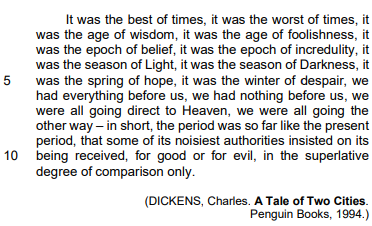
Imagem associada para resolução da questão


The extract above

Alternativas
Q1937049 Inglês

Directions: Look at the chart in Text I. Read the transcript and answer the question.


TEXT I


Transcript:

Q: To what extent, if at all, do you feel that your generation will have had a better or worse life than your parent’s generation, or will it be about the same?

Key: Better

Total

Great Britain


The verb tense used in your generation will have had a better or worse life
Alternativas
Q1937048 Inglês

Directions: Look at the chart in Text I. Read the transcript and answer the question.


TEXT I


Transcript:

Q: To what extent, if at all, do you feel that your generation will have had a better or worse life than your parent’s generation, or will it be about the same?

Key: Better

Total

Great Britain


Mark the option in which the information DISAGREES with the chart.
Alternativas
Ano: 2022 Banca: NC-UFPR Órgão: PM-PR Prova: NC-UFPR - 2022 - PM-PR - Cadete |
Q1901498 Inglês
The following text refer to question. 

The surprising history of India’s vibrant sari tradition

   South Asian women have draped themselves in colorful silks and cottons for eons. The ways they’re made and worn are dazzling and diverse.
   The word “sari” means “strip of cloth” in Sanskrit. But for the Indian women – and a few men – who have been wrapping themselves in silk, cotton, or linen for millennia, these swaths of fabric are more than just simple garments. They’re symbols of national pride, ambassadors for traditional (and cutting-edge) design and craftsmanship, and a prime example of the rich differences in India’s 29 states.
   “The sari both as symbol and reality has filled the imagination of the subcontinent, with its appeal and its ability to conceal and reveal the personality of the person wearing it,” says Delhi-based textile historian Rta Kapur Chishti, author of Saris of India: Tradition and Beyond and co-founder of Taanbaan, a fabric company devoted to reviving and preserving traditional Indian spinning and weaving methods.
   The first mention of saris (alternately spelled sarees) is in the Rig Veda, a Hindu book of hymns dating to 3,000 B.C.; draped garments show up on Indian sculptures from the first through sixth centuries, too. What Delhi-based textile historian Rta Kapur Chishti calls the “magical unstitched garment” is ideally suited to India’s blazingly hot climate and the modest-dress customs of both Hindu and Muslim communities. Saris also remain traditional for women in other South Asian countries including Pakistan, Bangladesh, and Nepal. 

(Available in: https://www.nationalgeographic.com/travel/photography/the-story-of-the-sari-in-india/.)
Sari, which in Sanskrit means “strip of cloth”, represents more than a piece of clothing in India. In relation to the different meaning(s) attributed to the sari, consider the following affirmatives:

1. It stands for both up-to-date and conventional patterns.
2. People wear it in different ways.
3. Both men and women can wear it.
4. People cannot avoid an arrogant attitude when they put it on.

Mark the affirmative(s) that is/are present in the text. 
Alternativas
Q2179145 Inglês

The following text refers to question.


There have been 18 opioid-related deaths in Nova Scotia so far this year


        Paramedics in Nova Scotia used naloxone to save 165 people from opioid overdoses in 2018 and 188 people in 2019. In 2020, 102 people were saved as of July 31.

        Eight years ago, Matthew Bonn watched his friend turn blue and become deathly quiet as fentanyl flooded his body. Bonn jumped in, performing rescue breathing until paramedics arrived. That was the first time Bonn fought to keep someone alive during an overdose.

        But it wouldn't be his last. Over the years, he tried more dangerous ways to snap people out of an overdose.

        "I remember doing crazy things like throwing people in bathtubs, or, you know, giving them cocaine. As we know now, that doesn't help," said Bonn, a harm-reduction advocate in Halifax. "But ... in those panic modes, you try to do whatever you can to keep that person alive."

        This was before naloxone – a drug that can reverse an opioid overdose – became widely available to the public. In 2017, the Nova Scotia government made kits with the drug available for free at pharmacies.

        Whether used by community members or emergency crews, naloxone has helped save hundreds of lives in the province. Matthew Bonn is a program co-ordinator with the Canadian Association of People Who Use Drugs, and a current drug user himself.

        Almost every other day in Nova Scotia, paramedics and medical first responders in the province use the drug to reverse an opioid overdose, according to Emergency Health Services (EHS).


(Available in: https://www.cbc.ca/news/canada/nova-scotia/ehs-naloxone-opioids-drug-use-emergency-care-1.5745907.)

In the text, the word “whether” underlined and in bold type can be replaced without losing its meaning by:
Alternativas
Ano: 2021 Banca: UFPR Órgão: PM-PR Prova: UFPR - 2021 - PM-PR - Aspirante |
Q2097616 Inglês
The following text refers to the question.

There have been 18 opioid-related deaths in Nova Scotia so far this year

             Paramedics in Nova Scotia used naloxone to save 165 people from opioid overdoses in 2018 and 188 people in 2019. In 2020, 102 people were saved as of July 31.
           Eight years ago, Matthew Bonn watched his friend turn blue and become deathly quiet as fentanyl flooded his body. Bonn jumped in, performing rescue breathing until paramedics arrived. That was the first time Bonn fought to keep someone alive during an overdose.
               But it wouldn't be his last. Over the years, he tried more dangerous ways to snap people out of an overdose.
             "I remember doing crazy things like throwing people in bathtubs, or, you know, giving them cocaine. As we know now, that doesn't help," said Bonn, a harm-reduction advocate in Halifax. "But ... in those panic modes, you try to do whatever you can to keep that person alive."     
            This was before naloxone – a drug that can reverse an opioid overdose – became widely available to the public. In 2017, the Nova Scotia government made kits with the drug available for free at pharmacies.
        Whether used by community members or emergency crews, naloxone has helped save hundreds of lives in the province.    
         Matthew Bonn is a program co-ordinator with the Canadian Association of People Who Use Drugs, and a current drug user himself.
            Almost every other day in Nova Scotia, paramedics and medical first responders in the province use the drug to reverse an opioid overdose, according to Emergency Health Services (EHS).

(Available in: https://www.cbc.ca/news/canada/nova-scotia/ehs-naloxone-opioids-drug-use-emergency-care-1.5745907.) 
In the text, the underlined and in bold type word “this” refers, among other things, to the act of:
Alternativas
Ano: 2021 Banca: UFPR Órgão: PM-PR Prova: UFPR - 2021 - PM-PR - Aspirante |
Q2097615 Inglês
The following text refers to the question.

There have been 18 opioid-related deaths in Nova Scotia so far this year

             Paramedics in Nova Scotia used naloxone to save 165 people from opioid overdoses in 2018 and 188 people in 2019. In 2020, 102 people were saved as of July 31.
           Eight years ago, Matthew Bonn watched his friend turn blue and become deathly quiet as fentanyl flooded his body. Bonn jumped in, performing rescue breathing until paramedics arrived. That was the first time Bonn fought to keep someone alive during an overdose.
               But it wouldn't be his last. Over the years, he tried more dangerous ways to snap people out of an overdose.
             "I remember doing crazy things like throwing people in bathtubs, or, you know, giving them cocaine. As we know now, that doesn't help," said Bonn, a harm-reduction advocate in Halifax. "But ... in those panic modes, you try to do whatever you can to keep that person alive."     
            This was before naloxone – a drug that can reverse an opioid overdose – became widely available to the public. In 2017, the Nova Scotia government made kits with the drug available for free at pharmacies.
        Whether used by community members or emergency crews, naloxone has helped save hundreds of lives in the province.    
         Matthew Bonn is a program co-ordinator with the Canadian Association of People Who Use Drugs, and a current drug user himself.
            Almost every other day in Nova Scotia, paramedics and medical first responders in the province use the drug to reverse an opioid overdose, according to Emergency Health Services (EHS).

(Available in: https://www.cbc.ca/news/canada/nova-scotia/ehs-naloxone-opioids-drug-use-emergency-care-1.5745907.) 
Based on the text, it is correct to say that Matthew Bonn:
Alternativas
Ano: 2021 Banca: UFPR Órgão: PM-PR Prova: UFPR - 2021 - PM-PR - Aspirante |
Q2097614 Inglês
The following text refers to the question.

There have been 18 opioid-related deaths in Nova Scotia so far this year

             Paramedics in Nova Scotia used naloxone to save 165 people from opioid overdoses in 2018 and 188 people in 2019. In 2020, 102 people were saved as of July 31.
           Eight years ago, Matthew Bonn watched his friend turn blue and become deathly quiet as fentanyl flooded his body. Bonn jumped in, performing rescue breathing until paramedics arrived. That was the first time Bonn fought to keep someone alive during an overdose.
               But it wouldn't be his last. Over the years, he tried more dangerous ways to snap people out of an overdose.
             "I remember doing crazy things like throwing people in bathtubs, or, you know, giving them cocaine. As we know now, that doesn't help," said Bonn, a harm-reduction advocate in Halifax. "But ... in those panic modes, you try to do whatever you can to keep that person alive."     
            This was before naloxone – a drug that can reverse an opioid overdose – became widely available to the public. In 2017, the Nova Scotia government made kits with the drug available for free at pharmacies.
        Whether used by community members or emergency crews, naloxone has helped save hundreds of lives in the province.    
         Matthew Bonn is a program co-ordinator with the Canadian Association of People Who Use Drugs, and a current drug user himself.
            Almost every other day in Nova Scotia, paramedics and medical first responders in the province use the drug to reverse an opioid overdose, according to Emergency Health Services (EHS).

(Available in: https://www.cbc.ca/news/canada/nova-scotia/ehs-naloxone-opioids-drug-use-emergency-care-1.5745907.) 
According to the text, it is correct to say that in the province of Nova Scotia:
Alternativas
Q1901467 Inglês
Leia o texto destacado para responder à questão.

Meritocracy has become a leading social ideal. Politicians across the ideological spectrum continually return to the theme that the rewards of life—money, power, jobs, university admission—should be distributed according to skill and effort. The most common metaphor is the ‘even playing field’ upon which players can rise to the position that fits their merit. Conceptually and morally, meritocracy is presented as the opposite of systems such as hereditary aristocracy, in which one’s social position is determined by the lottery of birth. Under meritocracy, wealth and advantage are merit’s rightful compensation, not the fortuitous windfall of external events. And most people don’t just think the world should be run meritocratically, they think it is meritocratic. However, although widely held, the belief that merit rather than luck determines success or failure in the world is demonstrably false. This is not least because merit itself is, in large part, the result of luck. Talent and the capacity for determined effort, sometimes called ‘grit’, depend a great deal on one’s genetic endowments and upbringing.
Perhaps more disturbing, simply holding meritocracy as a value seems to promote discriminatory behaviour. The management scholar Emilio Castilla at the Massachusetts Institute of Technology and the sociologist Stephen Benard at Indiana University studied attempts to implement meritocratic practices, such as performance-based compensation in private companies. They found that, in companies that explicitly held meritocracy as a core value, managers assigned greater rewards to male employees over female employees with identical performance evaluations. This preference disappeared where meritocracy was not explicitly adopted as a value.
This is surprising because impartiality is the core of meritocracy’s moral appeal. The ‘even playing field’ is intended to avoid unfair inequalities based on gender, race and the like. Yet  Castilla and Benard found that, ironically, attempts to implement meritocracy leads to just the kinds of inequalities that it aims to eliminate. They suggest that this ‘paradox of meritocracy’ occurs because explicitly adopting meritocracy as a value convinces subjects of their own moral sincerity. Satisfied that they are just, they become less inclined to examine their own behaviour for signs of prejudice.
As with any ideology, part of its draw is that it justifies the status quo, explaining why people belong where they happen to be in the social order. It is a well-established psychological principle that people prefer to believe that the world is just.

Fonte: https://bigthink.com/. Publicado em 23/03/2019. Acesso em 20/08/2021. Adaptado.
De acordo com o quarto parágrafo, a meritocracia promove 
Alternativas
Q1901466 Inglês
Leia o texto destacado para responder à questão.

Meritocracy has become a leading social ideal. Politicians across the ideological spectrum continually return to the theme that the rewards of life—money, power, jobs, university admission—should be distributed according to skill and effort. The most common metaphor is the ‘even playing field’ upon which players can rise to the position that fits their merit. Conceptually and morally, meritocracy is presented as the opposite of systems such as hereditary aristocracy, in which one’s social position is determined by the lottery of birth. Under meritocracy, wealth and advantage are merit’s rightful compensation, not the fortuitous windfall of external events. And most people don’t just think the world should be run meritocratically, they think it is meritocratic. However, although widely held, the belief that merit rather than luck determines success or failure in the world is demonstrably false. This is not least because merit itself is, in large part, the result of luck. Talent and the capacity for determined effort, sometimes called ‘grit’, depend a great deal on one’s genetic endowments and upbringing.
Perhaps more disturbing, simply holding meritocracy as a value seems to promote discriminatory behaviour. The management scholar Emilio Castilla at the Massachusetts Institute of Technology and the sociologist Stephen Benard at Indiana University studied attempts to implement meritocratic practices, such as performance-based compensation in private companies. They found that, in companies that explicitly held meritocracy as a core value, managers assigned greater rewards to male employees over female employees with identical performance evaluations. This preference disappeared where meritocracy was not explicitly adopted as a value.
This is surprising because impartiality is the core of meritocracy’s moral appeal. The ‘even playing field’ is intended to avoid unfair inequalities based on gender, race and the like. Yet  Castilla and Benard found that, ironically, attempts to implement meritocracy leads to just the kinds of inequalities that it aims to eliminate. They suggest that this ‘paradox of meritocracy’ occurs because explicitly adopting meritocracy as a value convinces subjects of their own moral sincerity. Satisfied that they are just, they become less inclined to examine their own behaviour for signs of prejudice.
As with any ideology, part of its draw is that it justifies the status quo, explaining why people belong where they happen to be in the social order. It is a well-established psychological principle that people prefer to believe that the world is just.

Fonte: https://bigthink.com/. Publicado em 23/03/2019. Acesso em 20/08/2021. Adaptado.
According to the third and fourth paragraphs, researchers at the Massachusetts Institute of Technology and Indiana University found that meritocracy 
Alternativas
Q1901465 Inglês
Leia o texto destacado para responder à questão.

Meritocracy has become a leading social ideal. Politicians across the ideological spectrum continually return to the theme that the rewards of life—money, power, jobs, university admission—should be distributed according to skill and effort. The most common metaphor is the ‘even playing field’ upon which players can rise to the position that fits their merit. Conceptually and morally, meritocracy is presented as the opposite of systems such as hereditary aristocracy, in which one’s social position is determined by the lottery of birth. Under meritocracy, wealth and advantage are merit’s rightful compensation, not the fortuitous windfall of external events. And most people don’t just think the world should be run meritocratically, they think it is meritocratic. However, although widely held, the belief that merit rather than luck determines success or failure in the world is demonstrably false. This is not least because merit itself is, in large part, the result of luck. Talent and the capacity for determined effort, sometimes called ‘grit’, depend a great deal on one’s genetic endowments and upbringing.
Perhaps more disturbing, simply holding meritocracy as a value seems to promote discriminatory behaviour. The management scholar Emilio Castilla at the Massachusetts Institute of Technology and the sociologist Stephen Benard at Indiana University studied attempts to implement meritocratic practices, such as performance-based compensation in private companies. They found that, in companies that explicitly held meritocracy as a core value, managers assigned greater rewards to male employees over female employees with identical performance evaluations. This preference disappeared where meritocracy was not explicitly adopted as a value.
This is surprising because impartiality is the core of meritocracy’s moral appeal. The ‘even playing field’ is intended to avoid unfair inequalities based on gender, race and the like. Yet  Castilla and Benard found that, ironically, attempts to implement meritocracy leads to just the kinds of inequalities that it aims to eliminate. They suggest that this ‘paradox of meritocracy’ occurs because explicitly adopting meritocracy as a value convinces subjects of their own moral sincerity. Satisfied that they are just, they become less inclined to examine their own behaviour for signs of prejudice.
As with any ideology, part of its draw is that it justifies the status quo, explaining why people belong where they happen to be in the social order. It is a well-established psychological principle that people prefer to believe that the world is just.

Fonte: https://bigthink.com/. Publicado em 23/03/2019. Acesso em 20/08/2021. Adaptado.
According to the first paragraph, one of the supporting arguments for meritocracy is:  
Alternativas
Q1901464 Inglês
Leia o texto destacado para responder à questão.

In a new survey of North American Indian languages, Marianne Mithun gives an admirably clear statement of what is lost as each language ceases to be used. “Speakers of these languages and their descendants are acutely aware of what it can mean to lose a language,” she begins – and this is perfectly true, although these speakers must have taken the decision themselves not to teach the language to their children. It happens all too often – people regret that their language and culture are being lost but at the same time decide not to saddle their own children with the chore of preserving them.
When a language disappears [Mithun continues] the most intimate aspects of culture can disappear as well: fundamental ways of organizing experience into concepts, of relating ideas to each other, of interacting to people. The more conscious genres of verbal art are usually lost as well: traditional ritual, oratory, myth, legends, and even humor. Speakers commonly remark that when they speak a different language, they say different things and even think different thoughts. These are very interesting assertions. They slip by in a book on anthropological linguistics, where in a book on linguistic theory they would be highly contentious. Is it true that “fundamental ways of organizing experience into concepts [and] of relating ideas to each other” are specific to individual languages and are therefore likely to be lost when a language ceases to be used? Is it true that when speakers speak a different language, they “say different things and even think different thoughts”? Again, the extent to which thought depends on language is very controversial. These questions must be now faced, because only when we have reached an opinion on them will we be able to accept or reject Marianne Mithun’s conclusion: “The loss of a language represents a definitive separation of a people from its heritage. It also represents an irreparable loss for us all, the loss of opportunities to glimpse alternative ways of making sense of the human experience.”

Fonte: Dalby, Andrew. Language in danger. New York: Columbia University Press, 2003, p. 252; 285. Adaptado.  
De acordo com o texto, é correto afirmar que com o desaparecimento de uma língua, aspectos dessa cultura também estão fadados ao desaparecimento, exceto 
Alternativas
Q1901463 Inglês
Leia o texto destacado para responder à questão.

In a new survey of North American Indian languages, Marianne Mithun gives an admirably clear statement of what is lost as each language ceases to be used. “Speakers of these languages and their descendants are acutely aware of what it can mean to lose a language,” she begins – and this is perfectly true, although these speakers must have taken the decision themselves not to teach the language to their children. It happens all too often – people regret that their language and culture are being lost but at the same time decide not to saddle their own children with the chore of preserving them.
When a language disappears [Mithun continues] the most intimate aspects of culture can disappear as well: fundamental ways of organizing experience into concepts, of relating ideas to each other, of interacting to people. The more conscious genres of verbal art are usually lost as well: traditional ritual, oratory, myth, legends, and even humor. Speakers commonly remark that when they speak a different language, they say different things and even think different thoughts. These are very interesting assertions. They slip by in a book on anthropological linguistics, where in a book on linguistic theory they would be highly contentious. Is it true that “fundamental ways of organizing experience into concepts [and] of relating ideas to each other” are specific to individual languages and are therefore likely to be lost when a language ceases to be used? Is it true that when speakers speak a different language, they “say different things and even think different thoughts”? Again, the extent to which thought depends on language is very controversial. These questions must be now faced, because only when we have reached an opinion on them will we be able to accept or reject Marianne Mithun’s conclusion: “The loss of a language represents a definitive separation of a people from its heritage. It also represents an irreparable loss for us all, the loss of opportunities to glimpse alternative ways of making sense of the human experience.”

Fonte: Dalby, Andrew. Language in danger. New York: Columbia University Press, 2003, p. 252; 285. Adaptado.  
O termo “must”, destacado em itálico no excerto do segundo parágrafo, “These questions must be now faced”, pode ser substituído, sem alteração de significado, por 
Alternativas
Q1901462 Inglês
Leia o texto destacado para responder à questão.

In a new survey of North American Indian languages, Marianne Mithun gives an admirably clear statement of what is lost as each language ceases to be used. “Speakers of these languages and their descendants are acutely aware of what it can mean to lose a language,” she begins – and this is perfectly true, although these speakers must have taken the decision themselves not to teach the language to their children. It happens all too often – people regret that their language and culture are being lost but at the same time decide not to saddle their own children with the chore of preserving them.
When a language disappears [Mithun continues] the most intimate aspects of culture can disappear as well: fundamental ways of organizing experience into concepts, of relating ideas to each other, of interacting to people. The more conscious genres of verbal art are usually lost as well: traditional ritual, oratory, myth, legends, and even humor. Speakers commonly remark that when they speak a different language, they say different things and even think different thoughts. These are very interesting assertions. They slip by in a book on anthropological linguistics, where in a book on linguistic theory they would be highly contentious. Is it true that “fundamental ways of organizing experience into concepts [and] of relating ideas to each other” are specific to individual languages and are therefore likely to be lost when a language ceases to be used? Is it true that when speakers speak a different language, they “say different things and even think different thoughts”? Again, the extent to which thought depends on language is very controversial. These questions must be now faced, because only when we have reached an opinion on them will we be able to accept or reject Marianne Mithun’s conclusion: “The loss of a language represents a definitive separation of a people from its heritage. It also represents an irreparable loss for us all, the loss of opportunities to glimpse alternative ways of making sense of the human experience.”

Fonte: Dalby, Andrew. Language in danger. New York: Columbia University Press, 2003, p. 252; 285. Adaptado.  
De acordo com a linguista Marianne Mithun  
Alternativas
Q1901461 Inglês
Leia o texto destacado para responder à questão.

Jaap Wagelaar was my all-time favorite secondary school teacher. He gave me a 10/10 for my oral Dutch literature exam, taught psychoanalysis during grammar class, astounded pupils with odd puppet show performances during lunch breaks and sadly ended his career with a burn-out. Few students and fellow teachers understood him. But since I trusted his judgment like nobody else’s, I once asked him why Piet Paaltjens and Gerard Reve, both canonized Dutch literary figures, albeit of very divergent genres, could occasionally be kind or ironic but were more often rather cynical, cold and heartless. The response he gave has stuck with me ever since: cynical people are in fact the most emotional ones. Because of their sentimentality they are unable to handle injustice and feel forced to build up a self-protective screen against painful emotions called cynicism. Irony is mild, harmless and green. Sarcasm is biting and represents an orange traffic light. And the color of cynicism is deep red, with the shape of a grim scar that hides a hurt soul. They are all equally beautiful. 
These words again came to my mind when thinking back on the dozens of ironic, sarcastic and cynical memes about underperforming politicians and policy scandals disseminated over the past year. Who has not seen the image of Donald Trump walking through a desolate, scorched forest mumbling to himself: ‘My work here is almost done’? Who has not read the scathing reports of Flemish Ministers Bart Somers and Hilde Crevits escaping from a window aided by an unidentified third person after a meeting of the Council of Ministers to avoid critical journalists with the defense that they urgently needed to go on holiday and windows are faster than doors? Who has not come across the video announcement for a fictitious thriller called Angstra Zeneca with Dutch Health Minister Hugo de Jonge exclaiming ‘ik heb er zo’n kankerbende van gemaakt’ (I have made it all a cancerous mess) with a grimace stretching from ear to ear? And who has missed the most recent true story tragicomedy played by Charles Michel, male President of the European Council, and Ursula von der Leyen, female President of the European Commission, who had jointly been invited by Turkish President Recep Tayyip Erdogan to discuss the position of women in Turkey? Unfortunately, they were only offered one chair for two people, which was symbolically occupied by Michel who left Von der Leyen standing awkwardly for a while. She ended up settling for a place on the comfortable sofa reserved for second rank guests. It was damned easy to get addicted to these countless videos, photos, images and written parodies. Oh, did we have fun with them! Some were ironic, some sarcastic and others cynical, but they jointly sketch a disconcerting image of the quality and reputation of key politicians in liberal Western democracies.

Fonte: https://www.eur.nl/en/news/. Publicado em 16/04/2021. Acesso em 29/08/21. Adaptado.  
Em um encontro para discutir a posição da mulher, o anfitrião 
Alternativas
Respostas
801: B
802: C
803: A
804: C
805: D
806: D
807: B
808: B
809: D
810: C
811: A
812: B
813: D
814: A
815: E
816: B
817: D
818: C
819: B
820: C