Questões Militares
Comentadas sobre interpretação de texto | reading comprehension em inglês
Foram encontradas 1.577 questões


Mark Zuckerberg’s 650 Million Friends (and counting)
Back in June 2009, the globe’s potpourri of social-networking sites was extremely diverse:
Google’s Orkut dominated India and Brazil; Central and South America preferred Hi5; Maktoob was
king in the Arab world. The Vietnamese liked Zing, the Czechs loved Lidé, South Koreans surfed
Cyworld. Two years after that, and Facebook has stolen users away from its rivals very fast. It’s
completely knocked Hi5 off the map in former strongholds such as Peru, Mexico, and Thailand.
After a tense back-and-forth with Orkut in India, Facebook has emerged victorious. And it’s becoming
more popular in Armenia, Georgia, and the Netherlands, where local providers are making a
desperate last stand.
There are some glaring exceptions to Facebook’s colonization kick. Russians continue to use
Vkontakte and Odnoklassniki, with Facebook a distant fourth in the rankings. China remains highly
committed to domestic sites such as Qzone and Renren. But for the rest of us, we’re living in
Zuckerberg’s world.
(endereço eletrônico omitido propositadamente)
Mark Zuckerberg’s 650 Million Friends (and counting)
Back in June 2009, the globe’s potpourri of social-networking sites was extremely diverse:
Google’s Orkut dominated India and Brazil; Central and South America preferred Hi5; Maktoob was
king in the Arab world. The Vietnamese liked Zing, the Czechs loved Lidé, South Koreans surfed
Cyworld. Two years after that, and Facebook has stolen users away from its rivals very fast. It’s
completely knocked Hi5 off the map in former strongholds such as Peru, Mexico, and Thailand.
After a tense back-and-forth with Orkut in India, Facebook has emerged victorious. And it’s becoming
more popular in Armenia, Georgia, and the Netherlands, where local providers are making a
desperate last stand.
There are some glaring exceptions to Facebook’s colonization kick. Russians continue to use
Vkontakte and Odnoklassniki, with Facebook a distant fourth in the rankings. China remains highly
committed to domestic sites such as Qzone and Renren. But for the rest of us, we’re living in
Zuckerberg’s world.
(endereço eletrônico omitido propositadamente)
Mark Zuckerberg’s 650 Million Friends (and counting)
Back in June 2009, the globe’s potpourri of social-networking sites was extremely diverse:
Google’s Orkut dominated India and Brazil; Central and South America preferred Hi5; Maktoob was
king in the Arab world. The Vietnamese liked Zing, the Czechs loved Lidé, South Koreans surfed
Cyworld. Two years after that, and Facebook has stolen users away from its rivals very fast. It’s
completely knocked Hi5 off the map in former strongholds such as Peru, Mexico, and Thailand.
After a tense back-and-forth with Orkut in India, Facebook has emerged victorious. And it’s becoming
more popular in Armenia, Georgia, and the Netherlands, where local providers are making a
desperate last stand.
There are some glaring exceptions to Facebook’s colonization kick. Russians continue to use
Vkontakte and Odnoklassniki, with Facebook a distant fourth in the rankings. China remains highly
committed to domestic sites such as Qzone and Renren. But for the rest of us, we’re living in
Zuckerberg’s world.
(endereço eletrônico omitido propositadamente)

There are countries where people have two options to pay for their treatment.
There are health systems in which patients pay a standard charge but for drug treatments.
Those who pay taxes are not entitled to receive free treatment.
There are countries where people can get free treatment no matter how serious their disease can be.
In most countries, the provision of health care is entirely free of charge.
In our present-day society, there may be other issues as critical as those concerning health care.
The “two tier” (l.21) system provides different kinds of health care depending upon the economic status of patients.
Instrução: Leia o texto para responder a questão.
The Big Destructiveness Of The Tiny Bribe
Alexandra Wrage 03.01.2010
The smallest bribes can be the most vexing. Not suitcases full of money and transfers to offshore accounts, but the thousands of everyday payments people make to Indian building inspectors, Chinese customs officials and Nigerian airport functionaries, just to get things done. They’re payments for routine government services that a government official is legally obliged to perform but for which he’s hoping to skim off a little extra.
Unlike more serious bribes, these very modest payouts, formally known as “facilitating payments”, are not against the laws of the U.S., Canada, Australia, New Zealand or South Korea, when made abroad. They’re illegal for Great Britain, but the Serious Fraud Office there has taken the extraordinary public position that they’re unlikely to give rise to a prosecution.
Why don’t governments that lead the fight against large-scale bribery fall in line with what is already the practice of many major companies? They don’t want to outlaw such small-scale graft in foreign places, they say, because they don’t have the manpower to prosecute violators. By that logic, communities with just enough resources to handle murder and armed robbery would give a green light to shoplifting. You’d think a government could at least go after a few high-profile cases to set an example and a precedent. Permitting these smaller payments has to impede the effort to crack down on the larger ones. Companies know this.
“Facilitating” bribes are not tips. Tipping is voluntary, and you decide to do it after a service has been rendered. You don’t pay it at the outset to induce the waiter to bring the food, and you can always go somewhere else to eat next time should the service be bad.
Nor are they welfare for underpaid civil servants. If government workers are underpaid, we should compensate them for the cost of customs inspections or airport security by aboveboard means, through taxation and so forth. Payment to individuals not only slows service but also encourages entrepreneurial civil servants to increase their income by creating more and greater obstacles.
Nor are they a mere distraction from the fight against bigger bribes. Rather, they fuel the problem. Junior officials who look for small bribes rise to higher positions by paying off those above them. Corruption creates pyramids of illegal payments flowing upward. Legalizing the base of the pyramid gives it a strong and lasting foundation.
Nor are these payments legal where they’re made. They may not be banned by the wealthy countries mentioned above, but they are outlawed in the countries where they’re actually a problem. Do developed countries want to say they wouldn’t tolerate such payments at home but don’t care if they’re made abroad? And since they’re illegal in the countries where they’re paid, companies can’t put them on their books. The classic cover for a bribe is to call it a “consulting fee”, but that is a books and records violation that is illegal in any country.
(www.forbes.com. Adaptado.)
Instrução: Leia o texto para responder a questão.
The Big Destructiveness Of The Tiny Bribe
Alexandra Wrage 03.01.2010
The smallest bribes can be the most vexing. Not suitcases full of money and transfers to offshore accounts, but the thousands of everyday payments people make to Indian building inspectors, Chinese customs officials and Nigerian airport functionaries, just to get things done. They’re payments for routine government services that a government official is legally obliged to perform but for which he’s hoping to skim off a little extra.
Unlike more serious bribes, these very modest payouts, formally known as “facilitating payments”, are not against the laws of the U.S., Canada, Australia, New Zealand or South Korea, when made abroad. They’re illegal for Great Britain, but the Serious Fraud Office there has taken the extraordinary public position that they’re unlikely to give rise to a prosecution.
Why don’t governments that lead the fight against large-scale bribery fall in line with what is already the practice of many major companies? They don’t want to outlaw such small-scale graft in foreign places, they say, because they don’t have the manpower to prosecute violators. By that logic, communities with just enough resources to handle murder and armed robbery would give a green light to shoplifting. You’d think a government could at least go after a few high-profile cases to set an example and a precedent. Permitting these smaller payments has to impede the effort to crack down on the larger ones. Companies know this.
“Facilitating” bribes are not tips. Tipping is voluntary, and you decide to do it after a service has been rendered. You don’t pay it at the outset to induce the waiter to bring the food, and you can always go somewhere else to eat next time should the service be bad.
Nor are they welfare for underpaid civil servants. If government workers are underpaid, we should compensate them for the cost of customs inspections or airport security by aboveboard means, through taxation and so forth. Payment to individuals not only slows service but also encourages entrepreneurial civil servants to increase their income by creating more and greater obstacles.
Nor are they a mere distraction from the fight against bigger bribes. Rather, they fuel the problem. Junior officials who look for small bribes rise to higher positions by paying off those above them. Corruption creates pyramids of illegal payments flowing upward. Legalizing the base of the pyramid gives it a strong and lasting foundation.
Nor are these payments legal where they’re made. They may not be banned by the wealthy countries mentioned above, but they are outlawed in the countries where they’re actually a problem. Do developed countries want to say they wouldn’t tolerate such payments at home but don’t care if they’re made abroad? And since they’re illegal in the countries where they’re paid, companies can’t put them on their books. The classic cover for a bribe is to call it a “consulting fee”, but that is a books and records violation that is illegal in any country.
(www.forbes.com. Adaptado.)
Instrução: Leia o texto para responder a questão.
The Big Destructiveness Of The Tiny Bribe
Alexandra Wrage 03.01.2010
The smallest bribes can be the most vexing. Not suitcases full of money and transfers to offshore accounts, but the thousands of everyday payments people make to Indian building inspectors, Chinese customs officials and Nigerian airport functionaries, just to get things done. They’re payments for routine government services that a government official is legally obliged to perform but for which he’s hoping to skim off a little extra.
Unlike more serious bribes, these very modest payouts, formally known as “facilitating payments”, are not against the laws of the U.S., Canada, Australia, New Zealand or South Korea, when made abroad. They’re illegal for Great Britain, but the Serious Fraud Office there has taken the extraordinary public position that they’re unlikely to give rise to a prosecution.
Why don’t governments that lead the fight against large-scale bribery fall in line with what is already the practice of many major companies? They don’t want to outlaw such small-scale graft in foreign places, they say, because they don’t have the manpower to prosecute violators. By that logic, communities with just enough resources to handle murder and armed robbery would give a green light to shoplifting. You’d think a government could at least go after a few high-profile cases to set an example and a precedent. Permitting these smaller payments has to impede the effort to crack down on the larger ones. Companies know this.
“Facilitating” bribes are not tips. Tipping is voluntary, and you decide to do it after a service has been rendered. You don’t pay it at the outset to induce the waiter to bring the food, and you can always go somewhere else to eat next time should the service be bad.
Nor are they welfare for underpaid civil servants. If government workers are underpaid, we should compensate them for the cost of customs inspections or airport security by aboveboard means, through taxation and so forth. Payment to individuals not only slows service but also encourages entrepreneurial civil servants to increase their income by creating more and greater obstacles.
Nor are they a mere distraction from the fight against bigger bribes. Rather, they fuel the problem. Junior officials who look for small bribes rise to higher positions by paying off those above them. Corruption creates pyramids of illegal payments flowing upward. Legalizing the base of the pyramid gives it a strong and lasting foundation.
Nor are these payments legal where they’re made. They may not be banned by the wealthy countries mentioned above, but they are outlawed in the countries where they’re actually a problem. Do developed countries want to say they wouldn’t tolerate such payments at home but don’t care if they’re made abroad? And since they’re illegal in the countries where they’re paid, companies can’t put them on their books. The classic cover for a bribe is to call it a “consulting fee”, but that is a books and records violation that is illegal in any country.
(www.forbes.com. Adaptado.)
Instrução: Leia o texto para responder a questão.
The Big Destructiveness Of The Tiny Bribe
Alexandra Wrage 03.01.2010
The smallest bribes can be the most vexing. Not suitcases full of money and transfers to offshore accounts, but the thousands of everyday payments people make to Indian building inspectors, Chinese customs officials and Nigerian airport functionaries, just to get things done. They’re payments for routine government services that a government official is legally obliged to perform but for which he’s hoping to skim off a little extra.
Unlike more serious bribes, these very modest payouts, formally known as “facilitating payments”, are not against the laws of the U.S., Canada, Australia, New Zealand or South Korea, when made abroad. They’re illegal for Great Britain, but the Serious Fraud Office there has taken the extraordinary public position that they’re unlikely to give rise to a prosecution.
Why don’t governments that lead the fight against large-scale bribery fall in line with what is already the practice of many major companies? They don’t want to outlaw such small-scale graft in foreign places, they say, because they don’t have the manpower to prosecute violators. By that logic, communities with just enough resources to handle murder and armed robbery would give a green light to shoplifting. You’d think a government could at least go after a few high-profile cases to set an example and a precedent. Permitting these smaller payments has to impede the effort to crack down on the larger ones. Companies know this.
“Facilitating” bribes are not tips. Tipping is voluntary, and you decide to do it after a service has been rendered. You don’t pay it at the outset to induce the waiter to bring the food, and you can always go somewhere else to eat next time should the service be bad.
Nor are they welfare for underpaid civil servants. If government workers are underpaid, we should compensate them for the cost of customs inspections or airport security by aboveboard means, through taxation and so forth. Payment to individuals not only slows service but also encourages entrepreneurial civil servants to increase their income by creating more and greater obstacles.
Nor are they a mere distraction from the fight against bigger bribes. Rather, they fuel the problem. Junior officials who look for small bribes rise to higher positions by paying off those above them. Corruption creates pyramids of illegal payments flowing upward. Legalizing the base of the pyramid gives it a strong and lasting foundation.
Nor are these payments legal where they’re made. They may not be banned by the wealthy countries mentioned above, but they are outlawed in the countries where they’re actually a problem. Do developed countries want to say they wouldn’t tolerate such payments at home but don’t care if they’re made abroad? And since they’re illegal in the countries where they’re paid, companies can’t put them on their books. The classic cover for a bribe is to call it a “consulting fee”, but that is a books and records violation that is illegal in any country.
(www.forbes.com. Adaptado.)
Instrução: Leia o texto para responder a questão.
The Big Destructiveness Of The Tiny Bribe
Alexandra Wrage 03.01.2010
The smallest bribes can be the most vexing. Not suitcases full of money and transfers to offshore accounts, but the thousands of everyday payments people make to Indian building inspectors, Chinese customs officials and Nigerian airport functionaries, just to get things done. They’re payments for routine government services that a government official is legally obliged to perform but for which he’s hoping to skim off a little extra.
Unlike more serious bribes, these very modest payouts, formally known as “facilitating payments”, are not against the laws of the U.S., Canada, Australia, New Zealand or South Korea, when made abroad. They’re illegal for Great Britain, but the Serious Fraud Office there has taken the extraordinary public position that they’re unlikely to give rise to a prosecution.
Why don’t governments that lead the fight against large-scale bribery fall in line with what is already the practice of many major companies? They don’t want to outlaw such small-scale graft in foreign places, they say, because they don’t have the manpower to prosecute violators. By that logic, communities with just enough resources to handle murder and armed robbery would give a green light to shoplifting. You’d think a government could at least go after a few high-profile cases to set an example and a precedent. Permitting these smaller payments has to impede the effort to crack down on the larger ones. Companies know this.
“Facilitating” bribes are not tips. Tipping is voluntary, and you decide to do it after a service has been rendered. You don’t pay it at the outset to induce the waiter to bring the food, and you can always go somewhere else to eat next time should the service be bad.
Nor are they welfare for underpaid civil servants. If government workers are underpaid, we should compensate them for the cost of customs inspections or airport security by aboveboard means, through taxation and so forth. Payment to individuals not only slows service but also encourages entrepreneurial civil servants to increase their income by creating more and greater obstacles.
Nor are they a mere distraction from the fight against bigger bribes. Rather, they fuel the problem. Junior officials who look for small bribes rise to higher positions by paying off those above them. Corruption creates pyramids of illegal payments flowing upward. Legalizing the base of the pyramid gives it a strong and lasting foundation.
Nor are these payments legal where they’re made. They may not be banned by the wealthy countries mentioned above, but they are outlawed in the countries where they’re actually a problem. Do developed countries want to say they wouldn’t tolerate such payments at home but don’t care if they’re made abroad? And since they’re illegal in the countries where they’re paid, companies can’t put them on their books. The classic cover for a bribe is to call it a “consulting fee”, but that is a books and records violation that is illegal in any country.
(www.forbes.com. Adaptado.)
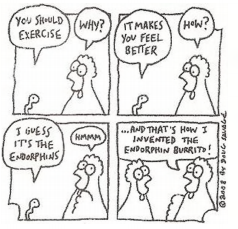
www.savagechichens.com/2008/04/endorphins.html.
According to this cartoon, the

According to the University of Vermont research, the workoufs feel-good effects last

“Both have been reieved of their duties” (/. 23-24)
This sentence means that both the controller and the supervisor have_______________
The only alternative that does not complete this sentence correctly is

 Conheça nossos planos