Questões Militares
Comentadas sobre interpretação de texto | reading comprehension em inglês
Foram encontradas 1.577 questões


Violence Prevention Among Young People in Brazil
Crime and violence have increased dramatically in Brazil in recent decades, particularly in large urban areas, leading to more intense public debate on causes and solutions. The right to life is the most fundamental of all rights. Having security means living without fearing the risk of violation of one’s life, liberty, physical integrity or property. Security means not only to be free from actual risks, but also to be able to enjoy the feeling of security. In this respect, human rights are systematically undermined by violence and insecurity.
UNESCO expects to play a primary role in supporting actions of social inclusion to help in the prevention of violence, especially among young people. The attributes and resources to be found in the heart of the Organization’s different areas will be grouped around this objective.
Violence is seen as a violation of fundamental human rights, as a threat to the respect for the principles of liberty and equality. An approach focused on the access to quality education, to decent jobs, to cultural, sports and leisure activities, to digital inclusion and the protection and promotion of human rights and of the environment will be implemented as a response to the challenge of preventing violence among youths. Such approach should also help in creating real opportunities for young people to improve their life conditions and develop their citizenship.
(www.unesco.org. Adaptado)
Violence Prevention Among Young People in Brazil
Crime and violence have increased dramatically in Brazil in recent decades, particularly in large urban areas, leading to more intense public debate on causes and solutions. The right to life is the most fundamental of all rights. Having security means living without fearing the risk of violation of one’s life, liberty, physical integrity or property. Security means not only to be free from actual risks, but also to be able to enjoy the feeling of security. In this respect, human rights are systematically undermined by violence and insecurity.
UNESCO expects to play a primary role in supporting actions of social inclusion to help in the prevention of violence, especially among young people. The attributes and resources to be found in the heart of the Organization’s different areas will be grouped around this objective.
Violence is seen as a violation of fundamental human rights, as a threat to the respect for the principles of liberty and equality. An approach focused on the access to quality education, to decent jobs, to cultural, sports and leisure activities, to digital inclusion and the protection and promotion of human rights and of the environment will be implemented as a response to the challenge of preventing violence among youths. Such approach should also help in creating real opportunities for young people to improve their life conditions and develop their citizenship.
(www.unesco.org. Adaptado)
I learnt to fly in a balloon in a race across the Atlantic Ocean in 1992 and became fascinated by the sport. In the same way that a mountain climber dreams of climbing the world's highest mountain, I dreamed about flying non-stop around the world.
I spent six years planning the flight and failed twice before we managed to succeed. Our route took us over China, but we could only get permission to travel over the south. This meant going first to North Africa to catch the right winds. That added 10,000 kilometers, and another week, to our journey. But because of this, our flight broke all the records for distance and time spent in the air.
My main memory of the trip is that we lived in the air for 20 days and the rising sun was the most amazing thing we saw. We had to go out of the balloon's capsule, in which we were transported, three times while in the air to repair the fuel system. We didn't have any safety equipment but when you are in a situation like that, you just do what you have to do without thinking about feeling afraid.
Landing was a fantastic moment. I remember when I got out of the capsule, I looked at my footprint in the sand. I remembered the astronaut Neil Armstrong who was so happy to put his footprint on the moon, so far away from Earth. At that moment, I was so happy to have my foot back on Earth!
(Fonte: Original)
What was the newspaper headline after the balloon landed?
I learnt to fly in a balloon in a race across the Atlantic Ocean in 1992 and became fascinated by the sport. In the same way that a mountain climber dreams of climbing the world's highest mountain, I dreamed about flying non-stop around the world.
I spent six years planning the flight and failed twice before we managed to succeed. Our route took us over China, but we could only get permission to travel over the south. This meant going first to North Africa to catch the right winds. That added 10,000 kilometers, and another week, to our journey. But because of this, our flight broke all the records for distance and time spent in the air.
My main memory of the trip is that we lived in the air for 20 days and the rising sun was the most amazing thing we saw. We had to go out of the balloon's capsule, in which we were transported, three times while in the air to repair the fuel system. We didn't have any safety equipment but when you are in a situation like that, you just do what you have to do without thinking about feeling afraid.
Landing was a fantastic moment. I remember when I got out of the capsule, I looked at my footprint in the sand. I remembered the astronaut Neil Armstrong who was so happy to put his footprint on the moon, so far away from Earth. At that moment, I was so happy to have my foot back on Earth!
(Fonte: Original)
Why did the pilots get out of the capsule during the flight?
I learnt to fly in a balloon in a race across the Atlantic Ocean in 1992 and became fascinated by the sport. In the same way that a mountain climber dreams of climbing the world's highest mountain, I dreamed about flying non-stop around the world.
I spent six years planning the flight and failed twice before we managed to succeed. Our route took us over China, but we could only get permission to travel over the south. This meant going first to North Africa to catch the right winds. That added 10,000 kilometers, and another week, to our journey. But because of this, our flight broke all the records for distance and time spent in the air.
My main memory of the trip is that we lived in the air for 20 days and the rising sun was the most amazing thing we saw. We had to go out of the balloon's capsule, in which we were transported, three times while in the air to repair the fuel system. We didn't have any safety equipment but when you are in a situation like that, you just do what you have to do without thinking about feeling afraid.
Landing was a fantastic moment. I remember when I got out of the capsule, I looked at my footprint in the sand. I remembered the astronaut Neil Armstrong who was so happy to put his footprint on the moon, so far away from Earth. At that moment, I was so happy to have my foot back on Earth!
(Fonte: Original)
Why did the balloon fly over south China?
I learnt to fly in a balloon in a race across the Atlantic Ocean in 1992 and became fascinated by the sport. In the same way that a mountain climber dreams of climbing the world's highest mountain, I dreamed about flying non-stop around the world.
I spent six years planning the flight and failed twice before we managed to succeed. Our route took us over China, but we could only get permission to travel over the south. This meant going first to North Africa to catch the right winds. That added 10,000 kilometers, and another week, to our journey. But because of this, our flight broke all the records for distance and time spent in the air.
My main memory of the trip is that we lived in the air for 20 days and the rising sun was the most amazing thing we saw. We had to go out of the balloon's capsule, in which we were transported, three times while in the air to repair the fuel system. We didn't have any safety equipment but when you are in a situation like that, you just do what you have to do without thinking about feeling afraid.
Landing was a fantastic moment. I remember when I got out of the capsule, I looked at my footprint in the sand. I remembered the astronaut Neil Armstrong who was so happy to put his footprint on the moon, so far away from Earth. At that moment, I was so happy to have my foot back on Earth!
(Fonte: Original)
What's Piccard's main reason for writing this text?
Michael Jackson died while preparing to set a world record for the most successful concert run ever, but he unknowingly set another record that led to his death.
Jackson may be the only human ever to go two months without REM - Rapid Eye Movement - sleep, which is vital to keep the brain and body alive. The 60 nights of propofol infusions Dr. Conrad Murray said he gave Jackson to treat his insomnia is something a sleep expert says no one had ever undergone.
“The symptoms that Mr. Jackson was exhibiting were consistent with what someone might expect to see of someone suffering from total sleep deprivation over a chronic period,” Dr. Charles Czeisler, a Harvard Medical School sleep expert, testified Friday at the wrongful-death trial of concert promoter AEG Live, company that hired Dr. Conrad Murray as Jackson's personal physician.
Propofol disrupts the normal sleep cycle and offers no REM sleep, yet it leaves a patient feeling refreshed as if they had experienced genuine sleep, according to Czeisler.
If the singer had not died on June 25, 2009, of an overdose of the surgical anesthetic, the lack of REM sleep may have soon taken his life anyway, according Czeisler's testimony Friday.
Jackson morreria certamente devido à falta de sono REM (1ª parte). De acordo com o Dr. Conrad Murray, o tratamento com injeções de propofol já havia sido usado/administrado em humanos e, por isso, foi recomendado a Michael Jackson (2ª parte).
A sentença está:
A significant area of interest within the US Army empirical literature on leadership is emotional intelligence (EI), which in recent years has been the focus of considerable attention in relationship to leadership efficacy. Emotional intelligence involves an awareness of one’s own emotions as well as the ability to control them, social awareness of others and their emotions, and the capacity to understand and manage relationship and social networks.
In understanding others’ emotions, an important contributing factor to the success of the more effective military officers is their ability to empathize with their subordinates. In discussing empathy, FM (Field Manual) 6-22 defines it as “the ability to see something from another person’s point of view, to identify with and enter into another person’s feelings and emotions”. Empathy is not typically a quality that most soldiers would readily identify as an essential characteristic to effective leadership or necessary to producing positive organizational outcomes, but it is an important quality for competent leadership, especially as it relates to EI.
Madrid (CNN) - “The people, united, will never be divided!” yells the crowd, angrily waving banners and placards. “To fight is the only way!” Dog-walkers, mothers with strollers, and pensioners carrying shopping bags join the crowd. These people on the sidewalk are no curious neighbors. Indeed, many of them are complete strangers to the family living on the fifth floor, but they are all here to protect Rocio from eviction - being forced to leave her property by legal process.
Rocio and her son, now 17 and in high school, moved from Ecuador in 2003, when times were good and jobs plentiful in Spain. But then the global financial crisis hit, bringing Spain’s economy down, Rocio lost her two jobs - in a shop, and as a cleaner. For a while, Rocio got by on benefits, but then those stopped too. She is an example of the crisis many Spaniards face as the country deals with the highest unemployment rate since the Civil War in the 1930s, and a recession entering its second year. “I can’t stand the thought of living on the streets with my son, but I have no idea where else to go”, she says.
Rocio’s story is echoed by others all over Spain. It is this fear that took many Spanish citizens to action. Many of those people who are outside the door of Rocio’s apartment block are supporters of “Stop Desahucios” (Stop Evictions), part of the Platform of People Affected by Mortgages (PAH - Plataforma de Afectados por la Hipoteca), a group that campaigns to prevent banks and authorities from eviction because of the country’s economic crisis. They accuse the banks and authorities of “real estate terrorism”.
There are also the mass marches of the 15-M movement - also known as the “Indignados”. Activist Dante Scherma, 24, says citizens were not used to speaking out on political issues. “The 15-M movement made people talk about social issues, and about politics in normal conversations - in cafés, restaurants, bars - where before they only talked about football or fashion.”
Back in Vicalvaro, the moment of truth has arrived, but the crowd - now shouting at the police, insisting they have to stop forcing families to leave their properties - appears to have had an impact. Lawyers from the PAH explain that Rocio will be able to stay - for a while, at least. For those working to stop Spain’s eviction epidemic, today has seen a small and temporary victory. For those demonstrating about cuts, corruption and lack of cash, the protests will go on.
Madrid (CNN) - “The people, united, will never be divided!” yells the crowd, angrily waving banners and placards. “To fight is the only way!” Dog-walkers, mothers with strollers, and pensioners carrying shopping bags join the crowd. These people on the sidewalk are no curious neighbors. Indeed, many of them are complete strangers to the family living on the fifth floor, but they are all here to protect Rocio from eviction - being forced to leave her property by legal process.
Rocio and her son, now 17 and in high school, moved from Ecuador in 2003, when times were good and jobs plentiful in Spain. But then the global financial crisis hit, bringing Spain’s economy down, Rocio lost her two jobs - in a shop, and as a cleaner. For a while, Rocio got by on benefits, but then those stopped too. She is an example of the crisis many Spaniards face as the country deals with the highest unemployment rate since the Civil War in the 1930s, and a recession entering its second year. “I can’t stand the thought of living on the streets with my son, but I have no idea where else to go”, she says.
Rocio’s story is echoed by others all over Spain. It is this fear that took many Spanish citizens to action. Many of those people who are outside the door of Rocio’s apartment block are supporters of “Stop Desahucios” (Stop Evictions), part of the Platform of People Affected by Mortgages (PAH - Plataforma de Afectados por la Hipoteca), a group that campaigns to prevent banks and authorities from eviction because of the country’s economic crisis. They accuse the banks and authorities of “real estate terrorism”.
There are also the mass marches of the 15-M movement - also known as the “Indignados”. Activist Dante Scherma, 24, says citizens were not used to speaking out on political issues. “The 15-M movement made people talk about social issues, and about politics in normal conversations - in cafés, restaurants, bars - where before they only talked about football or fashion.”
Back in Vicalvaro, the moment of truth has arrived, but the crowd - now shouting at the police, insisting they have to stop forcing families to leave their properties - appears to have had an impact. Lawyers from the PAH explain that Rocio will be able to stay - for a while, at least. For those working to stop Spain’s eviction epidemic, today has seen a small and temporary victory. For those demonstrating about cuts, corruption and lack of cash, the protests will go on.
Five days after deadliest elementary school shooting in U.S. history, President Obama said his administration plans immediate action early next year on proposals to curb an “epidemic of gun violence”. At a morning news conference, Obama announced the formation of a task force to be headed by Vice President Joe Biden that will formulate a package of policy recommendations by January. “The fact that this problem is complex can no longer be an excuse for doing nothing”, Obama said. “The fact that we can’t prevent every act of violence doesn’t mean that we can’t steadily reduce the violence and prevent the very worst violence.” The president said he intends to push for implementation of the proposals “without delay”. “This is a team that has a very specific task to pull together real reforms right now”, he said.
While Obama did not offer specifics, he suggested the task force would examine an array of steps to curb gun violence and prevent mass shootings, including legislative measures, mental health resources and a “look more closely at a culture that all-too-often glorifies guns and violence”. “I will use all the powers of this office to help advance efforts aimed at preventing more tragedies like this”, Obama said.
Obama made similar pronouncements following at least four other mass shootings that marked his first term. But few policy changes were made. “This is not the first incident of horrific gun violence of your four years. Where have you been?”, asked ABC News’ Jake Tapper. “I’ve been president of the United States, dealing with the worst economic crisis since the Great Depression, an auto industry on the verge of collapse, two wars. I don’t think I’ve been on vacation”, Obama responded.
Five days after deadliest elementary school shooting in U.S. history, President Obama said his administration plans immediate action early next year on proposals to curb an “epidemic of gun violence”. At a morning news conference, Obama announced the formation of a task force to be headed by Vice President Joe Biden that will formulate a package of policy recommendations by January. “The fact that this problem is complex can no longer be an excuse for doing nothing”, Obama said. “The fact that we can’t prevent every act of violence doesn’t mean that we can’t steadily reduce the violence and prevent the very worst violence.” The president said he intends to push for implementation of the proposals “without delay”. “This is a team that has a very specific task to pull together real reforms right now”, he said.
While Obama did not offer specifics, he suggested the task force would examine an array of steps to curb gun violence and prevent mass shootings, including legislative measures, mental health resources and a “look more closely at a culture that all-too-often glorifies guns and violence”. “I will use all the powers of this office to help advance efforts aimed at preventing more tragedies like this”, Obama said.
Obama made similar pronouncements following at least four other mass shootings that marked his first term. But few policy changes were made. “This is not the first incident of horrific gun violence of your four years. Where have you been?”, asked ABC News’ Jake Tapper. “I’ve been president of the United States, dealing with the worst economic crisis since the Great Depression, an auto industry on the verge of collapse, two wars. I don’t think I’ve been on vacation”, Obama responded.
Five days after deadliest elementary school shooting in U.S. history, President Obama said his administration plans immediate action early next year on proposals to curb an “epidemic of gun violence”. At a morning news conference, Obama announced the formation of a task force to be headed by Vice President Joe Biden that will formulate a package of policy recommendations by January. “The fact that this problem is complex can no longer be an excuse for doing nothing”, Obama said. “The fact that we can’t prevent every act of violence doesn’t mean that we can’t steadily reduce the violence and prevent the very worst violence.” The president said he intends to push for implementation of the proposals “without delay”. “This is a team that has a very specific task to pull together real reforms right now”, he said.
While Obama did not offer specifics, he suggested the task force would examine an array of steps to curb gun violence and prevent mass shootings, including legislative measures, mental health resources and a “look more closely at a culture that all-too-often glorifies guns and violence”. “I will use all the powers of this office to help advance efforts aimed at preventing more tragedies like this”, Obama said.
Obama made similar pronouncements following at least four other mass shootings that marked his first term. But few policy changes were made. “This is not the first incident of horrific gun violence of your four years. Where have you been?”, asked ABC News’ Jake Tapper. “I’ve been president of the United States, dealing with the worst economic crisis since the Great Depression, an auto industry on the verge of collapse, two wars. I don’t think I’ve been on vacation”, Obama responded.
I wouldn't call myself a social butterfly
And there's not much that separates me from the other guy
But when I log in I begin to live
There's an online world where I am king
Of a little website dedicated to me
With pictures of me and a list of my friends
And an unofficial record of the groups that I'm in
Before the internet, friendship was so tough
You actually had to be in people's presence and stuff
Who would have thought that with a point and a click
I could know that Hope Floats is your favorite flick
I'm hooked on Facebook
I used to meet girls hanging out at the mall
Now I just wait for them to write on my wall
Oh! Link's status changed, it says he's playing the recorder...
How do you know this person?
Did you hook up with this person?
Do you need to request confirmation?
Or did you just think they looked cute...
From their picture on Facebook?
If the internet crashed all across the land
Or my Facebook account was deleted by the man
I'd carry around a picture of my face
And a summary of me typed out on a page
I wouldn't call myself a social butterfly
And there's not much that separates me from the other guy
But when I log in I begin to live
There's an online world where I am king
Of a little website dedicated to me
With pictures of me and a list of my friends
And an unofficial record of the groups that I'm in
Before the internet, friendship was so tough
You actually had to be in people's presence and stuff
Who would have thought that with a point and a click
I could know that Hope Floats is your favorite flick
I'm hooked on Facebook
I used to meet girls hanging out at the mall
Now I just wait for them to write on my wall
Oh! Link's status changed, it says he's playing the recorder...
How do you know this person?
Did you hook up with this person?
Do you need to request confirmation?
Or did you just think they looked cute...
From their picture on Facebook?
If the internet crashed all across the land
Or my Facebook account was deleted by the man
I'd carry around a picture of my face
And a summary of me typed out on a page
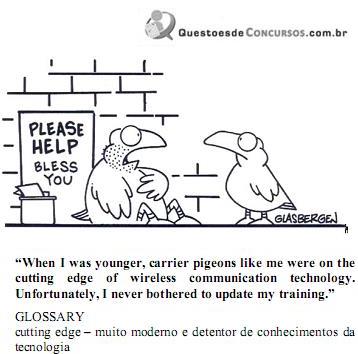
By reading the cartoon, we can infer that if people don’t seek to update, they’ll get
Para a questão, leia o texto seguinte e marque a opção correta.
The Bookstore's Last Stand
*Barnes & Noble is the largest book retailer in the United States.
(...) No one expects Barnes & Noble* to disappear overnight. The worry is that it might slowly wither as more readers embrace e-books. What if all those store shelves vanished, and Barnes & Noble became little more than a cafe and a digital connection point? Such fears came to the fore in eariy January, when the company projected that it would lose even more money this year than Wall Street had expected. Its share price promptly tumbled 17 percent that day.
Lurking behind all of this is Amazon.com , the dominant force in books online and the company that sets teeth on edge in publishing. From their perches in Midtown Manhattan, many publishing executives, editors and publicists view Amazon as the enemy — an adversary that, if unchecked, could threaten their industry and their livelihoods.
Like many struggling businesses, book publishers are cutting costs and trimming work forces. Yes, electronic books are booming, sometimes profitably, but not many publishers want e-books to dominate print books. Amazon's chief executive, Jeffrey P. Bezos, wants to cut out the middleman — that is, traditional publishers — by publishing e-books directly.
Which is why Barnes & Noble, once viewed as the brutal capitalist of the book trade, now seems so crucial to that industry's future. Sure, you can buy bestsellers at Walmart and potboilers at the supermarket. But in many locales, Barnes & Noble is the only retailer offering a wide selection of books. If something were to happen to Barnes & Noble, if it were merely to scale back its ambitions, Amazon could become even more powerful and — well, the very thought makes publishers queasy. (...)
Disponível em:http://www.nytimes.com/2012/01/29/business/barnes-noble-taking-on-amazon-in-the-fight-of-its-life.html?pagewanted=all>
The Bookstore’s Last Stand
*Barnes & Noble is the largest book retailer in the United States.
(…) No one expects Barnes & Noble* to disappear overnight. The worry is that it might slowly wither as more readers embrace e-books. What if all those store shelves vanished, and Barnes & Noble became little more than a cafe and a digital connection point? Such fears came to the fore in early January, when the company projected that it would lose even more money this year than Wall Street had expected. Its share price promptly tumbled 17 percent that day.
Lurking behind all of this is Amazon.com, the dominant force in books online and the company that sets teeth on edge in publishing. From their perches in Midtown Manhattan, many publishing executives, editors and publicists view Amazon as the enemy — an adversary that, if unchecked, could threaten their industry and their livelihoods.
Like many struggling businesses, book publishers are cutting costs and trimming work forces. Yes, electronic books are booming, sometimes profitably, but not many publishers want e-books to dominate print books. Amazon’s chief executive, Jeffrey P. Bezos, wants to cut out the middleman — that is, traditional publishers — by publishing e-books directly.
Which is why Barnes & Noble, once viewed as the brutal capitalist of the book trade, now seems so crucial to that industry’s future. Sure, you can buy bestsellers at Walmart and potboilers at the supermarket. But in many locales, Barnes & Noble is the only retailer offering a wide selection of books. If something were to happen to Barnes & Noble, if it were merely to scale back its ambitions, Amazon could become even more powerful and — well, the very thought makes publishers queasy. (…)
Disponível em:<http://www.nytimes.com/2012/01/29/business/barnes-noble-taking-on-amazon-inthe-fight-of-its-life.html?pagewanted=all>.

 Conheça nossos planos