Questões Militares
Comentadas sobre interpretação de texto | reading comprehension em inglês
Foram encontradas 1.577 questões



Based on the text, couch potato is a person
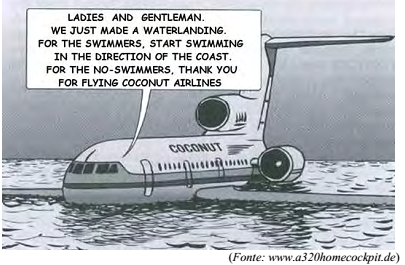
According to the cartoon, the pilot
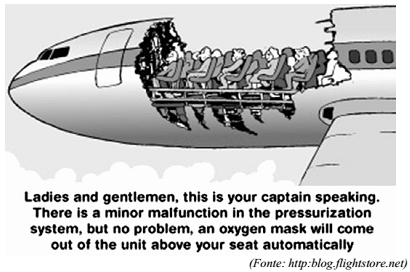
According to the captain speech:
Read the cartoon and write (T) for the true statements and (F) for the false statements.
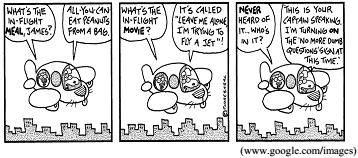
( ) The pilot is fed up with the passengers’ questions.
( ) The pilot is concerned about the in-flight movie and meal.
( ) The passenger is concerned about the in-flight movie and meal.
( ) The pilot and the passenger are engaged in a conversation about flying a jet safely.
Choose the alternative that corresponds to the correct order.

According to the text, write (T) for the true statements and (F) for the false statements.
( ) In 1977 two planes collided in Tenerife.
( ) In 1977 almost 600 people were killed due to heavy fog on the runway.
( ) In 1977 two planes collided when they were heading for Gran Canary airport.
( ) In 1977 two planes were guided to Gran Canary airport because Tenerife was closed.
Choose the alternative that corresponds to the order.


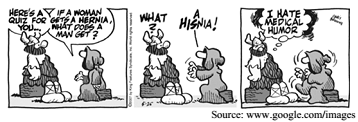
The doctor’s joke is funny only if the reader knows that


Leonardo da Vinci
Known as the greatest artist in the history of mankind, Leonardo da Vinci was also a great philosopher and scientist. Leonardo is the most influential figure in the Italian Renaissance and he is considered to be an inventive multi-genius.
Leonardo was born in 1452 in Vinci, Italy, as the child of Piero da Vinci, a notary, and Caterina, a country girl. He stayed with his father's family and they moved to Florence when he was just 12. At the age of 14, Leonardo started out his artist's apprenticeship at the studio of Andrea del Verrocchio (1435-1488), an Italian sculptor, goldsmith and painter.
The art of painting made Leonardo knowledgeable about anatomy and perspective. In addition to painting, Verrocchio's studio also offered technical and mechanical arts and sculpture. Leonardo had developed an interest in architecture so he went on to study engineering.
After a decade of highly original work as an artist, Leonardo wrote to several wealthy men to help finance his projects. The Duke of Milan, Ludovico Sforza (1452-1508), accepted his offer as Leonardo told him that he could design war weapons like guns and mines, and also structures like collapsible bridges. He lived in Milan with the Duke from 1482 to 1508, reportedly creating very innovational war machines. He also did painting and sculpture, as well as urban planning for large-scale water projects. There, he also wrote about making a telescope to view the moon.
Available at: <http://www.famousscientists.org/leonardo-da-vinc> (Edited).
Read this sentence from the text and analyze it:
“After a decade of highly original work as an artist, Leonardo wrote to several wealthy men to help finance his projects.”
The word “wealthy” could be replaced without change of meaning by
Leonardo da Vinci
Known as the greatest artist in the history of mankind, Leonardo da Vinci was also a great philosopher and scientist. Leonardo is the most influential figure in the Italian Renaissance and he is considered to be an inventive multi-genius.
Leonardo was born in 1452 in Vinci, Italy, as the child of Piero da Vinci, a notary, and Caterina, a country girl. He stayed with his father's family and they moved to Florence when he was just 12. At the age of 14, Leonardo started out his artist's apprenticeship at the studio of Andrea del Verrocchio (1435-1488), an Italian sculptor, goldsmith and painter.
The art of painting made Leonardo knowledgeable about anatomy and perspective. In addition to painting, Verrocchio's studio also offered technical and mechanical arts and sculpture. Leonardo had developed an interest in architecture so he went on to study engineering.
After a decade of highly original work as an artist, Leonardo wrote to several wealthy men to help finance his projects. The Duke of Milan, Ludovico Sforza (1452-1508), accepted his offer as Leonardo told him that he could design war weapons like guns and mines, and also structures like collapsible bridges. He lived in Milan with the Duke from 1482 to 1508, reportedly creating very innovational war machines. He also did painting and sculpture, as well as urban planning for large-scale water projects. There, he also wrote about making a telescope to view the moon.
Available at: <http://www.famousscientists.org/leonardo-da-vinc> (Edited).
Leonardo da Vinci
Known as the greatest artist in the history of mankind, Leonardo da Vinci was also a great philosopher and scientist. Leonardo is the most influential figure in the Italian Renaissance and he is considered to be an inventive multi-genius.
Leonardo was born in 1452 in Vinci, Italy, as the child of Piero da Vinci, a notary, and Caterina, a country girl. He stayed with his father's family and they moved to Florence when he was just 12. At the age of 14, Leonardo started out his artist's apprenticeship at the studio of Andrea del Verrocchio (1435-1488), an Italian sculptor, goldsmith and painter.
The art of painting made Leonardo knowledgeable about anatomy and perspective. In addition to painting, Verrocchio's studio also offered technical and mechanical arts and sculpture. Leonardo had developed an interest in architecture so he went on to study engineering.
After a decade of highly original work as an artist, Leonardo wrote to several wealthy men to help finance his projects. The Duke of Milan, Ludovico Sforza (1452-1508), accepted his offer as Leonardo told him that he could design war weapons like guns and mines, and also structures like collapsible bridges. He lived in Milan with the Duke from 1482 to 1508, reportedly creating very innovational war machines. He also did painting and sculpture, as well as urban planning for large-scale water projects. There, he also wrote about making a telescope to view the moon.
Available at: <http://www.famousscientists.org/leonardo-da-vinc> (Edited).
Leonardo da Vinci
Known as the greatest artist in the history of mankind, Leonardo da Vinci was also a great philosopher and scientist. Leonardo is the most influential figure in the Italian Renaissance and he is considered to be an inventive multi-genius.
Leonardo was born in 1452 in Vinci, Italy, as the child of Piero da Vinci, a notary, and Caterina, a country girl. He stayed with his father's family and they moved to Florence when he was just 12. At the age of 14, Leonardo started out his artist's apprenticeship at the studio of Andrea del Verrocchio (1435-1488), an Italian sculptor, goldsmith and painter.
The art of painting made Leonardo knowledgeable about anatomy and perspective. In addition to painting, Verrocchio's studio also offered technical and mechanical arts and sculpture. Leonardo had developed an interest in architecture so he went on to study engineering.
After a decade of highly original work as an artist, Leonardo wrote to several wealthy men to help finance his projects. The Duke of Milan, Ludovico Sforza (1452-1508), accepted his offer as Leonardo told him that he could design war weapons like guns and mines, and also structures like collapsible bridges. He lived in Milan with the Duke from 1482 to 1508, reportedly creating very innovational war machines. He also did painting and sculpture, as well as urban planning for large-scale water projects. There, he also wrote about making a telescope to view the moon.
Available at: <http://www.famousscientists.org/leonardo-da-vinc> (Edited).
The X-Files is an American science fiction horror drama television series created by Chris Carter. The program originally aired from September 10, 1993 to May 19, 2002 on Fox, spanning nine seasons and 202 episodes. The series revolves around FBI Special Agents Fox Mulder (David Duchovny) and Dana Scully (Gillian Anderson) investigating X-Files: marginalized, unsolved cases involving paranormal phenomena. Mulder believes in the existence of aliens and the paranormal while Scully, a skeptic, is assigned to make scientific analyses of Mulder’s discoveries to debunk his work and thus return him to mainstream cases. Early in the series, both agents become pawns in a larger conflict and come to trust only each other. They develop a close relationship, which begins as a platonic friendship, but becomes a romance by series end. In 2002 a movie was released with the following plot. When a group of women are abducted in the wintry hills of rural Virginia, the only clues to their disappearance are the grotesque human remains that begin to turn up in snow banks along the highway. With officials desperate for any lead, a disgraced priest’s questionable visions send local police on a wild goose chase and straight to a bizarre secret medical experiment that may or may not be connected to the women’s disappearance. It’s a case right out of The X-Files. But the FBI closed down its investigations into the paranormal years ago. And the best team for the job is ex-agents Fox Mulder and Dr. Dana Scully, who have no desire to revisit their dark past. Still, the truth of these horrific crimes is out there somewhere...and it will take Mulder and Scully to find it! This television 90´s series follows the adventures and lives of FBI agents investigating those cases that involve the paranormal or previously unsolved (especially by conventional means). FBI Special Agents Mulder, Scully, Doggett and Reyes work to uncover forces within the United States of America government that would violate people’s rights, alien creatures and monsters alike that attack and other mysteries.
Written by Lee Jamilkowski http://filmymp4.com/hollywood-mobile-movies/The-X-Files-I-Want-to-Believe
The X-Files is an American science fiction horror drama television series created by Chris Carter. The program originally aired from September 10, 1993 to May 19, 2002 on Fox, spanning nine seasons and 202 episodes. The series revolves around FBI Special Agents Fox Mulder (David Duchovny) and Dana Scully (Gillian Anderson) investigating X-Files: marginalized, unsolved cases involving paranormal phenomena. Mulder believes in the existence of aliens and the paranormal while Scully, a skeptic, is assigned to make scientific analyses of Mulder’s discoveries to debunk his work and thus return him to mainstream cases. Early in the series, both agents become pawns in a larger conflict and come to trust only each other. They develop a close relationship, which begins as a platonic friendship, but becomes a romance by series end. In 2002 a movie was released with the following plot. When a group of women are abducted in the wintry hills of rural Virginia, the only clues to their disappearance are the grotesque human remains that begin to turn up in snow banks along the highway. With officials desperate for any lead, a disgraced priest’s questionable visions send local police on a wild goose chase and straight to a bizarre secret medical experiment that may or may not be connected to the women’s disappearance. It’s a case right out of The X-Files. But the FBI closed down its investigations into the paranormal years ago. And the best team for the job is ex-agents Fox Mulder and Dr. Dana Scully, who have no desire to revisit their dark past. Still, the truth of these horrific crimes is out there somewhere...and it will take Mulder and Scully to find it! This television 90´s series follows the adventures and lives of FBI agents investigating those cases that involve the paranormal or previously unsolved (especially by conventional means). FBI Special Agents Mulder, Scully, Doggett and Reyes work to uncover forces within the United States of America government that would violate people’s rights, alien creatures and monsters alike that attack and other mysteries.
Written by Lee Jamilkowski http://filmymp4.com/hollywood-mobile-movies/The-X-Files-I-Want-to-Believe
The X-Files is an American science fiction horror drama television series created by Chris Carter. The program originally aired from September 10, 1993 to May 19, 2002 on Fox, spanning nine seasons and 202 episodes. The series revolves around FBI Special Agents Fox Mulder (David Duchovny) and Dana Scully (Gillian Anderson) investigating X-Files: marginalized, unsolved cases involving paranormal phenomena. Mulder believes in the existence of aliens and the paranormal while Scully, a skeptic, is assigned to make scientific analyses of Mulder’s discoveries to debunk his work and thus return him to mainstream cases. Early in the series, both agents become pawns in a larger conflict and come to trust only each other. They develop a close relationship, which begins as a platonic friendship, but becomes a romance by series end. In 2002 a movie was released with the following plot. When a group of women are abducted in the wintry hills of rural Virginia, the only clues to their disappearance are the grotesque human remains that begin to turn up in snow banks along the highway. With officials desperate for any lead, a disgraced priest’s questionable visions send local police on a wild goose chase and straight to a bizarre secret medical experiment that may or may not be connected to the women’s disappearance. It’s a case right out of The X-Files. But the FBI closed down its investigations into the paranormal years ago. And the best team for the job is ex-agents Fox Mulder and Dr. Dana Scully, who have no desire to revisit their dark past. Still, the truth of these horrific crimes is out there somewhere...and it will take Mulder and Scully to find it! This television 90´s series follows the adventures and lives of FBI agents investigating those cases that involve the paranormal or previously unsolved (especially by conventional means). FBI Special Agents Mulder, Scully, Doggett and Reyes work to uncover forces within the United States of America government that would violate people’s rights, alien creatures and monsters alike that attack and other mysteries.
Written by Lee Jamilkowski http://filmymp4.com/hollywood-mobile-movies/The-X-Files-I-Want-to-Believe

 Conheça nossos planos