Questões Militares
Comentadas sobre interpretação de texto | reading comprehension em inglês
Foram encontradas 1.577 questões


‘headed’, underlined in the text, means
To be or not to be Every one
Every one knows that ‘To be or Not to be, that is the question’ comes from Hamlet, but when someone says ‘Neither a borrower nor a lender be’, they are probably unaware that they also quoting from the same play.
Innovations/ Thompson
The quotation, in bold in the extract, means

Write (T) for true statements and (F) for false statements and choose the alternative that corresponds to the right order.
( ) The noise created by Lilium is too loud.
( ) Lilium will be a sustainable form of air transportation.
( ) Lilium has fan engines and an innovative technology to cut pollution.
( ) A European Space Agency designed an amazing aircraft with space for more than two people to sit.
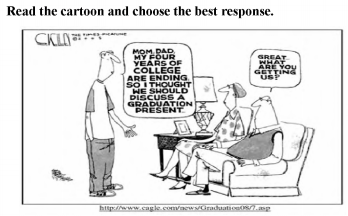
According to the cartoon

Woman who rescued Nigerian 'witch-child' beats Obama and Pope Francis to top list of world's most inspiring people

A woman who rescued a two-year-old boy who had been cast out by his own community for being a "witch-child" has been recognised in an international list of the most inspiring people of the year. Anja Ringgren Lovén, a Danish care worker who rescued the young Nigerian boy back in February 2016, beat the likes of Pope Francis, Barack Obama and the Dalai Lama to top the list of 100 inspiring individuals compiled by German-language OOOM Magazine.
An image of Ms Lovén giving the two-year-old boy (now called Hope) some water was shared around the world, and served to highlight the work she was doing to help orphan children in Nigeria. Witch accusations is a growing problem in many African countries, especially in Nigeria, where Anja's charity African Children's Aid Education and Development Foundation cares for other children like Hope.
"When she saw the starving child, she acted like a human being and became an inspiration for millions," said Georg Kindel, OOOM's editor-in-chief, who led the jury that chose the list. Speaking today about the experience, she said: "He was the size of a little baby, my whole body froze. I was thinking of my own son when I saw the boy. For me it was clear at that moment that I would fight with all my strength for him to survive."
Adapted from http://www.independent.co.uk/news/people/
worlds-most-inspiring-person-2016-ooom-anja-ringgren-lovennigeria-witch-child-a7460976.html
According to the text, read the statements and choose the correct alternative.
I - Hope's community didn't want him because of a superstition.
II - Ms Lovén started helping orphan children after she met Hope.
III - Anja's foundation cares for poor parents who have many children.
IV - George Kindel was the only person who voted for Ms Lovén.
V - Ms Lovén has a child of her own and it's a boy.
Woman who rescued Nigerian 'witch-child' beats Obama and Pope Francis to top list of world's most inspiring people
A woman who rescued a two-year-old boy who had been cast out by his own community for being a "witch-child" has been recognised in an international list of the most inspiring people of the year. Anja Ringgren Lovén, a Danish care worker who rescued the young Nigerian boy back in February 2016, beat the likes of Pope Francis, Barack Obama and the Dalai Lama to top the list of 100 inspiring individuals compiled by German-language OOOM Magazine.
An image of Ms Lovén giving the two-year-old boy (now called Hope) some water was shared around the world, and served to highlight the work she was doing to help orphan children in Nigeria. Witch accusations is a growing problem in many African countries, especially in Nigeria, where Anja's charity African Children's Aid Education and Development Foundation cares for other children like Hope.
"When she saw the starving child, she acted like a human being and became an inspiration for millions," said Georg Kindel, OOOM's editor-in-chief, who led the jury that chose the list. Speaking today about the experience, she said: "He was the size of a little baby, my whole body froze. I was thinking of my own son when I saw the boy. For me it was clear at that moment that I would fight with all my strength for him to survive."
Adapted from http://www.independent.co.uk/news/people/
worlds-most-inspiring-person-2016-ooom-anja-ringgren-lovennigeria-witch-child-a7460976.html
Military operations in megacities
A linguistic perspective
The challenge of conducting future military operations within megacities (cities with populations over ten million) lies in understanding the dynamic and multidimensional complexities of these urban areas. Military operations in megacities, whether combat-oriented or otherwise, will be similar to those in other urban environments, but will be complicated by factors unique to the megacity environment.
First and foremost, megacities are largely multilingual. While this can be said of large cities in general, the scale of multilingualism in megacities magnifies its effects. For instance, in New York City (NYC) - a metropolitan megacity of over eighteen million people - nine foreign languages are spoken by communities of one hundred thousand or larger. Language also plays a role in determining one's identity and the language community in which one decides to live. For example, the majority of Russian speakers in NYC tend to live in south Brooklyn and Staten Island, while Chinese speakers tend to cluster in Manhattan and Sunset Park. In megacities, language, culture, and regional context go hand in hand and often reach beyond ethnic identities.
In order to fully understand the context of a megacity, we must understand the role of the languages used in its communities. How _____(1) language communities interact in megacities? What tensions _____ (2) caused by multiple language communities in urban space? What role______ (3) language play in the power structures (government or otherwise) of megacities?
Adapted from Military Review - Jan/Feb 2016
Military operations in megacities
A linguistic perspective
The challenge of conducting future military operations within megacities (cities with populations over ten million) lies in understanding the dynamic and multidimensional complexities of these urban areas. Military operations in megacities, whether combat-oriented or otherwise, will be similar to those in other urban environments, but will be complicated by factors unique to the megacity environment.
First and foremost, megacities are largely multilingual. While this can be said of large cities in general, the scale of multilingualism in megacities magnifies its effects. For instance, in New York City (NYC) - a metropolitan megacity of over eighteen million people - nine foreign languages are spoken by communities of one hundred thousand or larger. Language also plays a role in determining one's identity and the language community in which one decides to live. For example, the majority of Russian speakers in NYC tend to live in south Brooklyn and Staten Island, while Chinese speakers tend to cluster in Manhattan and Sunset Park. In megacities, language, culture, and regional context go hand in hand and often reach beyond ethnic identities.
In order to fully understand the context of a megacity, we must understand the role of the languages used in its communities. How _____(1) language communities interact in megacities? What tensions _____ (2) caused by multiple language communities in urban space? What role______ (3) language play in the power structures (government or otherwise) of megacities?
Adapted from Military Review - Jan/Feb 2016
A handwritten note from September 11
In moments of crisis, our first thoughts are usually to get in contact with the people we love. September 11, 2001, was a day when many people wanted to know that their loved ones were safe. At 9:37 a.m., the Pentagon was attacked by terrorists who crashed an airplane into the western side of the building.
Many people tried using the mobile phones that existed then, but few were successful. Franklin and Daria Gaillard (Frank and Chip) were both members of the Air Force and worked at the Pentagon. They worked in different parts of the building and had a previous agreement that they would meet at their car in the parking lot if there were any emergency.
Daria was the first to arrive at the car and wrote a note to Franklin saying "Frank - Sweetie I am okay. I'm w/ my office over by the Lyndon B. Johnson Memorial Sign. I'll stay there till you come. Love lots & lots, Chip." Frank found the note and was able to locate his wife in the aftermath of the attack.
What makes this story so interesting is the handwritten note. Today, in our digital culture, we have a variety of ways to let people know that we are safe. Text messages, voicemail, and different forms of social media can be used to get the information out to loved ones. In 2001, when these attacks__________(1), the cellular network was still growing and was not as robust as it is today.
This letter is just one of the many objects that The National Museum of American History_________ (2) since 2001. To learn more, visit our online exhibition September 11th: Bearing Witness to History.
Adapted from http://americanhistory.si.edu/biog/handwritten-note-september-11-2001

A handwritten note from September 11
In moments of crisis, our first thoughts are usually to get in contact with the people we love. September 11, 2001, was a day when many people wanted to know that their loved ones were safe. At 9:37 a.m., the Pentagon was attacked by terrorists who crashed an airplane into the western side of the building.
Many people tried using the mobile phones that existed then, but few were successful. Franklin and Daria Gaillard (Frank and Chip) were both members of the Air Force and worked at the Pentagon. They worked in different parts of the building and had a previous agreement that they would meet at their car in the parking lot if there were any emergency.
Daria was the first to arrive at the car and wrote a note to Franklin saying "Frank - Sweetie I am okay. I'm w/ my office over by the Lyndon B. Johnson Memorial Sign. I'll stay there till you come. Love lots & lots, Chip." Frank found the note and was able to locate his wife in the aftermath of the attack.
What makes this story so interesting is the handwritten note. Today, in our digital culture, we have a variety of ways to let people know that we are safe. Text messages, voicemail, and different forms of social media can be used to get the information out to loved ones. In 2001, when these attacks__________(1), the cellular network was still growing and was not as robust as it is today.
This letter is just one of the many objects that The National Museum of American History_________ (2) since 2001. To learn more, visit our online exhibition September 11th: Bearing Witness to History.
Adapted from http://americanhistory.si.edu/biog/handwritten-note-september-11-2001
How diversity makes us smarter
Decades of research by organizational scientists, psychologists, sociologists, economists and demographers show that socially diverse groups (that is, those with a diversity of race, ethnicity, gender and sexual orientation) are more innovative than homogeneous groups. It means being around people who are different from us makes us more creative, more diligent and more hardworking.
It seems obvious that a group of people with diverse individual expertise would be better than a homogeneous group at solving complex, non-routine problems. It is less obvious that social diversity should work in the same way - yet the science shows that it does. This is not only because people with different backgrounds bring new information. Simply interacting with individuals who are different forces group members to prepare better, to anticipate alternative viewpoints and to expect that reaching consensus will take effort.
Diversity of expertise confers benefits that are obvious - you would not think of building a new car without engineers, designers and quality-control experts - but what about social diversity? The same logic applies to social diversity. People who are different from one another in race, gender and other dimensions bring unique information and experiences to bear on the task at hand. A male and a female engineer might have perspectives as different from one another as an engineer and a physicist - and that is a good thing.
The fact is that if you want to build teams or organizations capable of innovating, you need diversity. Diversity enhances creativity. It encourages the search for novel information and perspectives, leading to better decision making and problem solving. Diversity can improve the bottom line of companies and lead to discoveries and breakthrough innovations. Even simply being exposed to diversity can change the way you think.
Adapted from http://www.scientificamerican.com/article/how-diversity-makes-us-smarter/
How diversity makes us smarter
Decades of research by organizational scientists, psychologists, sociologists, economists and demographers show that socially diverse groups (that is, those with a diversity of race, ethnicity, gender and sexual orientation) are more innovative than homogeneous groups. It means being around people who are different from us makes us more creative, more diligent and more hardworking.
It seems obvious that a group of people with diverse individual expertise would be better than a homogeneous group at solving complex, non-routine problems. It is less obvious that social diversity should work in the same way - yet the science shows that it does. This is not only because people with different backgrounds bring new information. Simply interacting with individuals who are different forces group members to prepare better, to anticipate alternative viewpoints and to expect that reaching consensus will take effort.
Diversity of expertise confers benefits that are obvious - you would not think of building a new car without engineers, designers and quality-control experts - but what about social diversity? The same logic applies to social diversity. People who are different from one another in race, gender and other dimensions bring unique information and experiences to bear on the task at hand. A male and a female engineer might have perspectives as different from one another as an engineer and a physicist - and that is a good thing.
The fact is that if you want to build teams or organizations capable of innovating, you need diversity. Diversity enhances creativity. It encourages the search for novel information and perspectives, leading to better decision making and problem solving. Diversity can improve the bottom line of companies and lead to discoveries and breakthrough innovations. Even simply being exposed to diversity can change the way you think.
Adapted from http://www.scientificamerican.com/article/how-diversity-makes-us-smarter/
Which option is correct?
When a Search-and-Rescue Operation is in progress, the RCC or the OSC will instruct other vessels in the vicinity to keep radio-silence, unless they have messages about the accident. Radio silence is imposed to other vessels by the phrase
U.S. Navy’s USS Carl Vinson in Rio
By Jaylan Boyle, Senior Contributing Reporter - March 9,2010
RIO DE JANEIRO - Late last month, fresh from playing a key role in Operation Unified Response, the international humanitarian aid mission to assist Haiti after the disastrous earthquake, the U.S. aircraft carrier USS Cari Vinson made a stopover in Rio de Janeiro. The purpose of the trip was to strengthen bilateral military relations, and a number of U.S, sailors also took part in a series of volunteer exercises in the city.
“We appreciate the strong relationship that has developed between the military forces of our two countries. It is an interaction based on mutual respect, and our intention is to further strengthen our partnerships and joint missions,” said Thomas Shannon, the U.S. Ambassador of Brazil.
On February 27th, sailors from the carrier were involved in volunteer work that involved painting facilities at two Recreio public schools, Escola Municipal Vice-Almirante Alvaro Alberto and Escola Municipal Vice-Almirante Paulo Moreira. They were joined by about 20 of their fellow Brazilian sailors, and had the opportunity to get to know their colleagues and share experiences of life in the navy. After work was completed, the two schools were presented with photo collages commemorating the visit.
Another project that U.S. sailors participated in took place at the People’s Centra! Institute, a local community center in the Gamboa neighborhood which was founded by an American missionary over a century ago. The center helps local working parents by offering a daycare service, and provides a venue for the hosting of various cultural and sporting activities.
In addition to helping with painting and other maintenance tasks, the sailors, perhaps wearied after their labors, were well defeated by a team of local children in a friendly game of soccer. All of the children were given a USS Carl Vinson baseball cap and packed lunches.
The goodwill mission also involved further sporting fixtures between the sailors of both nations, although results have not been reported. A reception for around 400 guests was also held aboard the carrier.
International media was mainly focusing on the positive aspects of the visit: the only aberration on that theme was a French Agency reportedly questioning the motive of the mission, seeing it as an attempt to sway Brazil’s government into buying American military hardware.
(Abridged from http: / / riotimesonline. com)
According to the text, it is correct to state that

 Conheça nossos planos