🎯 Saiba o que estudar

Avançado com Treinador a partir de R$ 0,76/dia

Questões Militares Comentadas sobre interpretação de texto | reading comprehension em inglês

Foram encontradas 1.577 questões

Q1938450 Inglês

Read the text and answer the question.

Read the conversation between Carol and Neil. 

Neil: What do you do on New Year’s Day?

Carol: Well, we sometimes go downtown. They have fireworks. It’s really pretty. Other people invite friends to their house and they have a party.

Neil: Do you give presents to your friends and family?

Carol: No, we never give presents on New Year’s.

Neil: Do you have a meal with your family?

Carol: No, we do that on Christmas. On New Year’s we just party! 

From the Book World English 1A

The word “really” can be replaced by the words below, EXCEPT by: 
Alternativas
Q1938448 Inglês

Read the sentence below:


“I nearly passed out when I saw all the blood.”


The phrasal verb underlined means: 

Alternativas
Q1938447 Inglês

Read the text and answer the question. 


We saw the movie last night. 

Marjorie Fuchs and Margaret Bonner 

The year was 1912. The Titanic was a new, very large ship. People thought it _____ (to be) safe. But, on April 15, 1912, the Titanic hit an iceberg and _______ (to sink). More than 1,500 people lost their lives.

From the book Grammar Express Basic. 

According to the text, we can affirm that: 
Alternativas
Q1938446 Inglês

Read the text and answer the question. 


We saw the movie last night. 

Marjorie Fuchs and Margaret Bonner 

The year was 1912. The Titanic was a new, very large ship. People thought it _____ (to be) safe. But, on April 15, 1912, the Titanic hit an iceberg and _______ (to sink). More than 1,500 people lost their lives.

From the book Grammar Express Basic. 

Choose the alternative that best completes the blanks with the verbs in parentheses. 
Alternativas
Q1938445 Inglês

Read the text and answer the question.

Ben 

Michael Jackson  


Ben, the two of us need look no more

We both found what we were looking for 

with a friend to call my own

I will never be alone  

And you, my friend, will see  

you have got a friend in me

Ben, you are always running here and there

You feel you are not wanted anywhere

If you ever look behind and don’t like what you will find

There’s something you should know

You have got a place to go

I used to say “I” and “Me”

Now it’s us, now it’s we

Ben, most people would turn you away...

www.vagalume.com.br.

According to the text, we can affirm that: 
Alternativas
Q1938442 Inglês

Read the text and answer the question.

The best way to boost self-esteem 


Working hard to accomplish great things is a healthy way to pump your ego? Not necessarily, according to researchers at the University of Michigan. In their survey of 642 college freshmen, those who measured their self-worth against objective standards, such as getting good grades, were actually more stressed - and received no higher marks - than those who based how they felt themselves of their relationships with others. That’s not to say that you shouldn’t work hard; just don’t make it all about you. “Instead of focusing on whether you’re succeeding, ask yourself, ‘What am I contributing to society? How will people benefit from what I’m doing?’” suggests lead researcher Jennifer Crocker, Ph.D. “This takes the pressure off you and guarantees that your work will always feel meaningful.” 

From the book Inglês Doorway, Wilson Liberato.

In the sentence “In their survey of 642 college freshmen, those who measured their self-worth against objective standards, such as getting good grades, were actually more stressed...”, the word in bold refers to: 
Alternativas
Q1938441 Inglês

Read the text and answer the question.

The best way to boost self-esteem 


Working hard to accomplish great things is a healthy way to pump your ego? Not necessarily, according to researchers at the University of Michigan. In their survey of 642 college freshmen, those who measured their self-worth against objective standards, such as getting good grades, were actually more stressed - and received no higher marks - than those who based how they felt themselves of their relationships with others. That’s not to say that you shouldn’t work hard; just don’t make it all about you. “Instead of focusing on whether you’re succeeding, ask yourself, ‘What am I contributing to society? How will people benefit from what I’m doing?’” suggests lead researcher Jennifer Crocker, Ph.D. “This takes the pressure off you and guarantees that your work will always feel meaningful.” 

From the book Inglês Doorway, Wilson Liberato.

The phrasal verb in bold in the text means:
Alternativas
Q1938440 Inglês

Read the text and answer the question.

The best way to boost self-esteem 


Working hard to accomplish great things is a healthy way to pump your ego? Not necessarily, according to researchers at the University of Michigan. In their survey of 642 college freshmen, those who measured their self-worth against objective standards, such as getting good grades, were actually more stressed - and received no higher marks - than those who based how they felt themselves of their relationships with others. That’s not to say that you shouldn’t work hard; just don’t make it all about you. “Instead of focusing on whether you’re succeeding, ask yourself, ‘What am I contributing to society? How will people benefit from what I’m doing?’” suggests lead researcher Jennifer Crocker, Ph.D. “This takes the pressure off you and guarantees that your work will always feel meaningful.” 

From the book Inglês Doorway, Wilson Liberato.

The underlined word in the text can be replaced by:
Alternativas
Q1937057 Inglês

Directions: Read Text V and answer the question accordingly.


(SUMMER, Bernard; GILBERT, Gillian; HOOK, Peter; MORRIS, Stephen. Lyrics to Love Vigilantes, performed by New Order, Low Life CD, track 1, Universal Music Publishing Group, 1986. Taken from https://lyricfind.com)

The following sentence shows an instance of colloquial language:
Alternativas
Q1937050 Inglês

Directions: Read Text II and answer question 03 accordingly.


TEXT II
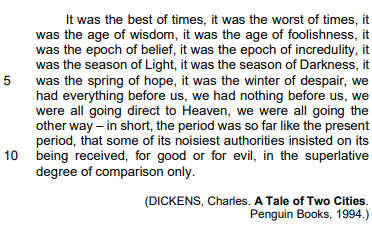
Imagem associada para resolução da questão


The extract above

Alternativas
Ano: 2022 Banca: NC-UFPR Órgão: PM-PR Prova: NC-UFPR - 2022 - PM-PR - Cadete |
Q1901500 Inglês
The following text refer to question. 

The surprising history of India’s vibrant sari tradition

   South Asian women have draped themselves in colorful silks and cottons for eons. The ways they’re made and worn are dazzling and diverse.
   The word “sari” means “strip of cloth” in Sanskrit. But for the Indian women – and a few men – who have been wrapping themselves in silk, cotton, or linen for millennia, these swaths of fabric are more than just simple garments. They’re symbols of national pride, ambassadors for traditional (and cutting-edge) design and craftsmanship, and a prime example of the rich differences in India’s 29 states.
   “The sari both as symbol and reality has filled the imagination of the subcontinent, with its appeal and its ability to conceal and reveal the personality of the person wearing it,” says Delhi-based textile historian Rta Kapur Chishti, author of Saris of India: Tradition and Beyond and co-founder of Taanbaan, a fabric company devoted to reviving and preserving traditional Indian spinning and weaving methods.
   The first mention of saris (alternately spelled sarees) is in the Rig Veda, a Hindu book of hymns dating to 3,000 B.C.; draped garments show up on Indian sculptures from the first through sixth centuries, too. What Delhi-based textile historian Rta Kapur Chishti calls the “magical unstitched garment” is ideally suited to India’s blazingly hot climate and the modest-dress customs of both Hindu and Muslim communities. Saris also remain traditional for women in other South Asian countries including Pakistan, Bangladesh, and Nepal. 

(Available in: https://www.nationalgeographic.com/travel/photography/the-story-of-the-sari-in-india/.)
In the fourth paragraph, Delhi-based textile historian Rta Kapur Chishti calls the sari the “unstitched garment” because it:
Alternativas
Q2179145 Inglês

The following text refers to question.


There have been 18 opioid-related deaths in Nova Scotia so far this year


        Paramedics in Nova Scotia used naloxone to save 165 people from opioid overdoses in 2018 and 188 people in 2019. In 2020, 102 people were saved as of July 31.

        Eight years ago, Matthew Bonn watched his friend turn blue and become deathly quiet as fentanyl flooded his body. Bonn jumped in, performing rescue breathing until paramedics arrived. That was the first time Bonn fought to keep someone alive during an overdose.

        But it wouldn't be his last. Over the years, he tried more dangerous ways to snap people out of an overdose.

        "I remember doing crazy things like throwing people in bathtubs, or, you know, giving them cocaine. As we know now, that doesn't help," said Bonn, a harm-reduction advocate in Halifax. "But ... in those panic modes, you try to do whatever you can to keep that person alive."

        This was before naloxone – a drug that can reverse an opioid overdose – became widely available to the public. In 2017, the Nova Scotia government made kits with the drug available for free at pharmacies.

        Whether used by community members or emergency crews, naloxone has helped save hundreds of lives in the province. Matthew Bonn is a program co-ordinator with the Canadian Association of People Who Use Drugs, and a current drug user himself.

        Almost every other day in Nova Scotia, paramedics and medical first responders in the province use the drug to reverse an opioid overdose, according to Emergency Health Services (EHS).


(Available in: https://www.cbc.ca/news/canada/nova-scotia/ehs-naloxone-opioids-drug-use-emergency-care-1.5745907.)

In the text, the word “whether” underlined and in bold type can be replaced without losing its meaning by:
Alternativas
Ano: 2021 Banca: UFPR Órgão: PM-PR Prova: UFPR - 2021 - PM-PR - Aspirante |
Q2097616 Inglês
The following text refers to the question.

There have been 18 opioid-related deaths in Nova Scotia so far this year

             Paramedics in Nova Scotia used naloxone to save 165 people from opioid overdoses in 2018 and 188 people in 2019. In 2020, 102 people were saved as of July 31.
           Eight years ago, Matthew Bonn watched his friend turn blue and become deathly quiet as fentanyl flooded his body. Bonn jumped in, performing rescue breathing until paramedics arrived. That was the first time Bonn fought to keep someone alive during an overdose.
               But it wouldn't be his last. Over the years, he tried more dangerous ways to snap people out of an overdose.
             "I remember doing crazy things like throwing people in bathtubs, or, you know, giving them cocaine. As we know now, that doesn't help," said Bonn, a harm-reduction advocate in Halifax. "But ... in those panic modes, you try to do whatever you can to keep that person alive."     
            This was before naloxone – a drug that can reverse an opioid overdose – became widely available to the public. In 2017, the Nova Scotia government made kits with the drug available for free at pharmacies.
        Whether used by community members or emergency crews, naloxone has helped save hundreds of lives in the province.    
         Matthew Bonn is a program co-ordinator with the Canadian Association of People Who Use Drugs, and a current drug user himself.
            Almost every other day in Nova Scotia, paramedics and medical first responders in the province use the drug to reverse an opioid overdose, according to Emergency Health Services (EHS).

(Available in: https://www.cbc.ca/news/canada/nova-scotia/ehs-naloxone-opioids-drug-use-emergency-care-1.5745907.) 
In the text, the underlined and in bold type word “this” refers, among other things, to the act of:
Alternativas
Ano: 2021 Banca: UFPR Órgão: PM-PR Prova: UFPR - 2021 - PM-PR - Aspirante |
Q2097615 Inglês
The following text refers to the question.

There have been 18 opioid-related deaths in Nova Scotia so far this year

             Paramedics in Nova Scotia used naloxone to save 165 people from opioid overdoses in 2018 and 188 people in 2019. In 2020, 102 people were saved as of July 31.
           Eight years ago, Matthew Bonn watched his friend turn blue and become deathly quiet as fentanyl flooded his body. Bonn jumped in, performing rescue breathing until paramedics arrived. That was the first time Bonn fought to keep someone alive during an overdose.
               But it wouldn't be his last. Over the years, he tried more dangerous ways to snap people out of an overdose.
             "I remember doing crazy things like throwing people in bathtubs, or, you know, giving them cocaine. As we know now, that doesn't help," said Bonn, a harm-reduction advocate in Halifax. "But ... in those panic modes, you try to do whatever you can to keep that person alive."     
            This was before naloxone – a drug that can reverse an opioid overdose – became widely available to the public. In 2017, the Nova Scotia government made kits with the drug available for free at pharmacies.
        Whether used by community members or emergency crews, naloxone has helped save hundreds of lives in the province.    
         Matthew Bonn is a program co-ordinator with the Canadian Association of People Who Use Drugs, and a current drug user himself.
            Almost every other day in Nova Scotia, paramedics and medical first responders in the province use the drug to reverse an opioid overdose, according to Emergency Health Services (EHS).

(Available in: https://www.cbc.ca/news/canada/nova-scotia/ehs-naloxone-opioids-drug-use-emergency-care-1.5745907.) 
Based on the text, it is correct to say that Matthew Bonn:
Alternativas
Ano: 2021 Banca: UFPR Órgão: PM-PR Prova: UFPR - 2021 - PM-PR - Aspirante |
Q2097614 Inglês
The following text refers to the question.

There have been 18 opioid-related deaths in Nova Scotia so far this year

             Paramedics in Nova Scotia used naloxone to save 165 people from opioid overdoses in 2018 and 188 people in 2019. In 2020, 102 people were saved as of July 31.
           Eight years ago, Matthew Bonn watched his friend turn blue and become deathly quiet as fentanyl flooded his body. Bonn jumped in, performing rescue breathing until paramedics arrived. That was the first time Bonn fought to keep someone alive during an overdose.
               But it wouldn't be his last. Over the years, he tried more dangerous ways to snap people out of an overdose.
             "I remember doing crazy things like throwing people in bathtubs, or, you know, giving them cocaine. As we know now, that doesn't help," said Bonn, a harm-reduction advocate in Halifax. "But ... in those panic modes, you try to do whatever you can to keep that person alive."     
            This was before naloxone – a drug that can reverse an opioid overdose – became widely available to the public. In 2017, the Nova Scotia government made kits with the drug available for free at pharmacies.
        Whether used by community members or emergency crews, naloxone has helped save hundreds of lives in the province.    
         Matthew Bonn is a program co-ordinator with the Canadian Association of People Who Use Drugs, and a current drug user himself.
            Almost every other day in Nova Scotia, paramedics and medical first responders in the province use the drug to reverse an opioid overdose, according to Emergency Health Services (EHS).

(Available in: https://www.cbc.ca/news/canada/nova-scotia/ehs-naloxone-opioids-drug-use-emergency-care-1.5745907.) 
According to the text, it is correct to say that in the province of Nova Scotia:
Alternativas
Q1901467 Inglês
Leia o texto destacado para responder à questão.

Meritocracy has become a leading social ideal. Politicians across the ideological spectrum continually return to the theme that the rewards of life—money, power, jobs, university admission—should be distributed according to skill and effort. The most common metaphor is the ‘even playing field’ upon which players can rise to the position that fits their merit. Conceptually and morally, meritocracy is presented as the opposite of systems such as hereditary aristocracy, in which one’s social position is determined by the lottery of birth. Under meritocracy, wealth and advantage are merit’s rightful compensation, not the fortuitous windfall of external events. And most people don’t just think the world should be run meritocratically, they think it is meritocratic. However, although widely held, the belief that merit rather than luck determines success or failure in the world is demonstrably false. This is not least because merit itself is, in large part, the result of luck. Talent and the capacity for determined effort, sometimes called ‘grit’, depend a great deal on one’s genetic endowments and upbringing.
Perhaps more disturbing, simply holding meritocracy as a value seems to promote discriminatory behaviour. The management scholar Emilio Castilla at the Massachusetts Institute of Technology and the sociologist Stephen Benard at Indiana University studied attempts to implement meritocratic practices, such as performance-based compensation in private companies. They found that, in companies that explicitly held meritocracy as a core value, managers assigned greater rewards to male employees over female employees with identical performance evaluations. This preference disappeared where meritocracy was not explicitly adopted as a value.
This is surprising because impartiality is the core of meritocracy’s moral appeal. The ‘even playing field’ is intended to avoid unfair inequalities based on gender, race and the like. Yet  Castilla and Benard found that, ironically, attempts to implement meritocracy leads to just the kinds of inequalities that it aims to eliminate. They suggest that this ‘paradox of meritocracy’ occurs because explicitly adopting meritocracy as a value convinces subjects of their own moral sincerity. Satisfied that they are just, they become less inclined to examine their own behaviour for signs of prejudice.
As with any ideology, part of its draw is that it justifies the status quo, explaining why people belong where they happen to be in the social order. It is a well-established psychological principle that people prefer to believe that the world is just.

Fonte: https://bigthink.com/. Publicado em 23/03/2019. Acesso em 20/08/2021. Adaptado.
De acordo com o quarto parágrafo, a meritocracia promove 
Alternativas
Q1901466 Inglês
Leia o texto destacado para responder à questão.

Meritocracy has become a leading social ideal. Politicians across the ideological spectrum continually return to the theme that the rewards of life—money, power, jobs, university admission—should be distributed according to skill and effort. The most common metaphor is the ‘even playing field’ upon which players can rise to the position that fits their merit. Conceptually and morally, meritocracy is presented as the opposite of systems such as hereditary aristocracy, in which one’s social position is determined by the lottery of birth. Under meritocracy, wealth and advantage are merit’s rightful compensation, not the fortuitous windfall of external events. And most people don’t just think the world should be run meritocratically, they think it is meritocratic. However, although widely held, the belief that merit rather than luck determines success or failure in the world is demonstrably false. This is not least because merit itself is, in large part, the result of luck. Talent and the capacity for determined effort, sometimes called ‘grit’, depend a great deal on one’s genetic endowments and upbringing.
Perhaps more disturbing, simply holding meritocracy as a value seems to promote discriminatory behaviour. The management scholar Emilio Castilla at the Massachusetts Institute of Technology and the sociologist Stephen Benard at Indiana University studied attempts to implement meritocratic practices, such as performance-based compensation in private companies. They found that, in companies that explicitly held meritocracy as a core value, managers assigned greater rewards to male employees over female employees with identical performance evaluations. This preference disappeared where meritocracy was not explicitly adopted as a value.
This is surprising because impartiality is the core of meritocracy’s moral appeal. The ‘even playing field’ is intended to avoid unfair inequalities based on gender, race and the like. Yet  Castilla and Benard found that, ironically, attempts to implement meritocracy leads to just the kinds of inequalities that it aims to eliminate. They suggest that this ‘paradox of meritocracy’ occurs because explicitly adopting meritocracy as a value convinces subjects of their own moral sincerity. Satisfied that they are just, they become less inclined to examine their own behaviour for signs of prejudice.
As with any ideology, part of its draw is that it justifies the status quo, explaining why people belong where they happen to be in the social order. It is a well-established psychological principle that people prefer to believe that the world is just.

Fonte: https://bigthink.com/. Publicado em 23/03/2019. Acesso em 20/08/2021. Adaptado.
According to the third and fourth paragraphs, researchers at the Massachusetts Institute of Technology and Indiana University found that meritocracy 
Alternativas
Q1901465 Inglês
Leia o texto destacado para responder à questão.

Meritocracy has become a leading social ideal. Politicians across the ideological spectrum continually return to the theme that the rewards of life—money, power, jobs, university admission—should be distributed according to skill and effort. The most common metaphor is the ‘even playing field’ upon which players can rise to the position that fits their merit. Conceptually and morally, meritocracy is presented as the opposite of systems such as hereditary aristocracy, in which one’s social position is determined by the lottery of birth. Under meritocracy, wealth and advantage are merit’s rightful compensation, not the fortuitous windfall of external events. And most people don’t just think the world should be run meritocratically, they think it is meritocratic. However, although widely held, the belief that merit rather than luck determines success or failure in the world is demonstrably false. This is not least because merit itself is, in large part, the result of luck. Talent and the capacity for determined effort, sometimes called ‘grit’, depend a great deal on one’s genetic endowments and upbringing.
Perhaps more disturbing, simply holding meritocracy as a value seems to promote discriminatory behaviour. The management scholar Emilio Castilla at the Massachusetts Institute of Technology and the sociologist Stephen Benard at Indiana University studied attempts to implement meritocratic practices, such as performance-based compensation in private companies. They found that, in companies that explicitly held meritocracy as a core value, managers assigned greater rewards to male employees over female employees with identical performance evaluations. This preference disappeared where meritocracy was not explicitly adopted as a value.
This is surprising because impartiality is the core of meritocracy’s moral appeal. The ‘even playing field’ is intended to avoid unfair inequalities based on gender, race and the like. Yet  Castilla and Benard found that, ironically, attempts to implement meritocracy leads to just the kinds of inequalities that it aims to eliminate. They suggest that this ‘paradox of meritocracy’ occurs because explicitly adopting meritocracy as a value convinces subjects of their own moral sincerity. Satisfied that they are just, they become less inclined to examine their own behaviour for signs of prejudice.
As with any ideology, part of its draw is that it justifies the status quo, explaining why people belong where they happen to be in the social order. It is a well-established psychological principle that people prefer to believe that the world is just.

Fonte: https://bigthink.com/. Publicado em 23/03/2019. Acesso em 20/08/2021. Adaptado.
According to the first paragraph, one of the supporting arguments for meritocracy is:  
Alternativas
Q1901464 Inglês
Leia o texto destacado para responder à questão.

In a new survey of North American Indian languages, Marianne Mithun gives an admirably clear statement of what is lost as each language ceases to be used. “Speakers of these languages and their descendants are acutely aware of what it can mean to lose a language,” she begins – and this is perfectly true, although these speakers must have taken the decision themselves not to teach the language to their children. It happens all too often – people regret that their language and culture are being lost but at the same time decide not to saddle their own children with the chore of preserving them.
When a language disappears [Mithun continues] the most intimate aspects of culture can disappear as well: fundamental ways of organizing experience into concepts, of relating ideas to each other, of interacting to people. The more conscious genres of verbal art are usually lost as well: traditional ritual, oratory, myth, legends, and even humor. Speakers commonly remark that when they speak a different language, they say different things and even think different thoughts. These are very interesting assertions. They slip by in a book on anthropological linguistics, where in a book on linguistic theory they would be highly contentious. Is it true that “fundamental ways of organizing experience into concepts [and] of relating ideas to each other” are specific to individual languages and are therefore likely to be lost when a language ceases to be used? Is it true that when speakers speak a different language, they “say different things and even think different thoughts”? Again, the extent to which thought depends on language is very controversial. These questions must be now faced, because only when we have reached an opinion on them will we be able to accept or reject Marianne Mithun’s conclusion: “The loss of a language represents a definitive separation of a people from its heritage. It also represents an irreparable loss for us all, the loss of opportunities to glimpse alternative ways of making sense of the human experience.”

Fonte: Dalby, Andrew. Language in danger. New York: Columbia University Press, 2003, p. 252; 285. Adaptado.  
De acordo com o texto, é correto afirmar que com o desaparecimento de uma língua, aspectos dessa cultura também estão fadados ao desaparecimento, exceto 
Alternativas
Q1901462 Inglês
Leia o texto destacado para responder à questão.

In a new survey of North American Indian languages, Marianne Mithun gives an admirably clear statement of what is lost as each language ceases to be used. “Speakers of these languages and their descendants are acutely aware of what it can mean to lose a language,” she begins – and this is perfectly true, although these speakers must have taken the decision themselves not to teach the language to their children. It happens all too often – people regret that their language and culture are being lost but at the same time decide not to saddle their own children with the chore of preserving them.
When a language disappears [Mithun continues] the most intimate aspects of culture can disappear as well: fundamental ways of organizing experience into concepts, of relating ideas to each other, of interacting to people. The more conscious genres of verbal art are usually lost as well: traditional ritual, oratory, myth, legends, and even humor. Speakers commonly remark that when they speak a different language, they say different things and even think different thoughts. These are very interesting assertions. They slip by in a book on anthropological linguistics, where in a book on linguistic theory they would be highly contentious. Is it true that “fundamental ways of organizing experience into concepts [and] of relating ideas to each other” are specific to individual languages and are therefore likely to be lost when a language ceases to be used? Is it true that when speakers speak a different language, they “say different things and even think different thoughts”? Again, the extent to which thought depends on language is very controversial. These questions must be now faced, because only when we have reached an opinion on them will we be able to accept or reject Marianne Mithun’s conclusion: “The loss of a language represents a definitive separation of a people from its heritage. It also represents an irreparable loss for us all, the loss of opportunities to glimpse alternative ways of making sense of the human experience.”

Fonte: Dalby, Andrew. Language in danger. New York: Columbia University Press, 2003, p. 252; 285. Adaptado.  
De acordo com a linguista Marianne Mithun  
Alternativas
Respostas
321: C
322: D
323: D
324: B
325: A
326: A
327: D
328: A
329: A
330: D
331: C
332: C
333: A
334: B
335: D
336: A
337: E
338: B
339: D
340: B