Questões Militares
Sobre adjetivos | adjectives em inglês
Foram encontradas 156 questões


Ano: 2014
Banca:
Aeronáutica
Órgão:
AFA
Prova:
Aeronáutica - 2014 - AFA - Aspirante da Aeronáutica |
Q524220
Inglês

Mark the option that contains an adjective in the same form
as in “The safest industries and jobs are dominated by
managers [...]” (lines 62 and 63).
Ano: 2014
Banca:
Exército
Órgão:
EsFCEx
Provas:
Exército - 2014 - EsFCEx - Oficial - Informática
|
Exército - 2014 - EsFCEx - Oficial - Administração |
Exército - 2014 - EsFCEx - Oficial - Biblioteconomia |
Exército - 2014 - EsFCEx - Oficial - Comunicação Social |
Exército - 2014 - EsFCEx - Oficial - Magistério em Espanhol |
Exército - 2014 - EsFCEx - Oficial - Magistério Geografia |
Exército - 2014 - EsFCEx - Oficial - Direito |
Exército - 2014 - EsFCEx - Oficial - Magistério Matemática |
Exército - 2014 - EsFCEx - Oficial - v |
Exército - 2014 - EsFCEx - Oficial - Magistério Química |
Exército - 2014 - EsFCEx - Oficial - Psicologia |
Exército - 2014 - EsFCEx - Oficial - Veterinária |
Exército - 2014 - EsFCEx - Oficial - Ciências Contábeis |
Exército - 2014 - EsFCEx - Oficial - Enfermagem |
Q520309
Inglês
Choose the alternative that correctly completes the sentences below:
My car wasn‟t big enough, so, I needed a ________ one. My new car is______ and __________ than the one I had. It is _________ car in the world.
My car wasn‟t big enough, so, I needed a ________ one. My new car is______ and __________ than the one I had. It is _________ car in the world.
Ano: 2014
Banca:
Aeronáutica
Órgão:
EEAR
Prova:
Aeronáutica - 2014 - EEAR - Sargento da Aeronáutica - Controle de Tráfego Aéreo |
Q494009
Inglês
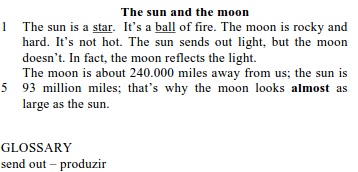
The sun is larger than the moon.
Ano: 2012
Banca:
CONSULTEC
Órgão:
PM-BA
Prova:
CONSULTEC - 2012 - PM-BA - Aspirante da Polícia Militar |
Q468810
Inglês

Based on the text, the only pair of opposites is in alternative
Ano: 2013
Banca:
Aeronáutica
Órgão:
EPCAR
Prova:
Aeronáutica - 2013 - EPCAR - Cadete da Aeronáutica |
Q380572
Inglês

The comparative form of the underlined word in the sentence “Webster’s dictionary [...] adopted the American orthography familiar todav” ílines 6 and 7) is
Ano: 2013
Banca:
Aeronáutica
Órgão:
EEAR
Prova:
Aeronáutica - 2013 - EEAR - Sargento da Aeronáutica - Controle de Tráfego Aéreo - ME |
Q357789
Inglês

Choose the alternative that best completes the text.
Ano: 2013
Banca:
Aeronáutica
Órgão:
EEAR
Prova:
Aeronáutica - 2013 - EEAR - Sargento da Aeronáutica - Controle de Tráfego Aéreo - ME |
Q357788
Inglês

The correspondent adjective for “Courage”, (line 06), is
Ano: 2011
Banca:
Exército
Órgão:
EsFCEx
Prova:
Exército - 2011 - EsFCEx - Oficial - Conhecimentos Gerais |
Q267600
Inglês
Choose the alternative that correctly shows the comparative form of the adjectives below:
Good – bad – ill – far – old
Good – bad – ill – far – old
Ano: 2010
Banca:
Exército
Órgão:
EsFCEx
Prova:
Exército - 2010 - EsFCEx - Oficial - Magistério Inglês |
Q245750
Inglês
Choose the alternativa that correctly completes the sentence: I want to travel somewhere _____________ .
Ano: 2010
Banca:
Exército
Órgão:
EsFCEx
Provas:
Exército - 2010 - EsFCEx - Oficial - Conhecimentos Gerais
|
Exército - 2010 - EsFCEx - Oficial - Magistério Matemática |
Q245662
Inglês
Choose the best alternative to complete the question below:
Which vegetable is __________ : carrots, onions or potatoes?
Which vegetable is __________ : carrots, onions or potatoes?
Ano: 2011
Banca:
Marinha
Órgão:
ESCOLA NAVAL
Prova:
Marinha - 2011 - ESCOLA NAVAL - Aspirante - 2º Dia |
Q244842
Inglês
Which of the alternatives below completes the sentence correctly?
"Because he was driving so ____(1) he was________ (2) hurt in the accident . "
"Because he was driving so ____(1) he was________ (2) hurt in the accident . "
Ano: 2009
Banca:
Marinha
Órgão:
ESCOLA NAVAL
Prova:
Marinha - 2009 - ESCOLA NAVAL - Aspirante - 2º Dia |
Q191565
Inglês
Choose the best sequence to complete the blanks.
GENUINE BUSINESS LESSONS FROM DONALD TRUMP
Trump has been so __________ (1) in large part because he has managed to build a lifestyle brand around the ___________ (2) life that he lives and most people aspire to. He works ___________ (3) to cultivate the image, and he uses it to expand into new business lines and find new areas for profit.
(Adapted from http: / /vmw.forbes.com)
GENUINE BUSINESS LESSONS FROM DONALD TRUMP
Trump has been so __________ (1) in large part because he has managed to build a lifestyle brand around the ___________ (2) life that he lives and most people aspire to. He works ___________ (3) to cultivate the image, and he uses it to expand into new business lines and find new areas for profit.
(Adapted from http: / /vmw.forbes.com)
Ano: 2009
Banca:
Exército
Órgão:
EsFCEx
Prova:
EsFCEx - 2009 - EsFCEx - Oficial - Magistério Inglês |
Q175783
Inglês
Some words ending in “ly” may belong to other parts of speech. Choose the word that can be both an adverb and an adjective.
Ano: 2009
Banca:
Exército
Órgão:
EsFCEx
Prova:
EsFCEx - 2009 - EsFCEx - Oficial - Magistério Inglês |
Q175782
Inglês
Some adjectives are used only in the attributive position. Which sentence exemplifies that?
Ano: 2009
Banca:
Exército
Órgão:
EsFCEx
Prova:
EsFCEx - 2009 - EsFCEx - Oficial - Conhecimentos Gerais |
Q172510
Inglês
Choose the best alternative to complete the question below:
Which animal do you like _________, tigers or lions?
Which animal do you like _________, tigers or lions?
Ano: 2009
Banca:
Exército
Órgão:
EsFCEx
Prova:
EsFCEx - 2009 - EsFCEx - Oficial - Conhecimentos Gerais |
Q172505
Inglês
What is the superlative form of the following adjectives “hot – young – bad – easy”?

 Conheça nossos planos