Selecionar segmento
Estude com questões de diferentes segmentos
Atenção: Isso limpará todos os campos já preenchidos no filtro!
Foram encontradas 75.429 questões
Resolva questões gratuitamente!
Junte-se a mais de 4 milhões de concurseiros!


Ano: 2025
Banca:
FUVEST
Órgão:
FUVEST
Prova:
FUVEST - 2025 - FUVEST - Vestibular - 1ª Fase - Conhecimentos Gerais |
Q3946305
Direito Internacional Público
A anexação, definida como a incorporação unilateral de
território de outro Estado, é proibida pela Carta das Nações
Unidas e pelo direito internacional geral, que enfatizam a
proibição do uso da força e o respeito à integridade territorial
dos Estados (Carta da ONU, 1945).
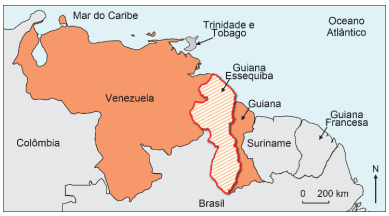
Disponível em https://www.parlamentomercosur.org. Adaptado. Partindo da carta da ONU e do mapa, é possível indicar que se refere
Disponível em https://www.parlamentomercosur.org. Adaptado. Partindo da carta da ONU e do mapa, é possível indicar que se refere
Ano: 2025
Banca:
FUVEST
Órgão:
FUVEST
Prova:
FUVEST - 2025 - FUVEST - Vestibular - 1ª Fase - Conhecimentos Gerais |
Q3946304
Geografia
Em 19 de setembro de 2023, o Azerbaijão lançou uma ofensiva contra a autoproclamada República de Nagorno-Karabakh (RAHK
ou Artsakh), um território povoado por armênios sob bloqueio desde dezembro de 2022. Em 28 de setembro de 2023, a RAHK
anunciou sua dissolução, que entrou em vigor a partir de 1º de janeiro de 2024, após mais de três décadas de existência não
reconhecida. Em agosto de 2025, o governo norte americano propôs que a rota de transporte estratégica turco-azerbaijana seja
controlada pelos EUA, por 99 anos. Essa proposta ainda está em curso, devido à oposição do Irã.
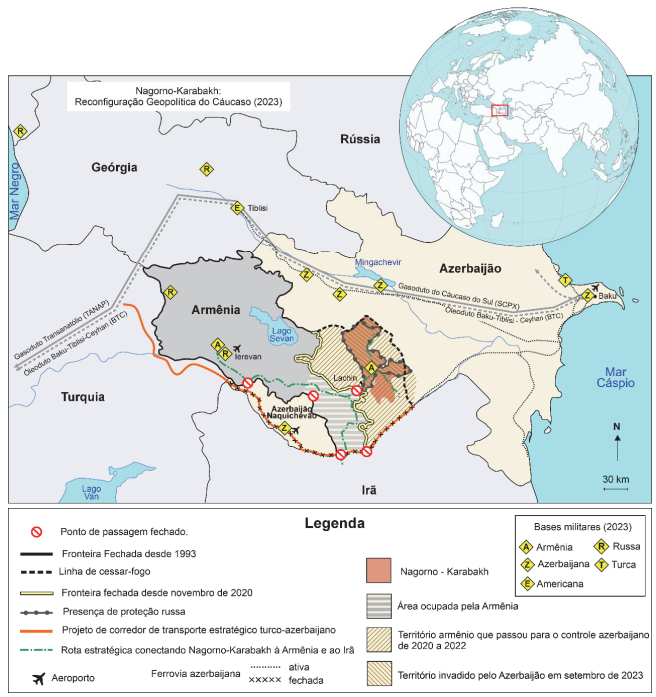
Reconfiguração geopolítica do Cáucaso (2023). Atlas Géopolitique Mondial, 2025. Adaptado.
Com base no texto, na legenda do mapa e em seus conhecimentos, assinale a alternativa que explica os motivos da ofensiva do Azerbaijão contra os armênios.
Reconfiguração geopolítica do Cáucaso (2023). Atlas Géopolitique Mondial, 2025. Adaptado.
Com base no texto, na legenda do mapa e em seus conhecimentos, assinale a alternativa que explica os motivos da ofensiva do Azerbaijão contra os armênios.
Ano: 2025
Banca:
FUVEST
Órgão:
FUVEST
Prova:
FUVEST - 2025 - FUVEST - Vestibular - 1ª Fase - Conhecimentos Gerais |
Q3946303
Português
No Afeganistão, em vinte anos de guerra, morreram mais
de 157 mil pessoas; no Iraque, de 2003 até hoje, dez anos
depois de as tropas americanas se retirarem do país, foram
mortas entre 308 e 600 mil; e no Paquistão, o aliado dos
Estados Unidos na Guerra ao Terror, 70 mil.
As violações de direitos humanos por militares americanos, como os abusos e a tortura de prisioneiros, muitas vezes inocentes, na prisão de Abu Ghraib, no Iraque, e na base de Guantánamo, em Cuba, geraram ainda mais ressentimento nas populações desses países.
A Guerra ao Terror provocou mais radicalização religiosa, conflitos internos, forçou milhões de pessoas a abandonar suas casas e a fugir para outros países, aumentando ainda mais o preconceito em relação a muçulmanos e árabes. Dizem que o mundo nunca mais foi o mesmo depois do Onze de Setembro.
Simone Duarte. O vento mudou de direção: o Onze de Setembro que o mundo não viu. São Paulo: Fósforo, 2021.
O excerto traz informações sobre a atuação militar norte-americana na Ásia após os atentados terroristas de 11 de setembro de 2001 e afirma que essas investidas militares
As violações de direitos humanos por militares americanos, como os abusos e a tortura de prisioneiros, muitas vezes inocentes, na prisão de Abu Ghraib, no Iraque, e na base de Guantánamo, em Cuba, geraram ainda mais ressentimento nas populações desses países.
A Guerra ao Terror provocou mais radicalização religiosa, conflitos internos, forçou milhões de pessoas a abandonar suas casas e a fugir para outros países, aumentando ainda mais o preconceito em relação a muçulmanos e árabes. Dizem que o mundo nunca mais foi o mesmo depois do Onze de Setembro.
Simone Duarte. O vento mudou de direção: o Onze de Setembro que o mundo não viu. São Paulo: Fósforo, 2021.
O excerto traz informações sobre a atuação militar norte-americana na Ásia após os atentados terroristas de 11 de setembro de 2001 e afirma que essas investidas militares
Ano: 2025
Banca:
FUVEST
Órgão:
FUVEST
Prova:
FUVEST - 2025 - FUVEST - Vestibular - 1ª Fase - Conhecimentos Gerais |
Q3946302
História
Entre os deveres de todo devoto do Islã está a
obrigatoriedade de pelo menos uma vez na vida fazer uma
peregrinação a Meca, cidade sagrada na qual Maomé
primeiro pregou a religião. Nem todos podiam fazer a
peregrinação, mas muitos faziam, geralmente juntando-se às
caravanas que percorriam o Saara, chegando a Meca a partir
do Cairo. Essa circulação de pessoas, que entravam em
contato com os lugares nos quais era intenso o ensino do Islã,
criava vínculos entre todo o mundo muçulmano do Sael, norte
da África e península Arábica. Os ensinamentos islâmicos
eram ainda reforçados pela ação dos ulemás, estudiosos do
Alcorão que se assentavam em algumas cidades ou
passavam períodos em diferentes lugares. As escolas
corânicas, nas quais os meninos liam e decoravam o Alcorão,
também eram lugares de atuação dos ulemás, que mantinham
vivo o ensino do islã.
Marina de Mello e Souza. África e Brasil africano. São Paulo: Ática, 2007.
Ao tratar do islamismo na Idade Média, o texto caracteriza
Marina de Mello e Souza. África e Brasil africano. São Paulo: Ática, 2007.
Ao tratar do islamismo na Idade Média, o texto caracteriza
Ano: 2025
Banca:
FUVEST
Órgão:
FUVEST
Prova:
FUVEST - 2025 - FUVEST - Vestibular - 1ª Fase - Conhecimentos Gerais |
Q3946301
História
[...] as lendárias Rotas da Seda, longe de serem meras
rotas comerciais, eram rodovias culturais que
desempenhavam um papel fundamental na ligação entre o
leste e o oeste, reunindo intermitentemente nômades e
moradores da cidade, povos pastoris e agricultores,
mercadores e monges, soldados e peregrinos. A noção de
movimento é, portanto, central para a compreensão das
relações entre os povos [...]. Um diálogo entre culturas
significa trocas não apenas de bens, mas também de ideias.
Vadime Elisséeff. “Introduction. Approaches Old and New to Silk Roads”. The Silk roads: highways of culture and commerce. New York: Berghahn Books, 2000. Traduzido e adaptado.
Com base no excerto, que aborda o complexo de rotas terrestres que se estenderam, durante a Idade Média, por boa parte da Ásia, Leste da África e Sul da Europa, as trocas culturais e os deslocamentos tiveram impacto na
Vadime Elisséeff. “Introduction. Approaches Old and New to Silk Roads”. The Silk roads: highways of culture and commerce. New York: Berghahn Books, 2000. Traduzido e adaptado.
Com base no excerto, que aborda o complexo de rotas terrestres que se estenderam, durante a Idade Média, por boa parte da Ásia, Leste da África e Sul da Europa, as trocas culturais e os deslocamentos tiveram impacto na
Ano: 2025
Banca:
FUVEST
Órgão:
FUVEST
Prova:
FUVEST - 2025 - FUVEST - Vestibular - 1ª Fase - Conhecimentos Gerais |
Q3946300
Português
Mwando está embasbacado com a descoberta do insólito
do mundo. Como o Adão no Paraíso, a voz da serpente
sugeriu-lhe a maçã, que lhe arrancou brutalmente a venda de
todos os mistérios. Sim, escutou os lábios de uma mulher
pronunciando em sussurros o seu nome, despertando-o do
ventre fecundo da inocência. Mwando nasceu. Sente o
coração a bater com força, mesmo à maneira do primeiro
amor.¬¬
(…)
Procurou o refúgio do quarto e fechou-se. Estava
transtornado. Sentia a sua devoção abalada pela paixão. Não
conseguia fugir às tramas da serpente, a Sarnau arrastava-o
cada vez mais para o abismo.
Paulina Chiziane.
Balada de amor ao vento.
Considerando a intertextualidade bíblica presente no excerto de Balada de amor ao vento, a experiência de Mwando é caracterizada
Balada de amor ao vento.
Considerando a intertextualidade bíblica presente no excerto de Balada de amor ao vento, a experiência de Mwando é caracterizada
Ano: 2025
Banca:
FUVEST
Órgão:
FUVEST
Prova:
FUVEST - 2025 - FUVEST - Vestibular - 1ª Fase - Conhecimentos Gerais |
Q3946299
Português
iii. Busca
Pelos campos fora Caminhava sempre Como se buscasse Uma presença ausente
“Onde estás tu, morte? Não posso te ver: Neste dia de Maio Com rosas e trigo É como se tu não Vivesses comigo [...] É verdade que passas Pela cidade às vezes Nos caixões de chumbo:
Mas viro o meu rosto Pois não te compreendo És um pesadelo Uma coisa inventada Que o vento desmente Com suas mãos frescas E a luz logo apaga” [...]
Sophia de Mello Breyner Andresen. O Cristo cigano.
É tão tenaz o desvio que a esquivança encobridora ante a morte exerce sobre a cotidianidade que, no ser-um-com-ooutro, seus ‘próximos’ ainda se empenham com frequência precisamente junto ao ‘moribundo’ para o persuadir de que escapa da morte e retorna em seguida à tranquila cotidianidade do mundo de suas ocupações. Tal ‘preocupação-com-o-outro’ pensa ‘consolar’ dessa maneira o ‘moribundo’. Ela quer devolvê-lo à existência, ajudando-o a encobrir ainda mais completamente sua possibilidade de ser mais própria e irremetente. A gente se ocupa dessa maneira de uma constante tranquilização sobre a morte. Mas, no fundo, ela vale tanto para o ‘moribundo’ quanto para ‘os que consolam’. E mesmo no caso do deixar de viver, a publicidade ainda não deve ser perturbada, nem inquietada pelo acontecimento na sua ocupada despreocupação. Pois não raro se vê na morte dos outros uma inconveniência social, quando não mesmo uma falta de tato, cuja publicidade deve ser poupada.
Martin Heidegger. Ser e Tempo, §51.
A escritora Sophia de Mello Breyner Andresen e o filósofo Martin Heidegger descrevem, por meio de recursos expositivos bem diferentes, uma mesma atitude geral comumente assumida por uma pessoa ante o desvelamento de sua própria mortalidade a partir da constatação da morte ou do adoecimento mortal de uma outra pessoa. Qual alternativa melhor descreve essa atitude?
Pelos campos fora Caminhava sempre Como se buscasse Uma presença ausente
“Onde estás tu, morte? Não posso te ver: Neste dia de Maio Com rosas e trigo É como se tu não Vivesses comigo [...] É verdade que passas Pela cidade às vezes Nos caixões de chumbo:
Mas viro o meu rosto Pois não te compreendo És um pesadelo Uma coisa inventada Que o vento desmente Com suas mãos frescas E a luz logo apaga” [...]
Sophia de Mello Breyner Andresen. O Cristo cigano.
É tão tenaz o desvio que a esquivança encobridora ante a morte exerce sobre a cotidianidade que, no ser-um-com-ooutro, seus ‘próximos’ ainda se empenham com frequência precisamente junto ao ‘moribundo’ para o persuadir de que escapa da morte e retorna em seguida à tranquila cotidianidade do mundo de suas ocupações. Tal ‘preocupação-com-o-outro’ pensa ‘consolar’ dessa maneira o ‘moribundo’. Ela quer devolvê-lo à existência, ajudando-o a encobrir ainda mais completamente sua possibilidade de ser mais própria e irremetente. A gente se ocupa dessa maneira de uma constante tranquilização sobre a morte. Mas, no fundo, ela vale tanto para o ‘moribundo’ quanto para ‘os que consolam’. E mesmo no caso do deixar de viver, a publicidade ainda não deve ser perturbada, nem inquietada pelo acontecimento na sua ocupada despreocupação. Pois não raro se vê na morte dos outros uma inconveniência social, quando não mesmo uma falta de tato, cuja publicidade deve ser poupada.
Martin Heidegger. Ser e Tempo, §51.
A escritora Sophia de Mello Breyner Andresen e o filósofo Martin Heidegger descrevem, por meio de recursos expositivos bem diferentes, uma mesma atitude geral comumente assumida por uma pessoa ante o desvelamento de sua própria mortalidade a partir da constatação da morte ou do adoecimento mortal de uma outra pessoa. Qual alternativa melhor descreve essa atitude?
Ano: 2025
Banca:
FUVEST
Órgão:
FUVEST
Prova:
FUVEST - 2025 - FUVEST - Vestibular - 1ª Fase - Conhecimentos Gerais |
Q3946298
Literatura
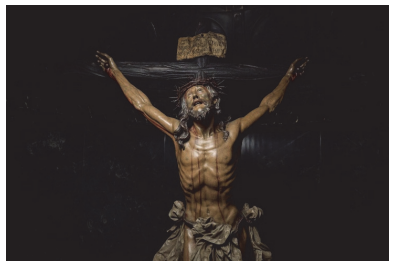
Francisco Ruiz Gijón (1683-1720), Santíssimo Cristo da Expiação, popularmente conhecido como Cristo Cachorro. Escultura em madeira, 1682 (detalhe).
A partir da comparação entre a escultura Cristo Cachorro, de Francisco Ruiz Gijón, e o livro O Cristo cigano, de Sophia de Mello Breyner Andresen, inspirado por ela, depreende-se:
Ano: 2025
Banca:
FUVEST
Órgão:
FUVEST
Prova:
FUVEST - 2025 - FUVEST - Vestibular - 1ª Fase - Conhecimentos Gerais |
Q3946297
História
Decretou então o ótimo Artífice que àquele ao qual nada
de próprio pudera dar tivesse como privativo tudo quanto fora
partilhado por cada um dos demais. Assim, pois, tomou o
homem, essa obra de tipo indefinido, e, tendo-o colocado no
centro do universo, falou-lhe nestes termos: ‘A ti, ó Adão, não
temos dado nem uma sede determinada, nem um aspecto
peculiar, nem uma função singular precisamente para que o
lugar, a imagem e as tarefas que reclamas para ti, tudo isso
tenhas e realizes, mas pelo mérito de tua vontade e livre
consentimento. As outras criaturas já foram prefixadas em sua
constituição pelas leis por nós estatuídas. Tu, porém, não
estás contido por amarra nenhuma. Antes, pela decisão do
arbítrio, em cujas mãos te depositei, hás de predeterminar a
tua compleição pessoal. Eu te coloquei no centro do mundo,
a fim de poderes inspecionar, daí, de todos os lados, da
maneira mais cômoda, tudo que existe.
Pico della Mirandola. Discurso sobre a dignidade do homem. In: PICO, Giovanni, Conde de Mirândola e de Concórdia. A dignidade do homem. 2ª. ed. Campo Grande: Solivros/Uniderp, 1999. Adaptado.
Elaborado em 1486, na região da atual Itália, o texto do humanista Pico della Mirandola apresenta algumas características do movimento renascentista, dentre as quais
Pico della Mirandola. Discurso sobre a dignidade do homem. In: PICO, Giovanni, Conde de Mirândola e de Concórdia. A dignidade do homem. 2ª. ed. Campo Grande: Solivros/Uniderp, 1999. Adaptado.
Elaborado em 1486, na região da atual Itália, o texto do humanista Pico della Mirandola apresenta algumas características do movimento renascentista, dentre as quais
Ano: 2025
Banca:
FUVEST
Órgão:
FUVEST
Prova:
FUVEST - 2025 - FUVEST - Vestibular - 1ª Fase - Conhecimentos Gerais |
Q3946296
Artes Visuais
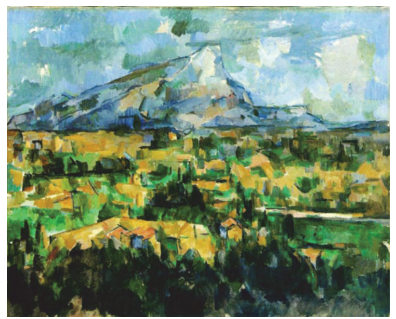
Paul Cézanne. A montanha de Sainte-Victoire, 1904.
Assim também o gênio de Cézanne consiste em fazer com que as deformações de perspectiva, pela disposição de conjunto do quadro, deixem de ser visíveis por si mesmas na visão global e contribuam apenas, como ocorre na visão natural, para dar impressão de uma ordem nascente, de um objeto que surge a se aglomerar sob o olhar. (...) O desenho deve então resultar da cor, se se quer que o mundo seja restituído em sua espessura, pois é uma massa sem lacunas, um organismo de cores, através das quais a fuga da perspectiva, os contornos, as retas, as curvas instalam-se como linhas de força, pois é vibrando que a órbita do espaço se constitui.
Merleau-Ponty. A dúvida de Cézanne.
Merleau-Ponty, filósofo francês do século XX, dedicou um espaço importante em sua filosofia à reflexão sobre a pintura e, em particular, à obra de Paul Cézanne.
Com base na proposição do filósofo e na observação da tela do artista, é correto afirmar que cabe à expressão por meio da pintura
Ano: 2025
Banca:
FUVEST
Órgão:
FUVEST
Prova:
FUVEST - 2025 - FUVEST - Vestibular - 1ª Fase - Conhecimentos Gerais |
Q3946295
Artes Visuais
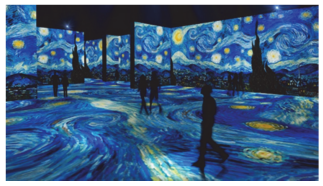
Imagem ilustrativa da exposição imersiva de Van Gogh.
Nos últimos anos, exposições imersivas têm atraído um público amplo ao proporcionar experiências sensoriais e visuais baseadas em obras de artistas consagrados, muitas delas com trilha sonora, narração de cartas e projeções em altíssima definição. Contudo, parte da crítica especializada tem problematizado essa tendência de oferecer vivências multissensoriais que buscam envolver o visitante por completo. As críticas apontam implicações relacionadas à natureza da experiência estética, à espetacularização da arte, ao patrocínio corporativo e ao sucesso de público mediado pelas redes sociais. A crítica de arte Sheila Leirner, por exemplo, comenta:
Fica como se O Jardim das Delícias, A Tentação de Santo Antônio (telas de Hieronymus Bosch) e outras preciosidades como as frutas de Giuseppe Arcimboldo ou as festas campestres de Brueghel fossem ilustrações ou decorações para a grandiloquência artificial e sensacionalista de um show de cabaré. Certo, pode ser muito bonito, mas será que estas maravilhas pictóricas (em si) precisam de “efeitos especiais” para que cheguemos a elas? Até mesmo uma pequena reprodução em cartão postal pode ser mais fiel à nossa percepção...
Disponível em https://sheilaleirnerblog.wordpress.com/.
Com base nas informações e discussões apresentadas, assinale a alternativa que expressa a análise crítica mais fundamentada sobre o fenômeno das exposições imersivas:
Ano: 2025
Banca:
FUVEST
Órgão:
FUVEST
Prova:
FUVEST - 2025 - FUVEST - Vestibular - 1ª Fase - Conhecimentos Gerais |
Q3946294
Português
Os espetáculos circenses organizados ao final do século XVIII
uniam o cômico e o dramático, como historicamente já faziam
outras formas de espetáculo, por meio da combinação da
atuação das famílias de saltimbancos, ciganos, atores da
Commedia dell’Arte, e mesclavam a pantomima e o palhaço
com a acrobacia, os equilíbrios, as exibições equestres e a
doma de animais em um mesmo espaço. Desde aquele
momento, fica visível a emergência não somente de novos
modelos de espetáculos, mas também novas estruturas de
organização e produção desses espetáculos, caracterizadas
pela delimitação do espaço físico das apresentações,
cobrança compulsória de entradas e alternância entre
exibições de equilibristas, acrobatas, artistas equestres,
comediantes, pantomimas e representações diversas, ou seja,
um espetáculo pautado na íntima mistura de expressões e
artistas originários de diferentes espaços e formações.
LOPES, Daniel de Carvalho; SILVA, Ermínia. Circo: percursos de uma arte em transformação contínua. Cadernos do GIPE-CIT, v. 1, 2020. Adaptado.
No contexto histórico, o circo
LOPES, Daniel de Carvalho; SILVA, Ermínia. Circo: percursos de uma arte em transformação contínua. Cadernos do GIPE-CIT, v. 1, 2020. Adaptado.
No contexto histórico, o circo
Ano: 2025
Banca:
FUVEST
Órgão:
FUVEST
Prova:
FUVEST - 2025 - FUVEST - Vestibular - 1ª Fase - Conhecimentos Gerais |
Q3946293
Português
O carnaval, para além de ser a mais importante
manifestação cultural brasileira, é o exercício concreto e
sensível de vários direitos conquistados e consagrados. Ele
celebra o direito à cidade, à manifestação, à associação e o
direito à liberdade de expressão. Como festa pagã e
sincrética, afirma o direito à liberdade religiosa sem ser
proselitista e, como representação cultural, amplia o espaço
cívico para combiná-lo com festividade, criatividade e
liberdade artística e cultural.
O carnaval, nas suas diversas facetas, é político. E essa característica não aparece somente nos debates promovidos através da festa, mas também pela possibilidade de desfrutar uma vida livre de censura de qualquer tipo por parte de pessoas de todas as regiões do país, em suas mais distintas realidades.
Ocupar as ruas é um ato político. O lazer e a folia em espaço público, o exercício do direito à fruição e de produzir e consumir conteúdos culturais diversos também são. É ainda mais relevante o ato de externalizar e amplificar histórias, memórias e narrativas sobre grupos historicamente silenciados no país, como as populações negra, indígena e de tantas outras comunidades tradicionais. A manifestação política através de brincadeiras, danças, marchinhas, cantos e fantasias é das formas mais sublimes de expressão da aliança entre luta social, cultura e expressão estética. É a possibilidade que brasileiras e brasileiros encontram de, lutando por meio da arte, fazer ecoar uma voz esquecida no cotidiano.
Artigo 19. 16/02/2024. Adaptado.
Ao afirmar que o carnaval é político, o texto objetiva
O carnaval, nas suas diversas facetas, é político. E essa característica não aparece somente nos debates promovidos através da festa, mas também pela possibilidade de desfrutar uma vida livre de censura de qualquer tipo por parte de pessoas de todas as regiões do país, em suas mais distintas realidades.
Ocupar as ruas é um ato político. O lazer e a folia em espaço público, o exercício do direito à fruição e de produzir e consumir conteúdos culturais diversos também são. É ainda mais relevante o ato de externalizar e amplificar histórias, memórias e narrativas sobre grupos historicamente silenciados no país, como as populações negra, indígena e de tantas outras comunidades tradicionais. A manifestação política através de brincadeiras, danças, marchinhas, cantos e fantasias é das formas mais sublimes de expressão da aliança entre luta social, cultura e expressão estética. É a possibilidade que brasileiras e brasileiros encontram de, lutando por meio da arte, fazer ecoar uma voz esquecida no cotidiano.
Artigo 19. 16/02/2024. Adaptado.
Ao afirmar que o carnaval é político, o texto objetiva
Ano: 2025
Banca:
FUVEST
Órgão:
FUVEST
Prova:
FUVEST - 2025 - FUVEST - Vestibular - 1ª Fase - Conhecimentos Gerais |
Q3946292
Português
Considere os dois fragmentos a seguir:
O fundamento psicológico sobre o qual se eleva o tipo das individualidades da cidade grande é a intensificação da vida nervosa, que resulta da mudança rápida e ininterrupta de impressões [...]. Talvez não haja nenhum fenômeno tão característico da cidade grande como o caráter blasé. [...] A essência do caráter blasé é o embotamento frente à distinção das coisas [...]. Em parte por conta dessa situação psicológica, em parte em virtude do direito à desconfiança que temos perante os elementos da vida na cidade grande, que passam por nós em um contato fugaz, somos coagidos a uma reserva, em virtude da qual mal conhecemos os vizinhos que temos por muitos anos [...]. Ao mesmo tempo, essa reserva garante ao indivíduo uma espécie [...] de liberdade pessoal.
Simmel, Georg. (2005). As grandes cidades e a vida do espírito. Mana, Trad. Leopoldo Waizbort. Adaptado.
As luzes da cidade se acendiam, as cortinas de aço das portas desciam com barulho e os caixeiros, os empregados que passavam o dia sorridentes ou abstratos, por trás dos balcões [...], se transformavam em homens misteriosos, individuais, que metiam um paletó, tinham uma casa, uma rua e iam comer o seu jantar, dormir o seu sono, trancar a sua porta. [...] Todos ali tinham a sua vida isolada, sua vida particular. E, naquela hora, cortavam as amarras, cada um procurando o seu mundo pessoal, a sua pequenina ilha.
Rachel de Queiroz. Caminho de Pedras. Adaptado.
No primeiro trecho, publicado originalmente em 1903, o sociólogo Georg Simmel procurou condensar as características fundamentais da vida psíquica nas grandes cidades. Já no segundo, com que Rachel de Queiroz inicia o capítulo 7 de Caminho de Pedras, vemos como o protagonista Roberto percebe sua cidade a bordo de um bonde. Lendo-os em conjunto, é possível afirmar:
O fundamento psicológico sobre o qual se eleva o tipo das individualidades da cidade grande é a intensificação da vida nervosa, que resulta da mudança rápida e ininterrupta de impressões [...]. Talvez não haja nenhum fenômeno tão característico da cidade grande como o caráter blasé. [...] A essência do caráter blasé é o embotamento frente à distinção das coisas [...]. Em parte por conta dessa situação psicológica, em parte em virtude do direito à desconfiança que temos perante os elementos da vida na cidade grande, que passam por nós em um contato fugaz, somos coagidos a uma reserva, em virtude da qual mal conhecemos os vizinhos que temos por muitos anos [...]. Ao mesmo tempo, essa reserva garante ao indivíduo uma espécie [...] de liberdade pessoal.
Simmel, Georg. (2005). As grandes cidades e a vida do espírito. Mana, Trad. Leopoldo Waizbort. Adaptado.
As luzes da cidade se acendiam, as cortinas de aço das portas desciam com barulho e os caixeiros, os empregados que passavam o dia sorridentes ou abstratos, por trás dos balcões [...], se transformavam em homens misteriosos, individuais, que metiam um paletó, tinham uma casa, uma rua e iam comer o seu jantar, dormir o seu sono, trancar a sua porta. [...] Todos ali tinham a sua vida isolada, sua vida particular. E, naquela hora, cortavam as amarras, cada um procurando o seu mundo pessoal, a sua pequenina ilha.
Rachel de Queiroz. Caminho de Pedras. Adaptado.
No primeiro trecho, publicado originalmente em 1903, o sociólogo Georg Simmel procurou condensar as características fundamentais da vida psíquica nas grandes cidades. Já no segundo, com que Rachel de Queiroz inicia o capítulo 7 de Caminho de Pedras, vemos como o protagonista Roberto percebe sua cidade a bordo de um bonde. Lendo-os em conjunto, é possível afirmar:
Ano: 2025
Banca:
FUVEST
Órgão:
FUVEST
Prova:
FUVEST - 2025 - FUVEST - Vestibular - 1ª Fase - Conhecimentos Gerais |
Q3946291
Sociologia
Os grotões transformaram-se em jardins cortados a meio
pelas avenidas e pela sombra dos viadutos não há mais sapo.
Nos jardins encontrareis recintos fechados com instrutoras,
dentistas, educadoras sanitárias dentro. São os parques
infantis, onde as crianças proletárias se socializam
aprendendo nos brinquedos o cooperativismo e a consciência
do homem social.
Mário de Andrade. “Dia de São Paulo”. Revista do Arquivo Municipal. São Paulo: Departamento de Cultura, 1936, nº 19.
O excerto relata alterações na paisagem urbana paulistana com a implantação de novos equipamentos que visavam
Mário de Andrade. “Dia de São Paulo”. Revista do Arquivo Municipal. São Paulo: Departamento de Cultura, 1936, nº 19.
O excerto relata alterações na paisagem urbana paulistana com a implantação de novos equipamentos que visavam
Ano: 2025
Banca:
FUVEST
Órgão:
FUVEST
Prova:
FUVEST - 2025 - FUVEST - Vestibular - 1ª Fase - Conhecimentos Gerais |
Q3946290
Geografia
No censo do IBGE 2022 foi possível perceber que, do total
de 203,1 milhões de pessoas da população brasileira, 177,5 milhões (87,4%) residiam em áreas urbanas, enquanto
25,6 milhões viviam em áreas rurais. Em relação a 2010,
quando o grau de urbanização foi de 84,4%, houve aumento
de 16,6 milhões de pessoas morando em áreas urbanas e
queda de 4,3 milhões vivendo em áreas rurais.
Já em relação à distribuição da população brasileira, o Censo 2022 trouxe uma importante constatação: o crescimento das cidades médias. Cabem nessa classificação do IBGE os municípios que contam entre 100 mil e 500 mil habitantes.
Além disso, os dados também revelam que os maiores percentuais de população urbana foram observados nas regiões Sudeste (94,44%) e Centro-Oeste (91,35%), seguidas das regiões Sul (88,24%), Norte (78,47%) e Nordeste (77,64%).
A população rural, por sua vez, apresentou pela primeira vez decréscimo em todas as regiões do Brasil. Segundo o Prof. Everaldo Melazzo, as cidades brasileiras estão ficando cada vez mais complexas e indicando algumas tendências inexistentes no Brasil até então. Este contexto de mudanças é denominado de fragmentação socioespacial [...].
Disponível em https://jornal.unesp.br/. Adaptado.
Com base no texto e em seus conhecimentos, é correto afirmar a respeito das novas tendências sobre a urbanização do Brasil:
Já em relação à distribuição da população brasileira, o Censo 2022 trouxe uma importante constatação: o crescimento das cidades médias. Cabem nessa classificação do IBGE os municípios que contam entre 100 mil e 500 mil habitantes.
Além disso, os dados também revelam que os maiores percentuais de população urbana foram observados nas regiões Sudeste (94,44%) e Centro-Oeste (91,35%), seguidas das regiões Sul (88,24%), Norte (78,47%) e Nordeste (77,64%).
A população rural, por sua vez, apresentou pela primeira vez decréscimo em todas as regiões do Brasil. Segundo o Prof. Everaldo Melazzo, as cidades brasileiras estão ficando cada vez mais complexas e indicando algumas tendências inexistentes no Brasil até então. Este contexto de mudanças é denominado de fragmentação socioespacial [...].
Disponível em https://jornal.unesp.br/. Adaptado.
Com base no texto e em seus conhecimentos, é correto afirmar a respeito das novas tendências sobre a urbanização do Brasil:
Ano: 2025
Banca:
FUVEST
Órgão:
FUVEST
Prova:
FUVEST - 2025 - FUVEST - Vestibular - 1ª Fase - Conhecimentos Gerais |
Q3946289
Matemática
Engenheiros estavam mapeando um terreno para construção
de um empreendimento com quatro prédios em formato
cilíndrico distribuídos em torno de uma praça com o formato
quadrado. Para a construção dos prédios, os engenheiros
demarcaram os vértices da praça nos pontos A = (0,0), B = (8,0), C e D, em sistema de coordenadas cartesianas
onde cada unidade corresponde a um metro.
Sabendo-se que a borda da seção circular de cada prédio tangencia cada lado do quadrado no seu ponto médio, qual deve ser a equação da circunferência do prédio que tem uma distância de 10 m do seu centro até o centro do quadrado e que passa pelo ponto de tangência P, conforme a figura?
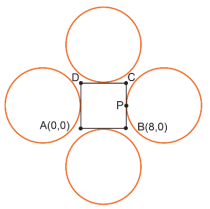
Imagem sem escala
Sabendo-se que a borda da seção circular de cada prédio tangencia cada lado do quadrado no seu ponto médio, qual deve ser a equação da circunferência do prédio que tem uma distância de 10 m do seu centro até o centro do quadrado e que passa pelo ponto de tangência P, conforme a figura?
Imagem sem escala
Ano: 2025
Banca:
FUVEST
Órgão:
FUVEST
Prova:
FUVEST - 2025 - FUVEST - Vestibular - 1ª Fase - Conhecimentos Gerais |
Q3946288
Matemática
Para realizar o cálculo da diferença de altitude (altura) entre
dois pontos A e B, localizados no terreno, um técnico utilizou
uma Estação Total (ET), equipamento usado para medir a
diferença entre níveis de pontos distintos. Ele posicionou o
equipamento, que tem 1,6 m de altura, em um ponto M,
equidistante na horizontal dos pontos A e B, a 40 m de cada
um, nos quais estão os prismas de leitura (miras), conforme a
figura a seguir:
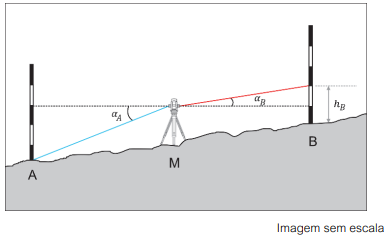
Admitindo-se que o ângulo de inclinação descendente, αA, é 7° e o ângulo de inclinação ascendente, αB, é 5° e que a leitura no prisma, hB, no ponto B foi de 3,60 m, determine a diferença de altitude (altura), em metros, entre os pontos A e B.
Admitindo-se que o ângulo de inclinação descendente, αA, é 7° e o ângulo de inclinação ascendente, αB, é 5° e que a leitura no prisma, hB, no ponto B foi de 3,60 m, determine a diferença de altitude (altura), em metros, entre os pontos A e B.
Ano: 2025
Banca:
FUVEST
Órgão:
FUVEST
Prova:
FUVEST - 2025 - FUVEST - Vestibular - 1ª Fase - Conhecimentos Gerais |
Q3946287
Geografia
Em regiões montanhosas e com clima tropical, é comum a
ocorrência de movimentações de massa associados a
volumes elevados de chuva. Pelos seus efeitos destrutivos,
principalmente em áreas ocupadas de forma irregular, tornam-se foco de estudos de identificação, caracterização,
monitoramento e prevenção. Observe a seguir um exemplo de
sistema de monitoramento:
Sistema de monitoramento de corrida de detritos
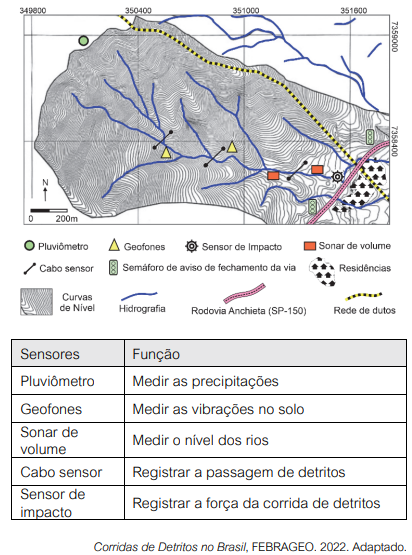
Sobre o motivo da localização dos sensores, assinale a alternativa correta:
Sistema de monitoramento de corrida de detritos
Sobre o motivo da localização dos sensores, assinale a alternativa correta:
Ano: 2025
Banca:
FUVEST
Órgão:
FUVEST
Prova:
FUVEST - 2025 - FUVEST - Vestibular - 1ª Fase - Conhecimentos Gerais |
Q3946286
Geografia
As cores das águas dos rios são resultado de transformações
físico-químicas, indicando fatores como os sólidos (material
inorgânico) em suspensão (SIS) e o material orgânico
dissolvido (MOD). A classificação científica das águas
amazônicas mais utilizada é a de Harald Sioli (1950), que
identificou três tipos: Brancas (alta concentração de SIS),
Pretas (alta concentração de MOD) e Claras (baixas
concentrações de SIS e MOD). Pesquisas mais recentes que
analisam dados hidroquímicos têm indicado uma composição
química mais variada nas águas amazônicas, dividindo os rios
da região também em dois tipos intermediários: A (subtipo das
águas claras) e B (subtipo que está entre as águas brancas e
pretas).
Principais rios da Região Hidrográfica Amazônica
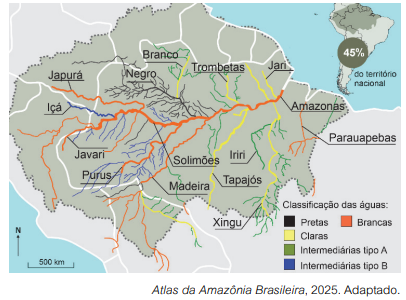
A partir das informações do mapa e do texto, assinale a alternativa correta.
Principais rios da Região Hidrográfica Amazônica
A partir das informações do mapa e do texto, assinale a alternativa correta.

 Conheça nossos planos