Questões de Vestibular
Foram encontradas 75.429 questões
Resolva questões gratuitamente!
Junte-se a mais de 4 milhões de concurseiros!


Ano: 2023
Banca:
CESPE / CEBRASPE
Órgão:
UNB
Prova:
CESPE / CEBRASPE - 2023 - UNB - Prova de Conhecimentos II - 1° dia |
Q3111415
Conhecimentos Gerais
Texto associado
A marchinha de carnaval é um gênero de música popular
surgido no Brasil, em 1899 com a canção Ó abre alas, de
Chiquinha Gonzaga, para o desfile de carnaval do Cordão Rosas
de Ouro, do bairro do Andaraí no Rio de Janeiro. Entretanto, as
marchinhas somente ganharam notoriedade vinte anos depois e
mantiveram esse prestígio popular até os anos 1960.
A marchinha de carnaval é um estilo musical originário
das marchas populares portuguesas, que possuíam um compasso
binário típico das marchas militares. Entretanto, as marchinhas de
carnaval são mais aceleradas que as marchas populares
portuguesas, com melodias simples e vivas, e letras picantes,
cheias de duplo sentido.
A partir da década de 1950, o sucesso das marchinhas de
carnaval foi tão grande que muitos artistas do Brasil se
arriscaram a compor marchinhas. Foi o caso de Chico Buarque,
que escreveu A banda para o carnaval de 1966 e Caetano
Veloso, que escreveu A filha da Chiquita Bacana, em 1977, em
homenagem a Carlos Alberto Ferreira Braga, também conhecido
como Braguinha ou João de Barro, que haviam escrito a marcha
Chiquita Bacana, em 1949.
Internet: <https://brasilescola.uol.com.br> (com adaptações).
Uma das marchinhas mais populares de todos os tempos é
a marcha Allah-la-ô, de Haroldo Lobo e Antônio Nássara,
composta para o carnaval de 1941. Sua criação é narrada por
Jairo Severiano e Zuza Homem de Mello, em A canção no
tempo.
A história de Alláh-lá-ô começou no carnaval de 1940,
quando um bloco do bairro da Gávea cantou nas ruas a marcha
Caravana, de autoria de seu patrono Haroldo Lobo, que tinha
apenas estes versos: Chegou, chegou a nossa caravana / viemos
do deserto / sem pão e sem banana pra comer / o sol estava de
amargar / queimava a nossa cara / fazia a gente suar.
Meses depois, preparando o repertório para o carnaval de
1941, Haroldo pediu a Antônio Nássara para completar a
composição. Achando a ideia (a caravana, o deserto, o calor…)
bem melhor do que os versos, ele logo faria esta segunda parte:
Viemos do Egito / e muitas vezes nós tivemos que rezar / Alá,
Alá, Alá, meu bom Alá / mande água pra Ioiô / mande água pra
Iaiá / Alá, meu bom Alá.
Conta Nássara - em depoimento realizado para o
Arquivo da Cidade do Rio de Janeiro, em 1983 - que, quando
Haroldo tomou conhecimento dos versos, com a palavra “Alá”
repetida várias vezes, entusiasmou-se: “Mas que palavra você me
arranjou, rapaz!” E ali, na hora, criou o refrão Alá-lá-ô, ô-ô-ô
ô-ô-ô / mas que calor, ô-ô-ô ô-ô-ô’, ponto alto da composição.
Internet: <https://musicaemprosa.com> (com adaptações).
Tendo como referência os textos precedentes, julgue o item a seguir.
Cordões carnavalescos são agremiações recreativas de bairros, predecessores das escolas de samba, os quais, no final do século XIX, desfilavam inicialmente pelas ruas do Rio de Janeiro e, posteriormente, pelas de São Paulo e de outras cidades brasileiras, e o nome “cordão” deve-se ao fato de seus integrantes dançarem enfileirados, mas sem a existência real de um cordão que os una.
Cordões carnavalescos são agremiações recreativas de bairros, predecessores das escolas de samba, os quais, no final do século XIX, desfilavam inicialmente pelas ruas do Rio de Janeiro e, posteriormente, pelas de São Paulo e de outras cidades brasileiras, e o nome “cordão” deve-se ao fato de seus integrantes dançarem enfileirados, mas sem a existência real de um cordão que os una.
Ano: 2023
Banca:
CESPE / CEBRASPE
Órgão:
UNB
Prova:
CESPE / CEBRASPE - 2023 - UNB - Prova de Conhecimentos II - 1° dia |
Q3111414
Educação Artística
Texto associado
A marchinha de carnaval é um gênero de música popular
surgido no Brasil, em 1899 com a canção Ó abre alas, de
Chiquinha Gonzaga, para o desfile de carnaval do Cordão Rosas
de Ouro, do bairro do Andaraí no Rio de Janeiro. Entretanto, as
marchinhas somente ganharam notoriedade vinte anos depois e
mantiveram esse prestígio popular até os anos 1960.
A marchinha de carnaval é um estilo musical originário
das marchas populares portuguesas, que possuíam um compasso
binário típico das marchas militares. Entretanto, as marchinhas de
carnaval são mais aceleradas que as marchas populares
portuguesas, com melodias simples e vivas, e letras picantes,
cheias de duplo sentido.
A partir da década de 1950, o sucesso das marchinhas de
carnaval foi tão grande que muitos artistas do Brasil se
arriscaram a compor marchinhas. Foi o caso de Chico Buarque,
que escreveu A banda para o carnaval de 1966 e Caetano
Veloso, que escreveu A filha da Chiquita Bacana, em 1977, em
homenagem a Carlos Alberto Ferreira Braga, também conhecido
como Braguinha ou João de Barro, que haviam escrito a marcha
Chiquita Bacana, em 1949.
Internet: <https://brasilescola.uol.com.br> (com adaptações).
Uma das marchinhas mais populares de todos os tempos é
a marcha Allah-la-ô, de Haroldo Lobo e Antônio Nássara,
composta para o carnaval de 1941. Sua criação é narrada por
Jairo Severiano e Zuza Homem de Mello, em A canção no
tempo.
A história de Alláh-lá-ô começou no carnaval de 1940,
quando um bloco do bairro da Gávea cantou nas ruas a marcha
Caravana, de autoria de seu patrono Haroldo Lobo, que tinha
apenas estes versos: Chegou, chegou a nossa caravana / viemos
do deserto / sem pão e sem banana pra comer / o sol estava de
amargar / queimava a nossa cara / fazia a gente suar.
Meses depois, preparando o repertório para o carnaval de
1941, Haroldo pediu a Antônio Nássara para completar a
composição. Achando a ideia (a caravana, o deserto, o calor…)
bem melhor do que os versos, ele logo faria esta segunda parte:
Viemos do Egito / e muitas vezes nós tivemos que rezar / Alá,
Alá, Alá, meu bom Alá / mande água pra Ioiô / mande água pra
Iaiá / Alá, meu bom Alá.
Conta Nássara - em depoimento realizado para o
Arquivo da Cidade do Rio de Janeiro, em 1983 - que, quando
Haroldo tomou conhecimento dos versos, com a palavra “Alá”
repetida várias vezes, entusiasmou-se: “Mas que palavra você me
arranjou, rapaz!” E ali, na hora, criou o refrão Alá-lá-ô, ô-ô-ô
ô-ô-ô / mas que calor, ô-ô-ô ô-ô-ô’, ponto alto da composição.
Internet: <https://musicaemprosa.com> (com adaptações).
Tendo como referência os textos precedentes, julgue o item a seguir.
A marchinha de carnaval é uma música puramente europeia, embasada em ritmos, harmonias, melodias e instrumental advindos do velho continente, portanto suas melodias possuem uma alta complexidade técnica, sendo difícil cantá-las.
A marchinha de carnaval é uma música puramente europeia, embasada em ritmos, harmonias, melodias e instrumental advindos do velho continente, portanto suas melodias possuem uma alta complexidade técnica, sendo difícil cantá-las.
Ano: 2023
Banca:
CESPE / CEBRASPE
Órgão:
UNB
Prova:
CESPE / CEBRASPE - 2023 - UNB - Prova de Conhecimentos II - 1° dia |
Q3111413
Música
Texto associado
A marchinha de carnaval é um gênero de música popular
surgido no Brasil, em 1899 com a canção Ó abre alas, de
Chiquinha Gonzaga, para o desfile de carnaval do Cordão Rosas
de Ouro, do bairro do Andaraí no Rio de Janeiro. Entretanto, as
marchinhas somente ganharam notoriedade vinte anos depois e
mantiveram esse prestígio popular até os anos 1960.
A marchinha de carnaval é um estilo musical originário
das marchas populares portuguesas, que possuíam um compasso
binário típico das marchas militares. Entretanto, as marchinhas de
carnaval são mais aceleradas que as marchas populares
portuguesas, com melodias simples e vivas, e letras picantes,
cheias de duplo sentido.
A partir da década de 1950, o sucesso das marchinhas de
carnaval foi tão grande que muitos artistas do Brasil se
arriscaram a compor marchinhas. Foi o caso de Chico Buarque,
que escreveu A banda para o carnaval de 1966 e Caetano
Veloso, que escreveu A filha da Chiquita Bacana, em 1977, em
homenagem a Carlos Alberto Ferreira Braga, também conhecido
como Braguinha ou João de Barro, que haviam escrito a marcha
Chiquita Bacana, em 1949.
Internet: <https://brasilescola.uol.com.br> (com adaptações).
Uma das marchinhas mais populares de todos os tempos é
a marcha Allah-la-ô, de Haroldo Lobo e Antônio Nássara,
composta para o carnaval de 1941. Sua criação é narrada por
Jairo Severiano e Zuza Homem de Mello, em A canção no
tempo.
A história de Alláh-lá-ô começou no carnaval de 1940,
quando um bloco do bairro da Gávea cantou nas ruas a marcha
Caravana, de autoria de seu patrono Haroldo Lobo, que tinha
apenas estes versos: Chegou, chegou a nossa caravana / viemos
do deserto / sem pão e sem banana pra comer / o sol estava de
amargar / queimava a nossa cara / fazia a gente suar.
Meses depois, preparando o repertório para o carnaval de
1941, Haroldo pediu a Antônio Nássara para completar a
composição. Achando a ideia (a caravana, o deserto, o calor…)
bem melhor do que os versos, ele logo faria esta segunda parte:
Viemos do Egito / e muitas vezes nós tivemos que rezar / Alá,
Alá, Alá, meu bom Alá / mande água pra Ioiô / mande água pra
Iaiá / Alá, meu bom Alá.
Conta Nássara - em depoimento realizado para o
Arquivo da Cidade do Rio de Janeiro, em 1983 - que, quando
Haroldo tomou conhecimento dos versos, com a palavra “Alá”
repetida várias vezes, entusiasmou-se: “Mas que palavra você me
arranjou, rapaz!” E ali, na hora, criou o refrão Alá-lá-ô, ô-ô-ô
ô-ô-ô / mas que calor, ô-ô-ô ô-ô-ô’, ponto alto da composição.
Internet: <https://musicaemprosa.com> (com adaptações).
Tendo como referência os textos precedentes, julgue o item a seguir.
A marchinha de carnaval tem sua origem rítmica nas marchas militares, compostas em compasso de dois tempos com acentuação no segundo tempo.
Ano: 2023
Banca:
CESPE / CEBRASPE
Órgão:
UNB
Prova:
CESPE / CEBRASPE - 2023 - UNB - Prova de Conhecimentos I - 1° dia - Inglês |
Q3108579
Inglês
Texto associado
Literature, Environment,
Activism – Module description
The Literature, Environment, Activism module
explores the creative and quietly subversive political
performances of environmental writing-as-advocacy, within a
predominantly North American context. This module explores
how nature and environmental writing can be politicised in
defence of local, state, and federal land protections — whether by
writers themselves, or by conservationists, activists,
policymakers, and others. We will study the intersections of page
and place through a selection of nonfiction environmental texts
from the mid-nineteenth century onwards that have informed and
moulded on-the-ground land conservation practices, or
contributed to environmental regulation and legislation. We will
also look at how fiction — such as climate fiction, speculative
fiction, and graphic novels — has emerged as another platform
for commentary on the environmental condition. This module
offers geographical approaches and tools to help students explore
the contributions of environmental writing to conservation
campaigns, and its place in wider environmental activism and
protest narratives. We will ask questions of ‘literature,’
‘environment,’ and ‘activism,’ and the intersections between
them.
Internet: <geography.exeter.ac.uk> (adapted).
According to the previous text, judge the items from 27 through
29 and concerning the item 30 choose the correct option.
The module focuses on American authors who wrote fiction during the 19th century.
The module focuses on American authors who wrote fiction during the 19th century.
Ano: 2023
Banca:
CESPE / CEBRASPE
Órgão:
UNB
Prova:
CESPE / CEBRASPE - 2023 - UNB - Prova de Conhecimentos I - 1° dia - Inglês |
Q3108578
Inglês
Texto associado
Literature, Environment,
Activism – Module description
The Literature, Environment, Activism module
explores the creative and quietly subversive political
performances of environmental writing-as-advocacy, within a
predominantly North American context. This module explores
how nature and environmental writing can be politicised in
defence of local, state, and federal land protections — whether by
writers themselves, or by conservationists, activists,
policymakers, and others. We will study the intersections of page
and place through a selection of nonfiction environmental texts
from the mid-nineteenth century onwards that have informed and
moulded on-the-ground land conservation practices, or
contributed to environmental regulation and legislation. We will
also look at how fiction — such as climate fiction, speculative
fiction, and graphic novels — has emerged as another platform
for commentary on the environmental condition. This module
offers geographical approaches and tools to help students explore
the contributions of environmental writing to conservation
campaigns, and its place in wider environmental activism and
protest narratives. We will ask questions of ‘literature,’
‘environment,’ and ‘activism,’ and the intersections between
them.
Internet: <geography.exeter.ac.uk> (adapted).
According to the previous text, judge the items from 27 through
29 and concerning the item 30 choose the correct option.
The text informs the reader about a course offered to students interested in writing their own literary works on nature.
The text informs the reader about a course offered to students interested in writing their own literary works on nature.
Ano: 2023
Banca:
CESPE / CEBRASPE
Órgão:
UNB
Prova:
CESPE / CEBRASPE - 2023 - UNB - Prova de Conhecimentos I - 1° dia - Inglês |
Q3108577
Inglês
Texto associado
Literature, Environment,
Activism – Module description
The Literature, Environment, Activism module
explores the creative and quietly subversive political
performances of environmental writing-as-advocacy, within a
predominantly North American context. This module explores
how nature and environmental writing can be politicised in
defence of local, state, and federal land protections — whether by
writers themselves, or by conservationists, activists,
policymakers, and others. We will study the intersections of page
and place through a selection of nonfiction environmental texts
from the mid-nineteenth century onwards that have informed and
moulded on-the-ground land conservation practices, or
contributed to environmental regulation and legislation. We will
also look at how fiction — such as climate fiction, speculative
fiction, and graphic novels — has emerged as another platform
for commentary on the environmental condition. This module
offers geographical approaches and tools to help students explore
the contributions of environmental writing to conservation
campaigns, and its place in wider environmental activism and
protest narratives. We will ask questions of ‘literature,’
‘environment,’ and ‘activism,’ and the intersections between
them.
Internet: <geography.exeter.ac.uk> (adapted).
According to the previous text, judge the items from 27 through
29 and concerning the item 30 choose the correct option.
At the beginning of the text, the expression “quietly subversive” means that the authors associated to environmental writing establish their point of view on environmental topics in a discreet and subtle way.
At the beginning of the text, the expression “quietly subversive” means that the authors associated to environmental writing establish their point of view on environmental topics in a discreet and subtle way.
Ano: 2023
Banca:
CESPE / CEBRASPE
Órgão:
UNB
Prova:
CESPE / CEBRASPE - 2023 - UNB - Prova de Conhecimentos I - 1° dia - Inglês |
Q3108576
Inglês
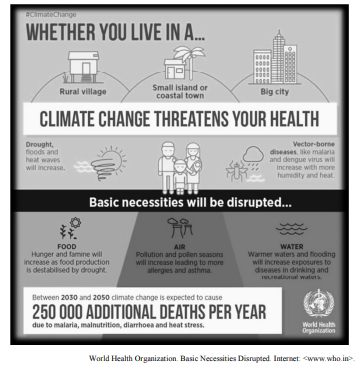
Judge the items from 23 through 26 based on the preceding
infographic.
With the infographic, the World Health Organization wants to inform that two hundred and fifty thousand people will die by 2050.
With the infographic, the World Health Organization wants to inform that two hundred and fifty thousand people will die by 2050.
Ano: 2023
Banca:
CESPE / CEBRASPE
Órgão:
UNB
Prova:
CESPE / CEBRASPE - 2023 - UNB - Prova de Conhecimentos I - 1° dia - Inglês |
Q3108575
Inglês
Judge the items from 23 through 26 based on the preceding
infographic.
The modal verb “will” is used in most sentences of the infographic because the World Health Organization is showing the reader some projections about the future of the world regarding climate change.
The modal verb “will” is used in most sentences of the infographic because the World Health Organization is showing the reader some projections about the future of the world regarding climate change.
Ano: 2023
Banca:
CESPE / CEBRASPE
Órgão:
UNB
Prova:
CESPE / CEBRASPE - 2023 - UNB - Prova de Conhecimentos I - 1° dia - Inglês |
Q3108574
Inglês
Judge the items from 23 through 26 based on the preceding
infographic.
One of the main goals of the text is to draw attention to the relationship between vector-borne diseases and the lack of clean water.
One of the main goals of the text is to draw attention to the relationship between vector-borne diseases and the lack of clean water.
Ano: 2023
Banca:
CESPE / CEBRASPE
Órgão:
UNB
Prova:
CESPE / CEBRASPE - 2023 - UNB - Prova de Conhecimentos I - 1° dia - Inglês |
Q3108573
Inglês
Judge the items from 23 through 26 based on the preceding infographic.
According to the infographic, the entire population will suffer the effects of the climate change irrespective of where people live.
Ano: 2023
Banca:
CESPE / CEBRASPE
Órgão:
UNB
Prova:
CESPE / CEBRASPE - 2023 - UNB - Prova de Conhecimentos I - 1° dia - Inglês |
Q3108572
Inglês
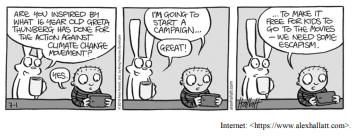
Regarding the preceding comic strip and the conversation between the rabbit and the kid, judge the following item.
The passage “to make it free for kids to go to the movies” (third box) can be correctly rewritten as to make kids free to go to the cinema.
The passage “to make it free for kids to go to the movies” (third box) can be correctly rewritten as to make kids free to go to the cinema.
Ano: 2023
Banca:
CESPE / CEBRASPE
Órgão:
UNB
Prova:
CESPE / CEBRASPE - 2023 - UNB - Prova de Conhecimentos I - 1° dia - Inglês |
Q3108571
Inglês
Regarding the preceding comic strip and the conversation between the rabbit and the kid, judge the following item.
In can be inferred from the use of the structure “I’m going to start” (second box) that the kid had already considered the idea of starting a campaign and has decided to go for it.
In can be inferred from the use of the structure “I’m going to start” (second box) that the kid had already considered the idea of starting a campaign and has decided to go for it.
Ano: 2023
Banca:
CESPE / CEBRASPE
Órgão:
UNB
Prova:
CESPE / CEBRASPE - 2023 - UNB - Prova de Conhecimentos I - 1° dia - Inglês |
Q3108570
Inglês
Regarding the preceding comic strip and the conversation between the rabbit and the kid, judge the following item.
The kid’s answer indicates that he is not aware of who Greta Thunberg is, nor of what she has done.
The kid’s answer indicates that he is not aware of who Greta Thunberg is, nor of what she has done.
Ano: 2023
Banca:
CESPE / CEBRASPE
Órgão:
UNB
Prova:
CESPE / CEBRASPE - 2023 - UNB - Prova de Conhecimentos I - 1° dia - Inglês |
Q3108569
Inglês
Regarding the preceding comic strip and the conversation between the rabbit and the kid, judge the following item.
The comic strip shows that, for the kid, going to the movies is a way of thinking about something other than climate change.
The comic strip shows that, for the kid, going to the movies is a way of thinking about something other than climate change.
Ano: 2023
Banca:
CESPE / CEBRASPE
Órgão:
UNB
Prova:
CESPE / CEBRASPE - 2023 - UNB - Prova de Conhecimentos I - 1° dia - Inglês |
Q3108568
Inglês
Regarding the preceding comic strip and the conversation between the rabbit and the kid, judge the following item.
In the first box, the words in “action against climate change” work together as a way to define the “movement” to which the rabbit is referring.
In the first box, the words in “action against climate change” work together as a way to define the “movement” to which the rabbit is referring.
Ano: 2023
Banca:
CESPE / CEBRASPE
Órgão:
UNB
Prova:
CESPE / CEBRASPE - 2023 - UNB - Prova de Conhecimentos I - 1° dia - Inglês |
Q3108567
Inglês
Regarding the preceding comic strip and the conversation between the rabbit and the kid, judge the following item.
The expression “16 year old Greta Thunberg”, in the first box, could have been correctly written as 16-year-old Greta Thunberg.
The expression “16 year old Greta Thunberg”, in the first box, could have been correctly written as 16-year-old Greta Thunberg.
Ano: 2023
Banca:
CESPE / CEBRASPE
Órgão:
UNB
Prova:
CESPE / CEBRASPE - 2023 - UNB - Prova de Conhecimentos I - 1° dia - Inglês |
Q3108566
Inglês
Regarding the preceding comic strip and the conversation
between the rabbit and the kid, judge the following item.
The rabbit is representing an adult who is scared by the action against climate change movement.
The rabbit is representing an adult who is scared by the action against climate change movement.
Ano: 2023
Banca:
CESPE / CEBRASPE
Órgão:
UNB
Prova:
CESPE / CEBRASPE - 2023 - UNB - Prova de Conhecimentos I - 1° dia - Inglês |
Q3108564
Inglês
Texto associado
Gender inequality coupled with the climate crisis is one of
the greatest challenges of our time. It poses threats to ways of
life, livelihoods, health, safety and security for women and girls
around the world.
It is important to acknowledge that the climate crisis is not
“gender neutral”. Across the world, women depend more on, yet
have less access to, natural resources. In many regions, women
bear a disproportionate responsibility for securing food, water,
and fuel. Agriculture is the most important employment sector
for women in low- and lower-middle income countries. During
periods of drought and erratic rainfall, women, as agricultural
workers and primary procurers, work harder to secure income
and resources for their families. This puts added pressure on
girls, who often have to leave school to help their mothers
manage the increased burden.
Climate change is a “threat multiplier”, meaning it
escalates social, political and economic tensions in fragile and
conflict-affected settings. As climate change drives conflict
across the world, women and girls face increased vulnerabilities
to all forms of gender-based violence, including conflict-related
sexual violence, human trafficking, child marriage, and other
forms of violence.
UNWomen. Explainer: How gender inequality and climate
change are interconnected. Explainer (adapted).
According to the previous text, judge the item below.
The sentence “Across the world (…) resources” (second sentence of the second paragraph) can be correctly rewritten as In the whole world, women are more dependent on natural resources, even though they have less access to.
The sentence “Across the world (…) resources” (second sentence of the second paragraph) can be correctly rewritten as In the whole world, women are more dependent on natural resources, even though they have less access to.
Ano: 2023
Banca:
CESPE / CEBRASPE
Órgão:
UNB
Prova:
CESPE / CEBRASPE - 2023 - UNB - Prova de Conhecimentos I - 1° dia - Inglês |
Q3108563
Inglês
Texto associado
Gender inequality coupled with the climate crisis is one of
the greatest challenges of our time. It poses threats to ways of
life, livelihoods, health, safety and security for women and girls
around the world.
It is important to acknowledge that the climate crisis is not
“gender neutral”. Across the world, women depend more on, yet
have less access to, natural resources. In many regions, women
bear a disproportionate responsibility for securing food, water,
and fuel. Agriculture is the most important employment sector
for women in low- and lower-middle income countries. During
periods of drought and erratic rainfall, women, as agricultural
workers and primary procurers, work harder to secure income
and resources for their families. This puts added pressure on
girls, who often have to leave school to help their mothers
manage the increased burden.
Climate change is a “threat multiplier”, meaning it
escalates social, political and economic tensions in fragile and
conflict-affected settings. As climate change drives conflict
across the world, women and girls face increased vulnerabilities
to all forms of gender-based violence, including conflict-related
sexual violence, human trafficking, child marriage, and other
forms of violence.
UNWomen. Explainer: How gender inequality and climate
change are interconnected. Explainer (adapted).
According to the previous text, judge the item below.
In the second sentence of the first paragraph, the word “livelihoods” refers to means of support or sources of money people need to survive.
In the second sentence of the first paragraph, the word “livelihoods” refers to means of support or sources of money people need to survive.
Ano: 2023
Banca:
CESPE / CEBRASPE
Órgão:
UNB
Prova:
CESPE / CEBRASPE - 2023 - UNB - Prova de Conhecimentos I - 1° dia - Inglês |
Q3108562
Inglês
Texto associado
Gender inequality coupled with the climate crisis is one of
the greatest challenges of our time. It poses threats to ways of
life, livelihoods, health, safety and security for women and girls
around the world.
It is important to acknowledge that the climate crisis is not
“gender neutral”. Across the world, women depend more on, yet
have less access to, natural resources. In many regions, women
bear a disproportionate responsibility for securing food, water,
and fuel. Agriculture is the most important employment sector
for women in low- and lower-middle income countries. During
periods of drought and erratic rainfall, women, as agricultural
workers and primary procurers, work harder to secure income
and resources for their families. This puts added pressure on
girls, who often have to leave school to help their mothers
manage the increased burden.
Climate change is a “threat multiplier”, meaning it
escalates social, political and economic tensions in fragile and
conflict-affected settings. As climate change drives conflict
across the world, women and girls face increased vulnerabilities
to all forms of gender-based violence, including conflict-related
sexual violence, human trafficking, child marriage, and other
forms of violence.
UNWomen. Explainer: How gender inequality and climate
change are interconnected. Explainer (adapted).
According to the previous text, judge the item below.
The text states that the combination of gender inequality and climate change is the most serious problem humans face in current time.
The text states that the combination of gender inequality and climate change is the most serious problem humans face in current time.

 Conheça nossos planos