Foram encontradas 75.219 questões
Resolva questões gratuitamente!
Junte-se a mais de 4 milhões de concurseiros!


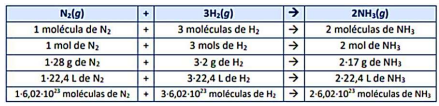
Reação de Síntese da Amônia (Processo de Haber-Bosch):
N2(g) + 3H2(g) → 2NH3(g)
As relações entre os participantes dessa reação podem ser lidas das seguintes maneiras:
Em Proporção de Moléculas:
A nível microscópico, 1 molécula de gás nitrogênio reage com 3 moléculas de gás hidrogênio para formar 2 moléculas de amônia.
Em Proporção de Mols:
Para quantidades molares, 1 mol de gás nitrogênio reage com 3 mols de gás hidrogênio, produzindo 2 mols de amônia.
Em Proporção de Massa:
Considerando as massas molares, 28 gramas de gás nitrogênio reagem com 6 gramas de gás hidrogênio para produzir 34 gramas de amônia, o que demonstra a conservação da massa.
Em Proporção de Volume (CNTP):
Nas Condições Normais de Temperatura e Pressão, 22,4 litros de gás nitrogênio reagem com 67,2 litros de gás hidrogênio para formar 44,8 litros de amônia.
Em Proporção de Número de Partículas:
Utilizando a constante de Avogadro, 6,02 x 10²³ moléculas de gás nitrogênio reagem com três vezes esse número de moléculas de gás hidrogênio (aproximadamente 18,06 x 10²³ moléculas) para formar duas vezes esse número de moléculas de amônia (aproximadamente 12,04 x 10²³ moléculas).
O sistema é composto por uma polia de rolamento suíço, fabricada em um polímero de baixo atrito, considerada ideal para este cálculo (sem massa e sem atrito). Um fio de fibra de carbono, com comprimento total de 12 metros e uma resistência à tração testada de 50 N, é utilizado. O fio é considerado inextensível e de massa desprezível.
O Corpo 1 (o "caldeirão" cenográfico) possui uma massa de 20 g (0,02 kg).
O Corpo 2 (um contrapeso de chumbo) possui uma massa de 30 g (0,03 kg).
O sistema parte do repouso no início da cena. Para o relatório técnico de segurança, a engenheira cênica precisa validar os cálculos da dinâmica do sistema, considerando a aceleração da gravidade local como g = 10 m/s².
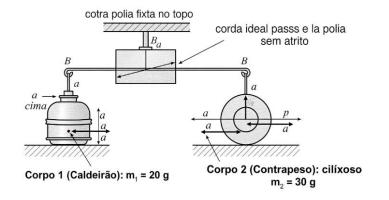
Com base na análise das forças que governam o sistema (Peso e Tração), e aplicando a Segunda Lei de Newton para corpos interligados, determine o módulo da aceleração com que o "elevador" (caldeirão) sobe.
Para a análise do modelo, são adotadas as seguintes hipóteses simplificadoras: o movimento ocorre em condições onde a resistência do ar é desprezível, e o campo gravitacional é considerado constante, resultando em uma aceleração de módulo g = 10 m/s² que se opõe ao movimento de subida. O ponto culminante da trajetória, conhecido como apogeu, é caracterizado pela inversão do sentido do movimento, momento em que a velocidade do projétil se anula instantaneamente. A determinação desta altitude é um dado fundamental na análise do movimento. Sendo assim, calcule a altura máxima, em metros, atingida pelo projétil em relação ao seu ponto de partida.
Para o teste, um objeto de massa m = 0,60 kg é liberado do repouso absoluto (v_A = 0) a partir do cume da rampa, o ponto A. Este ponto está posicionado a uma altura vertical h = 2,0 m em relação ao nível de referência da base (ponto B), onde a mola está instalada.
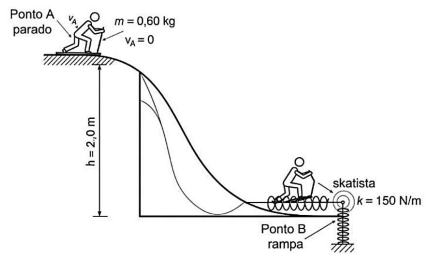
Considera-se que a rampa possui um acabamento de baixíssimo atrito e que a resistência do ar é desprezível, permitindo que o sistema seja analisado como conservativo. A mola de segurança, por sua vez, foi projetada para obedecer à Lei de Hooke e possui uma constante elástica previamente aferida de k = 150 N/m. O módulo da aceleração da gravidade no local do experimento é g = 10 m/s². A máxima compressão da mola vale, em metros:
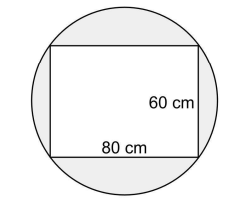
De acordo com essas informações, qual é a área (A) da moldura, destacada em cinza na imagem? (considere π = 3,14)
De acordo com as regras de regência verbal, os verbos destacados nesta frase funcionam, respectivamente, como:
De acordo com o texto base, analise as afirmações a seguir e assinale a alternativa correta.
Sintaticamente, é correto afirmar que, nesta frase:
A expressão destacada na frase trata-se de uma oração:
Morfologicamente, é correto afirmar que, nesta frase:
HOW IMPORTANT IS TECHNOLOGY IN EDUCATION?
Technology provides students with easy-toaccess information, accelerated learning, and fun opportunities to practice what they learn.
By Rambabu Dixit
1.The Meaning of Education
Knowledge, learning, and information: the word "education" is used in the English language and is derived from the Latin word "educatum" which means "teaching work." Some great scholars have attributed its origin to "educare" which means "to raise."
1.a. Narrow Meaning
This is the education given to the child in the school. The place, duration, curriculum, etc. of such education is fixed. In this sense, the person's school life is their education. Mackenzie has written: "In a narrow sense, education refers to the conscious efforts made for the development and promotion of our powers."
1.b. Broader Meaning
In this sense, education is a lifelong process by which a person develops their overall personality, social interactions, and their ability to adjust to their environment.
2.The Meaning of Technology
The use of scientific inventions, rules, principles, and processes in different aspects of life comes under the use of technology. Many types of technologies exist, including educational technology. In other words, the application of scientific principles to different areas of life is called technology. Therefore, when scientific, orderly, and well-organized knowledge is used to do daily work, then it is given the name of technology. The word "technology" is usually associated with machines, but it is not necessary that machines should always be used.
3.The Meaning of Educational Technology
When scientific, technical, and psychological principles and methods are properly used to make the teaching/learning process easy, simple, efficient, and effective, it comes under the umbrella term “educational technology”. Today, scientific and technological inventions have affected every aspect of human life. Education, teaching, and learning have also been greatly affected by them. In the field of education, as a result of the latest research, discoveries, and investigations, such techniques (i.e., skills) have been developed, which are helping in achieving the objectives of education. These competencies and skills, which are especially based on science, are given the name of educational technology.
Avaiable at: https://elearningindustry.com/how-important-istechnology-in-education. Access 20 Oct. 2023. Adapted.
HOW IMPORTANT IS TECHNOLOGY IN EDUCATION?
Technology provides students with easy-toaccess information, accelerated learning, and fun opportunities to practice what they learn.
By Rambabu Dixit
1.The Meaning of Education
Knowledge, learning, and information: the word "education" is used in the English language and is derived from the Latin word "educatum" which means "teaching work." Some great scholars have attributed its origin to "educare" which means "to raise."
1.a. Narrow Meaning
This is the education given to the child in the school. The place, duration, curriculum, etc. of such education is fixed. In this sense, the person's school life is their education. Mackenzie has written: "In a narrow sense, education refers to the conscious efforts made for the development and promotion of our powers."
1.b. Broader Meaning
In this sense, education is a lifelong process by which a person develops their overall personality, social interactions, and their ability to adjust to their environment.
2.The Meaning of Technology
The use of scientific inventions, rules, principles, and processes in different aspects of life comes under the use of technology. Many types of technologies exist, including educational technology. In other words, the application of scientific principles to different areas of life is called technology. Therefore, when scientific, orderly, and well-organized knowledge is used to do daily work, then it is given the name of technology. The word "technology" is usually associated with machines, but it is not necessary that machines should always be used.
3.The Meaning of Educational Technology
When scientific, technical, and psychological principles and methods are properly used to make the teaching/learning process easy, simple, efficient, and effective, it comes under the umbrella term “educational technology”. Today, scientific and technological inventions have affected every aspect of human life. Education, teaching, and learning have also been greatly affected by them. In the field of education, as a result of the latest research, discoveries, and investigations, such techniques (i.e., skills) have been developed, which are helping in achieving the objectives of education. These competencies and skills, which are especially based on science, are given the name of educational technology.
Avaiable at: https://elearningindustry.com/how-important-istechnology-in-education. Access 20 Oct. 2023. Adapted.
( ) Educational technology is just one of the many types of technology.
( ) Technology necessarily involves the use of machines.
( ) Scientific, technical, and psychological principles are not involved in educational technology.
( ) Few aspects of human lives have been affected by scientific and technological inventions.
HOW IMPORTANT IS TECHNOLOGY IN EDUCATION?
Technology provides students with easy-toaccess information, accelerated learning, and fun opportunities to practice what they learn.
By Rambabu Dixit
1.The Meaning of Education
Knowledge, learning, and information: the word "education" is used in the English language and is derived from the Latin word "educatum" which means "teaching work." Some great scholars have attributed its origin to "educare" which means "to raise."
1.a. Narrow Meaning
This is the education given to the child in the school. The place, duration, curriculum, etc. of such education is fixed. In this sense, the person's school life is their education. Mackenzie has written: "In a narrow sense, education refers to the conscious efforts made for the development and promotion of our powers."
1.b. Broader Meaning
In this sense, education is a lifelong process by which a person develops their overall personality, social interactions, and their ability to adjust to their environment.
2.The Meaning of Technology
The use of scientific inventions, rules, principles, and processes in different aspects of life comes under the use of technology. Many types of technologies exist, including educational technology. In other words, the application of scientific principles to different areas of life is called technology. Therefore, when scientific, orderly, and well-organized knowledge is used to do daily work, then it is given the name of technology. The word "technology" is usually associated with machines, but it is not necessary that machines should always be used.
3.The Meaning of Educational Technology
When scientific, technical, and psychological principles and methods are properly used to make the teaching/learning process easy, simple, efficient, and effective, it comes under the umbrella term “educational technology”. Today, scientific and technological inventions have affected every aspect of human life. Education, teaching, and learning have also been greatly affected by them. In the field of education, as a result of the latest research, discoveries, and investigations, such techniques (i.e., skills) have been developed, which are helping in achieving the objectives of education. These competencies and skills, which are especially based on science, are given the name of educational technology.
Avaiable at: https://elearningindustry.com/how-important-istechnology-in-education. Access 20 Oct. 2023. Adapted.
Sabendo-se que a capacidade do recipiente é de 500.0 mL, e que a reação entre os constituintes é
2SO2(g) + O2(g) ⇆ 2SO3(g) ,
o valor da constante de equilíbrio nas condições apresentadas, negligenciando as unidades, é:

 Conheça nossos planos