Questões de Vestibular
Comentadas sobre voz ativa e passiva | passive and active voice em inglês
Foram encontradas 31 questões


Leia o texto a seguir para responder à questão.
Back To School But Not To Screens: States Ramp Up Cellphone Bans
Work has been easier for public high school teacher Brian Kerekes since last August, when he first experienced the impacts of a newly enacted Florida law to restrict students’ cellphone use during class. The longtime statistics instructor, who started a new school year on Monday, now spends less time circling the classroom policing students and more time educating them on how to gather and interpret data.
Before Florida passed the ban in May 2023 — becoming the first of at least eight U.S. states to prohibit or restrict cellphone use in schools — phones proved a constant disruption in Kerekes’ classroom at Tohopekaliga High School in the central Florida city of Kissimmee.
“Students were either using them to talk to someone in a different class or talk to someone on the other side of the room or just to zone out, get on TikTok or whatever,” Kerekes, who's been a teacher for 17 years, said in an interview.
Fellow teachers nationwide face the same challenge, which explains why more states and districts are moving to limit or outright ban cellphones in the classroom, and even during the school day altogether.
The rules will look different from state to state and district to district, but all stem from the same concerns.
Seventy-two percent of high school teachers cite cellphones as a major distraction in the classroom, according to a fall 2023 Pew Research Center study. Educators also worry that constant access to social media can adversely impact kids’ mental health.
U.S. Surgeon General Vivek Murthy went so far as to issue a health advisory last year, warning that enough evidence exists to show social media can be unsafe for children and teens. “We are in the middle of a national youth mental health crisis,” he said, “and I am concerned that social media is an important driver of that crisis, one that we must urgently address.”
While social media can connect kids, make them feel less alone and offer an entertaining and creative outlet, it also exposes them to harmful content, Murthy pointed out in the advisory released by the U.S. Department of Health and Human Services. And, as educators such as Kerekes note, some students use their phones to bully fellow students online during the school day, and in the most extreme cases, to set up fights and film them.
The hope is that cellphone bans will reduce such incidents. Kerekes said he’s hearing they have.
Fonte: KATZ, Leslie. Back To School But Not To Screens: States Ramp Up Cellphone Bans. Forbes, 13 ago. 2024. Disponível em: https://www.forbes.com/sites/lesliekatz/2024/08/13/back-to-school-but-not-to-screens-more-students-face-cellphone-bans/
The passage “which they believed was a key factor” (first paragraph) could be correctly rewritten in the passive voice as which was believed to be a key factor, without this changing the meaning and coherence of the text.
Read Text to
answer question.
The article analyzes the relationship of Indigenous
Peoples with the public policy of Social Assistance (AS) in Brazil. Based on
data collected during field work carried out in 2014, will analyze the case of
the Indigenous Reserve of Dourados, Mato Grosso do Sul. In the first part, I
characterize the unequal relationship between society and national state with
Indigenous Peoples to, then approach the Welfare State politics as an
opportunity to face the violation of rights resulting from the colonial siege. Then
we will see if Dourados to illustrate the dilemmas and possibilities of
autonomy and indigenous role faced with this public policy. It is expected to
contribute to the discussion of statehood pointing concrete cases where the
local implementation of AS policy is permeable to a greater or lesser extent,
the demands of Indigenous Peoples by adaptation to their social organizations
and worldviews.
(BORGES, Júlio César. Brazilian society has made us poor: Social Assistance and ethnic autonomy of Indiggenous Peoples. The case of Dourados, Mato Grosso do Sul. Horiz. antropol. Disponível em: <http://www.scielo.br/scielo.php?script=sci_abstract&pid=S0104-71832016000200303&lng=en&nrm=iso&tlng=en>. Acesso em: 10 nov. 2018).
Cleir Avila Ferreira Júnior was born in Campo Grande, Mato Grosso do Sul State, Brazil. He is a self-taught artist. He has painted professionally since he was 18 years old. He has begun his artistic works with a hyperrealist influence, where he portrayed some regional and ecological themes, especially the Pantanal nature, presented in almost all his art.
In 1994, he started his mural work on the sides of some Campo Grande’s buildings, as example: the great "Onça Pintada" (50m high and 220m2) took him and his team a month of execution, and the "Tuiuiús" (40m high and 300m2) was his second mural. In 1995, he painted the "Blue Macaw" (45m high and 430m2). In 1996, he built the "Macaws’ Monument" in front of the international airport in Campo Grande, MS. In 1998, he painted a mural of 700m2 in Corumbá, MS, where he portrayed the red macaw in one of its walls and in the other two a big gold fish. Therefore, he did uncountable art around Mato Grosso do Sul State, mainly into the touristic cities.
(FERREIRA JÚNIOR, Cleir Avila. Disponível em: <http://www.artenossaterra.xpg.com.br/index.html>. Acesso em: 10 nov. 2018).
Based on part of the Text II, answer the question: In which verb tense are the following sentences?
“In 1995, he painted the ‘Blue Macaw’ (45m high and 430m2 ). In 1996, he built the ‘Macaws Monument’ in front of the international airport in Campo Grande, MS. In 1998, he painted a mural of 700m2 in Corumbá, MS, where he portrayed the red macaw in one of its walls and in the other two a big gold fish. Therefore, he did uncountable art around Mato Grosso do Sul State, mainly into the touristic cities”.
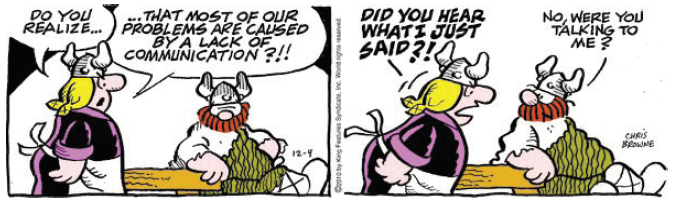
Leia a tirinha:
Fonte: http://englishteachermargarita.blogspot.com
A construção “... most of our problems are caused by a lack of communication” está na voz passiva.
Assinale a opção que a transforma em voz ativa.
TEXTO 03

“Consumerism is ruining our lives and the world” a voz passiva da frase está CORRETAMENTE construída e sem
alterar o sentido na alternativa:

One of the marked characteristics of scientific texts is the presence of passive voice.
An example from the text that illustrates this characteristic is indicated in:
How World Leaders Reacted to Trump at the U.N.
By SOMINI SENGUPTA and MEGAN SPECIA SEPT. 23, 2017
He was called a “giant gold Goliath” and a “rogue newcomer.” But in a few corners the remarks made by President Trump at the United Nations were described as “courageous” and “gratifying.”
Throughout the week, Mr. Trump’s first address to the General Assembly drew many direct and indirect swipes, from allies and rivals alike, and sparse support.
While the North Korean leader, Kim Jong-un, attacked Mr. Trump from afar — calling him a “dotard” in a statement on North Korean national television — others used their platforms at the United Nations to respond.
Some leaders were more subtle than others.
Robert Mugabe, Zimbabwe’s 93-year-old president, took aim at Mr. Trump during his own speech on Thursday. Mr. Mugabe mocked Mr. Trump as a “giant gold Goliath” and said other nations were “embarrassed if not frightened” by his statements about North Korea.
“Are we having a return of Goliath to our midst, who threatens the extinction of other countries?” Mr. Mugabe asked. Some responded with applause to his reference to the biblical character who threatened the Israelites before being slain by the young shepherd David, who would become king.
Mr. Mugabe then went on to address Mr. Trump directly, telling him to “blow your trumpet in a musical way towards the values of unity, peace, cooperation, togetherness and dialogue which we have always stood for.”
During his speech, Mr. Trump notably omitted any talk of climate change, seen as one of the most pressing issues for many world leaders.
Prime Minister Justin Trudeau of Canada received the longest applause during his General Assembly speech on Thursday after an implicit dig at Mr. Trump.
“There is no country on the planet that can walk away from the challenge and reality of climate change,” Mr. Trudeau said, referring to Mr. Trump’s plans to pull out of the Paris climate accord.
(Adapted from https://www.nytimes.com/2017/09/23/world/americas/world-leaders-trump-un.html?mcubz=0)
Turn the active voice into passive voice:
Mr. Trump notably omitted any talk of climate change
Text 4
Eclipse in Africa: 'Ring of Fire' eclipse wows stargazers
Stargazers in parts of Africa have been treated to a spectacular "ring of fire" in the sky as the sun was almost - but not completely - eclipsed.
An annular eclipse happens when the moon is farther away from the Earth than during a total eclipse.
The result is a bright circle of sunshine surrounding a dark, shadowy core.
The best views were seen in Tanzania, where the event lasted about three minutes.
The eclipse could also be viewed in parts of Gabon, Congo-Brazzaville, the Democratic Republic of Congo, Madagascar, and the French Indian Ocean island of La Reunion.
The moon does not move in a perfect circle around the earth - instead, its orbit is slightly elliptical. That means the distance of the moon varies between around 225,000-252,000 miles (362,000-405,555 km).
When the moon is farther away from the earth, it appears smaller - and does not totally cover the sun's disc during a total eclipse. The result is also known as a "ring of fire" eclipse.
The next eclipse is due to take place in February 2017, and can be seen from parts of South America and Africa.
Avaiable at:http://www.bbc.com/news/world-africa. Accessed on 02/09/16.
Answer the question below, according to the Text 4.
Leia o texto a seguir para responder à questão.
Migrant or Refugee? There Is a Difference, With Legal Implications
In the first half of this year alone, at least 137,000 men, women and children crossed the Mediterranean Sea to reach the shores of Europe, according to the United Nations. Thousands are traveling across the Balkans now. However, are they refugee or migrants? Does it make any difference? In search for these answers, let’s read the interview.
Q. Does it matter what you call them?
A. Yes. The terms “migrant” and “refugee” are sometimes used interchangeably, but there is a crucial legal difference between the two.
Q. Who is a refugee?
A. Briefly, a refugee is a person who has fled his or her country to escape war or persecution, and can prove it.
Q. What does the distinction mean for European countries?
A. Refugees are entitled to basic protections under the 1951 convention and other international agreements. Once in Europe, refugees can apply for political asylum or another protected status, sometimes temporary. By law, refugees cannot be sent back to countries where their lives would be in danger. “One of the most fundamental principles laid down in international law is that refugees should not be expelled or returned to situations where their life and freedom would be under threat,” the refugee agency said in a statement on Thursday.
Q. Who is a migrant?
A. Anyone moving from one country to another is considered a migrant unless he or she is specifically fleeing war or persecution. Migrants may be fleeing dire poverty, or may be well-off and merely seeking better opportunities, or may be migrating to join relatives who have gone before them. There is an emerging debate about whether migrants fleeing their homes because of the effects of climate change – the desertification of the Sahel region, for example, or the sinking of coastal islands in Bangladesh – ought to be reclassified as refugees.
Q. Are migrants treated differently from refugees?
A. Countries are free to deport migrants who arrive without legal papers, which they cannot do with refugees under the 1951 convention. So it is not surprising that many politicians in Europe prefer to refer to everyone fleeing to the continent as migrants.
Disponível em: <https://www.nytimes.com/2015/08/28/world/migrants-refugees-europe-syria.html?_r=0>. Acesso em: 15 set. 2015.
Technology isn’t working
The digital revolution has yet to fulfil its promise of higher productivity and better jobs
If there is a technological revolution in progress, rich economies could be forgiven for wishing it would go away. Workers in America, Europe and Japan have been through a difficult few decades. In the 1970s the blistering growth after the second world war vanished in both Europe and America. In the early 1990s Japan joined the slump, entering a prolonged period of economic stagnation. Brief spells of faster growth in intervening years quickly petered out. The rich world is still trying to shake off the effects of the 2008 financial crisis. And now the digital economy, far from pushing up wages across the board in response to higher productivity, is keeping them flat for the mass of workers while extravagantly rewarding the most talented ones.
It seems difficult to square this unhappy experience with the extraordinary technological progress during that period, but the same thing has happened before. Most economic historians reckon there was very little improvement in living standards in Britain in the century after the first Industrial Revolution. And in the early 20th century, as Victorian inventions such as electric lighting came into their own, productivity growth was every bit as slow as it has been in recent decades.
Read the text and choose the alternative that completes the sentences with the CORRECT passive voice.
Britain’s Roman Villas
Numerous monuments recall the 400 or so years when Britain was part of the Roman Empire. Ancient city walls, old roads, front defenses. But it is at the villas that one feels closest to the everyday life of Roman Britain.
The villas were homes. In their kitchens bread 1 _________ (to bake). Along their corridors echoed family conversations. They 2 _________ well _________ (to build) and handsomely 3 _________.
The first villa 4 _________ (to build) around A.D. 80-90. It was a small farm. Later on, the house 5 _________ (to extend), kitchens and baths 6 _________ (to add).
It 7 _________ (to know) that many villas 8 _________ (to destroy) by fire. Their ruins remain hidden for years and it is often by accident that the site 9 _________ (to discover).
So in Hampshire a number of oyster-shells 10_________ (to find) by a farmer, and the shells, remnants of a long-ago feast, led to the discovery of the villa at Rockbourne.
Disponível em: <http://englishstandarts.blogspot.com.br/2012/06/passive-voice-texts-proverbs-and.html> . Acesso em: julho de 2015.
TEXT
A library tradition is being refashioned to emphasize early literacy and better prepare young children for school, and drawing many new fans in the process.
Among parents of the under-5 set, spots for story time have become as coveted as seats for a hot Broadway show like “Hamilton.” Lines stretch down the block at some branches, with tickets given out on a first-come-first-served basis because there is not enough room to accommodate all of the children who show up.
Workers at the 67th Street Library on the Upper East Side of Manhattan turn away at least 10 people from every reading. They have been so overwhelmed by the rush at story time — held in the branch’s largest room, on the third floor — that once the space is full, they close the door and shut down the elevator. “It is so crowded and so popular, it’s insane,” Jacqueline Schector, a librarian, said.
Story time is drawing capacity crowds at public libraries across New York and across the country at a time when, more than ever, educators are emphasizing the importance of early literacy in preparing children for school and for developing critical thinking skills. The demand crosses economic lines, with parents at all income levels vying to get in.
Many libraries have refashioned the traditional readings to include enrichment activities such as counting numbers and naming colors, as well as music and dance. And many parents have made story time a fixture in their family routines alongside school pickups and playground outings — and, for those who employ nannies, a nonnegotiable requirement of the job.
In New York, demand for story time has surged across the city’s three library systems — the New York Public Library, the Brooklyn Public Library, and the Queens Library — and has posed logistical challenges for some branches, particularly those in small or cramped buildings. Citywide, story time attendance rose to 510,367 people in fiscal year 2015, up nearly 28 percent from 399,751 in fiscal 2013.
“The secret’s out,” said Lucy Yates, 44, an opera coach with two sons who goes to story time at the Fort Washington Library every week.
Stroller-pushing parents and nannies begin to line up for story time outside some branches an hour before doors open. To prevent overcrowding, tickets are given out at the New Amsterdam and Webster branches, both in Manhattan, the Parkchester branch in the Bronx, and a half-dozen branches in Brooklyn, including in Park Slope, Kensington and Bay Ridge.
The 67th Street branch keeps adding story times — there are now six a week — and holds sessions outdoors in the summer, when crowds can swell to 200 people.
In Queens, 41 library branches are scheduled to add weekend hours this month, and many will undoubtedly include weekend story times. As Joanne King, a spokeswoman for the library explained, parents have been begging for them and “every story time is full, every time we have one.”
Long a library staple, story time has typically been an informal reading to a small group of boys and girls sitting in a circle. Today’s story times involve carefully planned lessons by specially trained librarians that emphasize education as much as entertainment, and often include suggestions for parents and caregivers about how to reinforce what children have learned, library officials said.
Libraries around the country have expanded story time and other children’s programs in recent years, attracting a new generation of patrons in an age when online offerings sometimes make trips to the book stacks unnecessary. Sari Feldman, president of the American Library Association, said such early-literacy efforts are part of a larger transformation libraries are undergoing to become active learning centers for their communities by offering services like classes in English as a second language, computer skills and career counseling.
Ms. Feldman said the increased demand for story time was a product, in part, of more than a decade of work by the library association and others to encourage libraries to play a larger role in preparing young children for school. In 2004, as part of that effort, the association developed a curriculum, “Every Child Ready to Read,” that she said is now used by thousands of libraries.
The New York Public Library is adding 45 children’s librarians to support story time and other programs, some of which are run in partnership with the city government. It has also designated 20 of its 88 neighborhood branches, including the Fort Washington Library, as “enhanced literary sites.” As such, they will double their story time sessions, to an average of four a week, and distribute 15,000 “family literacy kits” that include a book and a schedule of story times.
“It is clear that reading and being exposed to books early in life are critical factors in student success,” Anthony W. Marx, president of the New York Public Library, said. “The library is playing an increasingly important role in strengthening early literacy in this city, expanding efforts to bring reading to children and their families through quality, free story times, curated literacy programs, after-school programs and more.”
For its part, the Queens Library plans to expand a “Kick Off to Kindergarten” program that attracted more than 180 families for a series of workshops last year. Library officials said that more than three-quarters of the children who enrolled, many of whom spoke a language other than English at home, developed measurable classroom skills.
From: www.nytimes.com/2015/11/02
TEXT
A library tradition is being refashioned to emphasize early literacy and better prepare young children for school, and drawing many new fans in the process.
Among parents of the under-5 set, spots for story time have become as coveted as seats for a hot Broadway show like “Hamilton.” Lines stretch down the block at some branches, with tickets given out on a first-come-first-served basis because there is not enough room to accommodate all of the children who show up.
Workers at the 67th Street Library on the Upper East Side of Manhattan turn away at least 10 people from every reading. They have been so overwhelmed by the rush at story time — held in the branch’s largest room, on the third floor — that once the space is full, they close the door and shut down the elevator. “It is so crowded and so popular, it’s insane,” Jacqueline Schector, a librarian, said.
Story time is drawing capacity crowds at public libraries across New York and across the country at a time when, more than ever, educators are emphasizing the importance of early literacy in preparing children for school and for developing critical thinking skills. The demand crosses economic lines, with parents at all income levels vying to get in.
Many libraries have refashioned the traditional readings to include enrichment activities such as counting numbers and naming colors, as well as music and dance. And many parents have made story time a fixture in their family routines alongside school pickups and playground outings — and, for those who employ nannies, a nonnegotiable requirement of the job.
In New York, demand for story time has surged across the city’s three library systems — the New York Public Library, the Brooklyn Public Library, and the Queens Library — and has posed logistical challenges for some branches, particularly those in small or cramped buildings. Citywide, story time attendance rose to 510,367 people in fiscal year 2015, up nearly 28 percent from 399,751 in fiscal 2013.
“The secret’s out,” said Lucy Yates, 44, an opera coach with two sons who goes to story time at the Fort Washington Library every week.
Stroller-pushing parents and nannies begin to line up for story time outside some branches an hour before doors open. To prevent overcrowding, tickets are given out at the New Amsterdam and Webster branches, both in Manhattan, the Parkchester branch in the Bronx, and a half-dozen branches in Brooklyn, including in Park Slope, Kensington and Bay Ridge.
The 67th Street branch keeps adding story times — there are now six a week — and holds sessions outdoors in the summer, when crowds can swell to 200 people.
In Queens, 41 library branches are scheduled to add weekend hours this month, and many will undoubtedly include weekend story times. As Joanne King, a spokeswoman for the library explained, parents have been begging for them and “every story time is full, every time we have one.”
Long a library staple, story time has typically been an informal reading to a small group of boys and girls sitting in a circle. Today’s story times involve carefully planned lessons by specially trained librarians that emphasize education as much as entertainment, and often include suggestions for parents and caregivers about how to reinforce what children have learned, library officials said.
Libraries around the country have expanded story time and other children’s programs in recent years, attracting a new generation of patrons in an age when online offerings sometimes make trips to the book stacks unnecessary. Sari Feldman, president of the American Library Association, said such early-literacy efforts are part of a larger transformation libraries are undergoing to become active learning centers for their communities by offering services like classes in English as a second language, computer skills and career counseling.
Ms. Feldman said the increased demand for story time was a product, in part, of more than a decade of work by the library association and others to encourage libraries to play a larger role in preparing young children for school. In 2004, as part of that effort, the association developed a curriculum, “Every Child Ready to Read,” that she said is now used by thousands of libraries.
The New York Public Library is adding 45 children’s librarians to support story time and other programs, some of which are run in partnership with the city government. It has also designated 20 of its 88 neighborhood branches, including the Fort Washington Library, as “enhanced literary sites.” As such, they will double their story time sessions, to an average of four a week, and distribute 15,000 “family literacy kits” that include a book and a schedule of story times.
“It is clear that reading and being exposed to books early in life are critical factors in student success,” Anthony W. Marx, president of the New York Public Library, said. “The library is playing an increasingly important role in strengthening early literacy in this city, expanding efforts to bring reading to children and their families through quality, free story times, curated literacy programs, after-school programs and more.”
For its part, the Queens Library plans to expand a “Kick Off to Kindergarten” program that attracted more than 180 families for a series of workshops last year. Library officials said that more than three-quarters of the children who enrolled, many of whom spoke a language other than English at home, developed measurable classroom skills.
From: www.nytimes.com/2015/11/02

 Conheça nossos planos