Questões de Vestibular
Sobre voz ativa e passiva | passive and active voice em inglês
Foram encontradas 71 questões


Leia o texto a seguir para responder à questão.
Back To School But Not To Screens: States Ramp Up Cellphone Bans
Work has been easier for public high school teacher Brian Kerekes since last August, when he first experienced the impacts of a newly enacted Florida law to restrict students’ cellphone use during class. The longtime statistics instructor, who started a new school year on Monday, now spends less time circling the classroom policing students and more time educating them on how to gather and interpret data.
Before Florida passed the ban in May 2023 — becoming the first of at least eight U.S. states to prohibit or restrict cellphone use in schools — phones proved a constant disruption in Kerekes’ classroom at Tohopekaliga High School in the central Florida city of Kissimmee.
“Students were either using them to talk to someone in a different class or talk to someone on the other side of the room or just to zone out, get on TikTok or whatever,” Kerekes, who's been a teacher for 17 years, said in an interview.
Fellow teachers nationwide face the same challenge, which explains why more states and districts are moving to limit or outright ban cellphones in the classroom, and even during the school day altogether.
The rules will look different from state to state and district to district, but all stem from the same concerns.
Seventy-two percent of high school teachers cite cellphones as a major distraction in the classroom, according to a fall 2023 Pew Research Center study. Educators also worry that constant access to social media can adversely impact kids’ mental health.
U.S. Surgeon General Vivek Murthy went so far as to issue a health advisory last year, warning that enough evidence exists to show social media can be unsafe for children and teens. “We are in the middle of a national youth mental health crisis,” he said, “and I am concerned that social media is an important driver of that crisis, one that we must urgently address.”
While social media can connect kids, make them feel less alone and offer an entertaining and creative outlet, it also exposes them to harmful content, Murthy pointed out in the advisory released by the U.S. Department of Health and Human Services. And, as educators such as Kerekes note, some students use their phones to bully fellow students online during the school day, and in the most extreme cases, to set up fights and film them.
The hope is that cellphone bans will reduce such incidents. Kerekes said he’s hearing they have.
Fonte: KATZ, Leslie. Back To School But Not To Screens: States Ramp Up Cellphone Bans. Forbes, 13 ago. 2024. Disponível em: https://www.forbes.com/sites/lesliekatz/2024/08/13/back-to-school-but-not-to-screens-more-students-face-cellphone-bans/
Instrução: A questão está relacionada ao texto abaixo.
Adapted from: DEHAENE, Stanislas. How we learn: Why brains learn better than any machine… for now. New York: Viking Press, 2020.
I - The use of present perfect simple in the clause No other animal has managed to change its ecological niche so radically (l. 08-09) implies that the author considers the event referred to finished and unrelated to the present.
II - The use of simple past in More recently, humanity discovered (l. 39) is a deviation from the standard norm, and the fragment would be made grammatically correct if its verb tense were the present perfect simple since the event it refers to is said to be recent.
III- The use of passive voice in the clause These parameters are carefully chosen (l. 24-25) means that the author does not know or prefers not to stress who or what makes the choice referred to.
Which ones are correct according to the text?
Instrução: A questão está relacionada ao texto abaixo.
Adaptado de: ÁLVAREZ, J. Snow. In: Castillo-Speed, L. Latina – Women’s voices from the borderlands. New York: Touchstone, 1995.
( ) O trecho taught by the Sisters of Charity (l. 03) pode ser substituído por which was taught by the Sisters of Charity, sem prejuízo da correção gramatical e do significado original do texto.
( ) O trecho I was put in a special seat (l. 10-11) pode ser substituído por Sister Zoe put me in a special sit, sem prejuízo da correção gramatical e do significado original do texto.
( ) A expressão so that (l. 12) pode ser substituída por in order to, sem prejuízo da correção gramatical e do significado original do texto.
( ) A oração I follow ed my breath to school (l. 37) faz referência ao fato de a respiração da menina gerar um vapor visível à sua frente, nas manhãs geladas de Nova Iorque.
A sequência correta de preenchimento dos parênteses, de cima para baixo, é
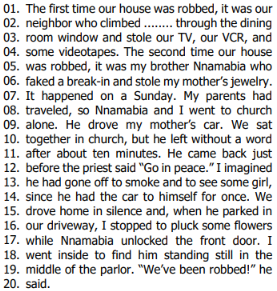
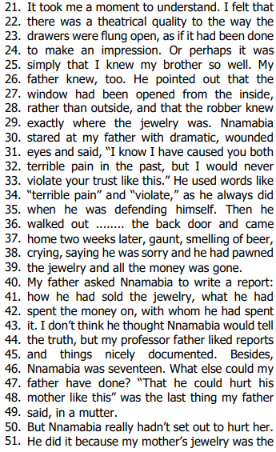
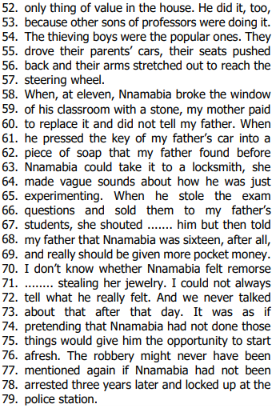
I - A substituição do pronome he (l. 13) por they implicaria a modificação de duas outras palavras na frase que o contém.
II - O uso da voz passiva na oração the window had been opened from the inside (l. 26-27) indica que existe certeza quanto a quem executou a ação descrita.
III- As ocorrências do pronome it, nas linhas 51, 52 e 53, têm como referente o roubo das joias da mãe de Nnamabia.
Quais estão corretas?
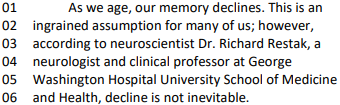
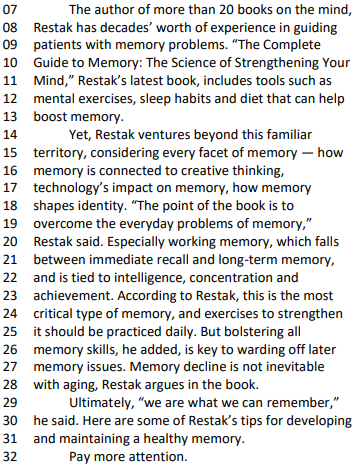
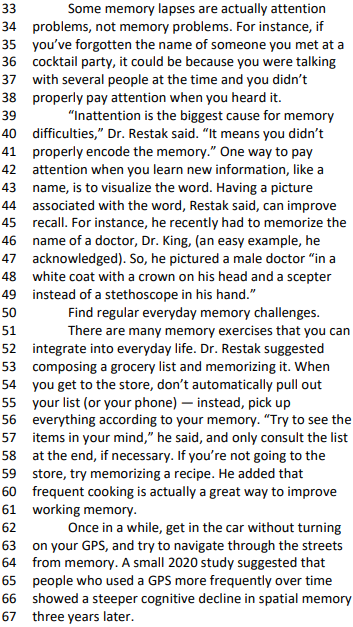
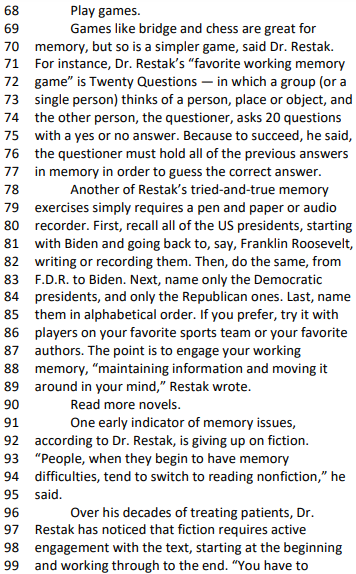
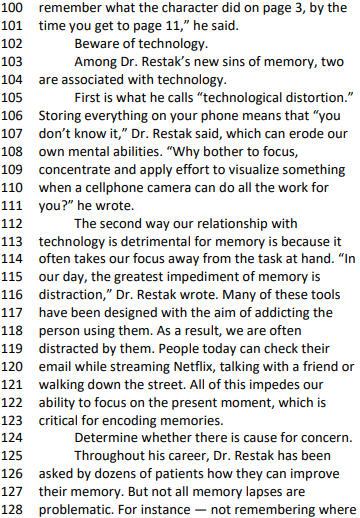
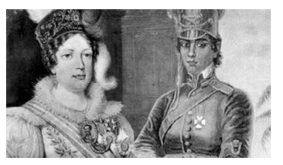
The passage “which they believed was a key factor” (first paragraph) could be correctly rewritten in the passive voice as which was believed to be a key factor, without this changing the meaning and coherence of the text.
Essential reading on, and beyond, Indigenous Peoples Day
our people are still being attacked by the many forms of colonization, (l. 29-30)
The sentence above exhibits the passive voice.
Another occurrence of the passive voice is underlined below:

https://www.theguardian.com/environment/
2021/sep/27/
https://www.theguardian.com/environment/
2021/sep/27/

Backpacs” (title) - a large bag carried on the back.
“strap” (l. 2) - a strip of leather, cloth or other flexible material.
“lugging” (l. 5) - carrying something with great effort. “prof” (l. 8) - professor.
“sprains” (l. 18) - injuries.
“strains” (l. 18) - severe demands on physical strengh.



TEXTO
The Future Of Work: 5 Important Ways Jobs
Will Change In The 4th Industrial Revolution


Fonte:
https://www.forbes.com/2019/07/15

 Conheça nossos planos