Questões de Vestibular Sobre inglês
Foram encontradas 6.367 questões


Big Tech made the social media mess. It has to fix it
Analysis by David Goldman, CNN Business
Social media has given people a platform to spew hate speech and radical beliefs to other people, amplifying what are otherwise fringe opinions. A few have turned that hate into violence.
Silicon Valley has built the biggest, most powerful companies in the world. Now, tech leaders have a responsibility to rein in the creations that have grown too unwieldy for them to control.
These are businesses, and their leaders will have to And out how to do that without destroying their companies. So far, balancing Big Tech's responsibilities to society and its duties to investors has proven difficult.
A difficult balance
Facebook (FB) announced in July it would invest billions of dollars a year to improve safety and security on the platform. The company said the effort would come at the expense of user growth and profitability. The company's stock lost about a third of its value because investors were concerned about Facebook's growth stalling.
Twitter has largely rid ISIS recruiters from the social network. Facebook and YouTube have labeled fake news stories as such. Yet, the work isn't close to done. Google has also made significant changes to YouTube's advertising policies after ads from 300 companies and organizations ran on channels promoting hate groups.
"YouTube has strict policies that prohibit content which incites others to violence or promotes hatred," a YouTube spokesperson said. "We quickly remove videos violating our policies when flagged by our users."
What seemed to cross no one's mind a decade ago was the potential downside to building a platform with billions of customers. So many posts can't possibly be monitored in real time. The networks gave the dregs of society the ability to reach like-minded people and poison the minds of others.
Without that foresight, Silicon Valley allowed their creations to break down. They're not beyond repair, but fixing them will be costly and difficult. Whether Big Tech is up to the task will determine the fates of their platforms.
Available: https://edition.cnn.com/2018/10/29/tech/social-media- -hate-speech/index.html. Access: 30 may 2019. Adapted.
Glossary: spew: lançar; fringe: periféricas; to rein in: controlar; unwieldy: desordenado; duties: deveres; profitability, lucro;
stock: ação (no mercado); stalling: interrupção; flagged: sinalizados; dregs of society: pessoas inescrupulosas; like-minded: pessoas que compartilham ideias semelhantes; poison: envenenar;
foresight: visão; beyond repair: sem conserto; up to the task: à
altura da tarefa.
Fire Devastates Brazil's Oldest Science Museum
The overnight inferno likely claimed fossils, cultural artifacts, and more irreplaceable collections amassed over 200 years.
By Michael Greshko ______________________________________
PUBLISHED September 6, 2018
Major pieces of Brazil's scientific and cultural heritage went up in smoke on September 2, as a devastating fire ripped through much of Rio de Janeiro's Museu Nacional, or National Museum. Founded in 1818, the museum is Brazil's oldest scientific institution and one of the largest and most renowned museums in Latin America, amassing a collection of some 20 million scientifically and culturally invaluable artifacts.
The Museu Nacional's holdings include Luzia, an 11,500-year-old skull considered one of South America's oldest human fossils, as well as the bones of uniquely Brazilian creatures such as the long-necked dinosaur Maxakalisaurus. Because of the auction tastes of Brazil's 19th-century emperors, the Museu Nacional also ended up with Latin America's oldest collection of Egyptian mummies and artifacts.
Even the building holds historical importance: It housed the exiled Portuguese royal family from 1808 to 1821, after they fled to Rio de Janeiro in 1807 to escape Napoleon. The complex also served as the palace for Brazil's post-independence emperors until 1889, before the museum collections were transferred there in 1902. In an September 5 email, Museu Nacional curator Débora Pires wrote that the entomology and arachnology collections were completely destroyed, as was most of the mollusk collection. However, technicians had braved the fire to save 80 percent of the mollusk holotypes—the specimens that formally serve as the global references for a given species. The museum's vertebrate specimens, herbarium, and library were housed separately and survived the fire.
(…)
An Irreplaceable Loss
It's not yet clear how the fire started, but it did begin after the museum was closed to the public, and no injuries have yet been reported. Firefighters worked through the night to douse the burnt-out shell of the main building, but it seems the blaze has already seared a gaping hole in many scientists' careers.
“The importance of the collections that were lost couldn't be overstated,” says Luiz Rocha, a Brazilian ichthyologist now at the California Academy of Sciences who has visited the Museu Nacional several times to study its collections. “They were unique as it gets: Many of them were irreplaceable, there's no way to put a monetary value on it.”
“In terms of [my] life-long research agenda, I'm pretty much lost,” says Marcus Guidoti, a Brazilian entomologist finishing up his Ph.D. in a program co-run by Brazil's Federal University of Rio Grande do Sul.
Guidoti studies lace bugs, an insect family with more than 2,000 species worldwide. The Museu Nacional held one of the world's largest lace bug collections, but the fire likely destroyed it and the rest of the museum's five million arthropod specimens. “Those type specimens can't be replaced, and they are crucial to understand the species,” he says by text message. “If I was willing to keep working on this family in this region of the globe, this was definitely a big hit.”
Paleontologist Dimila Mothé, a postdoctoral researcher at the Federal University of the State of Rio de Janeiro, adds that the blows to science extend beyond the collections themselves. “It's not only the cultural history, the natural history, but all the theses and research developed there,” she says. “Most of the laboratories there were lost, too, and the research of several professors. I'm not sure you can say the impact of what was lost.”
Brazil’s indigenous knowledge also has suffered. The Museu Nacional housed world-renowned collections of indigenous objects, as well as many audio recordings of indigenous languages from all over Brazil. Some of these recordings, now lost, were of languages that are no longer spoken.
“I have no words to say how horrible this is,” says Brazilian anthropologist Mariana Françozo, an expert on South American indigenous objects at Leiden University. “The indigenous collections are a tremendous loss … we can no longer study them, we can no longer understand what our ancestors did. It’s heartbreaking.”
On Monday, The Brazilian publication G1 Rio reported that ashes of burned documents—some still flecked in notes or illustrations—have rained down from the sky more than a mile away from the Museu Nacional, thrown aloft by the inferno.
(…)
Editor's Note: This story was updated on September 6, 2018, with new details about which artifacts survived the fire.
Taken from:
https://www.nationalgeographic.com/science/2018/09/news-museu-nacional-fire-rio-de-janeiro-natural-history/. Access: 11 dez. 2018.
Fire Devastates Brazil's Oldest Science Museum
The overnight inferno likely claimed fossils, cultural artifacts, and more irreplaceable collections amassed over 200 years.
By Michael Greshko ______________________________________
PUBLISHED September 6, 2018
Major pieces of Brazil's scientific and cultural heritage went up in smoke on September 2, as a devastating fire ripped through much of Rio de Janeiro's Museu Nacional, or National Museum. Founded in 1818, the museum is Brazil's oldest scientific institution and one of the largest and most renowned museums in Latin America, amassing a collection of some 20 million scientifically and culturally invaluable artifacts.
The Museu Nacional's holdings include Luzia, an 11,500-year-old skull considered one of South America's oldest human fossils, as well as the bones of uniquely Brazilian creatures such as the long-necked dinosaur Maxakalisaurus. Because of the auction tastes of Brazil's 19th-century emperors, the Museu Nacional also ended up with Latin America's oldest collection of Egyptian mummies and artifacts.
Even the building holds historical importance: It housed the exiled Portuguese royal family from 1808 to 1821, after they fled to Rio de Janeiro in 1807 to escape Napoleon. The complex also served as the palace for Brazil's post-independence emperors until 1889, before the museum collections were transferred there in 1902. In an September 5 email, Museu Nacional curator Débora Pires wrote that the entomology and arachnology collections were completely destroyed, as was most of the mollusk collection. However, technicians had braved the fire to save 80 percent of the mollusk holotypes—the specimens that formally serve as the global references for a given species. The museum's vertebrate specimens, herbarium, and library were housed separately and survived the fire.
(…)
An Irreplaceable Loss
It's not yet clear how the fire started, but it did begin after the museum was closed to the public, and no injuries have yet been reported. Firefighters worked through the night to douse the burnt-out shell of the main building, but it seems the blaze has already seared a gaping hole in many scientists' careers.
“The importance of the collections that were lost couldn't be overstated,” says Luiz Rocha, a Brazilian ichthyologist now at the California Academy of Sciences who has visited the Museu Nacional several times to study its collections. “They were unique as it gets: Many of them were irreplaceable, there's no way to put a monetary value on it.”
“In terms of [my] life-long research agenda, I'm pretty much lost,” says Marcus Guidoti, a Brazilian entomologist finishing up his Ph.D. in a program co-run by Brazil's Federal University of Rio Grande do Sul.
Guidoti studies lace bugs, an insect family with more than 2,000 species worldwide. The Museu Nacional held one of the world's largest lace bug collections, but the fire likely destroyed it and the rest of the museum's five million arthropod specimens. “Those type specimens can't be replaced, and they are crucial to understand the species,” he says by text message. “If I was willing to keep working on this family in this region of the globe, this was definitely a big hit.”
Paleontologist Dimila Mothé, a postdoctoral researcher at the Federal University of the State of Rio de Janeiro, adds that the blows to science extend beyond the collections themselves. “It's not only the cultural history, the natural history, but all the theses and research developed there,” she says. “Most of the laboratories there were lost, too, and the research of several professors. I'm not sure you can say the impact of what was lost.”
Brazil’s indigenous knowledge also has suffered. The Museu Nacional housed world-renowned collections of indigenous objects, as well as many audio recordings of indigenous languages from all over Brazil. Some of these recordings, now lost, were of languages that are no longer spoken.
“I have no words to say how horrible this is,” says Brazilian anthropologist Mariana Françozo, an expert on South American indigenous objects at Leiden University. “The indigenous collections are a tremendous loss … we can no longer study them, we can no longer understand what our ancestors did. It’s heartbreaking.”
On Monday, The Brazilian publication G1 Rio reported that ashes of burned documents—some still flecked in notes or illustrations—have rained down from the sky more than a mile away from the Museu Nacional, thrown aloft by the inferno.
(…)
Editor's Note: This story was updated on September 6, 2018, with new details about which artifacts survived the fire.
Taken from:
https://www.nationalgeographic.com/science/2018/09/news-museu-nacional-fire-rio-de-janeiro-natural-history/. Access: 11 dez. 2018.
Fire Devastates Brazil's Oldest Science Museum
The overnight inferno likely claimed fossils, cultural artifacts, and more irreplaceable collections amassed over 200 years.
By Michael Greshko ______________________________________
PUBLISHED September 6, 2018
Major pieces of Brazil's scientific and cultural heritage went up in smoke on September 2, as a devastating fire ripped through much of Rio de Janeiro's Museu Nacional, or National Museum. Founded in 1818, the museum is Brazil's oldest scientific institution and one of the largest and most renowned museums in Latin America, amassing a collection of some 20 million scientifically and culturally invaluable artifacts.
The Museu Nacional's holdings include Luzia, an 11,500-year-old skull considered one of South America's oldest human fossils, as well as the bones of uniquely Brazilian creatures such as the long-necked dinosaur Maxakalisaurus. Because of the auction tastes of Brazil's 19th-century emperors, the Museu Nacional also ended up with Latin America's oldest collection of Egyptian mummies and artifacts.
Even the building holds historical importance: It housed the exiled Portuguese royal family from 1808 to 1821, after they fled to Rio de Janeiro in 1807 to escape Napoleon. The complex also served as the palace for Brazil's post-independence emperors until 1889, before the museum collections were transferred there in 1902. In an September 5 email, Museu Nacional curator Débora Pires wrote that the entomology and arachnology collections were completely destroyed, as was most of the mollusk collection. However, technicians had braved the fire to save 80 percent of the mollusk holotypes—the specimens that formally serve as the global references for a given species. The museum's vertebrate specimens, herbarium, and library were housed separately and survived the fire.
(…)
An Irreplaceable Loss
It's not yet clear how the fire started, but it did begin after the museum was closed to the public, and no injuries have yet been reported. Firefighters worked through the night to douse the burnt-out shell of the main building, but it seems the blaze has already seared a gaping hole in many scientists' careers.
“The importance of the collections that were lost couldn't be overstated,” says Luiz Rocha, a Brazilian ichthyologist now at the California Academy of Sciences who has visited the Museu Nacional several times to study its collections. “They were unique as it gets: Many of them were irreplaceable, there's no way to put a monetary value on it.”
“In terms of [my] life-long research agenda, I'm pretty much lost,” says Marcus Guidoti, a Brazilian entomologist finishing up his Ph.D. in a program co-run by Brazil's Federal University of Rio Grande do Sul.
Guidoti studies lace bugs, an insect family with more than 2,000 species worldwide. The Museu Nacional held one of the world's largest lace bug collections, but the fire likely destroyed it and the rest of the museum's five million arthropod specimens. “Those type specimens can't be replaced, and they are crucial to understand the species,” he says by text message. “If I was willing to keep working on this family in this region of the globe, this was definitely a big hit.”
Paleontologist Dimila Mothé, a postdoctoral researcher at the Federal University of the State of Rio de Janeiro, adds that the blows to science extend beyond the collections themselves. “It's not only the cultural history, the natural history, but all the theses and research developed there,” she says. “Most of the laboratories there were lost, too, and the research of several professors. I'm not sure you can say the impact of what was lost.”
Brazil’s indigenous knowledge also has suffered. The Museu Nacional housed world-renowned collections of indigenous objects, as well as many audio recordings of indigenous languages from all over Brazil. Some of these recordings, now lost, were of languages that are no longer spoken.
“I have no words to say how horrible this is,” says Brazilian anthropologist Mariana Françozo, an expert on South American indigenous objects at Leiden University. “The indigenous collections are a tremendous loss … we can no longer study them, we can no longer understand what our ancestors did. It’s heartbreaking.”
On Monday, The Brazilian publication G1 Rio reported that ashes of burned documents—some still flecked in notes or illustrations—have rained down from the sky more than a mile away from the Museu Nacional, thrown aloft by the inferno.
(…)
Editor's Note: This story was updated on September 6, 2018, with new details about which artifacts survived the fire.
Taken from:
https://www.nationalgeographic.com/science/2018/09/news-museu-nacional-fire-rio-de-janeiro-natural-history/. Access: 11 dez. 2018.
Fire Devastates Brazil's Oldest Science Museum
The overnight inferno likely claimed fossils, cultural artifacts, and more irreplaceable collections amassed over 200 years.
By Michael Greshko ______________________________________
PUBLISHED September 6, 2018
Major pieces of Brazil's scientific and cultural heritage went up in smoke on September 2, as a devastating fire ripped through much of Rio de Janeiro's Museu Nacional, or National Museum. Founded in 1818, the museum is Brazil's oldest scientific institution and one of the largest and most renowned museums in Latin America, amassing a collection of some 20 million scientifically and culturally invaluable artifacts.
The Museu Nacional's holdings include Luzia, an 11,500-year-old skull considered one of South America's oldest human fossils, as well as the bones of uniquely Brazilian creatures such as the long-necked dinosaur Maxakalisaurus. Because of the auction tastes of Brazil's 19th-century emperors, the Museu Nacional also ended up with Latin America's oldest collection of Egyptian mummies and artifacts.
Even the building holds historical importance: It housed the exiled Portuguese royal family from 1808 to 1821, after they fled to Rio de Janeiro in 1807 to escape Napoleon. The complex also served as the palace for Brazil's post-independence emperors until 1889, before the museum collections were transferred there in 1902. In an September 5 email, Museu Nacional curator Débora Pires wrote that the entomology and arachnology collections were completely destroyed, as was most of the mollusk collection. However, technicians had braved the fire to save 80 percent of the mollusk holotypes—the specimens that formally serve as the global references for a given species. The museum's vertebrate specimens, herbarium, and library were housed separately and survived the fire.
(…)
An Irreplaceable Loss
It's not yet clear how the fire started, but it did begin after the museum was closed to the public, and no injuries have yet been reported. Firefighters worked through the night to douse the burnt-out shell of the main building, but it seems the blaze has already seared a gaping hole in many scientists' careers.
“The importance of the collections that were lost couldn't be overstated,” says Luiz Rocha, a Brazilian ichthyologist now at the California Academy of Sciences who has visited the Museu Nacional several times to study its collections. “They were unique as it gets: Many of them were irreplaceable, there's no way to put a monetary value on it.”
“In terms of [my] life-long research agenda, I'm pretty much lost,” says Marcus Guidoti, a Brazilian entomologist finishing up his Ph.D. in a program co-run by Brazil's Federal University of Rio Grande do Sul.
Guidoti studies lace bugs, an insect family with more than 2,000 species worldwide. The Museu Nacional held one of the world's largest lace bug collections, but the fire likely destroyed it and the rest of the museum's five million arthropod specimens. “Those type specimens can't be replaced, and they are crucial to understand the species,” he says by text message. “If I was willing to keep working on this family in this region of the globe, this was definitely a big hit.”
Paleontologist Dimila Mothé, a postdoctoral researcher at the Federal University of the State of Rio de Janeiro, adds that the blows to science extend beyond the collections themselves. “It's not only the cultural history, the natural history, but all the theses and research developed there,” she says. “Most of the laboratories there were lost, too, and the research of several professors. I'm not sure you can say the impact of what was lost.”
Brazil’s indigenous knowledge also has suffered. The Museu Nacional housed world-renowned collections of indigenous objects, as well as many audio recordings of indigenous languages from all over Brazil. Some of these recordings, now lost, were of languages that are no longer spoken.
“I have no words to say how horrible this is,” says Brazilian anthropologist Mariana Françozo, an expert on South American indigenous objects at Leiden University. “The indigenous collections are a tremendous loss … we can no longer study them, we can no longer understand what our ancestors did. It’s heartbreaking.”
On Monday, The Brazilian publication G1 Rio reported that ashes of burned documents—some still flecked in notes or illustrations—have rained down from the sky more than a mile away from the Museu Nacional, thrown aloft by the inferno.
(…)
Editor's Note: This story was updated on September 6, 2018, with new details about which artifacts survived the fire.
Taken from:
https://www.nationalgeographic.com/science/2018/09/news-museu-nacional-fire-rio-de-janeiro-natural-history/. Access: 11 dez. 2018.
Fire Devastates Brazil's Oldest Science Museum
The overnight inferno likely claimed fossils, cultural artifacts, and more irreplaceable collections amassed over 200 years.
By Michael Greshko ______________________________________
PUBLISHED September 6, 2018
Major pieces of Brazil's scientific and cultural heritage went up in smoke on September 2, as a devastating fire ripped through much of Rio de Janeiro's Museu Nacional, or National Museum. Founded in 1818, the museum is Brazil's oldest scientific institution and one of the largest and most renowned museums in Latin America, amassing a collection of some 20 million scientifically and culturally invaluable artifacts.
The Museu Nacional's holdings include Luzia, an 11,500-year-old skull considered one of South America's oldest human fossils, as well as the bones of uniquely Brazilian creatures such as the long-necked dinosaur Maxakalisaurus. Because of the auction tastes of Brazil's 19th-century emperors, the Museu Nacional also ended up with Latin America's oldest collection of Egyptian mummies and artifacts.
Even the building holds historical importance: It housed the exiled Portuguese royal family from 1808 to 1821, after they fled to Rio de Janeiro in 1807 to escape Napoleon. The complex also served as the palace for Brazil's post-independence emperors until 1889, before the museum collections were transferred there in 1902. In an September 5 email, Museu Nacional curator Débora Pires wrote that the entomology and arachnology collections were completely destroyed, as was most of the mollusk collection. However, technicians had braved the fire to save 80 percent of the mollusk holotypes—the specimens that formally serve as the global references for a given species. The museum's vertebrate specimens, herbarium, and library were housed separately and survived the fire.
(…)
An Irreplaceable Loss
It's not yet clear how the fire started, but it did begin after the museum was closed to the public, and no injuries have yet been reported. Firefighters worked through the night to douse the burnt-out shell of the main building, but it seems the blaze has already seared a gaping hole in many scientists' careers.
“The importance of the collections that were lost couldn't be overstated,” says Luiz Rocha, a Brazilian ichthyologist now at the California Academy of Sciences who has visited the Museu Nacional several times to study its collections. “They were unique as it gets: Many of them were irreplaceable, there's no way to put a monetary value on it.”
“In terms of [my] life-long research agenda, I'm pretty much lost,” says Marcus Guidoti, a Brazilian entomologist finishing up his Ph.D. in a program co-run by Brazil's Federal University of Rio Grande do Sul.
Guidoti studies lace bugs, an insect family with more than 2,000 species worldwide. The Museu Nacional held one of the world's largest lace bug collections, but the fire likely destroyed it and the rest of the museum's five million arthropod specimens. “Those type specimens can't be replaced, and they are crucial to understand the species,” he says by text message. “If I was willing to keep working on this family in this region of the globe, this was definitely a big hit.”
Paleontologist Dimila Mothé, a postdoctoral researcher at the Federal University of the State of Rio de Janeiro, adds that the blows to science extend beyond the collections themselves. “It's not only the cultural history, the natural history, but all the theses and research developed there,” she says. “Most of the laboratories there were lost, too, and the research of several professors. I'm not sure you can say the impact of what was lost.”
Brazil’s indigenous knowledge also has suffered. The Museu Nacional housed world-renowned collections of indigenous objects, as well as many audio recordings of indigenous languages from all over Brazil. Some of these recordings, now lost, were of languages that are no longer spoken.
“I have no words to say how horrible this is,” says Brazilian anthropologist Mariana Françozo, an expert on South American indigenous objects at Leiden University. “The indigenous collections are a tremendous loss … we can no longer study them, we can no longer understand what our ancestors did. It’s heartbreaking.”
On Monday, The Brazilian publication G1 Rio reported that ashes of burned documents—some still flecked in notes or illustrations—have rained down from the sky more than a mile away from the Museu Nacional, thrown aloft by the inferno.
(…)
Editor's Note: This story was updated on September 6, 2018, with new details about which artifacts survived the fire.
Taken from:
https://www.nationalgeographic.com/science/2018/09/news-museu-nacional-fire-rio-de-janeiro-natural-history/. Access: 11 dez. 2018.
Read Text to
answer question.
The article analyzes the relationship of Indigenous
Peoples with the public policy of Social Assistance (AS) in Brazil. Based on
data collected during field work carried out in 2014, will analyze the case of
the Indigenous Reserve of Dourados, Mato Grosso do Sul. In the first part, I
characterize the unequal relationship between society and national state with
Indigenous Peoples to, then approach the Welfare State politics as an
opportunity to face the violation of rights resulting from the colonial siege. Then
we will see if Dourados to illustrate the dilemmas and possibilities of
autonomy and indigenous role faced with this public policy. It is expected to
contribute to the discussion of statehood pointing concrete cases where the
local implementation of AS policy is permeable to a greater or lesser extent,
the demands of Indigenous Peoples by adaptation to their social organizations
and worldviews.
(BORGES, Júlio César. Brazilian society has made us poor: Social Assistance and ethnic autonomy of Indiggenous Peoples. The case of Dourados, Mato Grosso do Sul. Horiz. antropol. Disponível em: <http://www.scielo.br/scielo.php?script=sci_abstract&pid=S0104-71832016000200303&lng=en&nrm=iso&tlng=en>. Acesso em: 10 nov. 2018).
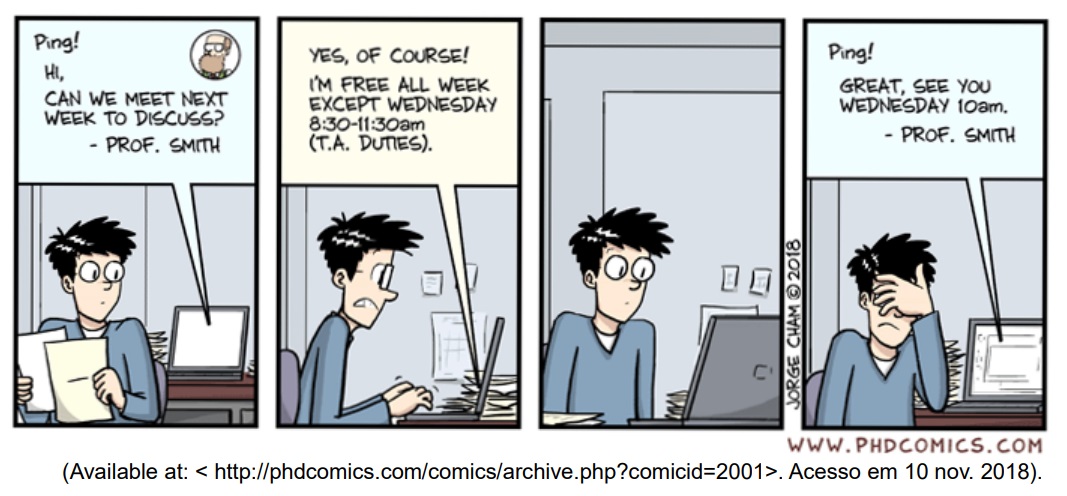
Read the comic to answer question.

According to the comic, it is correct to affirm that:
Read Text to
answer question.
The article analyzes the relationship of Indigenous
Peoples with the public policy of Social Assistance (AS) in Brazil. Based on
data collected during field work carried out in 2014, will analyze the case of
the Indigenous Reserve of Dourados, Mato Grosso do Sul. In the first part, I
characterize the unequal relationship between society and national state with
Indigenous Peoples to, then approach the Welfare State politics as an
opportunity to face the violation of rights resulting from the colonial siege. Then
we will see if Dourados to illustrate the dilemmas and possibilities of
autonomy and indigenous role faced with this public policy. It is expected to
contribute to the discussion of statehood pointing concrete cases where the
local implementation of AS policy is permeable to a greater or lesser extent,
the demands of Indigenous Peoples by adaptation to their social organizations
and worldviews.
(BORGES, Júlio César. Brazilian society has made us poor: Social Assistance and ethnic autonomy of Indiggenous Peoples. The case of Dourados, Mato Grosso do Sul. Horiz. antropol. Disponível em: <http://www.scielo.br/scielo.php?script=sci_abstract&pid=S0104-71832016000200303&lng=en&nrm=iso&tlng=en>. Acesso em: 10 nov. 2018).
Cleir Avila Ferreira Júnior was born in Campo Grande, Mato Grosso do Sul State, Brazil. He is a self-taught artist. He has painted professionally since he was 18 years old. He has begun his artistic works with a hyperrealist influence, where he portrayed some regional and ecological themes, especially the Pantanal nature, presented in almost all his art.
In 1994, he started his mural work on the sides of some Campo Grande’s buildings, as example: the great "Onça Pintada" (50m high and 220m2) took him and his team a month of execution, and the "Tuiuiús" (40m high and 300m2) was his second mural. In 1995, he painted the "Blue Macaw" (45m high and 430m2). In 1996, he built the "Macaws’ Monument" in front of the international airport in Campo Grande, MS. In 1998, he painted a mural of 700m2 in Corumbá, MS, where he portrayed the red macaw in one of its walls and in the other two a big gold fish. Therefore, he did uncountable art around Mato Grosso do Sul State, mainly into the touristic cities.
(FERREIRA JÚNIOR, Cleir Avila. Disponível em: <http://www.artenossaterra.xpg.com.br/index.html>. Acesso em: 10 nov. 2018).
The genre of text that tells the story of someone's life is called biography (bio is life, and graphy is written). It is a mixture between journalism, literature and history, in which the history of a person's life is reported and recorded, emphasizing the main facts.
So, considering Text II, what kind of genre was it written on?
Read Text to
answer question.
The article analyzes the relationship of Indigenous
Peoples with the public policy of Social Assistance (AS) in Brazil. Based on
data collected during field work carried out in 2014, will analyze the case of
the Indigenous Reserve of Dourados, Mato Grosso do Sul. In the first part, I
characterize the unequal relationship between society and national state with
Indigenous Peoples to, then approach the Welfare State politics as an
opportunity to face the violation of rights resulting from the colonial siege. Then
we will see if Dourados to illustrate the dilemmas and possibilities of
autonomy and indigenous role faced with this public policy. It is expected to
contribute to the discussion of statehood pointing concrete cases where the
local implementation of AS policy is permeable to a greater or lesser extent,
the demands of Indigenous Peoples by adaptation to their social organizations
and worldviews.
(BORGES, Júlio César. Brazilian society has made us poor: Social Assistance and ethnic autonomy of Indiggenous Peoples. The case of Dourados, Mato Grosso do Sul. Horiz. antropol. Disponível em: <http://www.scielo.br/scielo.php?script=sci_abstract&pid=S0104-71832016000200303&lng=en&nrm=iso&tlng=en>. Acesso em: 10 nov. 2018).
Cleir Avila Ferreira Júnior was born in Campo Grande, Mato Grosso do Sul State, Brazil. He is a self-taught artist. He has painted professionally since he was 18 years old. He has begun his artistic works with a hyperrealist influence, where he portrayed some regional and ecological themes, especially the Pantanal nature, presented in almost all his art.
In 1994, he started his mural work on the sides of some Campo Grande’s buildings, as example: the great "Onça Pintada" (50m high and 220m2) took him and his team a month of execution, and the "Tuiuiús" (40m high and 300m2) was his second mural. In 1995, he painted the "Blue Macaw" (45m high and 430m2). In 1996, he built the "Macaws’ Monument" in front of the international airport in Campo Grande, MS. In 1998, he painted a mural of 700m2 in Corumbá, MS, where he portrayed the red macaw in one of its walls and in the other two a big gold fish. Therefore, he did uncountable art around Mato Grosso do Sul State, mainly into the touristic cities.
(FERREIRA JÚNIOR, Cleir Avila. Disponível em: <http://www.artenossaterra.xpg.com.br/index.html>. Acesso em: 10 nov. 2018).
Based on part of the Text II, answer the question: In which verb tense are the following sentences?
“In 1995, he painted the ‘Blue Macaw’ (45m high and 430m2 ). In 1996, he built the ‘Macaws Monument’ in front of the international airport in Campo Grande, MS. In 1998, he painted a mural of 700m2 in Corumbá, MS, where he portrayed the red macaw in one of its walls and in the other two a big gold fish. Therefore, he did uncountable art around Mato Grosso do Sul State, mainly into the touristic cities”.
Read Text to
answer question.
The article analyzes the relationship of Indigenous
Peoples with the public policy of Social Assistance (AS) in Brazil. Based on
data collected during field work carried out in 2014, will analyze the case of
the Indigenous Reserve of Dourados, Mato Grosso do Sul. In the first part, I
characterize the unequal relationship between society and national state with
Indigenous Peoples to, then approach the Welfare State politics as an
opportunity to face the violation of rights resulting from the colonial siege. Then
we will see if Dourados to illustrate the dilemmas and possibilities of
autonomy and indigenous role faced with this public policy. It is expected to
contribute to the discussion of statehood pointing concrete cases where the
local implementation of AS policy is permeable to a greater or lesser extent,
the demands of Indigenous Peoples by adaptation to their social organizations
and worldviews.
(BORGES, Júlio César. Brazilian society has made us poor: Social Assistance and ethnic autonomy of Indiggenous Peoples. The case of Dourados, Mato Grosso do Sul. Horiz. antropol. Disponível em: <http://www.scielo.br/scielo.php?script=sci_abstract&pid=S0104-71832016000200303&lng=en&nrm=iso&tlng=en>. Acesso em: 10 nov. 2018).


 Conheça nossos planos