Questões de Vestibular Sobre inglês
Foram encontradas 6.367 questões


Ano: 2023
Banca:
PUC - RS
Órgão:
PUC - RS
Provas:
PUC - RS - 2022 - PUC - RS - Vestibular - Primeiro Semestre - Medicina
|
PUC - RS - 2023 - PUC - RS - Vestibular - Medicina |
Q2092709
Inglês
Texto associado
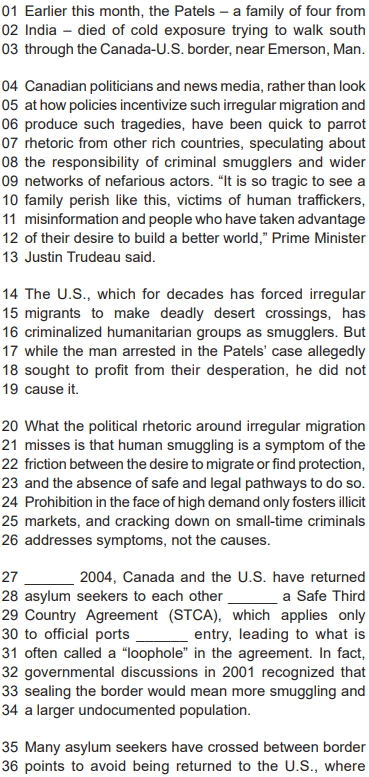
TEXTO 1
Asylum-seeker smuggling is a
symptom, not a root cause
Robert Falconer/Craig D. Smith - Jan 31, 2022
Source: https://www.theglobeandmail.com/opinion/
article-asylum-seeker-smuggling-is-a-symptom-not-a-root-cause/
Choose the alternative that best expresses the idea
presented in this excerpt (lines 40 to 43).
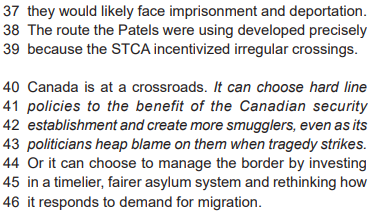
“It can choose hard line policies to the benefit of the Canadian security establishment and create more smugglers, even as its politicians heap blame on them when tragedy strikes.”
“It can choose hard line policies to the benefit of the Canadian security establishment and create more smugglers, even as its politicians heap blame on them when tragedy strikes.”
Ano: 2023
Banca:
PUC - RS
Órgão:
PUC - RS
Provas:
PUC - RS - 2022 - PUC - RS - Vestibular - Primeiro Semestre - Medicina
|
PUC - RS - 2023 - PUC - RS - Vestibular - Medicina |
Q2092708
Inglês
Texto associado
TEXTO 1
Asylum-seeker smuggling is a
symptom, not a root cause
Robert Falconer/Craig D. Smith - Jan 31, 2022
Source: https://www.theglobeandmail.com/opinion/
article-asylum-seeker-smuggling-is-a-symptom-not-a-root-cause/
The verb forms “fosters” (line 24) and “cracking down”
(line 25), and the adjective “small-time” (line 25), in
the context, mean, respectively,
Ano: 2023
Banca:
PUC - RS
Órgão:
PUC - RS
Provas:
PUC - RS - 2022 - PUC - RS - Vestibular - Primeiro Semestre - Medicina
|
PUC - RS - 2023 - PUC - RS - Vestibular - Medicina |
Q2092707
Inglês
Texto associado
TEXTO 1
Asylum-seeker smuggling is a
symptom, not a root cause
Robert Falconer/Craig D. Smith - Jan 31, 2022
Source: https://www.theglobeandmail.com/opinion/
article-asylum-seeker-smuggling-is-a-symptom-not-a-root-cause/
Consider the following sentences from text 1 and
answer T (true) or F (false).
( ) The last sentence in Text 1 (lines 44 to 46) presents two examples of adjectives in the comparative degree. ( ) “avoid being returned” (line 36) is about an action that will/would happen while “remember being arrested” is about an action that has already happened. ( ) The two instances of the word “such” (lines 05 and 06) have the same idea as “such” in “I cannot imagine anyone living on such a small salary”.
The alternative that presents the correct top-down sequence of answers to the sentences above is
( ) The last sentence in Text 1 (lines 44 to 46) presents two examples of adjectives in the comparative degree. ( ) “avoid being returned” (line 36) is about an action that will/would happen while “remember being arrested” is about an action that has already happened. ( ) The two instances of the word “such” (lines 05 and 06) have the same idea as “such” in “I cannot imagine anyone living on such a small salary”.
The alternative that presents the correct top-down sequence of answers to the sentences above is
Ano: 2023
Banca:
PUC - RS
Órgão:
PUC - RS
Provas:
PUC - RS - 2022 - PUC - RS - Vestibular - Primeiro Semestre - Medicina
|
PUC - RS - 2023 - PUC - RS - Vestibular - Medicina |
Q2092706
Inglês
Texto associado
TEXTO 1
Asylum-seeker smuggling is a
symptom, not a root cause
Robert Falconer/Craig D. Smith - Jan 31, 2022
Source: https://www.theglobeandmail.com/opinion/
article-asylum-seeker-smuggling-is-a-symptom-not-a-root-cause/
The question that does NOT find an answer in Text 1 is
Ano: 2023
Banca:
PUC - RS
Órgão:
PUC - RS
Provas:
PUC - RS - 2022 - PUC - RS - Vestibular - Primeiro Semestre - Medicina
|
PUC - RS - 2023 - PUC - RS - Vestibular - Medicina |
Q2092705
Inglês
Texto associado
TEXTO 1
Asylum-seeker smuggling is a
symptom, not a root cause
Robert Falconer/Craig D. Smith - Jan 31, 2022
Source: https://www.theglobeandmail.com/opinion/
article-asylum-seeker-smuggling-is-a-symptom-not-a-root-cause/
The word “loophole” (line 31), in this context, denotes
Ano: 2023
Banca:
PUC - RS
Órgão:
PUC - RS
Provas:
PUC - RS - 2022 - PUC - RS - Vestibular - Primeiro Semestre - Medicina
|
PUC - RS - 2023 - PUC - RS - Vestibular - Medicina |
Q2092704
Inglês
Texto associado
TEXTO 1
Asylum-seeker smuggling is a
symptom, not a root cause
Robert Falconer/Craig D. Smith - Jan 31, 2022
Source: https://www.theglobeandmail.com/opinion/
article-asylum-seeker-smuggling-is-a-symptom-not-a-root-cause/
The paragraph below was taken out of Text 1.
“Just three months earlier, the U.K.’s Interior Minister blamed smugglers for the death of 31 people when a boat capsized, and vowed to pass laws to make it illegal to claim asylum.”
After which paragraph in the text can it be placed
back?
Ano: 2023
Banca:
PUC - RS
Órgão:
PUC - RS
Provas:
PUC - RS - 2022 - PUC - RS - Vestibular - Primeiro Semestre - Medicina
|
PUC - RS - 2023 - PUC - RS - Vestibular - Medicina |
Q2092703
Inglês
Texto associado
TEXTO 1
Asylum-seeker smuggling is a
symptom, not a root cause
Robert Falconer/Craig D. Smith - Jan 31, 2022
Source: https://www.theglobeandmail.com/opinion/
article-asylum-seeker-smuggling-is-a-symptom-not-a-root-cause/
Circle the alternative that brings the right prepositions
to fill in the blanks in paragrah 5.
Q4204812
Inglês
Considere o trecho da notícia veiculada no Reino Unido.
A YouGov survey of more than 16,000 adults found that of the 40% of people who asked for a pay rise, just over a quarter succeeded.
(www.theguardian.com, 03.04.2022.)
De acordo com os dados da notícia, do total de entrevistados, aqueles que conseguiram aumento salarial representam
A YouGov survey of more than 16,000 adults found that of the 40% of people who asked for a pay rise, just over a quarter succeeded.
(www.theguardian.com, 03.04.2022.)
De acordo com os dados da notícia, do total de entrevistados, aqueles que conseguiram aumento salarial representam
Q4204757
Inglês

(https://boredpanda.com)
From the comic strip, one can say that happiness
Q4204756
Inglês
Texto associado
Leia o texto para responder à questão.
World’s happiest ranking goes to
Finland for fifth year in a row
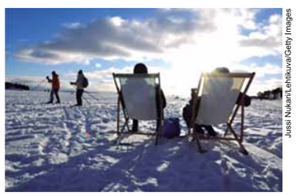
People enjoy sunny weather on the waterfront in Helsinki.
Finland was crowned the happiest country in the world for
the fifth consecutive year, with a score significantly ahead of its
peers in the World Happiness Report 2022 ranking, published
by a body linked to the United Nations. However, the authors
detected, on average, a long-term moderate upward trend in
stress, worry, and sadness in most countries, as well as “a
slight long-term decline in the enjoyment of life,” they wrote.
The report uses global survey data to report on how
people evaluate their own lives in more than 150 countries
around the world, with the ranking based on a three-year
average. Key variables that contribute to explaining people’s
life evaluations include healthy life expectancy, generosity,
social support, freedom to make life choices, perceptions of
corruption, and the gross domestic product per capita (an
indicator that measures a country’s economic output per
person, that is calculated by dividing the total gross domestic
product of a country by its population).
“World leaders should take heed,” Jeffrey Sachs, director
of the Center for Sustainable Development at Columbia
University, said. “Politics should be directed as the great
sages long ago insisted: to the well-being of the people, not
the power of the rulers.”
(Kati Pohjanpalo. www.bloomberg.com, 18.03.2022. Adaptado.)
No trecho do terceiro parágrafo ‘“World leaders should take
heed”’, a expressão sublinhada pode ser substituída, sem
alteração de sentido, por
Q4204755
Inglês
Texto associado
Leia o texto para responder à questão.
World’s happiest ranking goes to
Finland for fifth year in a row
People enjoy sunny weather on the waterfront in Helsinki.
Finland was crowned the happiest country in the world for
the fifth consecutive year, with a score significantly ahead of its
peers in the World Happiness Report 2022 ranking, published
by a body linked to the United Nations. However, the authors
detected, on average, a long-term moderate upward trend in
stress, worry, and sadness in most countries, as well as “a
slight long-term decline in the enjoyment of life,” they wrote.
The report uses global survey data to report on how
people evaluate their own lives in more than 150 countries
around the world, with the ranking based on a three-year
average. Key variables that contribute to explaining people’s
life evaluations include healthy life expectancy, generosity,
social support, freedom to make life choices, perceptions of
corruption, and the gross domestic product per capita (an
indicator that measures a country’s economic output per
person, that is calculated by dividing the total gross domestic
product of a country by its population).
“World leaders should take heed,” Jeffrey Sachs, director
of the Center for Sustainable Development at Columbia
University, said. “Politics should be directed as the great
sages long ago insisted: to the well-being of the people, not
the power of the rulers.”
(Kati Pohjanpalo. www.bloomberg.com, 18.03.2022. Adaptado.)
De acordo com o texto, uma das variáveis que ajuda a interpretar as avaliações das pessoas sobre a sua própria vida é o
Q4204754
Inglês
Texto associado
Leia o texto para responder à questão.
World’s happiest ranking goes to
Finland for fifth year in a row
People enjoy sunny weather on the waterfront in Helsinki.
Finland was crowned the happiest country in the world for
the fifth consecutive year, with a score significantly ahead of its
peers in the World Happiness Report 2022 ranking, published
by a body linked to the United Nations. However, the authors
detected, on average, a long-term moderate upward trend in
stress, worry, and sadness in most countries, as well as “a
slight long-term decline in the enjoyment of life,” they wrote.
The report uses global survey data to report on how
people evaluate their own lives in more than 150 countries
around the world, with the ranking based on a three-year
average. Key variables that contribute to explaining people’s
life evaluations include healthy life expectancy, generosity,
social support, freedom to make life choices, perceptions of
corruption, and the gross domestic product per capita (an
indicator that measures a country’s economic output per
person, that is calculated by dividing the total gross domestic
product of a country by its population).
“World leaders should take heed,” Jeffrey Sachs, director
of the Center for Sustainable Development at Columbia
University, said. “Politics should be directed as the great
sages long ago insisted: to the well-being of the people, not
the power of the rulers.”
(Kati Pohjanpalo. www.bloomberg.com, 18.03.2022. Adaptado.)
According to the text, the World Happiness Report 2022
Q4204752
Inglês
Texto associado
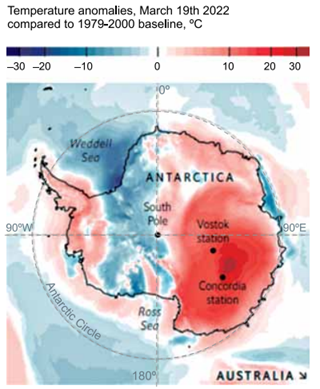
Examine o gráfico e o mapa e leia o texto para responder à questão.
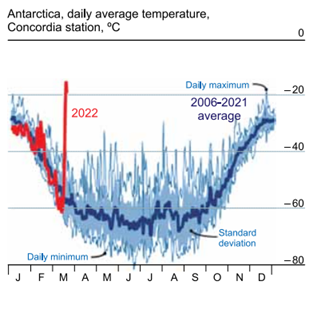
In March 2022, parts of Antarctica have been 40 ºC
warmer than their March average
The Concordia research station is one of the most
inhospitable places on Earth. At 3,000m above sea level on
the Antarctic Plateau, the temperature rarely rises above
-25 ºC even in the summer. In midwinter it can fall to around
-80 ºC. The air is painfully dry, and fingers, toes and noses
can freeze in minutes. The dozen or so crew, mainly French
and Italian, who live and work in the station would normally
venture out only for essential work. But Concordia has recently
experienced a heatwave. On March 18th the temperature
reached a high of -11.8 ºC — more than 40 ºC warmer than
the average for this time of year.
Similarly freakish weather was recorded across eastern
Antarctica. Temperatures at the Russian-run Vostok
research station rose to -17.7 ºC, more than 15 ºC above the
previous record for March, set in 1967. Across the continent
temperatures were 4.5 ºC higher than usual (though in recent
days they have returned to a normal range).
Meteorologists have attributed the latest heatwave to
an atmospheric “river” of warm, damp air blowing towards
Antarctica from the Southern Ocean near Australia. It is
difficult to know whether climate change is to blame for
one-off weather events. But over the past 65 years or
so there has been an increase in the number of “high
temperature” days at Antarctic stations.
Most regions of Antarctica have been spared global
warming. In the late 20th century, a large hole opened
up in the ozone layer above the South Pole. This has a
regional cooling effect, which has offset much of the heating
caused by rising concentrations of greenhouse gases in the
atmosphere. Temperatures on the continent rarely climb
above freezing, which preserves its vast ice sheets (although
rising sea temperatures do threaten some areas). Even in
the recent surge, temperatures stayed well below zero.
(www.economist.com, 24.03.2022. Adaptado.)
According to the third paragraph, meteorologists associate
the high temperature wave in Antarctica with
Q4204751
Inglês
Texto associado
Examine o gráfico e o mapa e leia o texto para responder à questão.
In March 2022, parts of Antarctica have been 40 ºC
warmer than their March average
The Concordia research station is one of the most
inhospitable places on Earth. At 3,000m above sea level on
the Antarctic Plateau, the temperature rarely rises above
-25 ºC even in the summer. In midwinter it can fall to around
-80 ºC. The air is painfully dry, and fingers, toes and noses
can freeze in minutes. The dozen or so crew, mainly French
and Italian, who live and work in the station would normally
venture out only for essential work. But Concordia has recently
experienced a heatwave. On March 18th the temperature
reached a high of -11.8 ºC — more than 40 ºC warmer than
the average for this time of year.
Similarly freakish weather was recorded across eastern
Antarctica. Temperatures at the Russian-run Vostok
research station rose to -17.7 ºC, more than 15 ºC above the
previous record for March, set in 1967. Across the continent
temperatures were 4.5 ºC higher than usual (though in recent
days they have returned to a normal range).
Meteorologists have attributed the latest heatwave to
an atmospheric “river” of warm, damp air blowing towards
Antarctica from the Southern Ocean near Australia. It is
difficult to know whether climate change is to blame for
one-off weather events. But over the past 65 years or
so there has been an increase in the number of “high
temperature” days at Antarctic stations.
Most regions of Antarctica have been spared global
warming. In the late 20th century, a large hole opened
up in the ozone layer above the South Pole. This has a
regional cooling effect, which has offset much of the heating
caused by rising concentrations of greenhouse gases in the
atmosphere. Temperatures on the continent rarely climb
above freezing, which preserves its vast ice sheets (although
rising sea temperatures do threaten some areas). Even in
the recent surge, temperatures stayed well below zero.
(www.economist.com, 24.03.2022. Adaptado.)
No contexto apresentado pelo segundo parágrafo, o trecho
“(though in recent days they have returned to a normal range)”
indica que as temperaturas
Q4204749
Inglês
Texto associado
Examine o gráfico e o mapa e leia o texto para responder à questão.
In March 2022, parts of Antarctica have been 40 ºC
warmer than their March average
The Concordia research station is one of the most
inhospitable places on Earth. At 3,000m above sea level on
the Antarctic Plateau, the temperature rarely rises above
-25 ºC even in the summer. In midwinter it can fall to around
-80 ºC. The air is painfully dry, and fingers, toes and noses
can freeze in minutes. The dozen or so crew, mainly French
and Italian, who live and work in the station would normally
venture out only for essential work. But Concordia has recently
experienced a heatwave. On March 18th the temperature
reached a high of -11.8 ºC — more than 40 ºC warmer than
the average for this time of year.
Similarly freakish weather was recorded across eastern
Antarctica. Temperatures at the Russian-run Vostok
research station rose to -17.7 ºC, more than 15 ºC above the
previous record for March, set in 1967. Across the continent
temperatures were 4.5 ºC higher than usual (though in recent
days they have returned to a normal range).
Meteorologists have attributed the latest heatwave to
an atmospheric “river” of warm, damp air blowing towards
Antarctica from the Southern Ocean near Australia. It is
difficult to know whether climate change is to blame for
one-off weather events. But over the past 65 years or
so there has been an increase in the number of “high
temperature” days at Antarctic stations.
Most regions of Antarctica have been spared global
warming. In the late 20th century, a large hole opened
up in the ozone layer above the South Pole. This has a
regional cooling effect, which has offset much of the heating
caused by rising concentrations of greenhouse gases in the
atmosphere. Temperatures on the continent rarely climb
above freezing, which preserves its vast ice sheets (although
rising sea temperatures do threaten some areas). Even in
the recent surge, temperatures stayed well below zero.
(www.economist.com, 24.03.2022. Adaptado.)
As informações apresentadas pelo gráfico também podem
ser encontradas
Q4204748
Inglês
Texto associado
Examine o gráfico e o mapa e leia o texto para responder à questão.
In March 2022, parts of Antarctica have been 40 ºC
warmer than their March average
The Concordia research station is one of the most
inhospitable places on Earth. At 3,000m above sea level on
the Antarctic Plateau, the temperature rarely rises above
-25 ºC even in the summer. In midwinter it can fall to around
-80 ºC. The air is painfully dry, and fingers, toes and noses
can freeze in minutes. The dozen or so crew, mainly French
and Italian, who live and work in the station would normally
venture out only for essential work. But Concordia has recently
experienced a heatwave. On March 18th the temperature
reached a high of -11.8 ºC — more than 40 ºC warmer than
the average for this time of year.
Similarly freakish weather was recorded across eastern
Antarctica. Temperatures at the Russian-run Vostok
research station rose to -17.7 ºC, more than 15 ºC above the
previous record for March, set in 1967. Across the continent
temperatures were 4.5 ºC higher than usual (though in recent
days they have returned to a normal range).
Meteorologists have attributed the latest heatwave to
an atmospheric “river” of warm, damp air blowing towards
Antarctica from the Southern Ocean near Australia. It is
difficult to know whether climate change is to blame for
one-off weather events. But over the past 65 years or
so there has been an increase in the number of “high
temperature” days at Antarctic stations.
Most regions of Antarctica have been spared global
warming. In the late 20th century, a large hole opened
up in the ozone layer above the South Pole. This has a
regional cooling effect, which has offset much of the heating
caused by rising concentrations of greenhouse gases in the
atmosphere. Temperatures on the continent rarely climb
above freezing, which preserves its vast ice sheets (although
rising sea temperatures do threaten some areas). Even in
the recent surge, temperatures stayed well below zero.
(www.economist.com, 24.03.2022. Adaptado.)
The information presented by the graph, the map and the text
show that in March 2022
Q4162969
Inglês
Texto associado
Instrução: A questão está relacionadas ao texto abaixo.
Adapted from: PINKER, S. The better angels of our
nature: why violence has declined.
London: Viking Penguin, 2011.
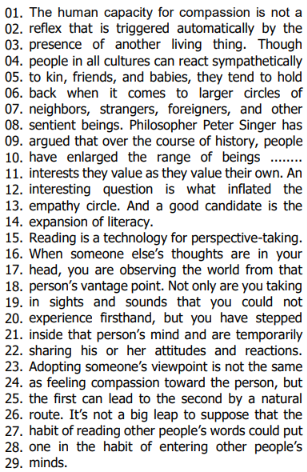
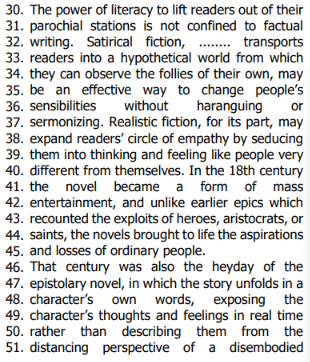
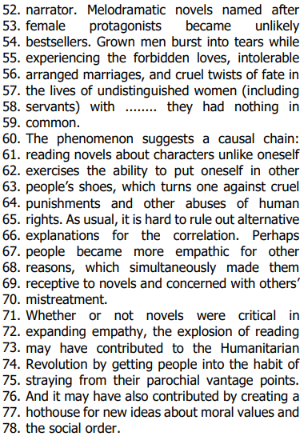
Consider the following propositions for rephrasing the sentence Melodramatic novels named after
female protagonists became unlikely bestsellers (l. 52-54).
I - Overemotional books with titles inspired by their heroines became unexpected bestsellers.
II - Melodramatic soap operas titled later than their female characters became surprising bestsellers.
III- Sensational stories with feminine characters more relevant than the titles became dislikable bestsellers.
If applied to the text, which ones would be correct and keep the literal meaning?
I - Overemotional books with titles inspired by their heroines became unexpected bestsellers.
II - Melodramatic soap operas titled later than their female characters became surprising bestsellers.
III- Sensational stories with feminine characters more relevant than the titles became dislikable bestsellers.
If applied to the text, which ones would be correct and keep the literal meaning?
Q4162968
Inglês
Texto associado
Instrução: A questão está relacionadas ao texto abaixo.
Adapted from: PINKER, S. The better angels of our
nature: why violence has declined.
London: Viking Penguin, 2011.
Consider the different uses of the -ing form.
1. Verb as the subject of the sentence.
2. Verb as part of the present progressive structure.
3. Verb preceded by a preposition (collocation).
Select the alternative which contains words that exemplify each of the uses presented above, in the same sequence.
1. Verb as the subject of the sentence.
2. Verb as part of the present progressive structure.
3. Verb preceded by a preposition (collocation).
Select the alternative which contains words that exemplify each of the uses presented above, in the same sequence.
Q4162967
Inglês
Texto associado
Instrução: A questão está relacionadas ao texto abaixo.
Adapted from: PINKER, S. The better angels of our
nature: why violence has declined.
London: Viking Penguin, 2011.
Consider the sentence When someone else’s thoughts are in your head, you are observing the
world from that person’s vantage point (l. 16-18). If the segment someone else’s thoughts
were replaced by other people’s thoughts, how many additional alterations would have to be made
to keep the paragraph grammatically correct?
Q4162966
Inglês
Texto associado
Instrução: A questão está relacionadas ao texto abaixo.
Adapted from: PINKER, S. The better angels of our
nature: why violence has declined.
London: Viking Penguin, 2011.
Select the alternative that offers adequate synonyms to the words kin (l. 05), parochial (l. 31), and
heyday (l. 46) as used in the text.

 Conheça nossos planos