Questões de Vestibular Sobre inglês
Foram encontradas 6.367 questões


T E X T
Social Media Use Is Linked to Brain Changes in Teens, Research Finds
The effect of social media use on children is a fraught area of research, as parents and policymakers try to ascertain the results of a vast experiment already in full swing. Successive studies have added pieces to the pu zzle, fleshing out the implications of a nearly constant stream of virtual interactions beginning in childhood.
A new study by neuroscientists at the University of North Carolina tries something new, conducting successive brain scans of middle schoolers between the ages of 12 and 15, a period of especially rapid brain development.
The researchers found that children who habitually checked their social media feeds at around age 12 showed a distinct trajectory, with their sensitivity to social rewards from peers heightening over time. Teenagers with less engagement in social media followed the opposite path, with a declining interest in social rewards.
The study has important limitations, the authors acknowledge. Because adolescence is a period of expanding social relationships, the brain differences could reflect a natural pivot toward peers, which could be driving more frequent social media use.
“We can’t make causal claims that social media is changing the brain,” said Eva H. Telzer, an associate professor of psychology and neuroscience at the University of North Carolina, Chapel Hill, and one of the authors of the study.
But, she added, “teens who are habitually checking their social media are showing these pretty dramatic changes in the way their brains are responding, which could potentially have long-term consequences well into adulthood, sort of setting the stage for brain development over time.”
A team of researchers studied an ethnically diverse group of 169 students in the sixth and seventh grades from a middle school in rural North Carolina, splitting them into groups according to how often they reported checking Facebook, Instagram and Snapchat feeds.
At around age 12, the students already showed distinct patterns of behavior. Habitual users reported checking their feeds 15 or more times a day; moderate users checked between one and 14 times; nonhabitual users checked less than once a day.
The subjects received full brain scans three times, at approximately one-year intervals, as they played a computerized game that delivered rewards and punishment in the form of smiling or scowling peers. While carrying out the task, the frequent checkers showed increasing activation of three brain areas: reward-processing circuits, which also respond to experiences like winning money or risk-taking behavior; brain regions that determine salience, picking out what stands out in the environment; and the prefrontal cortex, which helps with regulation and control.
The results showed that “teens who grow up checking social media more often are becoming hypersensitive to feedback from their peers,” Dr. Telzer said. Social sensitivity could be adaptive, showing that the teenagers are learning to connect with others; or it could lead to social anxiety and depression if social needs are not met.
“They are showing that the way you use it at one point in your life does influence the way your brain develops, but we don’t know by how much, or whether it’s good or bad,” said Jeff Hancock, the founding director of the Stanford Social Media Lab, who was not involved in the study. He said that many other variables could have contributed to these changes. He described the paper as “a very sophisticated piece of work,” contributing to research that has emerged recently showing that sensitivity to social media varies from person to person.
Over the last decade, social media has remapped the central experiences of adolescence, a period of rapid brain development. Researchers have documented a range of effects on children’s mental health. Some studies have linked use of social media with depression and anxiety, while others found little connection.
Without more information about other aspects of the students’ lives, “it is challenging to discern how specific differences in brain development are to social media checking,” said Adriana Galvan, a specialist in adolescent brain development at the University of California Los Angeles, who was not involved in the study.
Dr. Telzer, one of the study’s authors, described the rising sensitivity to social feedback as “neither good nor bad.” “It’s helping them connect to others and obtain rewards from the things that are common in their social world, which is engaging in social interactions online,” she said. This is the new norm,” she added. “Understanding how this new digital world is influencing teens is important. It may be associated with changes in the brain, but that may be for good or for bad. We don’t necessarily know the long-term implications yet.”
Adapted from: https://www.nytimes.com/2023/01/03/
T E X T
Social Media Use Is Linked to Brain Changes in Teens, Research Finds
The effect of social media use on children is a fraught area of research, as parents and policymakers try to ascertain the results of a vast experiment already in full swing. Successive studies have added pieces to the pu zzle, fleshing out the implications of a nearly constant stream of virtual interactions beginning in childhood.
A new study by neuroscientists at the University of North Carolina tries something new, conducting successive brain scans of middle schoolers between the ages of 12 and 15, a period of especially rapid brain development.
The researchers found that children who habitually checked their social media feeds at around age 12 showed a distinct trajectory, with their sensitivity to social rewards from peers heightening over time. Teenagers with less engagement in social media followed the opposite path, with a declining interest in social rewards.
The study has important limitations, the authors acknowledge. Because adolescence is a period of expanding social relationships, the brain differences could reflect a natural pivot toward peers, which could be driving more frequent social media use.
“We can’t make causal claims that social media is changing the brain,” said Eva H. Telzer, an associate professor of psychology and neuroscience at the University of North Carolina, Chapel Hill, and one of the authors of the study.
But, she added, “teens who are habitually checking their social media are showing these pretty dramatic changes in the way their brains are responding, which could potentially have long-term consequences well into adulthood, sort of setting the stage for brain development over time.”
A team of researchers studied an ethnically diverse group of 169 students in the sixth and seventh grades from a middle school in rural North Carolina, splitting them into groups according to how often they reported checking Facebook, Instagram and Snapchat feeds.
At around age 12, the students already showed distinct patterns of behavior. Habitual users reported checking their feeds 15 or more times a day; moderate users checked between one and 14 times; nonhabitual users checked less than once a day.
The subjects received full brain scans three times, at approximately one-year intervals, as they played a computerized game that delivered rewards and punishment in the form of smiling or scowling peers. While carrying out the task, the frequent checkers showed increasing activation of three brain areas: reward-processing circuits, which also respond to experiences like winning money or risk-taking behavior; brain regions that determine salience, picking out what stands out in the environment; and the prefrontal cortex, which helps with regulation and control.
The results showed that “teens who grow up checking social media more often are becoming hypersensitive to feedback from their peers,” Dr. Telzer said. Social sensitivity could be adaptive, showing that the teenagers are learning to connect with others; or it could lead to social anxiety and depression if social needs are not met.
“They are showing that the way you use it at one point in your life does influence the way your brain develops, but we don’t know by how much, or whether it’s good or bad,” said Jeff Hancock, the founding director of the Stanford Social Media Lab, who was not involved in the study. He said that many other variables could have contributed to these changes. He described the paper as “a very sophisticated piece of work,” contributing to research that has emerged recently showing that sensitivity to social media varies from person to person.
Over the last decade, social media has remapped the central experiences of adolescence, a period of rapid brain development. Researchers have documented a range of effects on children’s mental health. Some studies have linked use of social media with depression and anxiety, while others found little connection.
Without more information about other aspects of the students’ lives, “it is challenging to discern how specific differences in brain development are to social media checking,” said Adriana Galvan, a specialist in adolescent brain development at the University of California Los Angeles, who was not involved in the study.
Dr. Telzer, one of the study’s authors, described the rising sensitivity to social feedback as “neither good nor bad.” “It’s helping them connect to others and obtain rewards from the things that are common in their social world, which is engaging in social interactions online,” she said. This is the new norm,” she added. “Understanding how this new digital world is influencing teens is important. It may be associated with changes in the brain, but that may be for good or for bad. We don’t necessarily know the long-term implications yet.”
Adapted from: https://www.nytimes.com/2023/01/03/
T E X T
Social Media Use Is Linked to Brain Changes in Teens, Research Finds
The effect of social media use on children is a fraught area of research, as parents and policymakers try to ascertain the results of a vast experiment already in full swing. Successive studies have added pieces to the pu zzle, fleshing out the implications of a nearly constant stream of virtual interactions beginning in childhood.
A new study by neuroscientists at the University of North Carolina tries something new, conducting successive brain scans of middle schoolers between the ages of 12 and 15, a period of especially rapid brain development.
The researchers found that children who habitually checked their social media feeds at around age 12 showed a distinct trajectory, with their sensitivity to social rewards from peers heightening over time. Teenagers with less engagement in social media followed the opposite path, with a declining interest in social rewards.
The study has important limitations, the authors acknowledge. Because adolescence is a period of expanding social relationships, the brain differences could reflect a natural pivot toward peers, which could be driving more frequent social media use.
“We can’t make causal claims that social media is changing the brain,” said Eva H. Telzer, an associate professor of psychology and neuroscience at the University of North Carolina, Chapel Hill, and one of the authors of the study.
But, she added, “teens who are habitually checking their social media are showing these pretty dramatic changes in the way their brains are responding, which could potentially have long-term consequences well into adulthood, sort of setting the stage for brain development over time.”
A team of researchers studied an ethnically diverse group of 169 students in the sixth and seventh grades from a middle school in rural North Carolina, splitting them into groups according to how often they reported checking Facebook, Instagram and Snapchat feeds.
At around age 12, the students already showed distinct patterns of behavior. Habitual users reported checking their feeds 15 or more times a day; moderate users checked between one and 14 times; nonhabitual users checked less than once a day.
The subjects received full brain scans three times, at approximately one-year intervals, as they played a computerized game that delivered rewards and punishment in the form of smiling or scowling peers. While carrying out the task, the frequent checkers showed increasing activation of three brain areas: reward-processing circuits, which also respond to experiences like winning money or risk-taking behavior; brain regions that determine salience, picking out what stands out in the environment; and the prefrontal cortex, which helps with regulation and control.
The results showed that “teens who grow up checking social media more often are becoming hypersensitive to feedback from their peers,” Dr. Telzer said. Social sensitivity could be adaptive, showing that the teenagers are learning to connect with others; or it could lead to social anxiety and depression if social needs are not met.
“They are showing that the way you use it at one point in your life does influence the way your brain develops, but we don’t know by how much, or whether it’s good or bad,” said Jeff Hancock, the founding director of the Stanford Social Media Lab, who was not involved in the study. He said that many other variables could have contributed to these changes. He described the paper as “a very sophisticated piece of work,” contributing to research that has emerged recently showing that sensitivity to social media varies from person to person.
Over the last decade, social media has remapped the central experiences of adolescence, a period of rapid brain development. Researchers have documented a range of effects on children’s mental health. Some studies have linked use of social media with depression and anxiety, while others found little connection.
Without more information about other aspects of the students’ lives, “it is challenging to discern how specific differences in brain development are to social media checking,” said Adriana Galvan, a specialist in adolescent brain development at the University of California Los Angeles, who was not involved in the study.
Dr. Telzer, one of the study’s authors, described the rising sensitivity to social feedback as “neither good nor bad.” “It’s helping them connect to others and obtain rewards from the things that are common in their social world, which is engaging in social interactions online,” she said. This is the new norm,” she added. “Understanding how this new digital world is influencing teens is important. It may be associated with changes in the brain, but that may be for good or for bad. We don’t necessarily know the long-term implications yet.”
Adapted from: https://www.nytimes.com/2023/01/03/
The module focuses on American authors who wrote fiction during the 19th century.
The text informs the reader about a course offered to students interested in writing their own literary works on nature.
At the beginning of the text, the expression “quietly subversive” means that the authors associated to environmental writing establish their point of view on environmental topics in a discreet and subtle way.
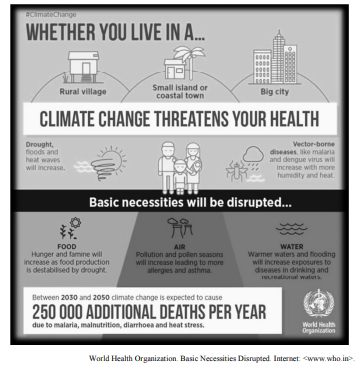
With the infographic, the World Health Organization wants to inform that two hundred and fifty thousand people will die by 2050.
The modal verb “will” is used in most sentences of the infographic because the World Health Organization is showing the reader some projections about the future of the world regarding climate change.
One of the main goals of the text is to draw attention to the relationship between vector-borne diseases and the lack of clean water.
Judge the items from 23 through 26 based on the preceding infographic.
According to the infographic, the entire population will suffer the effects of the climate change irrespective of where people live.

The passage “to make it free for kids to go to the movies” (third box) can be correctly rewritten as to make kids free to go to the cinema.
In can be inferred from the use of the structure “I’m going to start” (second box) that the kid had already considered the idea of starting a campaign and has decided to go for it.
The kid’s answer indicates that he is not aware of who Greta Thunberg is, nor of what she has done.
The comic strip shows that, for the kid, going to the movies is a way of thinking about something other than climate change.
In the first box, the words in “action against climate change” work together as a way to define the “movement” to which the rabbit is referring.
The expression “16 year old Greta Thunberg”, in the first box, could have been correctly written as 16-year-old Greta Thunberg.
The rabbit is representing an adult who is scared by the action against climate change movement.
The sentence “Across the world (…) resources” (second sentence of the second paragraph) can be correctly rewritten as In the whole world, women are more dependent on natural resources, even though they have less access to.
In the second sentence of the first paragraph, the word “livelihoods” refers to means of support or sources of money people need to survive.
The text states that the combination of gender inequality and climate change is the most serious problem humans face in current time.

 Conheça nossos planos