Questões de Vestibular Sobre inglês
Foram encontradas 6.380 questões


Amy Winehouse greets Whitney Houston in heaven
(by Hideaki Tailor)
HEAVEN – Psychics are saying that Amy Winehouse was the first soul singer to greet Whitney Houston, even before Michael Jackson.
Top psychics in Los Angeles are saying that Whitney Houston’s spirit is already “lighting up” heaven. “It’s like the universal source has called the greatest voice of all time back to heaven. It’s pure magic up there.”
“Amy was right there. She gave Whitney a big angel hug and walked with her as she met some of her ancestors, relatives and… Michael Jackson.”

Both singers had trouble on earth with alcohol and drugs, but they are at peace now. “Fame was too much for their gentle souls,” said Madam Marie of Sherman Oaks. “Their voices were a gift to our world, but caused great damage to their spirits on earth. Now, they are in a better place.”
One psychic said that Amy Winehouse and Whitney Houston are planning a “concert” together in Whitney’s first few months. “Amy’s been doing very well in heaven and feels free and happy.”
While Americans and fans around the world mourn the terrible loss of Whitney, the angels are rejoicing. “Our songbird is home,” is what St. Peter reportedly said when greeting Whitney, according to a psychic on Venice Beach.
(http://weeklyworldnews.com. Adaptado.)
Does he see himself as a champion of frustration? “I'm not on the side of frustration exactly, so much as the idea that one has to be able to bear frustration in order for satisfaction to be realistic. I'm interested in how the culture of consumer capitalism depends on the idea that we can't bear frustration, so that every time we feel a bit restless or bored or irritable, we eat, or we shop.”

guardian.co.uk, 1 June 2012. Adaptado.
Does he see himself as a champion of frustration? “I'm not on the side of frustration exactly, so much as the idea that one has to be able to bear frustration in order for satisfaction to be realistic. I'm interested in how the culture of consumer capitalism depends on the idea that we can't bear frustration, so that every time we feel a bit restless or bored or irritable, we eat, or we shop.”
guardian.co.uk, 1 June 2012. Adaptado.

By STEVE LOHR
The education gap facing the nation’s work force is evident in the numbers. Most new jobs will require more than a high school education, yet fewer than half of Americans under 30 have a (2) postsecondary degree of any kind. Recent state budget cuts, education experts agree, promise to make closing that gap even more difcult. The Bill and Melinda Gates Foundation, the William and Flora Hewlett Foundation, and four nonproft education organizations are beginning an ambitious initiative to address that challenge by accelerating the development and use of online learning tools. An initial $20 million round of money, from the Gates Foundation, will be for postsecondary online courses, particularly ones tailored for community colleges and low-income young people. Another round of grants, for high school programs, is scheduled for next year.
Just how efective technology can be in improving education - by making students more efective, more engaged learners - is a subject of debate. To date, education research shows that good teachers matter a lot, class size may be less important than once thought and nothing improves student performance as much as one-on-one human tutoring. If technology is well designed, experts say, it can help tailor the learning experience to individual students, facilitate student- teacher collaboration, and assist teachers in monitoring student performance each day and in quickly fne-tuning lessons. The potential benefts of technology are greater as students become older, more independent learners. Making that point, Mr. Gates said in an interview that for children from kindergarten to about ffth grade “the idea that you stick them in front of a computer is (3) ludicrous.”
(1)
higher education: educação superior.
(2)
postsecondary: termo que se refere aos cursos feitos após o high school ou, no modelo educacional brasileiro, o Ensino Médio.
(3)
ludicrous: ridícula, absurda.
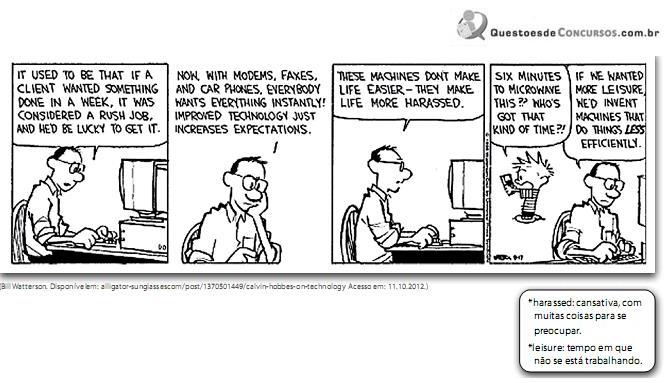

Two examples of informal use of language, present in the text, can be identified in:
One of these conclusions, however, may decrease the number of visitors to his blog because readers might consider his criticism as:
A new subject is introduced by the sentence above. The subject can be best summarized by the following word from the text:
The author’s main goal can be identified in the following alternative:
The fragment above points to what motivated the blog writer to develop his reflection. His motivation is related to the:
of the inequality champions
August 22nd, 2012

Brazil might be the leading economy in Latin America and has had a significant performance in reducing poverty in recent years, but it still remains among the countries with the highest inequality in the region together with Guatemala, Honduras and Colombia, points out the UNHabitat report. In all four countries based on 2009 data, the Gini income per capita distribution index stood at 0.56, to which must be added Dominican Republic and Bolivia, two inequality champions with high concentration of wealth. This compares with the US and Portugal Gini indicator of 0.38, two countries that offer no relief since Portugal, for example, has the highest inequality index of the European Union.
Nevertheless, Brazil advanced compared to 1990 when it had the highest degree of inequality and stood well ahead from the rest of the continent. But the region continues to have the highest inequality rate in spite of advances in helping income distribution. Among some of the causes for distribution improvement are productivity, upward trend of salaries and workers categories, strong economy and implementation of income transfer programs in several countries, particularly in the two leading economies, Brazil and Mexico. In the case of Brazil, the country’s economy now figures sixth at global level.
Former president Lula da Silva and one of the most popular leaders in history of that country based his success precisely on the Bolsa Família Plan, which distributed a monthly basic food basket to millions, helping anywhere from 14 to 22 million climb out of poverty, plus ensuring his Workers Party an encouraging future. The Gini coefficient or index measures the inequality among values of a frequency distribution (for instance, levels of income). A Gini coefficient of zero expresses perfect equality where all values are the same (for instance, where everyone has an exactly equal income). A Gini coefficient of one (100 on the percentile scale) expresses maximal inequality among values (for instance, where only one person has all the income).
(http://en.mercopress.com. Adaptado.)
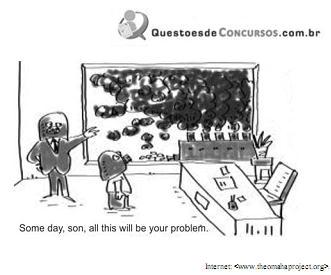
From the analysis of the cartoon above, it is possible to conclude that

 Conheça nossos planos