Questões de Vestibular Sobre inglês
Foram encontradas 6.365 questões


Q1264746
Inglês
Texto associado

Considere o texto a seguir para responder
a questão.
Tooth fairy quantum mechanics
The reason I can’t show you a Higgs boson1
is also
the solution to a parental dilemma.
Posted by Jon Butterworth
Sunday 23 December 2012 18.36 GMT, theguardian.com
I do sometimes get asked “If you’ve found a Higgs boson,
can you show me a picture of it?” Unfortunately, the answer
is no. But the reason for this provides a resolution to a severe
parental dilemma, and explains why I am in fact sometimes
the tooth fairy. Bear with me.
I can’t show you something which is definitely the new
boson, but I can show evidence for it, for example in the
picture below. It shows the distribution (black dots) of the
mass you get when you combine the energy and momenta2
of pairs of photons (particles of light) in the ATLAS detector.
The bump shows that there are more of these photon pairs
at masses corresponding to around 125 GeV than would be
expected from the trend. This excess implies the existence
of a particle at about this mass which decays to pairs of
photons.
The bump3
in this plot would not be there unless there
were a new boson (credit, ATLAS experiment and CERN). The
key is that even if I show you a collision event with a pair
of photons which exactly gives the “Higgs mass”, i.e. at the
top of that peak, it is still not possible to be sure that this
exact pair of photons came from a Higgs boson. There may
be several possible ways of producing a set of new particles
from the incoming ones; but if the resulting set is identical,
it is not physically meaningful to say which way occurred.
Now, to the parental dilemma. It is especially acute at this
time of year, but if you have children who are losing their
milk teeth, it is ever-present. Is the tooth fairy real? What
about Father Christmas? Do you spoil the fun or do you lie?
Something in me hates the idea of lying to my kids, and
undermining4
trust. Here’s my way out. Anything which has
the same initial state (tooth) and final state (money) might in
fact be an event in which a tooth fairy was present. To put it
another way, anything which removes the tooth and delivers
money shares such an essential property with a tooth fairy
that it can be said to be one (anything removing both teeth
and money is probably a dentist. Or possibly a mugger5
).
By now, my son doesn’t believe a word of it of course.
But in the early days it was the truth. We managed this
transition without lies, betrayal and tears because actually,
when tiptoeing into the bedroom with a shiny pound coin, I
really am the tooth fairy. I am of course also at the same time
Dad. This seemed to work, and now he’s older, it’s still fun.
It’s not much of stretch to extend this to Father Christmas,
and it also explains why sometimes Father Christmas uses
the same wrapping paper as your parents - he and they are,
in a sense, indistinguishable quantum possibilities for the
delivery process.
(theguardian.com/science/life-and-physics/2012/dec/23/tooth-fairy-quantum-mechanics Acesso em: 26.08.2013. Adaptado)
Glossário
1Higgs boson: partícula subatômica teórica que ficou conhecida
publicamente após ter sido divulgada como a “partícula de Deus”.
Sua existência é associada a pesquisas acerca da origem do universo.
(topics.nytimes.com/top/reference/timestopics/subjects/h/higgs_boson/index.html
Acesso em 02.10.2013. Adaptado)
2momenta: plural de momentum – conceito físico associado à
quantidade de movimento de uma partícula.
3bump: choque ou elevação.
4undermine: tornar algo gradativamente mais fraco, especialmente
a confiança ou autoridade de alguém.
5mugger: assaltante.
No segundo parágrafo do texto, o pronome relativo which
em – I can’t show you something which is definitely the new
boson – pode ser substituído, mantendo-se a sentença
gramaticalmente correta, por
Q1264745
Inglês
Texto associado
Considere o texto a seguir para responder
a questão.
Tooth fairy quantum mechanics
The reason I can’t show you a Higgs boson1
is also
the solution to a parental dilemma.
Posted by Jon Butterworth
Sunday 23 December 2012 18.36 GMT, theguardian.com
I do sometimes get asked “If you’ve found a Higgs boson,
can you show me a picture of it?” Unfortunately, the answer
is no. But the reason for this provides a resolution to a severe
parental dilemma, and explains why I am in fact sometimes
the tooth fairy. Bear with me.
I can’t show you something which is definitely the new
boson, but I can show evidence for it, for example in the
picture below. It shows the distribution (black dots) of the
mass you get when you combine the energy and momenta2
of pairs of photons (particles of light) in the ATLAS detector.
The bump shows that there are more of these photon pairs
at masses corresponding to around 125 GeV than would be
expected from the trend. This excess implies the existence
of a particle at about this mass which decays to pairs of
photons.
The bump3
in this plot would not be there unless there
were a new boson (credit, ATLAS experiment and CERN). The
key is that even if I show you a collision event with a pair
of photons which exactly gives the “Higgs mass”, i.e. at the
top of that peak, it is still not possible to be sure that this
exact pair of photons came from a Higgs boson. There may
be several possible ways of producing a set of new particles
from the incoming ones; but if the resulting set is identical,
it is not physically meaningful to say which way occurred.
Now, to the parental dilemma. It is especially acute at this
time of year, but if you have children who are losing their
milk teeth, it is ever-present. Is the tooth fairy real? What
about Father Christmas? Do you spoil the fun or do you lie?
Something in me hates the idea of lying to my kids, and
undermining4
trust. Here’s my way out. Anything which has
the same initial state (tooth) and final state (money) might in
fact be an event in which a tooth fairy was present. To put it
another way, anything which removes the tooth and delivers
money shares such an essential property with a tooth fairy
that it can be said to be one (anything removing both teeth
and money is probably a dentist. Or possibly a mugger5
).
By now, my son doesn’t believe a word of it of course.
But in the early days it was the truth. We managed this
transition without lies, betrayal and tears because actually,
when tiptoeing into the bedroom with a shiny pound coin, I
really am the tooth fairy. I am of course also at the same time
Dad. This seemed to work, and now he’s older, it’s still fun.
It’s not much of stretch to extend this to Father Christmas,
and it also explains why sometimes Father Christmas uses
the same wrapping paper as your parents - he and they are,
in a sense, indistinguishable quantum possibilities for the
delivery process.
(theguardian.com/science/life-and-physics/2012/dec/23/tooth-fairy-quantum-mechanics Acesso em: 26.08.2013. Adaptado)
Glossário
1Higgs boson: partícula subatômica teórica que ficou conhecida
publicamente após ter sido divulgada como a “partícula de Deus”.
Sua existência é associada a pesquisas acerca da origem do universo.
(topics.nytimes.com/top/reference/timestopics/subjects/h/higgs_boson/index.html
Acesso em 02.10.2013. Adaptado)
2momenta: plural de momentum – conceito físico associado à
quantidade de movimento de uma partícula.
3bump: choque ou elevação.
4undermine: tornar algo gradativamente mais fraco, especialmente
a confiança ou autoridade de alguém.
5mugger: assaltante.
O autor do texto afirma que
Q1264744
Inglês
Texto associado
Considere o texto a seguir para responder
a questão.
Tooth fairy quantum mechanics
The reason I can’t show you a Higgs boson1
is also
the solution to a parental dilemma.
Posted by Jon Butterworth
Sunday 23 December 2012 18.36 GMT, theguardian.com
I do sometimes get asked “If you’ve found a Higgs boson,
can you show me a picture of it?” Unfortunately, the answer
is no. But the reason for this provides a resolution to a severe
parental dilemma, and explains why I am in fact sometimes
the tooth fairy. Bear with me.
I can’t show you something which is definitely the new
boson, but I can show evidence for it, for example in the
picture below. It shows the distribution (black dots) of the
mass you get when you combine the energy and momenta2
of pairs of photons (particles of light) in the ATLAS detector.
The bump shows that there are more of these photon pairs
at masses corresponding to around 125 GeV than would be
expected from the trend. This excess implies the existence
of a particle at about this mass which decays to pairs of
photons.
The bump3
in this plot would not be there unless there
were a new boson (credit, ATLAS experiment and CERN). The
key is that even if I show you a collision event with a pair
of photons which exactly gives the “Higgs mass”, i.e. at the
top of that peak, it is still not possible to be sure that this
exact pair of photons came from a Higgs boson. There may
be several possible ways of producing a set of new particles
from the incoming ones; but if the resulting set is identical,
it is not physically meaningful to say which way occurred.
Now, to the parental dilemma. It is especially acute at this
time of year, but if you have children who are losing their
milk teeth, it is ever-present. Is the tooth fairy real? What
about Father Christmas? Do you spoil the fun or do you lie?
Something in me hates the idea of lying to my kids, and
undermining4
trust. Here’s my way out. Anything which has
the same initial state (tooth) and final state (money) might in
fact be an event in which a tooth fairy was present. To put it
another way, anything which removes the tooth and delivers
money shares such an essential property with a tooth fairy
that it can be said to be one (anything removing both teeth
and money is probably a dentist. Or possibly a mugger5
).
By now, my son doesn’t believe a word of it of course.
But in the early days it was the truth. We managed this
transition without lies, betrayal and tears because actually,
when tiptoeing into the bedroom with a shiny pound coin, I
really am the tooth fairy. I am of course also at the same time
Dad. This seemed to work, and now he’s older, it’s still fun.
It’s not much of stretch to extend this to Father Christmas,
and it also explains why sometimes Father Christmas uses
the same wrapping paper as your parents - he and they are,
in a sense, indistinguishable quantum possibilities for the
delivery process.
(theguardian.com/science/life-and-physics/2012/dec/23/tooth-fairy-quantum-mechanics Acesso em: 26.08.2013. Adaptado)
Glossário
1Higgs boson: partícula subatômica teórica que ficou conhecida
publicamente após ter sido divulgada como a “partícula de Deus”.
Sua existência é associada a pesquisas acerca da origem do universo.
(topics.nytimes.com/top/reference/timestopics/subjects/h/higgs_boson/index.html
Acesso em 02.10.2013. Adaptado)
2momenta: plural de momentum – conceito físico associado à
quantidade de movimento de uma partícula.
3bump: choque ou elevação.
4undermine: tornar algo gradativamente mais fraco, especialmente
a confiança ou autoridade de alguém.
5mugger: assaltante.
Segundo as indicações do texto, o gráfico apresentado
Q1264743
Inglês
Texto associado
Considere o texto a seguir para responder
a questão.
Tooth fairy quantum mechanics
The reason I can’t show you a Higgs boson1
is also
the solution to a parental dilemma.
Posted by Jon Butterworth
Sunday 23 December 2012 18.36 GMT, theguardian.com
I do sometimes get asked “If you’ve found a Higgs boson,
can you show me a picture of it?” Unfortunately, the answer
is no. But the reason for this provides a resolution to a severe
parental dilemma, and explains why I am in fact sometimes
the tooth fairy. Bear with me.
I can’t show you something which is definitely the new
boson, but I can show evidence for it, for example in the
picture below. It shows the distribution (black dots) of the
mass you get when you combine the energy and momenta2
of pairs of photons (particles of light) in the ATLAS detector.
The bump shows that there are more of these photon pairs
at masses corresponding to around 125 GeV than would be
expected from the trend. This excess implies the existence
of a particle at about this mass which decays to pairs of
photons.
The bump3
in this plot would not be there unless there
were a new boson (credit, ATLAS experiment and CERN). The
key is that even if I show you a collision event with a pair
of photons which exactly gives the “Higgs mass”, i.e. at the
top of that peak, it is still not possible to be sure that this
exact pair of photons came from a Higgs boson. There may
be several possible ways of producing a set of new particles
from the incoming ones; but if the resulting set is identical,
it is not physically meaningful to say which way occurred.
Now, to the parental dilemma. It is especially acute at this
time of year, but if you have children who are losing their
milk teeth, it is ever-present. Is the tooth fairy real? What
about Father Christmas? Do you spoil the fun or do you lie?
Something in me hates the idea of lying to my kids, and
undermining4
trust. Here’s my way out. Anything which has
the same initial state (tooth) and final state (money) might in
fact be an event in which a tooth fairy was present. To put it
another way, anything which removes the tooth and delivers
money shares such an essential property with a tooth fairy
that it can be said to be one (anything removing both teeth
and money is probably a dentist. Or possibly a mugger5
).
By now, my son doesn’t believe a word of it of course.
But in the early days it was the truth. We managed this
transition without lies, betrayal and tears because actually,
when tiptoeing into the bedroom with a shiny pound coin, I
really am the tooth fairy. I am of course also at the same time
Dad. This seemed to work, and now he’s older, it’s still fun.
It’s not much of stretch to extend this to Father Christmas,
and it also explains why sometimes Father Christmas uses
the same wrapping paper as your parents - he and they are,
in a sense, indistinguishable quantum possibilities for the
delivery process.
(theguardian.com/science/life-and-physics/2012/dec/23/tooth-fairy-quantum-mechanics Acesso em: 26.08.2013. Adaptado)
Glossário
1Higgs boson: partícula subatômica teórica que ficou conhecida
publicamente após ter sido divulgada como a “partícula de Deus”.
Sua existência é associada a pesquisas acerca da origem do universo.
(topics.nytimes.com/top/reference/timestopics/subjects/h/higgs_boson/index.html
Acesso em 02.10.2013. Adaptado)
2momenta: plural de momentum – conceito físico associado à
quantidade de movimento de uma partícula.
3bump: choque ou elevação.
4undermine: tornar algo gradativamente mais fraco, especialmente
a confiança ou autoridade de alguém.
5mugger: assaltante.
De acordo com o texto, é correto afirmar que o bóson de Higgs
Ano: 2013
Banca:
PUC-MINAS
Órgão:
PUC-MINAS
Prova:
PUC-MINAS - 2013 - PUC-MINAS - Prova - Medicina |
Q1263485
Inglês
Texto associado
Why the Internet is so addictive
"Checking Facebook should only take a minute." Those are the famous last words of countless people every
day, right before getting sucked into several hours of watching cat videos or commenting on Instagrammed sushi
lunches. That behavior is natural, given how the Internet is structured, experts say. The Internet’s omnipresence
and lack of limits encourage people to lose track of time, making it hard to exercise the self-control to turn it off.
"The Internet is not addictive in the same way as pharmacological substances are," said Tom Stafford, a
cognitive scientist at the University of Sheffield in the U.K. "But it's compulsive; it's compelling; it's distracting."
Humans are social creatures. Therefore, people enjoy the social information available via email and the Web.
The main reason the Internet is so addictive is that it lacks boundaries between tasks, Stafford said.
Someone may set out to "research something, and then accidentally go to Wikipedia, and then wind up trying to
find out what ever happened to Depeche Mode," Stafford said, referring to the music band. Studies suggest
willpower is like a muscle: It can be strengthened, but can also become exhausted. Because the Internet is always
"on," staying on task requires constantly flexing that willpower muscle, which can exhaust a person's self-control.
For those who want to loosen the grip of the Web on their lives, a few simple techniques may do the trick.
Web-blocking tools that limit surfing time can help people regain control over their time. Another method is to plan
ahead, committing to work for 20 minutes, or until a certain task is complete, and then allowing five minutes of Web
surfing, Stafford said.
(Adapted from: http://www.mnn.com/green-tech/computers/stories/why-the-internet-is-so-addictive)
If you want to gain control over your time, you should
Ano: 2013
Banca:
PUC-MINAS
Órgão:
PUC-MINAS
Prova:
PUC-MINAS - 2013 - PUC-MINAS - Prova - Medicina |
Q1263484
Inglês
Texto associado
Why the Internet is so addictive
"Checking Facebook should only take a minute." Those are the famous last words of countless people every
day, right before getting sucked into several hours of watching cat videos or commenting on Instagrammed sushi
lunches. That behavior is natural, given how the Internet is structured, experts say. The Internet’s omnipresence
and lack of limits encourage people to lose track of time, making it hard to exercise the self-control to turn it off.
"The Internet is not addictive in the same way as pharmacological substances are," said Tom Stafford, a
cognitive scientist at the University of Sheffield in the U.K. "But it's compulsive; it's compelling; it's distracting."
Humans are social creatures. Therefore, people enjoy the social information available via email and the Web.
The main reason the Internet is so addictive is that it lacks boundaries between tasks, Stafford said.
Someone may set out to "research something, and then accidentally go to Wikipedia, and then wind up trying to
find out what ever happened to Depeche Mode," Stafford said, referring to the music band. Studies suggest
willpower is like a muscle: It can be strengthened, but can also become exhausted. Because the Internet is always
"on," staying on task requires constantly flexing that willpower muscle, which can exhaust a person's self-control.
For those who want to loosen the grip of the Web on their lives, a few simple techniques may do the trick.
Web-blocking tools that limit surfing time can help people regain control over their time. Another method is to plan
ahead, committing to work for 20 minutes, or until a certain task is complete, and then allowing five minutes of Web
surfing, Stafford said.
(Adapted from: http://www.mnn.com/green-tech/computers/stories/why-the-internet-is-so-addictive)
The word It in “It can be strengthened” (paragraph 3) refers to
Ano: 2013
Banca:
PUC-MINAS
Órgão:
PUC-MINAS
Prova:
PUC-MINAS - 2013 - PUC-MINAS - Prova - Medicina |
Q1263483
Inglês
Texto associado
Why the Internet is so addictive
"Checking Facebook should only take a minute." Those are the famous last words of countless people every
day, right before getting sucked into several hours of watching cat videos or commenting on Instagrammed sushi
lunches. That behavior is natural, given how the Internet is structured, experts say. The Internet’s omnipresence
and lack of limits encourage people to lose track of time, making it hard to exercise the self-control to turn it off.
"The Internet is not addictive in the same way as pharmacological substances are," said Tom Stafford, a
cognitive scientist at the University of Sheffield in the U.K. "But it's compulsive; it's compelling; it's distracting."
Humans are social creatures. Therefore, people enjoy the social information available via email and the Web.
The main reason the Internet is so addictive is that it lacks boundaries between tasks, Stafford said.
Someone may set out to "research something, and then accidentally go to Wikipedia, and then wind up trying to
find out what ever happened to Depeche Mode," Stafford said, referring to the music band. Studies suggest
willpower is like a muscle: It can be strengthened, but can also become exhausted. Because the Internet is always
"on," staying on task requires constantly flexing that willpower muscle, which can exhaust a person's self-control.
For those who want to loosen the grip of the Web on their lives, a few simple techniques may do the trick.
Web-blocking tools that limit surfing time can help people regain control over their time. Another method is to plan
ahead, committing to work for 20 minutes, or until a certain task is complete, and then allowing five minutes of Web
surfing, Stafford said.
(Adapted from: http://www.mnn.com/green-tech/computers/stories/why-the-internet-is-so-addictive)
According to Tom Stafford, the main reason the Internet is so addictive is that
Ano: 2013
Banca:
PUC-MINAS
Órgão:
PUC-MINAS
Prova:
PUC-MINAS - 2013 - PUC-MINAS - Prova - Medicina |
Q1263482
Inglês
Texto associado
Why the Internet is so addictive
"Checking Facebook should only take a minute." Those are the famous last words of countless people every
day, right before getting sucked into several hours of watching cat videos or commenting on Instagrammed sushi
lunches. That behavior is natural, given how the Internet is structured, experts say. The Internet’s omnipresence
and lack of limits encourage people to lose track of time, making it hard to exercise the self-control to turn it off.
"The Internet is not addictive in the same way as pharmacological substances are," said Tom Stafford, a
cognitive scientist at the University of Sheffield in the U.K. "But it's compulsive; it's compelling; it's distracting."
Humans are social creatures. Therefore, people enjoy the social information available via email and the Web.
The main reason the Internet is so addictive is that it lacks boundaries between tasks, Stafford said.
Someone may set out to "research something, and then accidentally go to Wikipedia, and then wind up trying to
find out what ever happened to Depeche Mode," Stafford said, referring to the music band. Studies suggest
willpower is like a muscle: It can be strengthened, but can also become exhausted. Because the Internet is always
"on," staying on task requires constantly flexing that willpower muscle, which can exhaust a person's self-control.
For those who want to loosen the grip of the Web on their lives, a few simple techniques may do the trick.
Web-blocking tools that limit surfing time can help people regain control over their time. Another method is to plan
ahead, committing to work for 20 minutes, or until a certain task is complete, and then allowing five minutes of Web
surfing, Stafford said.
(Adapted from: http://www.mnn.com/green-tech/computers/stories/why-the-internet-is-so-addictive)
The word Therefore in: “Therefore, people enjoy the social information…” (paragraph 2) indicates
Ano: 2013
Banca:
PUC-MINAS
Órgão:
PUC-MINAS
Prova:
PUC-MINAS - 2013 - PUC-MINAS - Prova - Medicina |
Q1263481
Inglês
Texto associado
Why the Internet is so addictive
"Checking Facebook should only take a minute." Those are the famous last words of countless people every
day, right before getting sucked into several hours of watching cat videos or commenting on Instagrammed sushi
lunches. That behavior is natural, given how the Internet is structured, experts say. The Internet’s omnipresence
and lack of limits encourage people to lose track of time, making it hard to exercise the self-control to turn it off.
"The Internet is not addictive in the same way as pharmacological substances are," said Tom Stafford, a
cognitive scientist at the University of Sheffield in the U.K. "But it's compulsive; it's compelling; it's distracting."
Humans are social creatures. Therefore, people enjoy the social information available via email and the Web.
The main reason the Internet is so addictive is that it lacks boundaries between tasks, Stafford said.
Someone may set out to "research something, and then accidentally go to Wikipedia, and then wind up trying to
find out what ever happened to Depeche Mode," Stafford said, referring to the music band. Studies suggest
willpower is like a muscle: It can be strengthened, but can also become exhausted. Because the Internet is always
"on," staying on task requires constantly flexing that willpower muscle, which can exhaust a person's self-control.
For those who want to loosen the grip of the Web on their lives, a few simple techniques may do the trick.
Web-blocking tools that limit surfing time can help people regain control over their time. Another method is to plan
ahead, committing to work for 20 minutes, or until a certain task is complete, and then allowing five minutes of Web
surfing, Stafford said.
(Adapted from: http://www.mnn.com/green-tech/computers/stories/why-the-internet-is-so-addictive)
Why do people usually lose track of time when they are surfing the net?
Q1262964
Inglês
Texto associado
Read the following passage and choose the option which best completes each question, according to the
text:
Footfalls
London is a city made for walking. Unlike, for example, Los Angeles its centre is easily accessible on foot.
Between 2001 and 2011 the number of trips made daily on foot in London increased by 12%. Each day 6.2m walks
are made across the city.
Several reasons account for the walking boom. The number of Londoners increased by 12% from 7.3m in
2001 to 8.2m in 2011, and Underground trains are hot and overcrowded. But other factors also encourage
pedestrians. In 2004 Ken Livingstone, then mayor of London, promised to make London a “walkable city”. Some of
his plans were carried on by Boris Johnson, the current mayor. These include a scheme to create clearly-marked
maps for use across the city and make streets more pedestrian-friendly. Londoners may also be more aware of the
advantages of walking. Health campaigns like the National Health Service’s “Live Well” emphasize that walking is
the easiest form of exercise.
High streets and town centres need to win back walkers. Learning from London’s incentives could be a start.
(Adapted from: http://www.economist.com/news/britain/21582576-urban-pedestrians-buck-national-trend-footfalls.)
The word could in “Learning from London’s incentives could be a start.” (paragraph 03) indicates
Q1262963
Inglês
Texto associado
Read the following passage and choose the option which best completes each question, according to the
text:
Footfalls
London is a city made for walking. Unlike, for example, Los Angeles its centre is easily accessible on foot.
Between 2001 and 2011 the number of trips made daily on foot in London increased by 12%. Each day 6.2m walks
are made across the city.
Several reasons account for the walking boom. The number of Londoners increased by 12% from 7.3m in
2001 to 8.2m in 2011, and Underground trains are hot and overcrowded. But other factors also encourage
pedestrians. In 2004 Ken Livingstone, then mayor of London, promised to make London a “walkable city”. Some of
his plans were carried on by Boris Johnson, the current mayor. These include a scheme to create clearly-marked
maps for use across the city and make streets more pedestrian-friendly. Londoners may also be more aware of the
advantages of walking. Health campaigns like the National Health Service’s “Live Well” emphasize that walking is
the easiest form of exercise.
High streets and town centres need to win back walkers. Learning from London’s incentives could be a start.
(Adapted from: http://www.economist.com/news/britain/21582576-urban-pedestrians-buck-national-trend-footfalls.)
The National Health Service’s campaign “Live Well” call attention to the fact that
Q1262962
Inglês
Texto associado
Read the following passage and choose the option which best completes each question, according to the
text:
Footfalls
London is a city made for walking. Unlike, for example, Los Angeles its centre is easily accessible on foot.
Between 2001 and 2011 the number of trips made daily on foot in London increased by 12%. Each day 6.2m walks
are made across the city.
Several reasons account for the walking boom. The number of Londoners increased by 12% from 7.3m in
2001 to 8.2m in 2011, and Underground trains are hot and overcrowded. But other factors also encourage
pedestrians. In 2004 Ken Livingstone, then mayor of London, promised to make London a “walkable city”. Some of
his plans were carried on by Boris Johnson, the current mayor. These include a scheme to create clearly-marked
maps for use across the city and make streets more pedestrian-friendly. Londoners may also be more aware of the
advantages of walking. Health campaigns like the National Health Service’s “Live Well” emphasize that walking is
the easiest form of exercise.
High streets and town centres need to win back walkers. Learning from London’s incentives could be a start.
(Adapted from: http://www.economist.com/news/britain/21582576-urban-pedestrians-buck-national-trend-footfalls.)
The word these in “These include a scheme...” (paragraph 02) refers to
Q1262961
Inglês
Texto associado
Read the following passage and choose the option which best completes each question, according to the
text:
Footfalls
London is a city made for walking. Unlike, for example, Los Angeles its centre is easily accessible on foot.
Between 2001 and 2011 the number of trips made daily on foot in London increased by 12%. Each day 6.2m walks
are made across the city.
Several reasons account for the walking boom. The number of Londoners increased by 12% from 7.3m in
2001 to 8.2m in 2011, and Underground trains are hot and overcrowded. But other factors also encourage
pedestrians. In 2004 Ken Livingstone, then mayor of London, promised to make London a “walkable city”. Some of
his plans were carried on by Boris Johnson, the current mayor. These include a scheme to create clearly-marked
maps for use across the city and make streets more pedestrian-friendly. Londoners may also be more aware of the
advantages of walking. Health campaigns like the National Health Service’s “Live Well” emphasize that walking is
the easiest form of exercise.
High streets and town centres need to win back walkers. Learning from London’s incentives could be a start.
(Adapted from: http://www.economist.com/news/britain/21582576-urban-pedestrians-buck-national-trend-footfalls.)
What is one of reasons for the walking boom in London mentioned in the text?
Q1262960
Inglês
Texto associado
Read the following passage and choose the option which best completes each question, according to the
text:
Footfalls
London is a city made for walking. Unlike, for example, Los Angeles its centre is easily accessible on foot.
Between 2001 and 2011 the number of trips made daily on foot in London increased by 12%. Each day 6.2m walks
are made across the city.
Several reasons account for the walking boom. The number of Londoners increased by 12% from 7.3m in
2001 to 8.2m in 2011, and Underground trains are hot and overcrowded. But other factors also encourage
pedestrians. In 2004 Ken Livingstone, then mayor of London, promised to make London a “walkable city”. Some of
his plans were carried on by Boris Johnson, the current mayor. These include a scheme to create clearly-marked
maps for use across the city and make streets more pedestrian-friendly. Londoners may also be more aware of the
advantages of walking. Health campaigns like the National Health Service’s “Live Well” emphasize that walking is
the easiest form of exercise.
High streets and town centres need to win back walkers. Learning from London’s incentives could be a start.
(Adapted from: http://www.economist.com/news/britain/21582576-urban-pedestrians-buck-national-trend-footfalls.)
The word unlike in “Unlike, for instance, Los Angeles…” (paragraph 01) indicates that
Q1262176
Inglês
Texto associado
Read the text below to answer question.
Whaling Today
By Meghan E. Marrero and Stuart Thornton
Tuesday, November 1, 2011
In 1946, several countries joined to form the International
Whaling Commission (IWC). The IWC’s purpose is to prevent
overhunting of whales. Its original regulations, however, were loose,
and quotas were high. Whale stocks continued to decline. The IWC
eventually established whaling-free sanctuaries in the Indian Ocean
(1979) and the ocean surrounding Antarctica (1994).
The IWC called for a moratorium on commercial whaling in
1982. Both Japan and Norway voted against this policy. Today,
Norway supports hunting minke whales for meat. Japan allows whaling
for scientific purposes, although many experts question if more whales
are taken than are necessary. Meat from whales killed for research is
sold as food.
Many species of whale have benefitted from the IWC’s
moratorium. Dave Weller, a research biologist at NOAA’s Southwest
Fisheries Science Center in La Jolla, California, says the eastern
Pacific gray whale population has recovered.
“I think there is pretty good evidence that a moratorium on
hunting has allowed certain populations to recover from depleted
status when they were being whaled,” he says.
According to Weller, the IWC’s moratorium on whale hunting
is one of two major steps the organization is taking.
“The other thing that the IWC has very successfully done is
to collect information and provide analysis of data to help us
understand the status of various populations that in some cases we
knew very little about,” he says.
Despite the general moratorium, limited whaling is permitted
to indigenous cultures.
“In the United States, the Inuit Eskimos in the north slope of
Alaska, in Barrow, Alaska, still hunt for bowhead whales,” Weller says.
“There is a request by the Makah Indian tribe, which is in northern
Washington state, to resume gray whale hunting, which they had
traditionally done. But that’s pending deliberations right now.”
Source: http://education.nationalgeographic.com/education/news/
(Adapted)
Mark the CORRECT alternative, according to the text.
Q1262175
Inglês
Texto associado
Read the text below to answer question.
Whaling Today
By Meghan E. Marrero and Stuart Thornton
Tuesday, November 1, 2011
In 1946, several countries joined to form the International
Whaling Commission (IWC). The IWC’s purpose is to prevent
overhunting of whales. Its original regulations, however, were loose,
and quotas were high. Whale stocks continued to decline. The IWC
eventually established whaling-free sanctuaries in the Indian Ocean
(1979) and the ocean surrounding Antarctica (1994).
The IWC called for a moratorium on commercial whaling in
1982. Both Japan and Norway voted against this policy. Today,
Norway supports hunting minke whales for meat. Japan allows whaling
for scientific purposes, although many experts question if more whales
are taken than are necessary. Meat from whales killed for research is
sold as food.
Many species of whale have benefitted from the IWC’s
moratorium. Dave Weller, a research biologist at NOAA’s Southwest
Fisheries Science Center in La Jolla, California, says the eastern
Pacific gray whale population has recovered.
“I think there is pretty good evidence that a moratorium on
hunting has allowed certain populations to recover from depleted
status when they were being whaled,” he says.
According to Weller, the IWC’s moratorium on whale hunting
is one of two major steps the organization is taking.
“The other thing that the IWC has very successfully done is
to collect information and provide analysis of data to help us
understand the status of various populations that in some cases we
knew very little about,” he says.
Despite the general moratorium, limited whaling is permitted
to indigenous cultures.
“In the United States, the Inuit Eskimos in the north slope of
Alaska, in Barrow, Alaska, still hunt for bowhead whales,” Weller says.
“There is a request by the Makah Indian tribe, which is in northern
Washington state, to resume gray whale hunting, which they had
traditionally done. But that’s pending deliberations right now.”
Source: http://education.nationalgeographic.com/education/news/
(Adapted)
According to the text, judge the items below as true (T) or
false (F).
I. In 1946, a group of national governments formed the IWC in order to collaborate with the killing and hunting of whales for commercial purposes. II. The original regulations of IWC were not really helpful. III. The IWC does not make any exception for whaling. IV. The IWC requested a moratorium on commercial whaling in 1982. V. Japan and Norway completely agreed with the policy proposed by IWC.
Mark the correct option.
I. In 1946, a group of national governments formed the IWC in order to collaborate with the killing and hunting of whales for commercial purposes. II. The original regulations of IWC were not really helpful. III. The IWC does not make any exception for whaling. IV. The IWC requested a moratorium on commercial whaling in 1982. V. Japan and Norway completely agreed with the policy proposed by IWC.
Mark the correct option.
Q1262174
Inglês
Is age the cause of receding gums? By Claudia Hammond.
The phrase “long in the tooth” comes from the practice of gauging a horse’s age by the length of its teeth. Nineteenth century horse-traders were not a particularly trustworthy bunch, so a wise buyer would often check inside the animal’s mouth. If the teeth looked long it meant its gums had already receded, suggesting the potential purchase might be older than claimed. This might have served people well when it came to buying horses, but what about humans? Gingival recession, as it’s formally known, is more common amongst the elderly. A US study of almost 10,000 people found that 38% of people aged 30-39 had some degree of the condition, compared with 71% in the 50-59 age group, and 90% for those aged between 80-90. However that doesn’t mean ageing in itself is the cause. It’s a long process that can start in your teens, and one that can be triggered by various factors. In some cases, there is nothing people can do to reduce their chances of developing the condition. Some people inherit thin and fragile gums which recede more easily. Others have teeth which are overcrowded or stick out, meaning that there’s not enough jawbone to cover the root of the tooth. Dental hygiene also plays a big role. Plaque, consisting of a sticky film of bacteria, is constantly forming on our teeth. Failure to clear the build ups through brushing and flossing can lead to gum disease. If left untreated, one possible complication is the destruction of the bone around the teeth and the gum tissue in which they sit. As the tissue recedes, the root of the tooth is exposed, making it appear longer. Then there’s the way you brush your teeth. If you use a sawing action with a hard brush, there’s a danger of gradually wearing away the gum. For this reason dentists tend to advise brushing in small circles with a soft brush or using an electric toothbrush to prevent you from pressing so hard. The damage accumulates over time, causing the gums to recede imperceptibly, until one day you look in the mirror and realise you’ve changed. As this transformation can take decades, many people assume it’s a natural part of the ageing process. Research on receding gums often relies on asking people what kind of toothbrush they use, the brushing motions they use and how hard they brush. Some argue that due to a lack of controlled studies, there’s no definitive evidence that hard brushing does anything more than cause temporary abrasions, but many dentists do consider there to be a link. The condition is also more common in smokers. With so many different factors involved, controlled studies are difficult to do. Many are cross-sectional, meaning they take a snapshot in time. So if you’re looking to buy a horse it might be worth their checking their teeth, but ageing is not a direct cause of receding gums. It’s simply that the damage accumulates and becomes more obvious over time. Source: http://www.bbc.com (Adapted) According to the text, it is INCORRECT to say
The phrase “long in the tooth” comes from the practice of gauging a horse’s age by the length of its teeth. Nineteenth century horse-traders were not a particularly trustworthy bunch, so a wise buyer would often check inside the animal’s mouth. If the teeth looked long it meant its gums had already receded, suggesting the potential purchase might be older than claimed. This might have served people well when it came to buying horses, but what about humans? Gingival recession, as it’s formally known, is more common amongst the elderly. A US study of almost 10,000 people found that 38% of people aged 30-39 had some degree of the condition, compared with 71% in the 50-59 age group, and 90% for those aged between 80-90. However that doesn’t mean ageing in itself is the cause. It’s a long process that can start in your teens, and one that can be triggered by various factors. In some cases, there is nothing people can do to reduce their chances of developing the condition. Some people inherit thin and fragile gums which recede more easily. Others have teeth which are overcrowded or stick out, meaning that there’s not enough jawbone to cover the root of the tooth. Dental hygiene also plays a big role. Plaque, consisting of a sticky film of bacteria, is constantly forming on our teeth. Failure to clear the build ups through brushing and flossing can lead to gum disease. If left untreated, one possible complication is the destruction of the bone around the teeth and the gum tissue in which they sit. As the tissue recedes, the root of the tooth is exposed, making it appear longer. Then there’s the way you brush your teeth. If you use a sawing action with a hard brush, there’s a danger of gradually wearing away the gum. For this reason dentists tend to advise brushing in small circles with a soft brush or using an electric toothbrush to prevent you from pressing so hard. The damage accumulates over time, causing the gums to recede imperceptibly, until one day you look in the mirror and realise you’ve changed. As this transformation can take decades, many people assume it’s a natural part of the ageing process. Research on receding gums often relies on asking people what kind of toothbrush they use, the brushing motions they use and how hard they brush. Some argue that due to a lack of controlled studies, there’s no definitive evidence that hard brushing does anything more than cause temporary abrasions, but many dentists do consider there to be a link. The condition is also more common in smokers. With so many different factors involved, controlled studies are difficult to do. Many are cross-sectional, meaning they take a snapshot in time. So if you’re looking to buy a horse it might be worth their checking their teeth, but ageing is not a direct cause of receding gums. It’s simply that the damage accumulates and becomes more obvious over time. Source: http://www.bbc.com (Adapted) According to the text, it is INCORRECT to say
Q1262173
Inglês
Is age the cause of receding gums?
By Claudia Hammond.
The phrase “long in the tooth” comes from the practice of gauging a horse’s age by the length of its teeth. Nineteenth century horse-traders were not a particularly trustworthy bunch, so a wise buyer would often check inside the animal’s mouth. If the teeth looked long it meant its gums had already receded, suggesting the potential purchase might be older than claimed. This might have served people well when it came to buying horses, but what about humans? Gingival recession, as it’s formally known, is more common amongst the elderly. A US study of almost 10,000 people found that 38% of people aged 30-39 had some degree of the condition, compared with 71% in the 50-59 age group, and 90% for those aged between 80-90. However that doesn’t mean ageing in itself is the cause. It’s a long process that can start in your teens, and one that can be triggered by various factors. In some cases, there is nothing people can do to reduce their chances of developing the condition. Some people inherit thin and fragile gums which recede more easily. Others have teeth which are overcrowded or stick out, meaning that there’s not enough jawbone to cover the root of the tooth. Dental hygiene also plays a big role. Plaque, consisting of a sticky film of bacteria, is constantly forming on our teeth. Failure to clear the build ups through brushing and flossing can lead to gum disease. If left untreated, one possible complication is the destruction of the bone around the teeth and the gum tissue in which they sit. As the tissue recedes, the root of the tooth is exposed, making it appear longer. Then there’s the way you brush your teeth. If you use a sawing action with a hard brush, there’s a danger of gradually wearing away the gum. For this reason dentists tend to advise brushing in small circles with a soft brush or using an electric toothbrush to prevent you from pressing so hard. The damage accumulates over time, causing the gums to recede imperceptibly, until one day you look in the mirror and realise you’ve changed. As this transformation can take decades, many people assume it’s a natural part of the ageing process. Research on receding gums often relies on asking people what kind of toothbrush they use, the brushing motions they use and how hard they brush. Some argue that due to a lack of controlled studies, there’s no definitive evidence that hard brushing does anything more than cause temporary abrasions, but many dentists do consider there to be a link. The condition is also more common in smokers. With so many different factors involved, controlled studies are difficult to do. Many are cross-sectional, meaning they take a snapshot in time. So if you’re looking to buy a horse it might be worth their checking their teeth, but ageing is not a direct cause of receding gums. It’s simply that the damage accumulates and becomes more obvious over time. Source: http://www.bbc.com (Adapted)
According to the text, judge the items below as true (T) or false (F).
I. Nineteenth century horse-traders were reliable people. II. A buyer who would check the horse's gums before buying it, was not considered a clever person. III. Although it is more observed amongst the elderly, gingival recession can begin during youth. IV. The phrase “long in the tooth” is related to the practice of determining a horse's age, and therefore its value, by examining its teeth. V. People can always prevent the development of gingival recession, once it is never possible for them to inherited sensitive gums.
Mark the correct option:
The phrase “long in the tooth” comes from the practice of gauging a horse’s age by the length of its teeth. Nineteenth century horse-traders were not a particularly trustworthy bunch, so a wise buyer would often check inside the animal’s mouth. If the teeth looked long it meant its gums had already receded, suggesting the potential purchase might be older than claimed. This might have served people well when it came to buying horses, but what about humans? Gingival recession, as it’s formally known, is more common amongst the elderly. A US study of almost 10,000 people found that 38% of people aged 30-39 had some degree of the condition, compared with 71% in the 50-59 age group, and 90% for those aged between 80-90. However that doesn’t mean ageing in itself is the cause. It’s a long process that can start in your teens, and one that can be triggered by various factors. In some cases, there is nothing people can do to reduce their chances of developing the condition. Some people inherit thin and fragile gums which recede more easily. Others have teeth which are overcrowded or stick out, meaning that there’s not enough jawbone to cover the root of the tooth. Dental hygiene also plays a big role. Plaque, consisting of a sticky film of bacteria, is constantly forming on our teeth. Failure to clear the build ups through brushing and flossing can lead to gum disease. If left untreated, one possible complication is the destruction of the bone around the teeth and the gum tissue in which they sit. As the tissue recedes, the root of the tooth is exposed, making it appear longer. Then there’s the way you brush your teeth. If you use a sawing action with a hard brush, there’s a danger of gradually wearing away the gum. For this reason dentists tend to advise brushing in small circles with a soft brush or using an electric toothbrush to prevent you from pressing so hard. The damage accumulates over time, causing the gums to recede imperceptibly, until one day you look in the mirror and realise you’ve changed. As this transformation can take decades, many people assume it’s a natural part of the ageing process. Research on receding gums often relies on asking people what kind of toothbrush they use, the brushing motions they use and how hard they brush. Some argue that due to a lack of controlled studies, there’s no definitive evidence that hard brushing does anything more than cause temporary abrasions, but many dentists do consider there to be a link. The condition is also more common in smokers. With so many different factors involved, controlled studies are difficult to do. Many are cross-sectional, meaning they take a snapshot in time. So if you’re looking to buy a horse it might be worth their checking their teeth, but ageing is not a direct cause of receding gums. It’s simply that the damage accumulates and becomes more obvious over time. Source: http://www.bbc.com (Adapted)
According to the text, judge the items below as true (T) or false (F).
I. Nineteenth century horse-traders were reliable people. II. A buyer who would check the horse's gums before buying it, was not considered a clever person. III. Although it is more observed amongst the elderly, gingival recession can begin during youth. IV. The phrase “long in the tooth” is related to the practice of determining a horse's age, and therefore its value, by examining its teeth. V. People can always prevent the development of gingival recession, once it is never possible for them to inherited sensitive gums.
Mark the correct option:
Q1262172
Inglês
According to the cartoon below it is CORRECT to affirm.
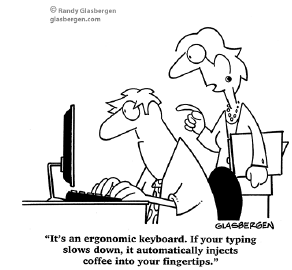
Source: www.glasbergen.com
Source: www.glasbergen.com
Q1262171
Inglês
According to the cartoon below, judge the following statements
as true (T) or false (F).
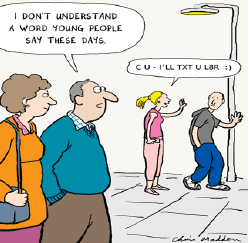
Source: http://eoienglishclub.wikispaces.com/ENGLISH+B1/unit3
I. The girl’s sentence can be transcript as “See you. I'll text you later”. II. Young people do not make difference between spoken and written speech. III. The old man can’t realize young people play with the sound of the words. IV. Young people text so much, they adequate their speech according to the facilities of keyboards. V. Language changes from one generation to another.
Choose the CORRECT alternative.
Source: http://eoienglishclub.wikispaces.com/ENGLISH+B1/unit3
I. The girl’s sentence can be transcript as “See you. I'll text you later”. II. Young people do not make difference between spoken and written speech. III. The old man can’t realize young people play with the sound of the words. IV. Young people text so much, they adequate their speech according to the facilities of keyboards. V. Language changes from one generation to another.
Choose the CORRECT alternative.

 Conheça nossos planos