Questões de Vestibular Sobre inglês
Foram encontradas 6.365 questões


Ano: 2014
Banca:
PUC - RS
Órgão:
PUC - RS
Prova:
PUC - RS - 2014 - PUC - RS - Vestibular - Primeiro Semestre 2º dia |
Q535800
Inglês

A frase “But without high-resolution images from more
areas, researchers cannot tell whether subduction might
also be happening in other locations” (linhas 25 a 27)
poderia ser assim compreendida:
Ano: 2014
Banca:
PUC - RS
Órgão:
PUC - RS
Prova:
PUC - RS - 2014 - PUC - RS - Vestibular - Primeiro Semestre 2º dia |
Q535799
Inglês
The “-ly” in “life-friendly” (line 28) performs the same
grammar role as in
Ano: 2014
Banca:
PUC - RS
Órgão:
PUC - RS
Prova:
PUC - RS - 2014 - PUC - RS - Vestibular - Primeiro Semestre 2º dia |
Q535798
Inglês
In line 07, the word “bolstered” can be substituted, without
change in meaning, by
Ano: 2014
Banca:
PUC - RS
Órgão:
PUC - RS
Prova:
PUC - RS - 2014 - PUC - RS - Vestibular - Primeiro Semestre 2º dia |
Q535797
Inglês
According to the text,
Ano: 2014
Banca:
PUC - RS
Órgão:
PUC - RS
Prova:
PUC - RS - 2014 - PUC - RS - Vestibular - Primeiro Semestre 2º dia |
Q535796
Inglês
INSTRUCTION: Answer question based on statements I to III.
I. NASA is looking for ideas for instruments to research Europa.
II. Researchers found that Europa’s ocean is habitable.
III. A system of plate tectonics on Europa’s icy crust has been suggested.
The correct statement(s) is/are
Q534793
Inglês
Texto associado
Leia o texto para responder à questão.
Urban Development – Solid Waste Management

Ask a mayor of a developing country city about his or her most pressing problems, and solid waste management generally will be high on the list. For many cities, solid waste management is their single largest budget item and largest employer.
It is also a critical matter of public health, environmental quality, quality of life, and economic development. A city that cannot effectively manage its waste is rarely able to manage more complex services such as health, education or transportation. And no one wants to live in a city surrounded by garbage.
As the world urbanizes, the situation is becoming more acute. More people mean more garbage, especially in fastgrowing cities where the bulk of waste is generated. We estimate that cities currently generate roughly 1.3 billion tonnes of solid waste per year; with current urbanization trends, this figure will grow to 2.2 billion tonnes per year by 2025 – an increase of 70 percent.
Managing waste will also become more expensive. Expenditures that today total $205 billion will grow to $375 billion. The cost impacts will be most severe in low income countries already struggling to meet basic social and infrastructure needs, particularly for their poorest residents.
Because it is such a major issue, waste management also represents a great opportunity for cities. Managed well, solid waste management practices can reduce greenhouse gas emission levels in a city, including short-lived climate pollutants that are far more potent than carbon dioxide. A city's ability to keep solid waste out of drainage ditches can also influence whether a neighborhood floods after a heavy storm.
(www.worldbank.org. Adaptado.)
Urban Development – Solid Waste Management
Ask a mayor of a developing country city about his or her most pressing problems, and solid waste management generally will be high on the list. For many cities, solid waste management is their single largest budget item and largest employer.
It is also a critical matter of public health, environmental quality, quality of life, and economic development. A city that cannot effectively manage its waste is rarely able to manage more complex services such as health, education or transportation. And no one wants to live in a city surrounded by garbage.
As the world urbanizes, the situation is becoming more acute. More people mean more garbage, especially in fastgrowing cities where the bulk of waste is generated. We estimate that cities currently generate roughly 1.3 billion tonnes of solid waste per year; with current urbanization trends, this figure will grow to 2.2 billion tonnes per year by 2025 – an increase of 70 percent.
Managing waste will also become more expensive. Expenditures that today total $205 billion will grow to $375 billion. The cost impacts will be most severe in low income countries already struggling to meet basic social and infrastructure needs, particularly for their poorest residents.
Because it is such a major issue, waste management also represents a great opportunity for cities. Managed well, solid waste management practices can reduce greenhouse gas emission levels in a city, including short-lived climate pollutants that are far more potent than carbon dioxide. A city's ability to keep solid waste out of drainage ditches can also influence whether a neighborhood floods after a heavy storm.
(www.worldbank.org. Adaptado.)
No trecho do último parágrafo – A city’s ability to keep solid waste out of drainage ditches can also influence whether a neighborhood floods after a heavy storm. –, a palavra whether pode ser substituída, sem alteração de sentido, por
Q534792
Inglês
Texto associado
Leia o texto para responder à questão.
Urban Development – Solid Waste Management
Ask a mayor of a developing country city about his or her most pressing problems, and solid waste management generally will be high on the list. For many cities, solid waste management is their single largest budget item and largest employer.
It is also a critical matter of public health, environmental quality, quality of life, and economic development. A city that cannot effectively manage its waste is rarely able to manage more complex services such as health, education or transportation. And no one wants to live in a city surrounded by garbage.
As the world urbanizes, the situation is becoming more acute. More people mean more garbage, especially in fastgrowing cities where the bulk of waste is generated. We estimate that cities currently generate roughly 1.3 billion tonnes of solid waste per year; with current urbanization trends, this figure will grow to 2.2 billion tonnes per year by 2025 – an increase of 70 percent.
Managing waste will also become more expensive. Expenditures that today total $205 billion will grow to $375 billion. The cost impacts will be most severe in low income countries already struggling to meet basic social and infrastructure needs, particularly for their poorest residents.
Because it is such a major issue, waste management also represents a great opportunity for cities. Managed well, solid waste management practices can reduce greenhouse gas emission levels in a city, including short-lived climate pollutants that are far more potent than carbon dioxide. A city's ability to keep solid waste out of drainage ditches can also influence whether a neighborhood floods after a heavy storm.
(www.worldbank.org. Adaptado.)
Urban Development – Solid Waste Management
Ask a mayor of a developing country city about his or her most pressing problems, and solid waste management generally will be high on the list. For many cities, solid waste management is their single largest budget item and largest employer.
It is also a critical matter of public health, environmental quality, quality of life, and economic development. A city that cannot effectively manage its waste is rarely able to manage more complex services such as health, education or transportation. And no one wants to live in a city surrounded by garbage.
As the world urbanizes, the situation is becoming more acute. More people mean more garbage, especially in fastgrowing cities where the bulk of waste is generated. We estimate that cities currently generate roughly 1.3 billion tonnes of solid waste per year; with current urbanization trends, this figure will grow to 2.2 billion tonnes per year by 2025 – an increase of 70 percent.
Managing waste will also become more expensive. Expenditures that today total $205 billion will grow to $375 billion. The cost impacts will be most severe in low income countries already struggling to meet basic social and infrastructure needs, particularly for their poorest residents.
Because it is such a major issue, waste management also represents a great opportunity for cities. Managed well, solid waste management practices can reduce greenhouse gas emission levels in a city, including short-lived climate pollutants that are far more potent than carbon dioxide. A city's ability to keep solid waste out of drainage ditches can also influence whether a neighborhood floods after a heavy storm.
(www.worldbank.org. Adaptado.)
De acordo com o texto, quando há uma boa gestão de resíduos sólidos,
Q534791
Inglês
Texto associado
Leia o texto para responder à questão.
Urban Development – Solid Waste Management
Ask a mayor of a developing country city about his or her most pressing problems, and solid waste management generally will be high on the list. For many cities, solid waste management is their single largest budget item and largest employer.
It is also a critical matter of public health, environmental quality, quality of life, and economic development. A city that cannot effectively manage its waste is rarely able to manage more complex services such as health, education or transportation. And no one wants to live in a city surrounded by garbage.
As the world urbanizes, the situation is becoming more acute. More people mean more garbage, especially in fastgrowing cities where the bulk of waste is generated. We estimate that cities currently generate roughly 1.3 billion tonnes of solid waste per year; with current urbanization trends, this figure will grow to 2.2 billion tonnes per year by 2025 – an increase of 70 percent.
Managing waste will also become more expensive. Expenditures that today total $205 billion will grow to $375 billion. The cost impacts will be most severe in low income countries already struggling to meet basic social and infrastructure needs, particularly for their poorest residents.
Because it is such a major issue, waste management also represents a great opportunity for cities. Managed well, solid waste management practices can reduce greenhouse gas emission levels in a city, including short-lived climate pollutants that are far more potent than carbon dioxide. A city's ability to keep solid waste out of drainage ditches can also influence whether a neighborhood floods after a heavy storm.
(www.worldbank.org. Adaptado.)
Urban Development – Solid Waste Management
Ask a mayor of a developing country city about his or her most pressing problems, and solid waste management generally will be high on the list. For many cities, solid waste management is their single largest budget item and largest employer.
It is also a critical matter of public health, environmental quality, quality of life, and economic development. A city that cannot effectively manage its waste is rarely able to manage more complex services such as health, education or transportation. And no one wants to live in a city surrounded by garbage.
As the world urbanizes, the situation is becoming more acute. More people mean more garbage, especially in fastgrowing cities where the bulk of waste is generated. We estimate that cities currently generate roughly 1.3 billion tonnes of solid waste per year; with current urbanization trends, this figure will grow to 2.2 billion tonnes per year by 2025 – an increase of 70 percent.
Managing waste will also become more expensive. Expenditures that today total $205 billion will grow to $375 billion. The cost impacts will be most severe in low income countries already struggling to meet basic social and infrastructure needs, particularly for their poorest residents.
Because it is such a major issue, waste management also represents a great opportunity for cities. Managed well, solid waste management practices can reduce greenhouse gas emission levels in a city, including short-lived climate pollutants that are far more potent than carbon dioxide. A city's ability to keep solid waste out of drainage ditches can also influence whether a neighborhood floods after a heavy storm.
(www.worldbank.org. Adaptado.)
Segundo o texto, o maior impacto do aumento de custos da gestão de resíduos sólidos será sobre
Q534790
Inglês
Texto associado
Leia o texto para responder à questão.
Urban Development – Solid Waste Management
Ask a mayor of a developing country city about his or her most pressing problems, and solid waste management generally will be high on the list. For many cities, solid waste management is their single largest budget item and largest employer.
It is also a critical matter of public health, environmental quality, quality of life, and economic development. A city that cannot effectively manage its waste is rarely able to manage more complex services such as health, education or transportation. And no one wants to live in a city surrounded by garbage.
As the world urbanizes, the situation is becoming more acute. More people mean more garbage, especially in fastgrowing cities where the bulk of waste is generated. We estimate that cities currently generate roughly 1.3 billion tonnes of solid waste per year; with current urbanization trends, this figure will grow to 2.2 billion tonnes per year by 2025 – an increase of 70 percent.
Managing waste will also become more expensive. Expenditures that today total $205 billion will grow to $375 billion. The cost impacts will be most severe in low income countries already struggling to meet basic social and infrastructure needs, particularly for their poorest residents.
Because it is such a major issue, waste management also represents a great opportunity for cities. Managed well, solid waste management practices can reduce greenhouse gas emission levels in a city, including short-lived climate pollutants that are far more potent than carbon dioxide. A city's ability to keep solid waste out of drainage ditches can also influence whether a neighborhood floods after a heavy storm.
(www.worldbank.org. Adaptado.)
Urban Development – Solid Waste Management
Ask a mayor of a developing country city about his or her most pressing problems, and solid waste management generally will be high on the list. For many cities, solid waste management is their single largest budget item and largest employer.
It is also a critical matter of public health, environmental quality, quality of life, and economic development. A city that cannot effectively manage its waste is rarely able to manage more complex services such as health, education or transportation. And no one wants to live in a city surrounded by garbage.
As the world urbanizes, the situation is becoming more acute. More people mean more garbage, especially in fastgrowing cities where the bulk of waste is generated. We estimate that cities currently generate roughly 1.3 billion tonnes of solid waste per year; with current urbanization trends, this figure will grow to 2.2 billion tonnes per year by 2025 – an increase of 70 percent.
Managing waste will also become more expensive. Expenditures that today total $205 billion will grow to $375 billion. The cost impacts will be most severe in low income countries already struggling to meet basic social and infrastructure needs, particularly for their poorest residents.
Because it is such a major issue, waste management also represents a great opportunity for cities. Managed well, solid waste management practices can reduce greenhouse gas emission levels in a city, including short-lived climate pollutants that are far more potent than carbon dioxide. A city's ability to keep solid waste out of drainage ditches can also influence whether a neighborhood floods after a heavy storm.
(www.worldbank.org. Adaptado.)
No trecho do terceiro parágrafo – this figure will grow –, a palavra figure refere-se, no texto, a
Q534789
Inglês
Texto associado
Leia o texto para responder à questão.
Urban Development – Solid Waste Management
Ask a mayor of a developing country city about his or her most pressing problems, and solid waste management generally will be high on the list. For many cities, solid waste management is their single largest budget item and largest employer.
It is also a critical matter of public health, environmental quality, quality of life, and economic development. A city that cannot effectively manage its waste is rarely able to manage more complex services such as health, education or transportation. And no one wants to live in a city surrounded by garbage.
As the world urbanizes, the situation is becoming more acute. More people mean more garbage, especially in fastgrowing cities where the bulk of waste is generated. We estimate that cities currently generate roughly 1.3 billion tonnes of solid waste per year; with current urbanization trends, this figure will grow to 2.2 billion tonnes per year by 2025 – an increase of 70 percent.
Managing waste will also become more expensive. Expenditures that today total $205 billion will grow to $375 billion. The cost impacts will be most severe in low income countries already struggling to meet basic social and infrastructure needs, particularly for their poorest residents.
Because it is such a major issue, waste management also represents a great opportunity for cities. Managed well, solid waste management practices can reduce greenhouse gas emission levels in a city, including short-lived climate pollutants that are far more potent than carbon dioxide. A city's ability to keep solid waste out of drainage ditches can also influence whether a neighborhood floods after a heavy storm.
(www.worldbank.org. Adaptado.)
Urban Development – Solid Waste Management
Ask a mayor of a developing country city about his or her most pressing problems, and solid waste management generally will be high on the list. For many cities, solid waste management is their single largest budget item and largest employer.
It is also a critical matter of public health, environmental quality, quality of life, and economic development. A city that cannot effectively manage its waste is rarely able to manage more complex services such as health, education or transportation. And no one wants to live in a city surrounded by garbage.
As the world urbanizes, the situation is becoming more acute. More people mean more garbage, especially in fastgrowing cities where the bulk of waste is generated. We estimate that cities currently generate roughly 1.3 billion tonnes of solid waste per year; with current urbanization trends, this figure will grow to 2.2 billion tonnes per year by 2025 – an increase of 70 percent.
Managing waste will also become more expensive. Expenditures that today total $205 billion will grow to $375 billion. The cost impacts will be most severe in low income countries already struggling to meet basic social and infrastructure needs, particularly for their poorest residents.
Because it is such a major issue, waste management also represents a great opportunity for cities. Managed well, solid waste management practices can reduce greenhouse gas emission levels in a city, including short-lived climate pollutants that are far more potent than carbon dioxide. A city's ability to keep solid waste out of drainage ditches can also influence whether a neighborhood floods after a heavy storm.
(www.worldbank.org. Adaptado.)
De acordo com o texto, o aumento na produção de resíduos sólidos ocorre, principalmente, devido
Q534788
Inglês
Texto associado
Leia o texto para responder à questão.
Urban Development – Solid Waste Management
Ask a mayor of a developing country city about his or her most pressing problems, and solid waste management generally will be high on the list. For many cities, solid waste management is their single largest budget item and largest employer.
It is also a critical matter of public health, environmental quality, quality of life, and economic development. A city that cannot effectively manage its waste is rarely able to manage more complex services such as health, education or transportation. And no one wants to live in a city surrounded by garbage.
As the world urbanizes, the situation is becoming more acute. More people mean more garbage, especially in fastgrowing cities where the bulk of waste is generated. We estimate that cities currently generate roughly 1.3 billion tonnes of solid waste per year; with current urbanization trends, this figure will grow to 2.2 billion tonnes per year by 2025 – an increase of 70 percent.
Managing waste will also become more expensive. Expenditures that today total $205 billion will grow to $375 billion. The cost impacts will be most severe in low income countries already struggling to meet basic social and infrastructure needs, particularly for their poorest residents.
Because it is such a major issue, waste management also represents a great opportunity for cities. Managed well, solid waste management practices can reduce greenhouse gas emission levels in a city, including short-lived climate pollutants that are far more potent than carbon dioxide. A city's ability to keep solid waste out of drainage ditches can also influence whether a neighborhood floods after a heavy storm.
(www.worldbank.org. Adaptado.)
Urban Development – Solid Waste Management
Ask a mayor of a developing country city about his or her most pressing problems, and solid waste management generally will be high on the list. For many cities, solid waste management is their single largest budget item and largest employer.
It is also a critical matter of public health, environmental quality, quality of life, and economic development. A city that cannot effectively manage its waste is rarely able to manage more complex services such as health, education or transportation. And no one wants to live in a city surrounded by garbage.
As the world urbanizes, the situation is becoming more acute. More people mean more garbage, especially in fastgrowing cities where the bulk of waste is generated. We estimate that cities currently generate roughly 1.3 billion tonnes of solid waste per year; with current urbanization trends, this figure will grow to 2.2 billion tonnes per year by 2025 – an increase of 70 percent.
Managing waste will also become more expensive. Expenditures that today total $205 billion will grow to $375 billion. The cost impacts will be most severe in low income countries already struggling to meet basic social and infrastructure needs, particularly for their poorest residents.
Because it is such a major issue, waste management also represents a great opportunity for cities. Managed well, solid waste management practices can reduce greenhouse gas emission levels in a city, including short-lived climate pollutants that are far more potent than carbon dioxide. A city's ability to keep solid waste out of drainage ditches can also influence whether a neighborhood floods after a heavy storm.
(www.worldbank.org. Adaptado.)
Segundo o texto, a gestão de resíduos sólidos
Q534787
Inglês
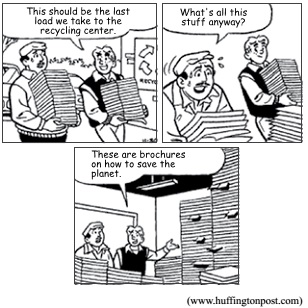
O humor da tira decorre
Q534786
Inglês
No segundo quadrinho, this stuff refere-se a
Q534785
Inglês
No trecho do primeiro quadrinho – This should be the last load –, a palavra should indica uma ideia de
Q534784
Inglês
Segundo as informações presentes na tira, os dois homens
Ano: 2014
Banca:
UniCEUB
Órgão:
UniCEUB
Prova:
UniCEUB - 2014 - UniCEUB - Vestibular - 2º Vestibular |
Q516031
Inglês
Choose the correct tag to finish the sentence.
“Yes. Probably we should. Did you take the number of the cab?"
“No. You didn't notice it, ...................... ?"
Extracted fromThe Necklace
by Guy de Maupassan
“Yes. Probably we should. Did you take the number of the cab?"
“No. You didn't notice it, ...................... ?"
Extracted fromThe Necklace
by Guy de Maupassan
Ano: 2014
Banca:
UniCEUB
Órgão:
UniCEUB
Prova:
UniCEUB - 2014 - UniCEUB - Vestibular - 2º Vestibular |
Q516030
Inglês
Circle the letter of the answer that correctly contains the following sentence into the negative form:
The conference director welcomes proposals for round tables and panels that deal with the development of important genres, literary movements, themes, and issues.
American Literature Association
Symposium on American Poetry
The conference director welcomes proposals for round tables and panels that deal with the development of important genres, literary movements, themes, and issues.
American Literature Association
Symposium on American Poetry
Ano: 2014
Banca:
UniCEUB
Órgão:
UniCEUB
Prova:
UniCEUB - 2014 - UniCEUB - Vestibular - 2º Vestibular |
Q516029
Inglês
Texto associado
When I ..................... a long time, very patiently, without ..................... him lie down, I resolved to open a little — a very, very little crevice in the lantern. So I opened it — you cannot imagine how stealthily,
stealthily — until, at length, a single dim ray, like the thread of the spider, shot from out the crevice and full upon the vulture eye.
Extracted from The Tell-Tale Heart by Edgar Allan Poe
When I ..................... a long time, very patiently, without ..................... him lie down, I resolved to open a little — a very, very little crevice in the lantern. So I opened it — you cannot imagine how stealthily,
stealthily — until, at length, a single dim ray, like the thread of the spider, shot from out the crevice and full upon the vulture eye.
Extracted from The Tell-Tale Heart by Edgar Allan Poe
Choose the words that best keep the meaning of the original sentence if they are substituted for the underlined words.
Ano: 2014
Banca:
UniCEUB
Órgão:
UniCEUB
Prova:
UniCEUB - 2014 - UniCEUB - Vestibular - 2º Vestibular |
Q516028
Inglês
Texto associado
When I ..................... a long time, very patiently, without ..................... him lie down, I resolved to open a little — a very, very little crevice in the lantern. So I opened it — you cannot imagine how stealthily,
stealthily — until, at length, a single dim ray, like the thread of the spider, shot from out the crevice and full upon the vulture eye.
Extracted from The Tell-Tale Heart by Edgar Allan Poe
When I ..................... a long time, very patiently, without ..................... him lie down, I resolved to open a little — a very, very little crevice in the lantern. So I opened it — you cannot imagine how stealthily,
stealthily — until, at length, a single dim ray, like the thread of the spider, shot from out the crevice and full upon the vulture eye.
Extracted from The Tell-Tale Heart by Edgar Allan Poe
Circle the letter of the verbs that correctly complete the sentences.
Ano: 2014
Banca:
UniCEUB
Órgão:
UniCEUB
Prova:
UniCEUB - 2014 - UniCEUB - Vestibular - 2º Vestibular |
Q516027
Inglês
Texto associado
TEXT 2
Gabriel García Márquez was a Literary Giant
With a Passion for Journalism
By Karla Zabludovsky Friday, April 18,2014
The late Gabriel García Márquez holds a special place in the hearts of journalists.
Like Charles Dickens, Mark Twain and Ernest Hemingway — or contemporaries like Pete Hamill and Tom Wolfe — García Márquez, a titan of 20th century literature, honed his writing skills as a reporter
before he became a celebrated novelist.
Even as his literary star rose, García Márquez, known colloquially across Latin America as Gabo, spoke proudly, tenderly and frequently about journalism.
“Those who are self-taught are avid and quick, and during those bygone times, we were that to a great extent in order to keep paving the way for the best profession in the world… as we ourselves called
it," said García Márquez during a speech about journalism at the 52nd Assembly of the Inter American Press Association in 1996.
Newsweek Magazine
Gabriel García Márquez was a Literary Giant
With a Passion for Journalism
By Karla Zabludovsky Friday, April 18,2014
The late Gabriel García Márquez holds a special place in the hearts of journalists.
Like Charles Dickens, Mark Twain and Ernest Hemingway — or contemporaries like Pete Hamill and Tom Wolfe — García Márquez, a titan of 20th century literature, honed his writing skills as a reporter
before he became a celebrated novelist.
Even as his literary star rose, García Márquez, known colloquially across Latin America as Gabo, spoke proudly, tenderly and frequently about journalism.
“Those who are self-taught are avid and quick, and during those bygone times, we were that to a great extent in order to keep paving the way for the best profession in the world… as we ourselves called
it," said García Márquez during a speech about journalism at the 52nd Assembly of the Inter American Press Association in 1996.
Newsweek Magazine
Choose the letter that best defines the phrase bygone times in the passage.

 Conheça nossos planos