Questões de Vestibular Sobre inglês
Foram encontradas 6.367 questões


Shares in the music streaming firm Spotify will be publicly traded for the first time when the firm debuts on the New York market.
The flotation marks a turning point for the firm that after 12 years has not yet made a profit. Spotify's listing, which could value it at $20billion (£14 billion), is unconventional: it is not issuing any new shares. Instead, shares held by the firm's private investors will be made available.
What was once an small upstart Swedish music platform, has grown rapidly in recent years, adding millions of users to its free-to-use ad-funded service, and converting many of them to its more lucrative subscription service. It's used in 61 countries, has 159 million active users and a library of 35 million songs. They developed the platform in 2006 as a response to the growing piracy problem the music industry was facing. It is now the global leader among music streaming companies, boasting 71 million paying customers, twice as many as runner-up Apple.
What Spotify must do to survive? So far costs and fees to recording companies for the rights to play their music, have exceeded Spotify's revenues. And some analysts predict the listing will speed-up Spotify's race towards profitability. "When that's done we'll see a bit of a shift in strategy and direction." says Mark Mulligan at MIDia Research. The firm made a commitment to investors who backed it as the company was growing, that they would be given the chance to cash in their investment. The streaming giant has filed for paperwork to start trading its shares publicly on the New York Stock Exchange.
What will Spotify look like in the future? So what will change? "So far they've been treading a very fine line between being the dramatic new future of the music business but simultaneously being the biggest friend of the old music industry by giving record labels a platform to build out of decline," says Mr Mulligan.
"To go to the next phase [Spotify] will have to stop being so friendly to the record companies." More than half of Spotify's revenue goes directly to the record companies. Chris Hayes expects Spotify to evolve. "I think over time they're going to have to diversify their offering." he says, helping to set them apart from a sea of rival streaming services. They have already moved into podcasts and producing original music. They may well start to offer more original content like Taylor Swift's recent video which was only made available on the platform, says Chris Hayes.
So can Spotify make money? The firm's first operating profit (not including debt financing) is on the horizon for 2019 based on current trends, according to Mr Hayes. "The strategy has always been the free tier, but it is a funnel through which to persuade free users to upgrade to the subscription tier which is lucrative.
"As long as subscriptions continue to grow it should eventually become profitable. "Spotify's rivals are the biggest companies in the world with bottomless pockets," he says, and they are using music as a way to sell their core products, not as a business proposition in itself.
Apple, Amazon and Google are also in the streaming game and - unlike Spotify - all sell devices on which consumers can listen to music. And while Spotify has signed deals with all the "big three" record labels - Warner, Universal and Sony - it is the music executives that still hold the bargaining chips.
Adapted from: http://www.bbc.com/news/business-43613398. Acesso em: 03 abr. 2018.
Shares in the music streaming firm Spotify will be publicly traded for the first time when the firm debuts on the New York market.
The flotation marks a turning point for the firm that after 12 years has not yet made a profit. Spotify's listing, which could value it at $20billion (£14 billion), is unconventional: it is not issuing any new shares. Instead, shares held by the firm's private investors will be made available.
What was once an small upstart Swedish music platform, has grown rapidly in recent years, adding millions of users to its free-to-use ad-funded service, and converting many of them to its more lucrative subscription service. It's used in 61 countries, has 159 million active users and a library of 35 million songs. They developed the platform in 2006 as a response to the growing piracy problem the music industry was facing. It is now the global leader among music streaming companies, boasting 71 million paying customers, twice as many as runner-up Apple.
What Spotify must do to survive? So far costs and fees to recording companies for the rights to play their music, have exceeded Spotify's revenues. And some analysts predict the listing will speed-up Spotify's race towards profitability. "When that's done we'll see a bit of a shift in strategy and direction." says Mark Mulligan at MIDia Research. The firm made a commitment to investors who backed it as the company was growing, that they would be given the chance to cash in their investment. The streaming giant has filed for paperwork to start trading its shares publicly on the New York Stock Exchange.
What will Spotify look like in the future? So what will change? "So far they've been treading a very fine line between being the dramatic new future of the music business but simultaneously being the biggest friend of the old music industry by giving record labels a platform to build out of decline," says Mr Mulligan.
"To go to the next phase [Spotify] will have to stop being so friendly to the record companies." More than half of Spotify's revenue goes directly to the record companies. Chris Hayes expects Spotify to evolve. "I think over time they're going to have to diversify their offering." he says, helping to set them apart from a sea of rival streaming services. They have already moved into podcasts and producing original music. They may well start to offer more original content like Taylor Swift's recent video which was only made available on the platform, says Chris Hayes.
So can Spotify make money? The firm's first operating profit (not including debt financing) is on the horizon for 2019 based on current trends, according to Mr Hayes. "The strategy has always been the free tier, but it is a funnel through which to persuade free users to upgrade to the subscription tier which is lucrative.
"As long as subscriptions continue to grow it should eventually become profitable. "Spotify's rivals are the biggest companies in the world with bottomless pockets," he says, and they are using music as a way to sell their core products, not as a business proposition in itself.
Apple, Amazon and Google are also in the streaming game and - unlike Spotify - all sell devices on which consumers can listen to music. And while Spotify has signed deals with all the "big three" record labels - Warner, Universal and Sony - it is the music executives that still hold the bargaining chips.
Adapted from: http://www.bbc.com/news/business-43613398. Acesso em: 03 abr. 2018.
TEXTO 03
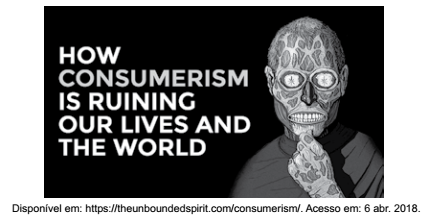
“Consumerism is ruining our lives and the world” a voz passiva da frase está CORRETAMENTE construída e sem
alterar o sentido na alternativa:
TEXTO 02

TEXTO 02
TEXTO 02
TEXTO 02
TEXTO 01
CAN TECH DELIVER A SUSTAINABLE FUTURE FOR PLANET EARTH?
Sustainability means many things to many people, but it boils down to this: saving Planet Earth.
Mankind1 , as a species, has been too successful for its own good – the global population is estimate to top nine billion by 2050, according to the United Nations Department of Economic and Social Affairs.
As a result, there is already a strain2 on the planet’s essential natural resources, particularly food and water, which population growth can only aggravate.
Meanwhile, our demand for energy has directed to the plundering3 of the earth’s hydrocarbons oil, gas and coal, producing a catastrophic climate change. In a month-long series of features on the theme of sustainability, Technology of Business will be examining the main challenges facing businesses and asking whether technology – which got us into this mess in the first place – can help get us out.
Global megatrends are affecting the business environment
Most companies are already being affected by climate change today, directly or indirectly, says *CDP, a global not-for-profit organization specializing in measuring business environmental impact.
Extreme weather, drought and flooding can disrupt production capacity and affect supply chains for a whole range of businesses. For example, in a CDP survey of 70 European companies, 83% said they had operations in “water-stressed” regions, while 73% said water shortages posed risks to their own operations or those of their suppliers.
Considering an increasingly globalised economy, few businesses can isolate themselves from the impacts of climate change, population growth and resource reduction, says Emma Price-Thomas, head of sustainability strategy at charity Business in the Community.
“The world is changing very fast. Global megatrends are markedly affecting the business environment. If companies don’t address these and think longer-term, they may end up putting themselves out of business,” she argues.
A lot of technology and research is being directed towards reducing water usage an industrial processes and designing products that need less water to work, she says.
*CDP - Carbon Disclosure Project é uma organização que opera o sistema global de divulgação para que investidores, gerenciem seus impactos ambientais
Fonte: WALL, Matthew, BBC NEWS, 2 May 2014. Disponível em: http://www.bbc.com/news/business27208569. Adaptado. Acesso em: 6 abr. 2018.
1 ManKind: Humanidade
2 Strain:Tensão
3 Plundering: Pilhagem
TEXTO 01
CAN TECH DELIVER A SUSTAINABLE FUTURE FOR PLANET EARTH?
Sustainability means many things to many people, but it boils down to this: saving Planet Earth.
Mankind1 , as a species, has been too successful for its own good – the global population is estimate to top nine billion by 2050, according to the United Nations Department of Economic and Social Affairs.
As a result, there is already a strain2 on the planet’s essential natural resources, particularly food and water, which population growth can only aggravate.
Meanwhile, our demand for energy has directed to the plundering3 of the earth’s hydrocarbons oil, gas and coal, producing a catastrophic climate change. In a month-long series of features on the theme of sustainability, Technology of Business will be examining the main challenges facing businesses and asking whether technology – which got us into this mess in the first place – can help get us out.
Global megatrends are affecting the business environment
Most companies are already being affected by climate change today, directly or indirectly, says *CDP, a global not-for-profit organization specializing in measuring business environmental impact.
Extreme weather, drought and flooding can disrupt production capacity and affect supply chains for a whole range of businesses. For example, in a CDP survey of 70 European companies, 83% said they had operations in “water-stressed” regions, while 73% said water shortages posed risks to their own operations or those of their suppliers.
Considering an increasingly globalised economy, few businesses can isolate themselves from the impacts of climate change, population growth and resource reduction, says Emma Price-Thomas, head of sustainability strategy at charity Business in the Community.
“The world is changing very fast. Global megatrends are markedly affecting the business environment. If companies don’t address these and think longer-term, they may end up putting themselves out of business,” she argues.
A lot of technology and research is being directed towards reducing water usage an industrial processes and designing products that need less water to work, she says.
*CDP - Carbon Disclosure Project é uma organização que opera o sistema global de divulgação para que investidores, gerenciem seus impactos ambientais
Fonte: WALL, Matthew, BBC NEWS, 2 May 2014. Disponível em: http://www.bbc.com/news/business27208569. Adaptado. Acesso em: 6 abr. 2018.
1 ManKind: Humanidade
2 Strain:Tensão
3 Plundering: Pilhagem
TEXTO 01
CAN TECH DELIVER A SUSTAINABLE FUTURE FOR PLANET EARTH?
Sustainability means many things to many people, but it boils down to this: saving Planet Earth.
Mankind1 , as a species, has been too successful for its own good – the global population is estimate to top nine billion by 2050, according to the United Nations Department of Economic and Social Affairs.
As a result, there is already a strain2 on the planet’s essential natural resources, particularly food and water, which population growth can only aggravate.
Meanwhile, our demand for energy has directed to the plundering3 of the earth’s hydrocarbons oil, gas and coal, producing a catastrophic climate change. In a month-long series of features on the theme of sustainability, Technology of Business will be examining the main challenges facing businesses and asking whether technology – which got us into this mess in the first place – can help get us out.
Global megatrends are affecting the business environment
Most companies are already being affected by climate change today, directly or indirectly, says *CDP, a global not-for-profit organization specializing in measuring business environmental impact.
Extreme weather, drought and flooding can disrupt production capacity and affect supply chains for a whole range of businesses. For example, in a CDP survey of 70 European companies, 83% said they had operations in “water-stressed” regions, while 73% said water shortages posed risks to their own operations or those of their suppliers.
Considering an increasingly globalised economy, few businesses can isolate themselves from the impacts of climate change, population growth and resource reduction, says Emma Price-Thomas, head of sustainability strategy at charity Business in the Community.
“The world is changing very fast. Global megatrends are markedly affecting the business environment. If companies don’t address these and think longer-term, they may end up putting themselves out of business,” she argues.
A lot of technology and research is being directed towards reducing water usage an industrial processes and designing products that need less water to work, she says.
*CDP - Carbon Disclosure Project é uma organização que opera o sistema global de divulgação para que investidores, gerenciem seus impactos ambientais
Fonte: WALL, Matthew, BBC NEWS, 2 May 2014. Disponível em: http://www.bbc.com/news/business27208569. Adaptado. Acesso em: 6 abr. 2018.
1 ManKind: Humanidade
2 Strain:Tensão
3 Plundering: Pilhagem
Observe as palavras destacadas no trecho a seguir.
“Considering an increasingly globalised economy, few businesses can isolate themselves from the impacts of climate change, population growth and resource depletion, says Emma Price-Thomas, head of sustainability strategy at charity Business in the Community.”
Marque a alternativa que é classificada como um VERBO na sentença:
TEXTO 01
CAN TECH DELIVER A SUSTAINABLE FUTURE FOR PLANET EARTH?
Sustainability means many things to many people, but it boils down to this: saving Planet Earth.
Mankind1 , as a species, has been too successful for its own good – the global population is estimate to top nine billion by 2050, according to the United Nations Department of Economic and Social Affairs.
As a result, there is already a strain2 on the planet’s essential natural resources, particularly food and water, which population growth can only aggravate.
Meanwhile, our demand for energy has directed to the plundering3 of the earth’s hydrocarbons oil, gas and coal, producing a catastrophic climate change. In a month-long series of features on the theme of sustainability, Technology of Business will be examining the main challenges facing businesses and asking whether technology – which got us into this mess in the first place – can help get us out.
Global megatrends are affecting the business environment
Most companies are already being affected by climate change today, directly or indirectly, says *CDP, a global not-for-profit organization specializing in measuring business environmental impact.
Extreme weather, drought and flooding can disrupt production capacity and affect supply chains for a whole range of businesses. For example, in a CDP survey of 70 European companies, 83% said they had operations in “water-stressed” regions, while 73% said water shortages posed risks to their own operations or those of their suppliers.
Considering an increasingly globalised economy, few businesses can isolate themselves from the impacts of climate change, population growth and resource reduction, says Emma Price-Thomas, head of sustainability strategy at charity Business in the Community.
“The world is changing very fast. Global megatrends are markedly affecting the business environment. If companies don’t address these and think longer-term, they may end up putting themselves out of business,” she argues.
A lot of technology and research is being directed towards reducing water usage an industrial processes and designing products that need less water to work, she says.
*CDP - Carbon Disclosure Project é uma organização que opera o sistema global de divulgação para que investidores, gerenciem seus impactos ambientais
Fonte: WALL, Matthew, BBC NEWS, 2 May 2014. Disponível em: http://www.bbc.com/news/business27208569. Adaptado. Acesso em: 6 abr. 2018.
1 ManKind: Humanidade
2 Strain:Tensão
3 Plundering: Pilhagem
TEXTO 01
CAN TECH DELIVER A SUSTAINABLE FUTURE FOR PLANET EARTH?
Sustainability means many things to many people, but it boils down to this: saving Planet Earth.
Mankind1 , as a species, has been too successful for its own good – the global population is estimate to top nine billion by 2050, according to the United Nations Department of Economic and Social Affairs.
As a result, there is already a strain2 on the planet’s essential natural resources, particularly food and water, which population growth can only aggravate.
Meanwhile, our demand for energy has directed to the plundering3 of the earth’s hydrocarbons oil, gas and coal, producing a catastrophic climate change. In a month-long series of features on the theme of sustainability, Technology of Business will be examining the main challenges facing businesses and asking whether technology – which got us into this mess in the first place – can help get us out.
Global megatrends are affecting the business environment
Most companies are already being affected by climate change today, directly or indirectly, says *CDP, a global not-for-profit organization specializing in measuring business environmental impact.
Extreme weather, drought and flooding can disrupt production capacity and affect supply chains for a whole range of businesses. For example, in a CDP survey of 70 European companies, 83% said they had operations in “water-stressed” regions, while 73% said water shortages posed risks to their own operations or those of their suppliers.
Considering an increasingly globalised economy, few businesses can isolate themselves from the impacts of climate change, population growth and resource reduction, says Emma Price-Thomas, head of sustainability strategy at charity Business in the Community.
“The world is changing very fast. Global megatrends are markedly affecting the business environment. If companies don’t address these and think longer-term, they may end up putting themselves out of business,” she argues.
A lot of technology and research is being directed towards reducing water usage an industrial processes and designing products that need less water to work, she says.
*CDP - Carbon Disclosure Project é uma organização que opera o sistema global de divulgação para que investidores, gerenciem seus impactos ambientais
Fonte: WALL, Matthew, BBC NEWS, 2 May 2014. Disponível em: http://www.bbc.com/news/business27208569. Adaptado. Acesso em: 6 abr. 2018.
1 ManKind: Humanidade
2 Strain:Tensão
3 Plundering: Pilhagem
Read the text below.
Read the text below. Fill in the blanks with the right conjunctions.
n today's world, (I) _________ just about everything is more convenient and accessible due to advances in technology across almost all sectors, it may seem (II)_________ it's a misnomer to even mention any disadvantages of technological advances. (III) __________, despite how far technology has taken humans and no matter (IV) ______ convenient it may make things, there are some disadvantages accompanying this level of access.
Technology advances show people a more efficient way to do things, and these processes get results. For example, education has been greatly advanced by the technological advances of computers. Students are able to learn on a global scale without ever leaving their classrooms. Agricultural processes (V)_______ once required dozens upon dozens of human workers can now be automated, thanks to advances in technology, which means cost-efficiency for farmers. Medical discoveries occur at a much more rapid rate, thanks to machines and computers that aid in the research process and allow for more intense educational research into medical matters.
Cost efficiency is an advantage in some ways and a disadvantage in others. (VI) _______ technology improves on existing processes and showcases new ways to accomplish tasks, machines are able to produce the same -- if not more -- output (VII) _______ humans in certain industries. This results in cost savings for business owners, allowing them to invest in growth in other areas of the business, (VIII) _________ contributes on a positive level to the economy as a whole.
Available at: ..smallbusiness.chron.com/advantages-disadvantages-technology-advances-12579.html
Mark the correct alternative.
Read the text below.
Read the text below.
The methodological suggestions presented by the official documents about education in Brazil, the National Curriculum Parameters, point to a socio-interactionist practice regarding the language teaching. To produce texts, therefore, is to act symbolically for the world, producing meanings for the other. In this production, the man, as a social being, acts in an ordered and organized manner in relation to the other. It is, thus, established what is called social interaction about which Marcuschi claims not to be "a chaotic activity, neither random or mechanical, but directed, coordinated and intentional." Social interaction is one of the most important devices for the social construction of reality, because the participants of the interaction are social constructors who use language as a facilitator way in this relationship to reach their various purposes and objectives. In this social practice, considering the different forms of language manifestation, one can not deny the undoubted presence of technology, which advances in the relations of interaction, especially among young people, through the social networks at the Internet. PRIETO, Sandra. A importância dos gêneros digitais na escola. Colégio Visconde de Porto Seguro. São Paulo, São Paulo, 05658-080, Brasil. (adaptado, tradução nossa). Disponível em: .http://www.iiisci.org/journal/CV$/risci/pdfs/CB844PO14.pdf.
According to this text, consider the following statements.
I - Technology, especially with the arise of the Internet, redefined an immense virtual social network, that connects the most diverse individuals by the most diversified forms at an astonishing speed.
II - The new scenery of digital technology relativized the need for physical presence at human beings’ relations and at their social life. This gives a new notion of social interaction, which can be achieved in digital media, through, among other, social media. In addition to this new format of social interaction, it brings to reflection a new way of using as the language in writing as an interactive practice.
III - The spaces of learning in the digital age are integrated not only between the social spaces (home, family, friends, leisure, physical community in general), but also with all virtual space and, so that one can live better into the society of knowledge, information and communication, it isn’t necessary to develop specific skills for the written interaction that allows the individual to pass through, occupy and interact, efficiently all these social contexts.
IV - There are the need and the importance of the school's role in relation to these new textual
supports that emerge new digital genres, which should be incorporated into the academic
context for a formation for the whole life.
It is correct what is stated on:
Read the text below.
Read the text below.
Over the 19th century, since the rupture of the colonial statute and the beginning of the construction of the national state in Brazil, put the need of developing a literary historiography, able not only to justify the existence of a Brazilian literature, how to think and point out their characters and specificities. From Ferdinand Denis to Ferdinand Wolf, from Gonçalves Magalhães to Joaquim Norberto, passing by Santiago Nunes Ribeiro and Francisco Adolfo de Varnhagen with the collaboration of many other, a historical-literary tradition was conceived with an important ideological role in the national construction. Collective construct, this operation involved many intellectuals and a decisive action of the state for a few decades.
This critical collection was re-elaborated in the last decades of the 19th century and in the beginning of the 20th century, by several other intellectuals, in their studies about the history of Brazilian literature, among them, Sílvio Romero, Araripe Júnior and José Veríssimo. Absorbing conceptions of the positivism, the naturalism and the evolutionism - especially by Auguste Comte, Herbert Spencer and Hippolyte Taine -, their formulations are impregnated with notions of race, language and culture. Notwithstanding the determinism of analysis and elaboration, these Brazilian authors become a basic or even paradigmatic reference for literary histories, until at least, the middle of the twentieth century.
It was only in the fifties of that century, that these references were to be reworked and surpassed by Antonio Candido, in the book Formation of Brazilian Literature, in 1959. In this study, the author, starting from the previous historical-critical heritage and incorporating many of its elements, rethought the chronological and cultural frame of the emergence of literature in Brazil, that is, its decisive moments – 18th century (Arcadism) and XIX (Romanticism) - together with the establishment of a literary system.
Fifty years after the publication of the important study by Antonio Candido, it is opportune and necessary to rediscuss and redefine the historical limits of the creation or formation of the national or Brazilian literature, through a various reading about the process of the State and nation organization in Brazil. LEONEL, M. C.; SEGATTO, J. A. Organização do Estado e formação da literatura – Fev. 2009. Disponível em: . Adaptado. Versão nossa.
Choose the alternative that represents the correct time-frame from the Brazilian Literary Schools.
Read the text below.
Read the text below
It is important to emphasize that it isn’t a question of changing an ethnocentric focus wellmarked from European root by an African, but rather of broadening the focus on the school curricula to the Brazilian cultural, racial, social, and economic diversity. For this, it is necessary to be sure that Art. 26-A added to Law n. 9.394/ 1996 provokes much more than an inclusion of new contents, it requires rethinking about ethnic-racial, social, pedagogical relations, teaching procedures, conditions offered for learning, tacit and explicit goals of the education offered by schools (BRASIL, 2014).
The multiculturalism in art teaching implies a broad conception of art, capable of encompassing multiple and differentiated artistic manifestations, and the same is placed on a specific field of musical education. A broad conception of music is, on the one hand, a necessary condition for that musical education can respond to the multicultural perspective. On the other hand, the conception of multiculturality contributes to the expansion of the conception of music that guides our educational position. In its origins, the multicultural movement is basically linked to ethnic issues, but little by little it "gives space to other aspects of cultural domination" (GONÇALVES; SILVA, 2000, p. 28).
PENNA, Maura. Poéticas musicais e práticas sociais: reflexões sobre a educação musical diante da diversidade. Revista da ABEM, Porto Alegre, V. 13, 7-16, set. 2005. Adaptado. Versão nossa.
Considering the presented text, evaluate the following statements and the relation proposed between them.
I - The multiculturalist posture must embrace the diversity of artistic and musical productions, linked to different social groups that produce or adopt certain musical poetics such as theirs, whether these groups are marked by particularities of class, region or generation, for example. As a consequence of this position, the references to pedagogical practices in music education can’t be restricted to classical music, which is rooted in European culture. It is essential to embrace the diversity of musical manifestations, including the popular ones and those of the media.
BECAUSE
II- The music, as well, in the play of its configurations, presents modes of engenderment that are typical from the poetic function of language, namely projections of similarity, in their most diverse possibilities of updating, on the axis of contiguity. [...] Poetry and music are constructions of forms, games of structuring, echoes and reverberations, progressions and retrogradations, overlaps, inversions, in short, poets and musicians are visual designers of the language (SANTAELLA, 2002, p. 46-47, versão nossa).
Regarding these statements, mark the correct alternative:
Read the text below.
Read the text below.
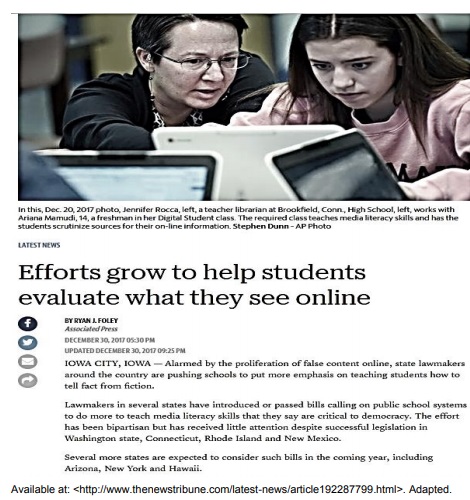
Taking the news into account, consider the following statements.
I - Jennifer Rocca, a high school librarian in Brookfield, Connecticut, was among several supporters who urged lawmakers to pass the legislation.
II - Jennifer Rocca’s digital literacy course, a requirement for freshmen, challenges students to evaluate the credibility of online sources so they can spot falsehoods and biased information. She requires students to cite their sources when conducting research and explain why each would have the authority to be credible.
III - The Lawmakers have pushed schools to incorporate media literacy — including the ability to evaluate and analyze sources of information.
IV - Studies show many children spend hours every day online but struggle to comprehend the content that comes at them.
It is correct what is stated on:

Consider the following propositions for rephrasing the clause It could be argued that the answer is one (l. 19).
I - One might argue that the answer is one.
II - You could say that the answer is one.
III- They should argue that the answer is one.
If applied to the text, which ones would be correct and keep the literal meaning?

 Conheça nossos planos