Questões de Vestibular Comentadas sobre inglês
Foram encontradas 2.807 questões


Will we ever grow replacement hands?
"Over the past few weeks on the BBC News websitewe have looked at the potential for bionic body partsand artificial organs to repair the human body. Now wetake a look at "growing-your-own".There is a pressing need. A shortage of availableorgans means many die on waiting lists and those thatget an organ must spend a lifetime onimmunosuppressant drugs to avoid rejection.
The idea is that using a patient's own stem cells togrow new body parts avoids the whole issue ofrejection as well as waiting for a donor.
Dr Anthony Atala, director of the Institute forRegenerative Medicine at the Wake Forest BaptistMedical Center in North Carolina, US, has madebreakthroughs in building bladders and urethras.
He breaks tissue-building into four levels ofcomplexity.
• Flat structures, such as the skin, are the simplest to engineer as they are generally made up of just the one type of cell.
• Tubes, such as blood vessels and urethras, which have two types of cells and act as a conduit. • Hollow non-tubular organs like the bladder and the stomach, which have more complex structures and functions.
• Solid organs, such as the kidney, heart and liver, are the most complex to engineer. They are exponentially more complex, have many different cell types, and more challenges in the blood supply.
"We've been able to implant the first three in humans. We don't have any examples yet of solid organs in humans because its much more complex," Dr Atala told the BBC.
Adapted from: http://www.bbc.co.uk/news/health-16679010 June 2012.
Will we ever grow replacement hands?
"Over the past few weeks on the BBC News websitewe have looked at the potential for bionic body partsand artificial organs to repair the human body. Now wetake a look at "growing-your-own".There is a pressing need. A shortage of availableorgans means many die on waiting lists and those thatget an organ must spend a lifetime onimmunosuppressant drugs to avoid rejection.
The idea is that using a patient's own stem cells togrow new body parts avoids the whole issue ofrejection as well as waiting for a donor.
Dr Anthony Atala, director of the Institute forRegenerative Medicine at the Wake Forest BaptistMedical Center in North Carolina, US, has madebreakthroughs in building bladders and urethras.
He breaks tissue-building into four levels ofcomplexity.
• Flat structures, such as the skin, are the simplest to engineer as they are generally made up of just the one type of cell.
• Tubes, such as blood vessels and urethras, which have two types of cells and act as a conduit. • Hollow non-tubular organs like the bladder and the stomach, which have more complex structures and functions.
• Solid organs, such as the kidney, heart and liver, are the most complex to engineer. They are exponentially more complex, have many different cell types, and more challenges in the blood supply.
"We've been able to implant the first three in humans. We don't have any examples yet of solid organs in humans because its much more complex," Dr Atala told the BBC.
Adapted from: http://www.bbc.co.uk/news/health-16679010 June 2012.
Analyze the following setence from the text:
“Solid organs, such as the kidney, heart and liver, are the most complex to engineer. They are exponentially more complex, have many different cell types, and more challenges in the blood supply.”
The expressions in bold print “the most complex” and “more complex” are examples of superlative and comparative structures. Select the alternatives that provide other examples of superlative and comparative sentences:
I. It has been selected as the best hospital in the state.
II. The treatment was highly expensive and extra medication was necessary.
III. The treatment is more effective on younger patients.
IV. Most of the time the effects of the medication are
hard to notice.
Will we ever grow replacement hands?
"Over the past few weeks on the BBC News websitewe have looked at the potential for bionic body partsand artificial organs to repair the human body. Now wetake a look at "growing-your-own".There is a pressing need. A shortage of availableorgans means many die on waiting lists and those thatget an organ must spend a lifetime onimmunosuppressant drugs to avoid rejection.
The idea is that using a patient's own stem cells togrow new body parts avoids the whole issue ofrejection as well as waiting for a donor.
Dr Anthony Atala, director of the Institute forRegenerative Medicine at the Wake Forest BaptistMedical Center in North Carolina, US, has madebreakthroughs in building bladders and urethras.
He breaks tissue-building into four levels ofcomplexity.
• Flat structures, such as the skin, are the simplest to engineer as they are generally made up of just the one type of cell.
• Tubes, such as blood vessels and urethras, which have two types of cells and act as a conduit. • Hollow non-tubular organs like the bladder and the stomach, which have more complex structures and functions.
• Solid organs, such as the kidney, heart and liver, are the most complex to engineer. They are exponentially more complex, have many different cell types, and more challenges in the blood supply.
"We've been able to implant the first three in humans. We don't have any examples yet of solid organs in humans because its much more complex," Dr Atala told the BBC.
Adapted from: http://www.bbc.co.uk/news/health-16679010 June 2012.
Based on the reading, select the alternatives that are CORRECT.
I. BBC news website is still showing programs on the potential for bionic body parts and artificial organs to repair the human body.
II. According to the BBC News article, there is a strong necessity for "growing-your-own" organs.
III. Many patients die on waiting lists due to disorganization and lack of donors.
IV. Dr. Atala has made important contributions in
building bladders and urethras.
Leia a letra da música, interpretada por Amy Winehouse, para responder às questões de números 26 a 30.
Tears dry on their own
All I can ever be to you,
Is a darkness that we knew
And this regret I got accustomed to
Once it was so right
When we were at our high,
Waiting for you in the hotel at night
I knew I hadn’t met my match
But every moment we could snatch
I don’t know why I got so attached
It’s my responsibility,
And you don’t owe nothing to me
But to walk away I have no capacity
He walks away
The sun goes down,
He takes the day but I’m grown
And in your way
In this blue shade
My tears dry on their own.
I don’t understand
Why do I stress a man,
When there’s so many bigger things at hand
We could have never had it all
We had to hit a wall
So this is inevitable withdrawal
Even if I stopped wanting you,
A perspective pushes through
I’ll be some next man’s other woman soon
[…]
I wish I could say no regrets
And no emotional debts
’Cause as we kissed goodbye the sun sets
So we are history
The shadow covers me
The sky above a blaze
That only lovers see
(http://letras.terra.com.br. Adaptado.)
Leia a letra da música, interpretada por Amy Winehouse, para responder às questões de números 26 a 30.
Tears dry on their own
All I can ever be to you,
Is a darkness that we knew
And this regret I got accustomed to
Once it was so right
When we were at our high,
Waiting for you in the hotel at night
I knew I hadn’t met my match
But every moment we could snatch
I don’t know why I got so attached
It’s my responsibility,
And you don’t owe nothing to me
But to walk away I have no capacity
He walks away
The sun goes down,
He takes the day but I’m grown
And in your way
In this blue shade
My tears dry on their own.
I don’t understand
Why do I stress a man,
When there’s so many bigger things at hand
We could have never had it all
We had to hit a wall
So this is inevitable withdrawal
Even if I stopped wanting you,
A perspective pushes through
I’ll be some next man’s other woman soon
[…]
I wish I could say no regrets
And no emotional debts
’Cause as we kissed goodbye the sun sets
So we are history
The shadow covers me
The sky above a blaze
That only lovers see
(http://letras.terra.com.br. Adaptado.)
Leia a letra da música, interpretada por Amy Winehouse, para responder às questões de números 26 a 30.
Tears dry on their own
All I can ever be to you,
Is a darkness that we knew
And this regret I got accustomed to
Once it was so right
When we were at our high,
Waiting for you in the hotel at night
I knew I hadn’t met my match
But every moment we could snatch
I don’t know why I got so attached
It’s my responsibility,
And you don’t owe nothing to me
But to walk away I have no capacity
He walks away
The sun goes down,
He takes the day but I’m grown
And in your way
In this blue shade
My tears dry on their own.
I don’t understand
Why do I stress a man,
When there’s so many bigger things at hand
We could have never had it all
We had to hit a wall
So this is inevitable withdrawal
Even if I stopped wanting you,
A perspective pushes through
I’ll be some next man’s other woman soon
[…]
I wish I could say no regrets
And no emotional debts
’Cause as we kissed goodbye the sun sets
So we are history
The shadow covers me
The sky above a blaze
That only lovers see
(http://letras.terra.com.br. Adaptado.)
Leia a letra da música, interpretada por Amy Winehouse, para responder às questões de números 26 a 30.
Tears dry on their own
All I can ever be to you,
Is a darkness that we knew
And this regret I got accustomed to
Once it was so right
When we were at our high,
Waiting for you in the hotel at night
I knew I hadn’t met my match
But every moment we could snatch
I don’t know why I got so attached
It’s my responsibility,
And you don’t owe nothing to me
But to walk away I have no capacity
He walks away
The sun goes down,
He takes the day but I’m grown
And in your way
In this blue shade
My tears dry on their own.
I don’t understand
Why do I stress a man,
When there’s so many bigger things at hand
We could have never had it all
We had to hit a wall
So this is inevitable withdrawal
Even if I stopped wanting you,
A perspective pushes through
I’ll be some next man’s other woman soon
[…]
I wish I could say no regrets
And no emotional debts
’Cause as we kissed goodbye the sun sets
So we are history
The shadow covers me
The sky above a blaze
That only lovers see
(http://letras.terra.com.br. Adaptado.)
Leia a letra da música, interpretada por Amy Winehouse, para responder às questões de números 26 a 30.
Tears dry on their own
All I can ever be to you,
Is a darkness that we knew
And this regret I got accustomed to
Once it was so right
When we were at our high,
Waiting for you in the hotel at night
I knew I hadn’t met my match
But every moment we could snatch
I don’t know why I got so attached
It’s my responsibility,
And you don’t owe nothing to me
But to walk away I have no capacity
He walks away
The sun goes down,
He takes the day but I’m grown
And in your way
In this blue shade
My tears dry on their own.
I don’t understand
Why do I stress a man,
When there’s so many bigger things at hand
We could have never had it all
We had to hit a wall
So this is inevitable withdrawal
Even if I stopped wanting you,
A perspective pushes through
I’ll be some next man’s other woman soon
[…]
I wish I could say no regrets
And no emotional debts
’Cause as we kissed goodbye the sun sets
So we are history
The shadow covers me
The sky above a blaze
That only lovers see
(http://letras.terra.com.br. Adaptado.)
By STEVE LOHR
The education gap facing the nation’s work force is evident in the numbers. Most new jobs will require more than a high school education, yet fewer than half of Americans under 30 have a (2) postsecondary degree of any kind. Recent state budget cuts, education experts agree, promise to make closing that gap even more difcult. The Bill and Melinda Gates Foundation, the William and Flora Hewlett Foundation, and four nonproft education organizations are beginning an ambitious initiative to address that challenge by accelerating the development and use of online learning tools. An initial $20 million round of money, from the Gates Foundation, will be for postsecondary online courses, particularly ones tailored for community colleges and low-income young people. Another round of grants, for high school programs, is scheduled for next year.
Just how efective technology can be in improving education - by making students more efective, more engaged learners - is a subject of debate. To date, education research shows that good teachers matter a lot, class size may be less important than once thought and nothing improves student performance as much as one-on-one human tutoring. If technology is well designed, experts say, it can help tailor the learning experience to individual students, facilitate student- teacher collaboration, and assist teachers in monitoring student performance each day and in quickly fne-tuning lessons. The potential benefts of technology are greater as students become older, more independent learners. Making that point, Mr. Gates said in an interview that for children from kindergarten to about ffth grade “the idea that you stick them in front of a computer is (3) ludicrous.”
(1)
higher education: educação superior.
(2)
postsecondary: termo que se refere aos cursos feitos após o high school ou, no modelo educacional brasileiro, o Ensino Médio.
(3)
ludicrous: ridícula, absurda.
By STEVE LOHR
The education gap facing the nation’s work force is evident in the numbers. Most new jobs will require more than a high school education, yet fewer than half of Americans under 30 have a (2) postsecondary degree of any kind. Recent state budget cuts, education experts agree, promise to make closing that gap even more difcult. The Bill and Melinda Gates Foundation, the William and Flora Hewlett Foundation, and four nonproft education organizations are beginning an ambitious initiative to address that challenge by accelerating the development and use of online learning tools. An initial $20 million round of money, from the Gates Foundation, will be for postsecondary online courses, particularly ones tailored for community colleges and low-income young people. Another round of grants, for high school programs, is scheduled for next year.
Just how efective technology can be in improving education - by making students more efective, more engaged learners - is a subject of debate. To date, education research shows that good teachers matter a lot, class size may be less important than once thought and nothing improves student performance as much as one-on-one human tutoring. If technology is well designed, experts say, it can help tailor the learning experience to individual students, facilitate student- teacher collaboration, and assist teachers in monitoring student performance each day and in quickly fne-tuning lessons. The potential benefts of technology are greater as students become older, more independent learners. Making that point, Mr. Gates said in an interview that for children from kindergarten to about ffth grade “the idea that you stick them in front of a computer is (3) ludicrous.”
(1)
higher education: educação superior.
(2)
postsecondary: termo que se refere aos cursos feitos após o high school ou, no modelo educacional brasileiro, o Ensino Médio.
(3)
ludicrous: ridícula, absurda.
By STEVE LOHR
The education gap facing the nation’s work force is evident in the numbers. Most new jobs will require more than a high school education, yet fewer than half of Americans under 30 have a (2) postsecondary degree of any kind. Recent state budget cuts, education experts agree, promise to make closing that gap even more difcult. The Bill and Melinda Gates Foundation, the William and Flora Hewlett Foundation, and four nonproft education organizations are beginning an ambitious initiative to address that challenge by accelerating the development and use of online learning tools. An initial $20 million round of money, from the Gates Foundation, will be for postsecondary online courses, particularly ones tailored for community colleges and low-income young people. Another round of grants, for high school programs, is scheduled for next year.
Just how efective technology can be in improving education - by making students more efective, more engaged learners - is a subject of debate. To date, education research shows that good teachers matter a lot, class size may be less important than once thought and nothing improves student performance as much as one-on-one human tutoring. If technology is well designed, experts say, it can help tailor the learning experience to individual students, facilitate student- teacher collaboration, and assist teachers in monitoring student performance each day and in quickly fne-tuning lessons. The potential benefts of technology are greater as students become older, more independent learners. Making that point, Mr. Gates said in an interview that for children from kindergarten to about ffth grade “the idea that you stick them in front of a computer is (3) ludicrous.”
(1)
higher education: educação superior.
(2)
postsecondary: termo que se refere aos cursos feitos após o high school ou, no modelo educacional brasileiro, o Ensino Médio.
(3)
ludicrous: ridícula, absurda.
By STEVE LOHR
The education gap facing the nation’s work force is evident in the numbers. Most new jobs will require more than a high school education, yet fewer than half of Americans under 30 have a (2) postsecondary degree of any kind. Recent state budget cuts, education experts agree, promise to make closing that gap even more difcult. The Bill and Melinda Gates Foundation, the William and Flora Hewlett Foundation, and four nonproft education organizations are beginning an ambitious initiative to address that challenge by accelerating the development and use of online learning tools. An initial $20 million round of money, from the Gates Foundation, will be for postsecondary online courses, particularly ones tailored for community colleges and low-income young people. Another round of grants, for high school programs, is scheduled for next year.
Just how efective technology can be in improving education - by making students more efective, more engaged learners - is a subject of debate. To date, education research shows that good teachers matter a lot, class size may be less important than once thought and nothing improves student performance as much as one-on-one human tutoring. If technology is well designed, experts say, it can help tailor the learning experience to individual students, facilitate student- teacher collaboration, and assist teachers in monitoring student performance each day and in quickly fne-tuning lessons. The potential benefts of technology are greater as students become older, more independent learners. Making that point, Mr. Gates said in an interview that for children from kindergarten to about ffth grade “the idea that you stick them in front of a computer is (3) ludicrous.”
(1)
higher education: educação superior.
(2)
postsecondary: termo que se refere aos cursos feitos após o high school ou, no modelo educacional brasileiro, o Ensino Médio.
(3)
ludicrous: ridícula, absurda.
By STEVE LOHR
The education gap facing the nation’s work force is evident in the numbers. Most new jobs will require more than a high school education, yet fewer than half of Americans under 30 have a (2) postsecondary degree of any kind. Recent state budget cuts, education experts agree, promise to make closing that gap even more difcult. The Bill and Melinda Gates Foundation, the William and Flora Hewlett Foundation, and four nonproft education organizations are beginning an ambitious initiative to address that challenge by accelerating the development and use of online learning tools. An initial $20 million round of money, from the Gates Foundation, will be for postsecondary online courses, particularly ones tailored for community colleges and low-income young people. Another round of grants, for high school programs, is scheduled for next year.
Just how efective technology can be in improving education - by making students more efective, more engaged learners - is a subject of debate. To date, education research shows that good teachers matter a lot, class size may be less important than once thought and nothing improves student performance as much as one-on-one human tutoring. If technology is well designed, experts say, it can help tailor the learning experience to individual students, facilitate student- teacher collaboration, and assist teachers in monitoring student performance each day and in quickly fne-tuning lessons. The potential benefts of technology are greater as students become older, more independent learners. Making that point, Mr. Gates said in an interview that for children from kindergarten to about ffth grade “the idea that you stick them in front of a computer is (3) ludicrous.”
(1)
higher education: educação superior.
(2)
postsecondary: termo que se refere aos cursos feitos após o high school ou, no modelo educacional brasileiro, o Ensino Médio.
(3)
ludicrous: ridícula, absurda.

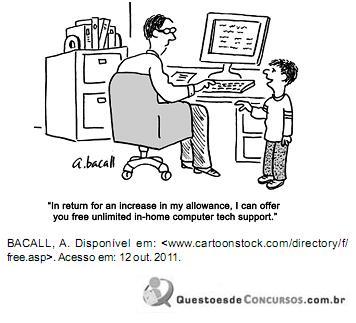
The boy in this cartoon


 Conheça nossos planos