Questões de Vestibular Sobre inglês
Foram encontradas 6.365 questões


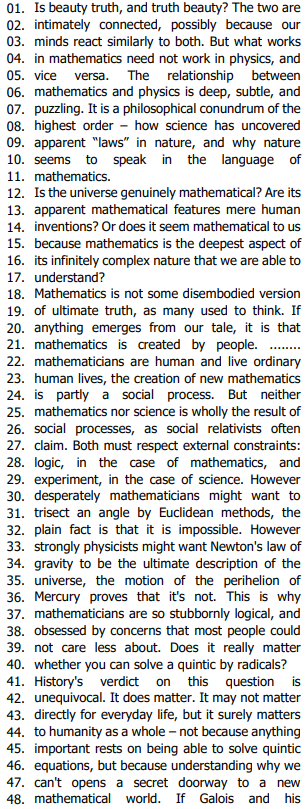
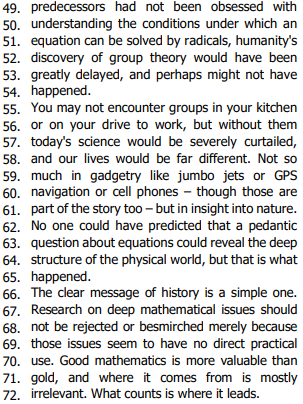
Adapted from: STEWART, I. Why Beauty is Truth – The History of Symmetry. Cambridge, MA: Basic Books, 2007. p. 275-276.
I - By using the phrase philosophical conundrum of the highest order (l. 07-08), the author expresses ethical issues related to the relationship between mathematics and physics.
II - By stating that Mathematics is not some disembodied version of the ultimate truth (l. 18-19), the author states mathematics is fallible just like the other social sciences.
III- By using the term unequivocal (l. 42), the author states that the importance of mathematics is not under question regardless of whether people agree on its importance.
Which ones are correct according to the text?
Adapted from: STEWART, I. Why Beauty is Truth – The History of Symmetry. Cambridge, MA: Basic Books, 2007. p. 275-276.
Adapted from: STEWART, I. Why Beauty is Truth – The History of Symmetry. Cambridge, MA: Basic Books, 2007. p. 275-276.
( ) Mathematics is not an area detached from human experience. Nevertheless, the text fails to provide practical examples of how it contributes to improve aspects of our daily life.
( ) The word could (l. 62) may be replaced by must, without causing changes to grammar accuracy or to the original meaning of the sentence.
( ) Mathematics unequivocally relates to social processes, history, logic, and philosophy.
( ) The segment Research on deep mathematical issues should not be rejected or besmirched (l. 67-68) may be rephrased as One should not reject or besmirch research on deep mathematical issues, without causing changes to grammar accuracy or to the original meaning of the sentence.
The correct sequence of filling in the parentheses, from top to bottom, is
Adapted from: STEWART, I. Why Beauty is Truth – The History of Symmetry. Cambridge, MA: Basic Books, 2007. p. 275-276.
Adapted from: STEWART, I. Why Beauty is Truth – The History of Symmetry. Cambridge, MA: Basic Books, 2007. p. 275-276.
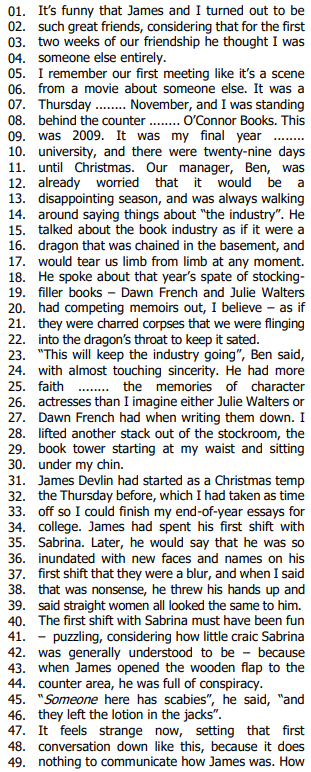
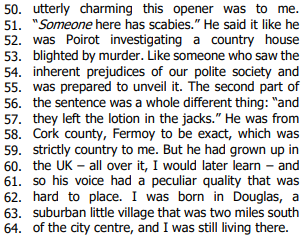
Adaptado de: O’DONOGHUE, C. The Rachel Incident. New York: Knopf Publishing Group, 2023. p. 10-11.
I - O pronome they (l. 21) refere-se a livros, como os escritos pelas atrizes Dawn French e Julie Walters.
II - O pronome they (l. 46) denota que James supõe que mais de uma pessoa precisou da loção que ele encontrou no banheiro.
III- As ocorrências do pronome it nas linhas 47, 48 e 51 têm o mesmo referente.
Quais estão corretas?
Adaptado de: O’DONOGHUE, C. The Rachel Incident. New York: Knopf Publishing Group, 2023. p. 10-11.
( ) charred (l. 21) ( ) sated (l. 22) ( ) blighted (l. 53)
1. saciado 2. iluminado 3. carbonizado 4. satisfeito 5. destruído 6. arruinado
A sequência correta de preenchimento dos parênteses, de cima para baixo, é
Adaptado de: O’DONOGHUE, C. The Rachel Incident. New York: Knopf Publishing Group, 2023. p. 10-11.
I - O segmento Later, he would say that he was so inundated with new faces and names on his first shift (l. 35-37) adiciona humor ao texto pelo claro exagero empregado.
II - O segmento The first shift with Sabrina must have been fun – puzzling, considering how little craic Sabrina was generally understood to be (l. 40-42) confere um tom irônico à narrativa.
III- A comparação entre James e Poirot (l. 51-53) deixa implícita a admiração da narradora pelo colega.
Quais estão corretas?
Adaptado de: O’DONOGHUE, C. The Rachel Incident. New York: Knopf Publishing Group, 2023. p. 10-11.
I - Substituição de like it’s (l. 05) por as if it were.
II - Substituição de he would say (l. 35) por he used to saying.
III- Substituição de it (l. 55) por them.
Quais resultariam gramaticalmente corretas, se aplicadas ao texto?
Adaptado de: O’DONOGHUE, C. The Rachel Incident. New York: Knopf Publishing Group, 2023. p. 10-11.
Adaptado de: O’DONOGHUE, C. The Rachel Incident. New York: Knopf Publishing Group, 2023. p. 10-11.
Adaptado de: O’DONOGHUE, C. The Rachel Incident. New York: Knopf Publishing Group, 2023. p. 10-11.
Instrução: A questão está relacionada ao texto abaixo.
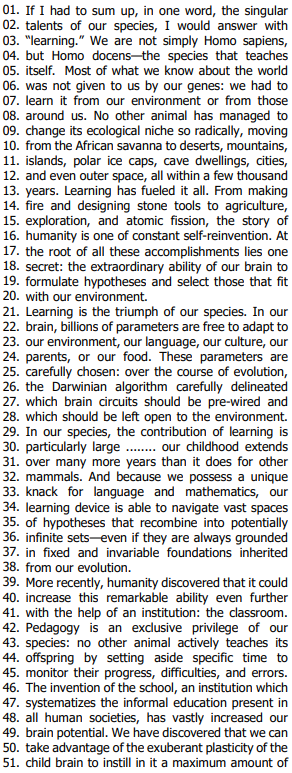
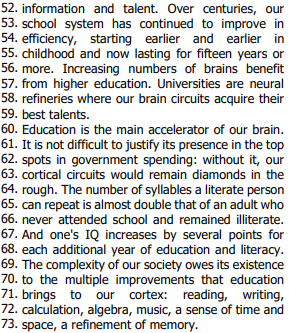
Adapted from: DEHAENE, Stanislas. How we learn: Why brains learn better than any machine… for now. New York: Viking Press, 2020.
Instrução: A questão está relacionada ao texto abaixo.
Adapted from: DEHAENE, Stanislas. How we learn: Why brains learn better than any machine… for now. New York: Viking Press, 2020.
Instrução: A questão está relacionada ao texto abaixo.
Adapted from: DEHAENE, Stanislas. How we learn: Why brains learn better than any machine… for now. New York: Viking Press, 2020.
I - The use of present perfect simple in the clause No other animal has managed to change its ecological niche so radically (l. 08-09) implies that the author considers the event referred to finished and unrelated to the present.
II - The use of simple past in More recently, humanity discovered (l. 39) is a deviation from the standard norm, and the fragment would be made grammatically correct if its verb tense were the present perfect simple since the event it refers to is said to be recent.
III- The use of passive voice in the clause These parameters are carefully chosen (l. 24-25) means that the author does not know or prefers not to stress who or what makes the choice referred to.
Which ones are correct according to the text?
Instrução: A questão está relacionada ao texto abaixo.
Adapted from: DEHAENE, Stanislas. How we learn: Why brains learn better than any machine… for now. New York: Viking Press, 2020.
I – The pronoun itself (l. 05) refers to species (l. 04).
II – The pronoun it (l. 07) refers to world (l. 05).
III – The possessive adjective its (l. 69) refers to society (l. 69).
Which ones are correct according to the text?
Instrução: A questão está relacionada ao texto abaixo.
Adapted from: DEHAENE, Stanislas. How we learn: Why brains learn better than any machine… for now. New York: Viking Press, 2020.
I - If I were supposed to sum up, in one word, the singular talents of our species, I would answer with “learning”.
II - Were I to sum up, in one word, the singular talents of our species, I would answer with “learning”.
III- Were I supposed to sum up, in one word, the singular talents of our species, I would answer with “learning”.
If applied to the text, which one(s) would be correct and keep the literal meaning?
Instrução: A questão está relacionada ao texto abaixo.
Adapted from: DEHAENE, Stanislas. How we learn: Why brains learn better than any machine… for now. New York: Viking Press, 2020.
( ) By using the phrase Darwinian algorithm (l. 26), the author stresses that human intelligence and Artificial Intelligence evolve by means of the same processes.
( ) The author draws a parallel between the number of years one spends at school with the increasing efficiency of education.
( ) The human tendency for abstract thinking through language and mathematics is one of the keys to our unique learning skills because it allows us to raise hypotheses.
( ) The author fears that without public investment in education human societies will become more complex due to lower IQ and memory rates.
The sequence that adequately fills in the parentheses, from top to bottom, is
Instrução: A questão está relacionada ao texto abaixo.
Adapted from: DEHAENE, Stanislas. How we learn: Why brains learn better than any machine… for now. New York: Viking Press, 2020.
I - According to the text, pedagogy and the creation of schools are the phenomena that have transformed Homo sapiens into Homo docens, a species that teaches itself.
II - The author states that the Darwinist evolutionary theory does not account for our species’ triumph of learning because what we inherit through our genes are fixed and invariable foundations.
III- The text implies that without education human societies might still be much more evolved than those of other species, but hardly as complex as they are today.
Which ones are correct according to the text?
Instrução: A questão está relacionada ao texto abaixo.
Adapted from: DEHAENE, Stanislas. How we learn: Why brains learn better than any machine… for now. New York: Viking Press, 2020.

 Conheça nossos planos