Questões de Vestibular
Sobre palavras conectivas | connective words em inglês
Foram encontradas 98 questões


I - Even though she was not reading it, Juliet had a book open on her lap. II - Despite she was not reading it, Juliet had a book open on her lap. III- ln spite of the fact that she was not reading it, Juliet had a book open on her lap.
Quais poderiam substituir o segmento, sem prejuízo do sentido original e da correção gramatical?
My sister is married _____ she lives in London.
Assinale a alternativa que preencha corretamente a lacuna.
Some artists were imprisoned during the dictatorship in Brazil. _____, some of them were exiled.
Assinale a alternativa que preencha corretamente a lacuna.

Considere os seguintes trechos extraídos do texto.
I - The idea is that, alongside the time-honoured “Best Picture” category, there will be another for films (l. 04-07).
II - It is understandable that the Oscar´s organisers should want to shake up the cerimony´s format (l. 38-40).
III- (…) best-picture winners are no longer the films that the great American public is queuing up to see (l. 42-45).
Em quais a palavra that pode ser tanto omitida quanto substituída por which?

Assinale com V (verdadeiro) ou F (falso) as afirmações abaixo, acerca da estrutura do texto.
( ) A palavra But (l. 10) poderia ser substituída por However, seguida por vírgula, sem prejuízo da correção gramatical e do significado original do texto.
( ) O trecho the Nigeria he returned to (l. 10) poderia ser susbstituído por the Nigeria to which he returned, sem prejuízo da correção gramatical e do significado original do texto.
( ) A palavra Besides (l. 32) poderia ser substituída por Notwithstanding, sem prejuízo da correção gramatical e do significado original do texto.
( ) O trecho a pleasure car stops for you (l. 42-43) poderia ser substituído por a pleasure car will stop for you, sem prejuízo da correção gramatical e do significado original do texto.
A sequência correta de preenchimento dos parênteses, de cima para baixo, é

Why so few nurses are men

Ask health professionals in any country what the biggest problem in their health-care system is and one of the most common answers is the shortage of nurses. In ageing rich countries, demand for nursing care is becoming increasingly insatiable. Britain’s National Health Service, for example, has 40,000-odd nurse vacancies. Poor countries struggle with the emigration of nurses for greener pastures. One obvious solution seems neglected: recruit more men. Typically, just 5-10% of nurses registered in a given country are men. Why so few?
Views of nursing as a “woman’s job” have deep roots. Florence Nightingale, who established the principles of modern nursing in the 1860s, insisted that men’s “hard and horny” hands were “not fitted to touch, bathe and dress wounded limbs”. In Britain the Royal College of Nursing, the profession’s union, did not even admit men as members until 1960. Some nursing schools in America started admitting men only in 1982, after a Supreme Court ruling forced them to. Senior nurse titles such as “sister” (a ward manager) and “matron” (which in some countries is used for men as well) do not help matters. Unsurprisingly, some older people do not even know that men can be nurses too. Male nurses often encounter patients who assume they are doctors.
Another problem is that beliefs about what a nursing job entails are often outdated – in ways that may be particularly off-putting for men. In films, nurses are commonly portrayed as the helpers of heroic male doctors. In fact, nurses do most of their work independently and are the first responders to patients in crisis. To dispel myths, nurse-recruitment campaigns display nursing as a professional job with career progression, specialisms like anaesthetics, cardiology or emergency care, and use for skills related to technology, innovation and leadership. However, attracting men without playing to gender stereotypes can be tricky. “Are you man enough to be a nurse?”, the slogan of an American campaign, was involved in controversy.
Nursing is not a career many boys aspire to, or are encouraged to consider. Only two-fifths of British parents say they would be proud if their son became a nurse. Because of all this, men who go into nursing are usually already closely familiar with the job. Some are following in the career footsteps of their mothers. Others decide that the job would suit them after they see a male nurse care for a relative or they themselves get care from a male nurse when hospitalised. Although many gender stereotypes about jobs and caring have crumbled, nursing has, so far, remained unaffected.
(www.economist.com, 22.08.2018. Adaptado.)
Read the text below.
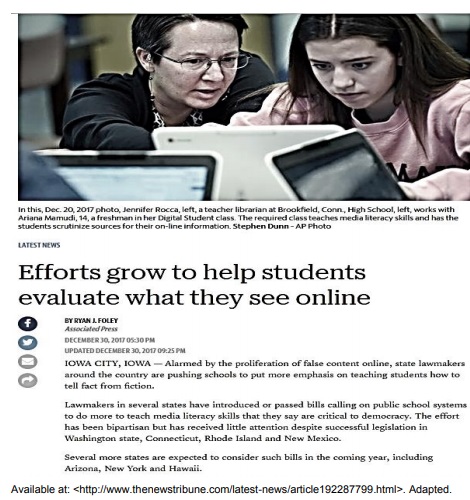
Read the text below. Fill in the blanks with the right conjunctions.
n today's world, (I) _________ just about everything is more convenient and accessible due to advances in technology across almost all sectors, it may seem (II)_________ it's a misnomer to even mention any disadvantages of technological advances. (III) __________, despite how far technology has taken humans and no matter (IV) ______ convenient it may make things, there are some disadvantages accompanying this level of access.
Technology advances show people a more efficient way to do things, and these processes get results. For example, education has been greatly advanced by the technological advances of computers. Students are able to learn on a global scale without ever leaving their classrooms. Agricultural processes (V)_______ once required dozens upon dozens of human workers can now be automated, thanks to advances in technology, which means cost-efficiency for farmers. Medical discoveries occur at a much more rapid rate, thanks to machines and computers that aid in the research process and allow for more intense educational research into medical matters.
Cost efficiency is an advantage in some ways and a disadvantage in others. (VI) _______ technology improves on existing processes and showcases new ways to accomplish tasks, machines are able to produce the same -- if not more -- output (VII) _______ humans in certain industries. This results in cost savings for business owners, allowing them to invest in growth in other areas of the business, (VIII) _________ contributes on a positive level to the economy as a whole.
Available at: ..smallbusiness.chron.com/advantages-disadvantages-technology-advances-12579.html
Mark the correct alternative.
Opportunity Cost
This phenomenon goes by the name of ‘opportunity cost,’ since by not investing in more equipment and a more rigid production flow, the company is forgoing the opportunity to earn increased profits. These costs are every bite as real as the payment of dollars out-of-pocket.
This notion _______ opportunity cost can be reinforced _________ a famous saying ______ Benjamin Franklin, no slouch himself _________ operations management. To make the point, however, we must make a brief excursion into logic. One truth of logic is the validity of the so-called contrapositive, which says simply that if the statement “If A, then B” is true, then it is also true that “If not B, then not A.” That is, of every time A occurs B follows, then we can be sure that if B does not occur, then A did not occur as well. Enough logic then, and back to Ben Franklin.
One of his Poor Richard sayings is that “A penny saved is a penny earned.” We have all recognized the truth of that since childhood, but I assert that by this saying Ben showed us he knows everything about opportunity cost. After all, what is the contrapositive of “A penny not earned is a penny not saved (i.e., a penny sent). All we are saying by this notion of opportunity cost is that “a penny not earned (an opportunity forgone) is a penny spent.” We shall often have occasion to consider opportunity costs, in analyzing and deciding various operations issues.
SCHMENNER, Roger W. Production/Operations Management. 5th
Edition. Prentice-Hall, 1993.
1. The word ‘himself’ underlined in the text, is being used in the sentence as a reflexive pronoun. 2. The negative form of: ‘This phenomenon goes by the name of ‘opportunity cost,...’, is: ‘This phenomenon doesn’t go by the name of ‘opportunity cost,…’ 3. The words in bold in the text are examples of irregular verbs. 4. The word ‘however’ in: ‘To make the point, however, we must make a brief excursion into logic.’ is being used as a contrastive connector
Choose the alternative which presents the correct ones:
Your gut, your emotions
What controls our emotions? The same two people might see the same tragic newspaper headline, (1) __________ one is much more emotionally affected than the other. Why is that? According to an international team led by UCLA researchers, these emotions may be partially driven by an unlikely source: our gut bacteria. In fact, the bacteria that colonize our intestines may influence the architecture of the brain itself.
The experiment examining the relationship between brain development and the gut microbiome was conducted with mice. Specific strains of mice, one that lacked a complete gut microbiome and one that had a normal microbiome, were compared in terms of their brain development and behavior. The influence of microorganisms is not limited to brain development.
Interestingly, the mice with the ―normal‖ microbiome had more anxiety and moved less than the mice without the microbiome. (2) __________ exposed to a microbiome early in life, the active, calm mice began to act more anxious and reduced their movements. Microbiota evidently had this influence by affecting hormonal expression and building particular pathways in the brain associated with anxiety. The influence on brain development apparently occurred at a particular point early in the mouse‘s life, so it‘s possible early exposure to a proper microbiome is important for normal development. The researchers speculate that the microbiome helps the mice develop an appropriate sense of caution.
The influence of microorganisms is not limited to brain development. (3) __________ no conclusive link has been established, a few studies have detected abnormalities in the gut microbiomes of children with Autism Spectrum Disorders compared to non-affected children. Nor is microorganism influence limited to gut bacteria. A separate study in hyenas (also awaiting conclusive proof) suggests that individual hyenas use a specific cocktail of stinky bacteria in their scent markers left as a message to other hyenas.
(4) __________ some fungus can get in on the act, hijacking ants and forcing the unfortunate insects to relocate to a place favorable for a fungus to grow. The ant does not survive, but it makes great fungus food. (5) __________ a growing body of evidence from other animals, until the UCLA study there was not much direct research on how the microbiome affects humans. But given its potential importance, hopefully there will soon be more research along these lines. Going with your gut, indeed!
Disponível em:< https://daily.jstor.org/your-gut-youremotions/?utm_term=YOUR%20GUT%2C%20YOUR%20EMOTIONS&utm_campaign=jstordaily_08032017&utm_content=e mail&utm_source=Act-On+Software&utm_medium=email>. Acesso em: 15 Set. 2017.
Check the CORRECT alternative.

Nathalie, the swimmer who lost a leg
Nathalie du Toit, the South African swimmer, was only seventeen when she lost her leg in a road accident. She was going to a training session at the swimming pool on her motorbike when a car hit her. Her leg had to be amputated at the knee. At the time she was one of South Africa’s most promising young swimmers. Everybody thought that she would never be able to swim competitively again.
But Nathalie was determined to carry on. She went back into the pool only three months after the accident. And just one year later, at the Commonwalth Games in Manchester, she swam 800 meters in 9 minutes 11:38 seconds and qualified for the final – but not for disabled swimmers, for able-bodied ones! Althought she didn’t win a medal, she still made history.
‘I remember how thrilled I was the first time that I swam after recovering from the operation – it felt like my leg was there. It still does,’ says Nathalie. The water is the gift that gives me back my leg. I’m still the same person I was before the accident. I believe everything happens in life for a reason. You cant go back and change anything. Swimming was my life and still is. My dream is to swim faster than I did before the accident.’
Oxeden, C; KOENIG, C. New English File. Intermediate Student’s Book. OXFORD University Press. (3c-47).
When does the brain work best?
The peak times and ages for learning

What’s your ideal time of the day for brain performance? Surprisingly, the answer to this isn’t as simple as being a morning or a night person. New research has shown that certain times of the day are best for completing specific tasks, and listening to your body’s natural clock may help you to accomplish more in 24 hours.
Science suggests that the best time for our natural peak productivity is late morning. Our body temperatures start to rise just before we wake up in the morning and continue to increase through midday, Steve Kay, a professor of molecular and computational biology at the University of Southern California told The Wall Street Journal. This gradual increase in body temperature means that our working memory, alertness, and concentration also gradually improve, peaking at about mid morning. Our alertness tends to dip after this point, but one study suggested that midday fatigue may actually boost our creative abilities. For a 2011 study, 428 students were asked to solve a series of two types of problems, requiring either analytical or novel thinking. Results showed that their performance on the second type was best at non-peak times of day when they were tired.
As for the age where our brains are at peak condition, science has long held that fluid intelligence, or the ability to think quickly and recall information, peaks at around age 20. However, a 2015 study revealed that peak brain age is far more complicated than previously believed and concluded that there are about 30 subsets of intelligence, all of which peak at different ages for different people. For example, the study found that raw speed in processing information appears to peak around age 18 or 19, then immediately starts to decline, but short-term memory continues to improve until around age 25, and then begins to drop around age 35, Medical Xpress reported. The ability to evaluate other people’s emotional states peaked much later, in the 40s or 50s. In addition, the study suggested that out our vocabulary may peak as late as our 60s’s or 70’s.
Still, while working according to your body’s natural clock may sound helpful, it’s important to remember that these times may differ from person to person. On average, people can be divided into two distinct groups: morning people tend to wake up and go to sleep earlier and to be most productive early in the day. Evening people tend to wake up later, start more slowly and peak in the evening. If being a morning or evening person has been working for you the majority of your life, it may be best to not fix what’s not broken.
(Dana Dovey. www.medicaldaily.com, 08.08.2016. Adaptado.)

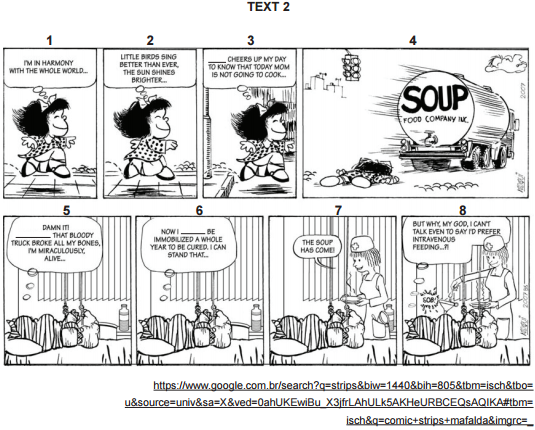

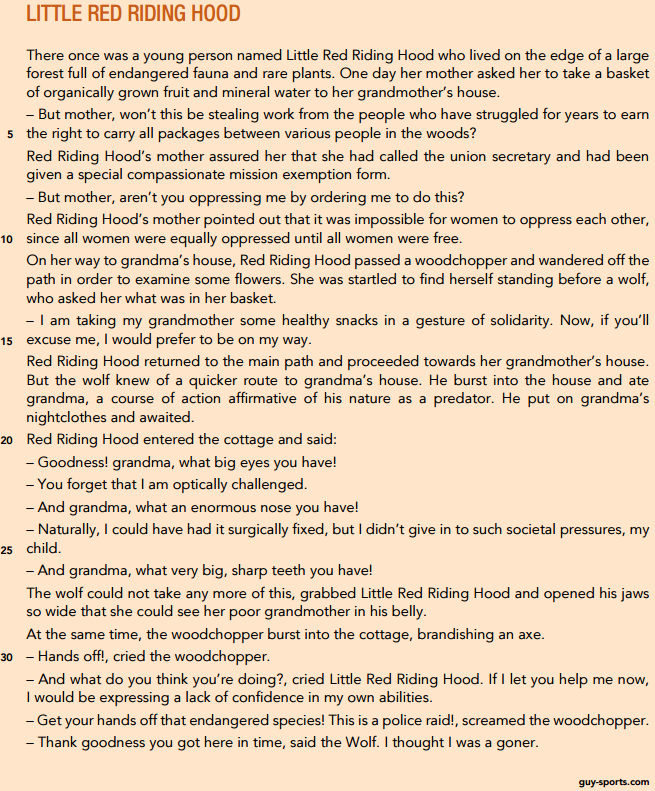
– But mother, aren’t you oppressing me by ordering me to do this? (l. 8)
In the sentence above, the word but fulfills the function of:
Leia o texto para responder à questão.
Disparity in life spans of the rich and the poor is growing
Sabrina Tavernise
February 12, 2016

Experts have long known that rich people generally live longer than poor people. But a growing body of data shows a more disturbing pattern: Despite big advances in medicine, technology and education, the longevity gap between high-income and low-income Americans has been widening sharply.
The poor are losing ground not only in income, but also in years of life, the most basic measure of well-being. In the early 1970s, a 60-year-old man in the top half of the earnings ladder could expect to live 1.2 years longer than a man of the same age in the bottom half, according to an analysis by the Social Security Administration. Fast-forward to 2001, and he could expect to live 5.8 years longer than his poorer counterpart.
New research released this month contains even more jarring numbers. Looking at the extreme ends of the income spectrum, economists at the Brookings Institution found that for men born in 1920, there was a six-year difference in life expectancy between the top 10 percent of earners and the bottom 10 percent. For men born in 1950, that difference had more than doubled, to 14 years. For women, the gap grew to 13 years, from 4.7 years. “There has been this huge spreading out,” said Gary Burtless, one of the authors of the study.
The growing chasm is alarming policy makers, and has surfaced in the presidential campaign. During a Democratic debate, Senator Bernie Sanders and Hillary Clinton expressed concern over shortening life spans for some Americans. “This may be the next frontier of the inequality discussion,” said Peter Orszag, a former Obama administration official now at Citigroup, who was among the first to highlight the pattern. The causes are still being investigated, but public health researchers say that deep declines in smoking among the affluent and educated may partly explain the difference.
Overall, according to the Brookings study, life expectancy for the bottom 10 percent of wage earners improved by just 3 percent for men born in 1950 compared with those born in 1920. For the top 10 percent, though, it jumped by about 28 percent. (The researchers used a common measure – life expectancy at age 50 – and included data from 1984 to 2012.)
(www.nytimes.com. Adaptado.)
Leia a charge para responder à questão.


 Conheça nossos planos