Questões de Vestibular
Comentadas sobre palavras conectivas | connective words em inglês
Foram encontradas 38 questões


Some artists were imprisoned during the dictatorship in Brazil. _____, some of them were exiled.
Assinale a alternativa que preencha corretamente a lacuna.
Why so few nurses are men

Ask health professionals in any country what the biggest problem in their health-care system is and one of the most common answers is the shortage of nurses. In ageing rich countries, demand for nursing care is becoming increasingly insatiable. Britain’s National Health Service, for example, has 40,000-odd nurse vacancies. Poor countries struggle with the emigration of nurses for greener pastures. One obvious solution seems neglected: recruit more men. Typically, just 5-10% of nurses registered in a given country are men. Why so few?
Views of nursing as a “woman’s job” have deep roots. Florence Nightingale, who established the principles of modern nursing in the 1860s, insisted that men’s “hard and horny” hands were “not fitted to touch, bathe and dress wounded limbs”. In Britain the Royal College of Nursing, the profession’s union, did not even admit men as members until 1960. Some nursing schools in America started admitting men only in 1982, after a Supreme Court ruling forced them to. Senior nurse titles such as “sister” (a ward manager) and “matron” (which in some countries is used for men as well) do not help matters. Unsurprisingly, some older people do not even know that men can be nurses too. Male nurses often encounter patients who assume they are doctors.
Another problem is that beliefs about what a nursing job entails are often outdated – in ways that may be particularly off-putting for men. In films, nurses are commonly portrayed as the helpers of heroic male doctors. In fact, nurses do most of their work independently and are the first responders to patients in crisis. To dispel myths, nurse-recruitment campaigns display nursing as a professional job with career progression, specialisms like anaesthetics, cardiology or emergency care, and use for skills related to technology, innovation and leadership. However, attracting men without playing to gender stereotypes can be tricky. “Are you man enough to be a nurse?”, the slogan of an American campaign, was involved in controversy.
Nursing is not a career many boys aspire to, or are encouraged to consider. Only two-fifths of British parents say they would be proud if their son became a nurse. Because of all this, men who go into nursing are usually already closely familiar with the job. Some are following in the career footsteps of their mothers. Others decide that the job would suit them after they see a male nurse care for a relative or they themselves get care from a male nurse when hospitalised. Although many gender stereotypes about jobs and caring have crumbled, nursing has, so far, remained unaffected.
(www.economist.com, 22.08.2018. Adaptado.)
Opportunity Cost
This phenomenon goes by the name of ‘opportunity cost,’ since by not investing in more equipment and a more rigid production flow, the company is forgoing the opportunity to earn increased profits. These costs are every bite as real as the payment of dollars out-of-pocket.
This notion _______ opportunity cost can be reinforced _________ a famous saying ______ Benjamin Franklin, no slouch himself _________ operations management. To make the point, however, we must make a brief excursion into logic. One truth of logic is the validity of the so-called contrapositive, which says simply that if the statement “If A, then B” is true, then it is also true that “If not B, then not A.” That is, of every time A occurs B follows, then we can be sure that if B does not occur, then A did not occur as well. Enough logic then, and back to Ben Franklin.
One of his Poor Richard sayings is that “A penny saved is a penny earned.” We have all recognized the truth of that since childhood, but I assert that by this saying Ben showed us he knows everything about opportunity cost. After all, what is the contrapositive of “A penny not earned is a penny not saved (i.e., a penny sent). All we are saying by this notion of opportunity cost is that “a penny not earned (an opportunity forgone) is a penny spent.” We shall often have occasion to consider opportunity costs, in analyzing and deciding various operations issues.
SCHMENNER, Roger W. Production/Operations Management. 5th
Edition. Prentice-Hall, 1993.
1. The word ‘himself’ underlined in the text, is being used in the sentence as a reflexive pronoun. 2. The negative form of: ‘This phenomenon goes by the name of ‘opportunity cost,...’, is: ‘This phenomenon doesn’t go by the name of ‘opportunity cost,…’ 3. The words in bold in the text are examples of irregular verbs. 4. The word ‘however’ in: ‘To make the point, however, we must make a brief excursion into logic.’ is being used as a contrastive connector
Choose the alternative which presents the correct ones:
Your gut, your emotions
What controls our emotions? The same two people might see the same tragic newspaper headline, (1) __________ one is much more emotionally affected than the other. Why is that? According to an international team led by UCLA researchers, these emotions may be partially driven by an unlikely source: our gut bacteria. In fact, the bacteria that colonize our intestines may influence the architecture of the brain itself.
The experiment examining the relationship between brain development and the gut microbiome was conducted with mice. Specific strains of mice, one that lacked a complete gut microbiome and one that had a normal microbiome, were compared in terms of their brain development and behavior. The influence of microorganisms is not limited to brain development.
Interestingly, the mice with the ―normal‖ microbiome had more anxiety and moved less than the mice without the microbiome. (2) __________ exposed to a microbiome early in life, the active, calm mice began to act more anxious and reduced their movements. Microbiota evidently had this influence by affecting hormonal expression and building particular pathways in the brain associated with anxiety. The influence on brain development apparently occurred at a particular point early in the mouse‘s life, so it‘s possible early exposure to a proper microbiome is important for normal development. The researchers speculate that the microbiome helps the mice develop an appropriate sense of caution.
The influence of microorganisms is not limited to brain development. (3) __________ no conclusive link has been established, a few studies have detected abnormalities in the gut microbiomes of children with Autism Spectrum Disorders compared to non-affected children. Nor is microorganism influence limited to gut bacteria. A separate study in hyenas (also awaiting conclusive proof) suggests that individual hyenas use a specific cocktail of stinky bacteria in their scent markers left as a message to other hyenas.
(4) __________ some fungus can get in on the act, hijacking ants and forcing the unfortunate insects to relocate to a place favorable for a fungus to grow. The ant does not survive, but it makes great fungus food. (5) __________ a growing body of evidence from other animals, until the UCLA study there was not much direct research on how the microbiome affects humans. But given its potential importance, hopefully there will soon be more research along these lines. Going with your gut, indeed!
Disponível em:< https://daily.jstor.org/your-gut-youremotions/?utm_term=YOUR%20GUT%2C%20YOUR%20EMOTIONS&utm_campaign=jstordaily_08032017&utm_content=e mail&utm_source=Act-On+Software&utm_medium=email>. Acesso em: 15 Set. 2017.
Check the CORRECT alternative.
When does the brain work best?
The peak times and ages for learning

What’s your ideal time of the day for brain performance? Surprisingly, the answer to this isn’t as simple as being a morning or a night person. New research has shown that certain times of the day are best for completing specific tasks, and listening to your body’s natural clock may help you to accomplish more in 24 hours.
Science suggests that the best time for our natural peak productivity is late morning. Our body temperatures start to rise just before we wake up in the morning and continue to increase through midday, Steve Kay, a professor of molecular and computational biology at the University of Southern California told The Wall Street Journal. This gradual increase in body temperature means that our working memory, alertness, and concentration also gradually improve, peaking at about mid morning. Our alertness tends to dip after this point, but one study suggested that midday fatigue may actually boost our creative abilities. For a 2011 study, 428 students were asked to solve a series of two types of problems, requiring either analytical or novel thinking. Results showed that their performance on the second type was best at non-peak times of day when they were tired.
As for the age where our brains are at peak condition, science has long held that fluid intelligence, or the ability to think quickly and recall information, peaks at around age 20. However, a 2015 study revealed that peak brain age is far more complicated than previously believed and concluded that there are about 30 subsets of intelligence, all of which peak at different ages for different people. For example, the study found that raw speed in processing information appears to peak around age 18 or 19, then immediately starts to decline, but short-term memory continues to improve until around age 25, and then begins to drop around age 35, Medical Xpress reported. The ability to evaluate other people’s emotional states peaked much later, in the 40s or 50s. In addition, the study suggested that out our vocabulary may peak as late as our 60s’s or 70’s.
Still, while working according to your body’s natural clock may sound helpful, it’s important to remember that these times may differ from person to person. On average, people can be divided into two distinct groups: morning people tend to wake up and go to sleep earlier and to be most productive early in the day. Evening people tend to wake up later, start more slowly and peak in the evening. If being a morning or evening person has been working for you the majority of your life, it may be best to not fix what’s not broken.
(Dana Dovey. www.medicaldaily.com, 08.08.2016. Adaptado.)
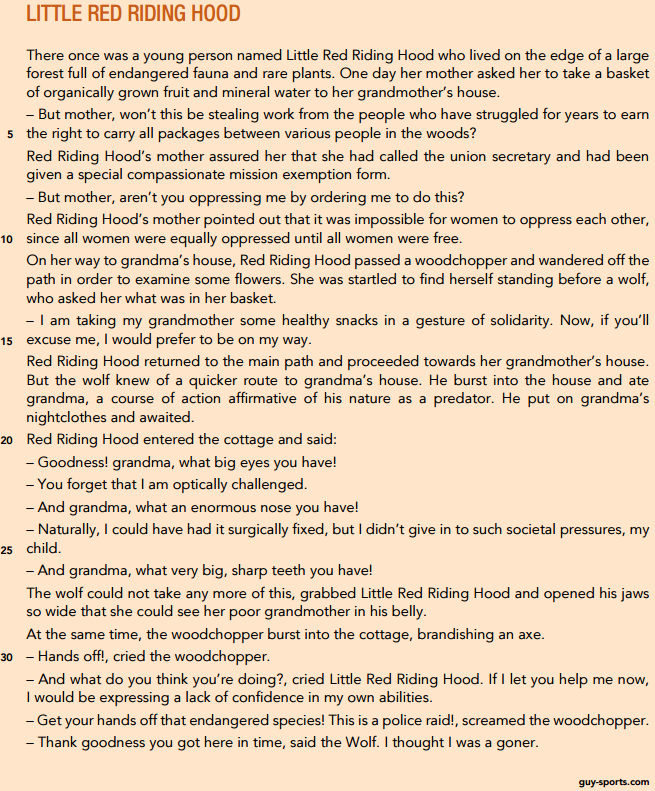
– But mother, aren’t you oppressing me by ordering me to do this? (l. 8)
In the sentence above, the word but fulfills the function of:
Leia o texto para responder à questão.
Disparity in life spans of the rich and the poor is growing
Sabrina Tavernise
February 12, 2016

Experts have long known that rich people generally live longer than poor people. But a growing body of data shows a more disturbing pattern: Despite big advances in medicine, technology and education, the longevity gap between high-income and low-income Americans has been widening sharply.
The poor are losing ground not only in income, but also in years of life, the most basic measure of well-being. In the early 1970s, a 60-year-old man in the top half of the earnings ladder could expect to live 1.2 years longer than a man of the same age in the bottom half, according to an analysis by the Social Security Administration. Fast-forward to 2001, and he could expect to live 5.8 years longer than his poorer counterpart.
New research released this month contains even more jarring numbers. Looking at the extreme ends of the income spectrum, economists at the Brookings Institution found that for men born in 1920, there was a six-year difference in life expectancy between the top 10 percent of earners and the bottom 10 percent. For men born in 1950, that difference had more than doubled, to 14 years. For women, the gap grew to 13 years, from 4.7 years. “There has been this huge spreading out,” said Gary Burtless, one of the authors of the study.
The growing chasm is alarming policy makers, and has surfaced in the presidential campaign. During a Democratic debate, Senator Bernie Sanders and Hillary Clinton expressed concern over shortening life spans for some Americans. “This may be the next frontier of the inequality discussion,” said Peter Orszag, a former Obama administration official now at Citigroup, who was among the first to highlight the pattern. The causes are still being investigated, but public health researchers say that deep declines in smoking among the affluent and educated may partly explain the difference.
Overall, according to the Brookings study, life expectancy for the bottom 10 percent of wage earners improved by just 3 percent for men born in 1950 compared with those born in 1920. For the top 10 percent, though, it jumped by about 28 percent. (The researchers used a common measure – life expectancy at age 50 – and included data from 1984 to 2012.)
(www.nytimes.com. Adaptado.)
Leia a charge para responder à questão.

Genetically modified foods
Genetically modified (GM) foods are foods derived from organisms whose genetic material (DNA) has been modified in a way that does not occur naturally, e.g. through the introduction of a gene from a different organism. Currently available GM foods stem mostly from plants, but in the future foods derived from GM microorganisms or GM animals are likely to be introduced on the market. Most existing genetically modified crops have been developed to improve yield, through the introduction of resistance to plant diseases or of increased tolerance of herbicides.
In the future, genetic modification could be aimed at altering the nutrient content of food, reducing its allergenic potential, or improving the efficiency of food production systems. All GM foods should be assessed before being allowed on the market. FAO/WHO Codex guidelines exist for risk analysis of GM food.
(www.who.int)
BY ISAAC STONE FISH
ASIA IN THE CATEGORY of the world's sexiest politicians, China's dour communist apparatchiks1 would seem to be far behind America's legendary ladies' men presidents and Europe's bunga-bunga leaders. But a survey released in December by the All-China Women's Federation found that a Middle Kingdom mandarin is the top pick for an ideal partner among Chinese women.
What's the appeal? (It can't be the ill-fitting suits.) It's money, money, money. While government officials receive a modest salary – well under $1,000 a month- they can usually leverage their position for personal gain, often through shady means. A corrupt vice district head in Beijing was recently arrested for accumulating more than $ 6,5 million; in other cases the perks have reached into the hundreds of millions. And even for officials who aren't skimming off the top, a government job (and the attendant legal perks) provides a level of security that's quite desirable for China's marriage-minded ladies, especially compared with a less stable position at a state-owned or private company.
There's also the growing reputation of Chinese government officials as a particularly virile lot. China's state-owned press often titillates readers with tales of bureaucratic sex scandals: in one major story last year, a provincial tobacco-bureau chief's diary was leaked online, with page after page of prurient details about his trysts2 with young beauties (including fellow government employees). The public's reaction was generally sympathetic to the cad. One prominent blogger maintained the bureau chief was a good official because he managed to spend some time with his wife despite the womanizing, took less than $10,000 in bribes, and didn't visit prostitutes. In other words, a real catch. In a survey on the blogger's site, almost all the more than 100,000 respondents thought the official should keep his job. That's sex appeal – and popular appeal.
( Newsweek, February 7, 2011.)
apparatchiks1 : burocratas do partido comunista chinês
trysts2 : encontros secretos
Instrução: Leia o texto para responder à questão.
I started to run because I felt desperately unfit. But the biggest pay-off for me was – and still is – the deep relaxation that I achieve by taking exercise. It tires me out but I find that it does calm me down. When I started running seven years ago, I could manage only 400 meters before I had to stop. Breathless and aching, I walked the next quarter of a mile, alternating these two activities for a couple of kilometers.
When I started to jog I never dreamt of running in a marathon, but a few years later I realized that if I trained for it, the London Marathon, one of the biggest British sporting events, would be within my reach. My story shows that an unfit 39-year-old, as I was when I started running, who had taken no serious exercise for twenty years, can do the marathon – and that this is a sport in which women can beat men. But is it crazy to do it? Does it make sense to run in the expectation of becoming healthier?
My advice is: if you are under forty, healthy and feel well, you can begin as I did by jogging gently until you are out of breath, then walking, and alternating the two for about three kilometers. Build up the jogging in stages until you can do the whole distance comfortably.
(Headway Intermediate – Student’s Book. Oxford University Press.
Adaptado.)
40.
Text 2
Because of the bright lights of the modern cities, when we look up at the sky we can see no more than 100 stars. But from dark parts of the Earth, the naked eye can see more than 5,000! And modern telescopes tell a very different story.
With the help of some of the world’s most powerful instruments to measure the brightness of all the galaxies in one sector of the cosmos, Australian astronomers say it is probable that there are 70 sextillion stars in the visible Universe. In other words and numbers, seven followed by 22 zeroes, a really astronomical figure.
That is more than the total number of grains of sand in all the world’s beaches and deserts, and that is only the visible Universe within range of our telescopes.
Dr. Simon Driver, of the Australian National University, has a theory that some of them probably have life. Dr. Driver’s theory is not exactly new, and those planets are so distant, he says, that there is no real possibility for us to see or contact anyone living on them.
Retirado do livro “Inglês série Brasil”, p. 8, 2008
GOOGLE TV: BOOM OR BUST
By: Tim Bajarin (10.18.2010)
The industry has been trying to bring IPTV to your TV since 1997. What makes Google and its partners think they'll be successful?
I have a question for you. Do you want to view the Internet on your TV? With all of the activity in IPTV these days, this is one of the key questions that is at the heart of whether IPTV eventually succeeds or fails. Since TVs were invented, we have been trained to sit in front of them and consume not interact with them. And only recently have we had to multitask with our TV. Even though we've had picture in picture for years, it took news scrolls at the bottom of our TV screens to train our brains. So, how will consumers integrate the new and even more complex IPTV features into their TV viewing experience?
One of the traits of consumers that has emboldened the IPTV crowd to push forward is the fact that many people sit on their couch and use their laptops or tablets while watching TV. They reason that if they multi-task in this fashion, they may be willing do it on the bigger screen. While I accept the fact that people may want Internet content, such as movies, TV shows, YouTube, etc. on their TV screens, it is quite a leap to assume that people also want to read their newspapers and magazines or view Web sites on a big-screen TV.
Source: http://www.pcmag.com/article2/0,2817,2370894,00.asp, accessed on November 4, 2010.
A TOOL FOR SPIES
When Iran’s opposition protesters used Twitter and other forms of social media last year to let the world know about their regime’s brutal post election crackdown, activists praised Twitter as the tool of revolution and freedom. But now Venezuelan President Hugo Chávez has figured out how to twist this tool into one of repression. Though as recently as this past January Chávez was decrying Twitter as a weapon of terrorists, he’s since turned into an avid Twitterer himself ( his account, the country’s most popular, boasted more than half a million followers at press time ), as well as a devoted Facebook user and blogger.
Far from embracing the democratic spirit of the Web, though, the Venezuelan strongman is using his accounts and blog to exhort people to spy on each other. At the launch of his Twitter account, Chávez enjoined the Boliviarian faithful to use it to keep an eye on state enemies, namely the wealthy. My Twitter account is open for you to denounce them, “ Chávez announced on his television program. El Presidente has hired a staff of 200 to deal with tweeted “requests, denunciations, and other problems,” which have resulted in actions against allegedly credit-stingy banks and currency speculators. He’s now considering going a step further and ruling that all Venezuelan Web sites must move from U.S.- based servers to domestic ones - which would, of course, make them far easier to control. Big Brother would be proud.
(Newsweek – June 14, 2010. By Mac Margolis and Alex Marin)



 Conheça nossos planos