Questões de Vestibular
Sobre interpretação de texto | reading comprehension em inglês
Foram encontradas 5.175 questões


Ano: 2019
Banca:
Cepros
Órgão:
CESMAC
Prova:
Cepros - 2019 - CESMAC - Prova de Medicina-2020.1- 1° DIA |
Q1391674
Inglês
Texto associado
Read the text below and answer the following question based on it

Disponível em: < https://www.wikihow.com/Write-a-Prescription> Acessado em 11 de outubro de 2017
Jane Michelle Smith has been instructed to
Ano: 2019
Banca:
Cepros
Órgão:
CESMAC
Prova:
Cepros - 2019 - CESMAC - Prova de Medicina-2020.1- 1° DIA |
Q1391673
Inglês
Texto associado
Read the text below and answer the following question based on it
Disponível em: < https://www.wikihow.com/Write-a-Prescription> Acessado em 11 de outubro de 2017
Jane has been told to
Q1391458
Inglês
Observe o infográfico a seguir para responder à questão .
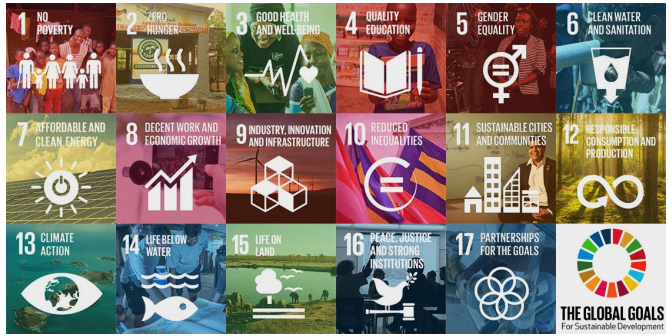
According to the information expressed in the image and the data, The Global Goals, we verify that the
Q1391456
Inglês
Texto associado
This is how UN scientists are preparing for the end of capitalism
Capitalism as we know it is over. So suggests a new report commissioned by a group of scientists
appointed by the UN secretary general. The main reason? We’re transitioning rapidly to a radically different global
economy, due to our increasingly unsustainable exploitation of the planet’s environmental resources and the shift
to less efficient energy sources .
Climate change and species extinctions are accelerating even as societies are experiencing rising
inequality, unemployment, slow economic growth, rising debt levels, and impotent governments. Contrary to the
way policymakers usually think about these problems these are not really separate crises at all.
These crises are part of the same fundamental transition. The new era is characterized by inefficient fossil
fuel production and escalating costs of climate change. Conventional capitalist economic thinking can no longer
explain, predict or solve the workings of the global economy in this new age.
Energy shift
Those are the implications of a new background paper prepared by a team of Finnish biophysicists who
were asked to provide research that would feed into the drafting of the UN Global Sustainable Development
Report (GSDR), which will be released in 2019.
For the “first time in human history”, the paper says, capitalist economies are “shifting to energy sources
that are less energy efficient.” Producing usable energy (“exergy”) to keep powering “both basic and non-basic
human activities” in industrial civilisation “will require more, not less, effort”.
At the same time, our hunger for energy is driving what the paper refers to as “sink costs.” The greater our
energy and material use, the more waste we generate, and so the greater the environmental costs. Though they
can be ignored for a while, eventually those environmental costs translate directly into economic costs as it
becomes more and more difficult to ignore their impacts on our societies.
Overall, the amount of energy we can extract, compared to the energy we are using to extract it, is
decreasing across the spectrum – unconventional oils, nuclear and renewables return less energy in generation
than conventional oils, whose production has peaked – and societies need to abandon fossil fuels because of
their impact on the climate.
Whether or not this system still comprises a form of capitalism is ultimately a semantic question. It
depends on how you define capitalism.
Economic activity is driven by meaning – maintaining equal possibilities for the good life while lowering
emissions dramatically – rather than profit, and the meaning is politically, collectively constructed. Well, this is the
best conceivable case in terms of modern state and market institutions. It can’t happen without considerable
reframing of economic-political thinking, in short words: rethinking capitalism as it is nowadays.
Disponível em: <https://www.independent.co.uk/news/long_reads/capitalism-un-scientists-preparing-end-fossil-fuels-warning-demise-a8523856.html>. Acesso em: 12 mar. 2019. (Adaptado).
Considerando os aspectos semânticos presentes no texto, verifica-se que a construção
Q1391455
Inglês
Texto associado
This is how UN scientists are preparing for the end of capitalism
Capitalism as we know it is over. So suggests a new report commissioned by a group of scientists
appointed by the UN secretary general. The main reason? We’re transitioning rapidly to a radically different global
economy, due to our increasingly unsustainable exploitation of the planet’s environmental resources and the shift
to less efficient energy sources .
Climate change and species extinctions are accelerating even as societies are experiencing rising
inequality, unemployment, slow economic growth, rising debt levels, and impotent governments. Contrary to the
way policymakers usually think about these problems these are not really separate crises at all.
These crises are part of the same fundamental transition. The new era is characterized by inefficient fossil
fuel production and escalating costs of climate change. Conventional capitalist economic thinking can no longer
explain, predict or solve the workings of the global economy in this new age.
Energy shift
Those are the implications of a new background paper prepared by a team of Finnish biophysicists who
were asked to provide research that would feed into the drafting of the UN Global Sustainable Development
Report (GSDR), which will be released in 2019.
For the “first time in human history”, the paper says, capitalist economies are “shifting to energy sources
that are less energy efficient.” Producing usable energy (“exergy”) to keep powering “both basic and non-basic
human activities” in industrial civilisation “will require more, not less, effort”.
At the same time, our hunger for energy is driving what the paper refers to as “sink costs.” The greater our
energy and material use, the more waste we generate, and so the greater the environmental costs. Though they
can be ignored for a while, eventually those environmental costs translate directly into economic costs as it
becomes more and more difficult to ignore their impacts on our societies.
Overall, the amount of energy we can extract, compared to the energy we are using to extract it, is
decreasing across the spectrum – unconventional oils, nuclear and renewables return less energy in generation
than conventional oils, whose production has peaked – and societies need to abandon fossil fuels because of
their impact on the climate.
Whether or not this system still comprises a form of capitalism is ultimately a semantic question. It
depends on how you define capitalism.
Economic activity is driven by meaning – maintaining equal possibilities for the good life while lowering
emissions dramatically – rather than profit, and the meaning is politically, collectively constructed. Well, this is the
best conceivable case in terms of modern state and market institutions. It can’t happen without considerable
reframing of economic-political thinking, in short words: rethinking capitalism as it is nowadays.
Disponível em: <https://www.independent.co.uk/news/long_reads/capitalism-un-scientists-preparing-end-fossil-fuels-warning-demise-a8523856.html>. Acesso em: 12 mar. 2019. (Adaptado).
Considerando as ideias apresentadas no texto, constata-se que
Q1387242
Inglês
Considere o cartum a seguir para responder à questão.
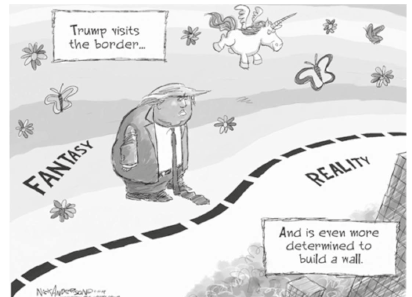
(https://www.gocomics.com/nickanderson/2019/01/11 - Acessado em: 10/03/2019.
De acordo com o cartum, Trump
Q1387241
Inglês
Texto associado
Considere o texto a seguir para a questão.
Why Orwell’s 1984 could be about now
By Jean Seaton - 7 May 2018
The book, with its disorientating first sentence, “It was a bright cold
day in April, and the clocks were striking thirteen”, defines the peculiar
characteristics of modern tyranny. In 1984 television screens watch you,
and everyone spies on everyone else. Today it is social media that collects
every gesture, purchase, comment we make online, and feeds an omniscient
presence in our lives that can predict our every preference. Modelled on
consumer choices, where the user is the commodity that is being marketed,
the harvesting of those preferences for political campaigns is now distorting
democracy.
But the greatest horror in Orwell’s dystopia is the systematic stripping
of meaning out of language. The regime aims to eradicate words and the
ideas and feelings they embody. Its real enemy is reality. Tyrannies attempt
to make understanding the real world impossible: seeking to replace it with
phantoms and lies.
(Adaptado de: http://www.bbc.com/culture/story/
20180507-why-orwells-1984-could-be-about-now - Acessado em: 11/03/2019.
. A partir da leitura do segundo parágrafo do texto, pode-se concluir
que
Q1387240
Inglês
Texto associado
Considere o texto a seguir para a questão.
Why Orwell’s 1984 could be about now
By Jean Seaton - 7 May 2018
The book, with its disorientating first sentence, “It was a bright cold
day in April, and the clocks were striking thirteen”, defines the peculiar
characteristics of modern tyranny. In 1984 television screens watch you,
and everyone spies on everyone else. Today it is social media that collects
every gesture, purchase, comment we make online, and feeds an omniscient
presence in our lives that can predict our every preference. Modelled on
consumer choices, where the user is the commodity that is being marketed,
the harvesting of those preferences for political campaigns is now distorting
democracy.
But the greatest horror in Orwell’s dystopia is the systematic stripping
of meaning out of language. The regime aims to eradicate words and the
ideas and feelings they embody. Its real enemy is reality. Tyrannies attempt
to make understanding the real world impossible: seeking to replace it with
phantoms and lies.
(Adaptado de: http://www.bbc.com/culture/story/
20180507-why-orwells-1984-could-be-about-now - Acessado em: 11/03/2019.
De acordo com o texto, os mecanismos por trás das mídias sociais
Q1387239
Inglês
Texto associado
Considere a notícia a seguir para responder à questão.
Poetry for a surveillance society
Joseph McAllister combines technologies with media to produce unique art
Thu, Jun 14, 2018, 06:35 - Marie Boran
I think that I shall never see a poem as lovely as a …webcam? Joseph
McAllister describes himself as “a computational artist and privacy
advocate”. He combines technologies like machine learning and programming with media including sculpture and interactive theatre to
produce unique art for the increasingly technocratic age we live in.
His latest work is Webcam Poetry, which uses a machine learning
method known as “dense captioning”, a method that detects objects in
video footage and produces descriptions in natural language. Combined
with his own programming (he calls it his poetry engine), it takes live
streaming webcam footage and “writes” poems based on what it sees.
(Adaptado de: https://www.irishtimes.com/business/technology/ poetry-for-a-surveillance-society-1.3528084 - Acessado em 07/03/2019.)
Segundo o texto, o trabalho “Webcam Poetry”
Q1387238
Inglês
Texto associado

Considere o cartum a seguir para responder à questão.
(https://www.gocomics.com/working-daze/2019/03/09 - Acessado em: 10/03/2109.)
A personagem do meio baseia seu pedido à Dana
Q1387237
Inglês
Texto associado
Considere o cartum a seguir para responder à questão.
(https://www.gocomics.com/working-daze/2019/03/09 - Acessado em: 10/03/2109.)
O que provoca a indignação de Dana?
Q1387236
Inglês
Texto associado
Considere o texto a seguir para responder à questão.
How INTERPOL supports Brazil to tackle international crime
Brazil is the largest South American country, with 16,000 km of land
border and 8,000 km of coastline to protect against incoming crime. Its
geographic location at the heart of the Americas, and its numerous
maritime ports sitting on transshipment routes to global markets, make it
attractive to organized crime.
The capacity to take investigations beyond this vast expanse of territory
to work with police forces the world over is crucial to safeguarding Brazilian
national security.
The INTERPOL National Central Bureau (NCB) in Brasilia plays a
fundamental role in protecting the country’s economy, institutions and
businesses against global crime.
(Adaptado de: https://www.interpol.int/Who-we-are/
Member-countries/Americas/BRAZIL - Acessado em: 05/03/2019.)
O texto afirma que o Brasil é “atraente para o crime organizado”. Assinale a alternativa que apresenta a melhor justificativa para essa afirmação, segundo as informações do texto.
Q1387235
Inglês
Texto associado
Considere o texto a seguir para responder à questão.
How INTERPOL supports Brazil to tackle international crime
Brazil is the largest South American country, with 16,000 km of land
border and 8,000 km of coastline to protect against incoming crime. Its
geographic location at the heart of the Americas, and its numerous
maritime ports sitting on transshipment routes to global markets, make it
attractive to organized crime.
The capacity to take investigations beyond this vast expanse of territory
to work with police forces the world over is crucial to safeguarding Brazilian
national security.
The INTERPOL National Central Bureau (NCB) in Brasilia plays a
fundamental role in protecting the country’s economy, institutions and
businesses against global crime.
(Adaptado de: https://www.interpol.int/Who-we-are/
Member-countries/Americas/BRAZIL - Acessado em: 05/03/2019.)
As medidas de 16 mil quilômetros e 8 mil quilômetros, no texto, referem-se
Q1387234
Inglês
Texto associado
Considere o trecho do resumo de um artigo relacionado ao uso de agrotóxicos na agricultura brasileira para responder à questão.
The intensive use of pesticides in Brazilian agriculture is a public
health issue due to contamination of the environment, food and human
health poisoning. The study aimed to show the spatial distribution of the
planted area of agricultural crops, the use of pesticides and related health
problems, as a Health Surveillance strategy. We obtained data from the
planted area of 21 predominant crops, indicators of the consumption of
pesticides per hectare for each crop and health problems. The amount of
pesticides used in the Brazilian municipalities was spatially distributed and
correlated with the incidence of pesticides poisoning: acute, sub-acute
and chronic. The health problems showed positive and significant correlations with pesticide use.
(Adaptado de: http://www.scielo.br/scielo.php?pid=
S1413-81232017021003281&script=sci_abstract&tlng=en - Acessado em: 07/03/2019.)
O objetivo do estudo apresentado era
Q1387233
Inglês
Texto associado
Considere o trecho do resumo de um artigo relacionado ao uso de agrotóxicos na agricultura brasileira para responder à questão.
The intensive use of pesticides in Brazilian agriculture is a public
health issue due to contamination of the environment, food and human
health poisoning. The study aimed to show the spatial distribution of the
planted area of agricultural crops, the use of pesticides and related health
problems, as a Health Surveillance strategy. We obtained data from the
planted area of 21 predominant crops, indicators of the consumption of
pesticides per hectare for each crop and health problems. The amount of
pesticides used in the Brazilian municipalities was spatially distributed and
correlated with the incidence of pesticides poisoning: acute, sub-acute
and chronic. The health problems showed positive and significant correlations with pesticide use.
(Adaptado de: http://www.scielo.br/scielo.php?pid=
S1413-81232017021003281&script=sci_abstract&tlng=en - Acessado em: 07/03/2019.)
De acordo com o texto, o uso intensivo de agrotóxicos
Q1386889
Inglês
“We showed for the first time that it’s possible to do all this computation and sensing using
insects in lieu of drones.” (Context Word Meaning)
Q1386887
Inglês
Texto associado

Researchers create first sensor package that can ride aboard bees.
Researchers at the University of Washington have created a sensor package
that is small enough to ride aboard a bumblebee.
Farmers can already use drones to soar over huge fields and monitor
temperature, humidity or crop health. But these machines need so much
power to fly that they can’t get very far without needing a charge.
Now, engineers at the University of Washington have created a sensing
system that is small enough to ride aboard a bumblebee. Because insects can fly on their own, the package
requires only a tiny rechargeable battery that could last for seven hours of flight and then charge while the bees
are in their hive at night.
“Drones can fly for maybe 10 or 20 minutes before they need to charge again, whereas our bees can collect
data for hours,” said senior author Shyam Gollakota, an associate professor in the UW’s Paul G. Allen School
of Computer Science & Engineering. “We showed for the first time that it’s possible to actually do all this
computation and sensing using insects in lieu of drones.”
Source: www.washington-edu/news/2018/12/11/sensor-bees/
The advantages of using a sensing system are… (Except - Text Comprehension)
Q1386886
Inglês
Texto associado

Should we relax about screen time?
The UK government's plans for regulation of the internet and social media contained a long list of online
harms. Among them was excessive screen use by teenagers.
On the Tech Tent podcast this week, we ask whether there is
convincing evidence that spending hours staring at smartphones
and other screens is damaging the mental health of young people.
f you read news headlines - or indeed the government's Online
Harms White Paper - you might think that the case against screen
time was a no-brainer.
But this week, a study by the Oxford Internet Institute suggested
that it had little obvious effect on the mental wellbeing of
teenagers, even if they were spending hours staring at screens at bedtime.
"We look at general wellbeing," one of the researchers, Amy Orben, tells us. "We do not find a relationship
between digital screen use 30 minutes, one hour and two hours before bed and a decrease in wellbeing."
The research examined data from more than 17,000 teenagers in the UK, Ireland and the United States
Source: www.bbc.com/news/technology-47910524
“If you read news headlines or indeed the government’s Online Harms White Paper […] (Discourse
Marker)
Q1386885
Inglês
Texto associado
Should we relax about screen time?
The UK government's plans for regulation of the internet and social media contained a long list of online
harms. Among them was excessive screen use by teenagers.
On the Tech Tent podcast this week, we ask whether there is
convincing evidence that spending hours staring at smartphones
and other screens is damaging the mental health of young people.
f you read news headlines - or indeed the government's Online
Harms White Paper - you might think that the case against screen
time was a no-brainer.
But this week, a study by the Oxford Internet Institute suggested
that it had little obvious effect on the mental wellbeing of
teenagers, even if they were spending hours staring at screens at bedtime.
"We look at general wellbeing," one of the researchers, Amy Orben, tells us. "We do not find a relationship
between digital screen use 30 minutes, one hour and two hours before bed and a decrease in wellbeing."
The research examined data from more than 17,000 teenagers in the UK, Ireland and the United States
Source: www.bbc.com/news/technology-47910524
Concerning to the text above “online harms” are… (Except) (Text Comprehension)
Q1386883
Inglês
Texto associado
A fire gutted parts of Notre Dame Cathedral and altered the Paris skyline
Paris (CNN) A catastrophic fire engulfed Notre Dame Cathedral in Paris on Monday, altering the city's skyline
and threatening a potent symbol of Catholicism at the start of Holy Week.
The fire burned for several hours, destroying the 850-year-old cathedral's iconic spire and roof before
firefighters contained the blaze early Tuesday morning.
A pair of bell towers immortalized in Victor Hugo's tale "The Hunchback of Notre Dame" survived, along
with the cathedral's elaborate stonework facade. Officials said invaluable artifacts were saved, including the
Crown of Thorns, believed to be a relic of the passion of Christ.
President Emmanuel Macron lamented the destruction of an awe-inspiring building that embodied the heart of
Paris for more than 800 years. But he pledged to rebuild, starting with the launch of an international fundraising
campaign.
"Notre Dame is our history, it's our literature, it's our imagery. It's
the place where we live our greatest moments, from wars to
pandemics to liberations," he said.
"This history is ours. And it burns. It burns and I know the sadness
so many of our fellow French feel."
The Paris prosecutor opened an investigation into the fire, the
cause of which is still unknown.
Hundreds of firefighters were deployed to the scene, snarled by rush hour traffic.
For much of the afternoon, flames and plumes of smoke billowed from the cathedral as firefighters in cranes
sprayed water onto the structure.
The cathedral was undergoing renovation work, the fire service said.
'Madness'
The fire, just days before Easter, was met with horror by Parisians and tourists.
As firefighters battled the blaze, Parisians gathered outside the church Monday night, raising their voices in
prayer.
"It's awful to see such a symbol disappearing in front of you. It's been there for so many years and in a few
minutes half of it disappeared ... crazy.
"Paris without Notre Dame, madness."
Source: www.cnn.com/2019/04/15/world/note-dame-cathedral-fire/index.html
Among invaluable artifacts that were saved, which one is considerable as a relic? (Text Comprehension)

 Conheça nossos planos