Questões de Vestibular
Sobre interpretação de texto | reading comprehension em inglês
Foram encontradas 5.175 questões


Jorge Mario Pedro Vargas Llosa, was born on March 28, 1936, in the Peruvian provincial city of Arequipa. He is a writer, politician, journalist, essayist, and Nobel Prize laureate. Vargas Llosa is one of Latin America's most significant novelists and essayists, and one of the leading authors of his generation. Some critics consider him to have had a larger international impact and worldwide audience than any other writer of the Latin American Boom. He was awarded the 2010 Nobel Prize in Literature "for his cartography of structures of power and his trenchant images of the individual's resistance, revolt, and defeat".
Vargas Llosa rose to fame in the 1960s with novels such as The Time of the Hero (La ciudad y los perros, literally The City and the Dogs, 1963/1966), The Green House (La casa verde, 1965/1968), and the monumental Conversation in the Cathedral (Conversación en la catedral, 1969/1975). He writes prolifically across an array of literary genres, including literary criticism and journalism. His novels include comedies, murder mysteries, historical novels, and political thrillers. Several, such as Captain Pantoja and the Special Service (1973/1978) and Aunt Julia and the Scriptwriter (1977/1982), have been adapted as feature films.
Many of Vargas Llosa's works are influenced by the writer's perception of Peruvian society and his own experiences as a native Peruvian. Increasingly, however, he has expanded his range, and tackled themes that arise from other parts of the world. Another change over the course of his career has been a shift from a style and approach associated with literary modernism, to a sometimes playful postmodernism.
Like many Latin American authors, Vargas Llosa has been politically active throughout his career; over the course of his life, he has gradually moved from the political left towards liberalism or neoliberalism, a definitively more conservative political position. While he initially supported the Cuban revolutionary government of Fidel Castro, Vargas Llosa later became disenchanted with the Cuban dictator and his authoritarian regime. He ran for the Peruvian presidency in 1990 with the center-right Frente Democrático (FREDEMO) coalition, advocating neoliberal reforms.
(Adapted from www.wikipedia.org)
Jorge Mario Pedro Vargas Llosa, was born on March 28, 1936, in the Peruvian provincial city of Arequipa. He is a writer, politician, journalist, essayist, and Nobel Prize laureate. Vargas Llosa is one of Latin America's most significant novelists and essayists, and one of the leading authors of his generation. Some critics consider him to have had a larger international impact and worldwide audience than any other writer of the Latin American Boom. He was awarded the 2010 Nobel Prize in Literature "for his cartography of structures of power and his trenchant images of the individual's resistance, revolt, and defeat".
Vargas Llosa rose to fame in the 1960s with novels such as The Time of the Hero (La ciudad y los perros, literally The City and the Dogs, 1963/1966), The Green House (La casa verde, 1965/1968), and the monumental Conversation in the Cathedral (Conversación en la catedral, 1969/1975). He writes prolifically across an array of literary genres, including literary criticism and journalism. His novels include comedies, murder mysteries, historical novels, and political thrillers. Several, such as Captain Pantoja and the Special Service (1973/1978) and Aunt Julia and the Scriptwriter (1977/1982), have been adapted as feature films.
Many of Vargas Llosa's works are influenced by the writer's perception of Peruvian society and his own experiences as a native Peruvian. Increasingly, however, he has expanded his range, and tackled themes that arise from other parts of the world. Another change over the course of his career has been a shift from a style and approach associated with literary modernism, to a sometimes playful postmodernism.
Like many Latin American authors, Vargas Llosa has been politically active throughout his career; over the course of his life, he has gradually moved from the political left towards liberalism or neoliberalism, a definitively more conservative political position. While he initially supported the Cuban revolutionary government of Fidel Castro, Vargas Llosa later became disenchanted with the Cuban dictator and his authoritarian regime. He ran for the Peruvian presidency in 1990 with the center-right Frente Democrático (FREDEMO) coalition, advocating neoliberal reforms.
(Adapted from www.wikipedia.org)
Are these statements about Vargas Llosa TRUE (T) or FALSE (F), according to the text?
( ) He was born in the city of Arequipa, Peru.
( ) He is a journalist, a lawyer, a writer and a Nobel Prize laureate.
( ) Some critics consider him to be the greatest writer in the Americas.
( ) He is one of the leading writers of the Latin American Boom.
( ) He was awarded the Nobel Prize in Literature in 1990.
Mark the alternative which presents the correct sequence, from top to bottom.
IX. Ascensão de Vasco da Gama
Os deuses da tormenta e os gigantes da terra Suspendem de repente o ódio da sua guerra E pasmam. Pelo vale onde se ascende aos céus Surge um silêncio, e vai, da névoa ondeando os véus, Primeiro um movimento e depois um assombro. Ladeiam-no, ao durar, os medos, ombro a ombro, E ao longe o rastro ruge em nuvens e clarões
Embaixo, onde a terra é, o pastor gela, e a flauta Cai-lhe, e em êxtase vê, à luz de mil trovões, O céu abrir o abismo à alma do Argonauta.
(PESSOA, Fernando. Mensagem. 2. ed. 1. reim. São
Paulo: Martin Claret, 2009. p. 47.)

The cartoons below show pregnant women. Match the headings to the cartoons. Choose the correct sequence.
I - “I´m sorry to tell you this at your age Mrs. Smith, but you’re expecting twins.” “What! I wanted at least triplets!”
II - “Her husband? No, I’m her lawyer.”
III - Pregnant couple: “I’m so glad I’m a woman / I’m so glad I’m a man.”
IV - “Wally – Guess what? You can stop worrying about getting me pregnant…”
(SMITH, David. Internet Addiction ‘is an illness’. The Observer. 28 March 2008. Adapted from: http://www. guardian.co.uk/technology/2008/mar/23/news.internet. Accessed on: 2 April 2011.)
Alguém ainda duvida de que vivemos na era da informação? Exemplo: estou em Lisboa, publicando isto num site americano que pode ter o seu servidor colocado em qualquer parte do mundo e, a partir do momento em que o texto é publicado, fica acessível a qualquer pessoa em praticamente qualquer parte do mundo.
Esta facilidade na divulgação da informação, esta democratização da informação acarreta e acarretará muitas mudanças no cenário mundial onde entra também a tão falada globalização. O comentarista de política internacional, Thomas L. Friedman, no seu livro mais recente, O Mundo é Plano, mostra os indícios que provam que o nosso mundo está a tornar-se mais plano a cada dia e menciona dez acontecimentos que contribuíram para que o mundo se tornasse plano. Eles são:
1 - 9/11/1989 - Quando se derrubaram muros e edificaram janelas Cai o muro de Berlim e aumenta a distribuição de informação. Começa uma uniformização corporativa, a partir da democratização da informação. Logo depois surge o Windows, permitindo que as pessoas interajam melhor com o PC, aumentando o número de aplicações criadas e aumentando a produtividade empresarial e pessoal.
2 - 9/9/1995 - Quando a Netscape se torna pública Abrem-se as portas para a massificação da Internet. O Netscape torna a Internet acessível a todos e ajuda a garantir que os protocolos já existentes (HTTP, FTP, TCP/IP, POP e outros) não sejam monopolizados pela Microsoft ou por outra grande corporação. Surgiu também a bolha das dotcom quando muitas empresas começaram a explorar a necessidade de comunicação e distribuir quilômetros de fibra ótica pelo mundo. Depois do estouro da bolha estas fibras foram vendidas muito barato o que facilitou e barateou a comunicação mundial.
3 - Software de sistematização dos fluxos de trabalho - Vamos almoçar: faça com que a sua aplicação “fale” com a minha aplicação
É uma revolução silenciosa que permite que as aplicações se comuniquem entre si contribuindo ainda mais para que o mundo se torne plano. Uma plataforma global foi criada, em vez de tentar-se manipular o formato das aplicações acabou-se por permitir que elas se entendessem entre si.
Estes três primeiros acontecimentos criaram uma plataforma poderosa que planificou o mundo, permitindo que todos se comunicassem. Os seis acontecimentos seguintes representam novas formas de colaboração que fazem uso desta plataforma.
4 - Open-Sourcing - Comunidades cooperantes auto-organizadas No open-sourcing ferramentas são desenvolvidas por várias pessoas e ninguém é proprietário da ferramenta. Temos como exemplo o Apache, que é usado por dois terços dos servidores de Internet actualmente e está em constante evolução por ser open source. Enquanto nos softwares comerciais o código fonte é guardado a sete chaves, nos softwares open source o código está à disponibilidade de quem quiser, permitindo que erros sejam detectados e corrigidos rapidamente e permitindo que o software seja melhorado por qualquer um. O open source disponibiliza gratuitamente muitas ferramentas e desafia as estruturas hierárquicas com um modelo horizontal de inovação. Outros exemplos, além do Apache, são o Linux, o Gimp, a Wikipédia, o Mozilla, entre outros.
5 - Outsourcing - Y2K
Com o famoso bug do milênio, muitas empresas americanas contrataram mão de obra mais barata, na Índia, para fazer o trabalho aborrecido de melhor alterar o ano nas datas de dois dígitos para quatro. Graças aos três primeiros acontecimentos mencionados, era possível enviar os programas para serem alterados na própria Índia, o que tornava o processo mais barato. Depois de resolvido o problema, o barateamento das comunicações permitiu que esta solução fosse adotada em outras situações, o que tornou a Índia, por exemplo, um grande celeiro de massa cinzenta para os EUA.
6 - Offshoring - Correndo com as gazelas, comendo com os leões
A entrada da China na OMC
permitiu que muitas empresas tivessem produtos
fabricados lá por um preço baixíssimo, barateando os custos de produção e consequentemente aumentando lucros empresariais e reduzindo preços.
7 - Encadeamento de Abastecimento - Comer Sushi no Arkansas A automação da comunicação entre as empresas foi facilitada quando o mundo começou a tornar-se plano, o que possibilita que as empresas se comuniquem entre si, aumentando a qualidade do serviço oferecido, diminuindo preços e facilitando a distribuição das mercadorias. Temos como exemplo a empresa americana Wal-Mart que controla o seu estoque diretamente com o fornecedor, conforme as mercadorias vão sendo vendidas o fornecedor vai adaptando a sua produção e distribuição.
8 - Insourcing - o que andam a fazer, na realidade,
aqueles indivíduos de calções castanhos engraçados
Insourcing é quando uma empresa contrata outra,
melhor capacitada, para prestar um serviço necessário. Por exemplo, se você tem um portátil Toshiba,
dentro do prazo de garantia, que se avariou, a Toshiba
lhe dará instruções para deixar o mesmo numa loja
da UPS para que seja reparado. Antigamente a UPS
transportava o portátil até uma autorizada da Toshiba para que o mesmo fosse reparado para acelerar o
processo; atualmente é a própria UPS que conserta
o portátil e o devolve. Outro exemplo, a Nike prefere investir na concepção de tênis, não em cadeias de
abastecimento, então melhorou o seu serviço ao contratar alguém com o know-how e a estrutura necessária para fazer a distribuição. Outro detalhe, a UPS
fornece serviço para todo tipo de empresa e tenta
adequar os preços permitindo que empresas menores
tenham a mesma qualidade de serviço das grandes,
favorecendo ainda mais a planificação do mundo ao
democratizar as oportunidades.
9 - In-Forming - Motores de busca Google, Yahoo! e MSN.
A informação ao alcance de todo o mundo, basta pesquisar na rede. Tente lembrar como era antigamente, quando não existia a Internet, por exemplo, era preciso ir-se às bibliotecas a procura de informações e, às vezes, era preciso um pouco de sorte para se encontrar rapidamente o que desejava, ou ter a sorte de a publicação pretendida estar disponível.
10 - Os Esteróides - Digitais, Móveis, Pessoais e Virtuais.
As comunicações sem fios, os telefones celulares, iPods, PDAs e outras ferramentas do mesmo estilo nos mantêm em contato com o mundo e com todos o tempo inteiro. O celular deixa de ser, a cada, um simples telefone para incorporar novas funções e características. No Japão, os jovens utilizam o PC no escritório e os celulares e apóiam o estilo de vida pessoal no celular. A informação disponível aos jovens japoneses, através da Internet nos celulares, é tão grande que mal tenham uma dúvida, a primeira coisa que fazem é buscar a resposta pelo telefone. Imagine a seguinte situação, o telefone tem um scan de códigos de barra e você está andando pela rua e vê um pôster anunciando um show da Madonna, você passa o scan pelo código e o bilhete é comprado. Outro pôster anuncia o novo CD da Madonna, você passa o scan e recebe no telefone amostras das músicas do CD, se gostar, passa o scan de novo e compra o CD que será entrega na sua casa, ou terá as músicas disponibilizadas para o telefone.
Enfim, muitas alterações já ocorreram e ainda há
muitas para ocorrer. Há muito espaço para a criatividade porque ainda há muita inovação a ser explorada.
Apresentei um resumo muito resumido das ideias todas só para dar uma noção das ideias principais.
Continuo a ler o livro, agora ele analisa as alterações no mercado de trabalho já que não estaremos mais restritos a barreiras físicas e geográficas, permitindo que os empregos se tornem mais concorridos.
(FRIEDMAN, Thomas L. O mundo é plano: uma breve história do século XXI. Comentário inicial e postagem: Cícero A. T. Disponível em: stcn.blogspot.com/2006/01/omundo-plano.html. Acesso em: 08 mar. 2011.)
 (Available on: http.flatclassroomproject.wikispaces.com
/file/view. Accessed on: 30 March, 2011.)
(Available on: http.flatclassroomproject.wikispaces.com
/file/view. Accessed on: 30 March, 2011.)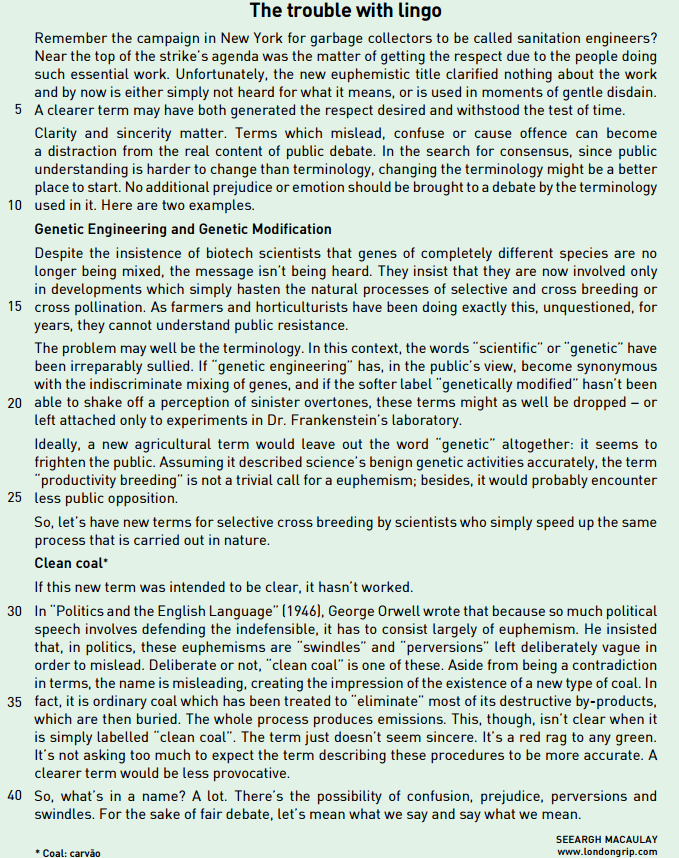
According to the text, the use of the expression “clean coal” might infuriate ecologists.
This idea is explicit in:
A euphemism is a mild, indirect or vague expression used instead of one considered offensive, harsh or blunt. It may be used to hide unpleasant or disturbing ideas.
According to the definition above, the expression “genetic engineering” can be considered a euphemism because:
The logical relationship between clauses establishes different notions.
An example which expresses the notion of concession is indicated in:

The passage from the text which best describes her bodily appearance is in:
In the second paragraph, Kazantzakis introduces a flashback, an interruption in the telling of the major action to show an episode that happened at an earlier time.
In this narrative, the flashback has the function of:
According to some authors, a memoir is how one remembers one’s own life; an autobiography is history, requiring research, dates and facts.
In relation to the author’s life, the text Happiness can be characterized as a memoir especially because of the presence of:
Some traffic engineers have attempted to apply the rules of fluid dynamics to traffic flow, likening it to the flow of a fluid in a pipe. Congestion simulations and real-time observations have shown that in heavy but free flowing traffic, jams can arise spontaneously, triggered by minor events (“butterfly effects"), such as an abrupt steering maneuver by a single motorist. Traffic scientists liken such a situation to the sudden freezing of supercooled fluid. However, unlike a fluid, traffic flow is often affected by signals or other events at junctions that periodically affect the smooth flow of traffic. Alternative mathematical theories exist, such as Boris Kerner's three phase traffic theory.
Because of the poor correlation of theoretical models to actual observed traffic flows, transportation planners and highway engineers attempt to forecast traffic flow using empirical models. Their working traffic models typically use a combination of macro-, micro- and mesoscopic features, and may add matrix entropy effects, by “platooning" groups of vehicles and by randomising the flow patterns within individual segments of the network.
( http://www.time.com/time/world/article/0,8599,1733872,00.html. Acesso em 20.12.2008.)
De acordo com o texto,
BY ISAAC STONE FISH
ASIA IN THE CATEGORY of the world's sexiest politicians, China's dour communist apparatchiks1 would seem to be far behind America's legendary ladies' men presidents and Europe's bunga-bunga leaders. But a survey released in December by the All-China Women's Federation found that a Middle Kingdom mandarin is the top pick for an ideal partner among Chinese women.
What's the appeal? (It can't be the ill-fitting suits.) It's money, money, money. While government officials receive a modest salary – well under $1,000 a month- they can usually leverage their position for personal gain, often through shady means. A corrupt vice district head in Beijing was recently arrested for accumulating more than $ 6,5 million; in other cases the perks have reached into the hundreds of millions. And even for officials who aren't skimming off the top, a government job (and the attendant legal perks) provides a level of security that's quite desirable for China's marriage-minded ladies, especially compared with a less stable position at a state-owned or private company.
There's also the growing reputation of Chinese government officials as a particularly virile lot. China's state-owned press often titillates readers with tales of bureaucratic sex scandals: in one major story last year, a provincial tobacco-bureau chief's diary was leaked online, with page after page of prurient details about his trysts2 with young beauties (including fellow government employees). The public's reaction was generally sympathetic to the cad. One prominent blogger maintained the bureau chief was a good official because he managed to spend some time with his wife despite the womanizing, took less than $10,000 in bribes, and didn't visit prostitutes. In other words, a real catch. In a survey on the blogger's site, almost all the more than 100,000 respondents thought the official should keep his job. That's sex appeal – and popular appeal.
( Newsweek, February 7, 2011.)
apparatchiks1 : burocratas do partido comunista chinês
trysts2 : encontros secretos
BY ISAAC STONE FISH
ASIA IN THE CATEGORY of the world's sexiest politicians, China's dour communist apparatchiks1 would seem to be far behind America's legendary ladies' men presidents and Europe's bunga-bunga leaders. But a survey released in December by the All-China Women's Federation found that a Middle Kingdom mandarin is the top pick for an ideal partner among Chinese women.
What's the appeal? (It can't be the ill-fitting suits.) It's money, money, money. While government officials receive a modest salary – well under $1,000 a month- they can usually leverage their position for personal gain, often through shady means. A corrupt vice district head in Beijing was recently arrested for accumulating more than $ 6,5 million; in other cases the perks have reached into the hundreds of millions. And even for officials who aren't skimming off the top, a government job (and the attendant legal perks) provides a level of security that's quite desirable for China's marriage-minded ladies, especially compared with a less stable position at a state-owned or private company.
There's also the growing reputation of Chinese government officials as a particularly virile lot. China's state-owned press often titillates readers with tales of bureaucratic sex scandals: in one major story last year, a provincial tobacco-bureau chief's diary was leaked online, with page after page of prurient details about his trysts2 with young beauties (including fellow government employees). The public's reaction was generally sympathetic to the cad. One prominent blogger maintained the bureau chief was a good official because he managed to spend some time with his wife despite the womanizing, took less than $10,000 in bribes, and didn't visit prostitutes. In other words, a real catch. In a survey on the blogger's site, almost all the more than 100,000 respondents thought the official should keep his job. That's sex appeal – and popular appeal.
( Newsweek, February 7, 2011.)
apparatchiks1 : burocratas do partido comunista chinês
trysts2 : encontros secretos
BY ISAAC STONE FISH
ASIA IN THE CATEGORY of the world's sexiest politicians, China's dour communist apparatchiks1 would seem to be far behind America's legendary ladies' men presidents and Europe's bunga-bunga leaders. But a survey released in December by the All-China Women's Federation found that a Middle Kingdom mandarin is the top pick for an ideal partner among Chinese women.
What's the appeal? (It can't be the ill-fitting suits.) It's money, money, money. While government officials receive a modest salary – well under $1,000 a month- they can usually leverage their position for personal gain, often through shady means. A corrupt vice district head in Beijing was recently arrested for accumulating more than $ 6,5 million; in other cases the perks have reached into the hundreds of millions. And even for officials who aren't skimming off the top, a government job (and the attendant legal perks) provides a level of security that's quite desirable for China's marriage-minded ladies, especially compared with a less stable position at a state-owned or private company.
There's also the growing reputation of Chinese government officials as a particularly virile lot. China's state-owned press often titillates readers with tales of bureaucratic sex scandals: in one major story last year, a provincial tobacco-bureau chief's diary was leaked online, with page after page of prurient details about his trysts2 with young beauties (including fellow government employees). The public's reaction was generally sympathetic to the cad. One prominent blogger maintained the bureau chief was a good official because he managed to spend some time with his wife despite the womanizing, took less than $10,000 in bribes, and didn't visit prostitutes. In other words, a real catch. In a survey on the blogger's site, almost all the more than 100,000 respondents thought the official should keep his job. That's sex appeal – and popular appeal.
( Newsweek, February 7, 2011.)
apparatchiks1 : burocratas do partido comunista chinês
trysts2 : encontros secretos
Sustainable flight
TAM was the first airline in South America to carry out an experimental flight using biofuel on November 22, 2010. Produced from the oil of 100% domestic nettlespurge, known in Portuguese as pinhão-manso, it reduces carbon emissions by between 65% and 80% compared with petroleum-derived kerosene, according to research. Besides, the plant does not threatens the food chain, as it is not edible for humans nor animals. “Compared with other biofuels, the fuel from this plant is very promising for the Brazilian scenario,” says Paulus Figueiredo, TAM’s fuel manager. The next step in the project is to implement a farming unit, in reduced scale, at TAM’s Technological Center in São Carlos (SP), exclusively to conduct studies and make better cultivation techniques viable. “The objective is to carry out studies concerning technical and economic viability to build a biofuel Brazilian platform based on nettlespurge,” explains TAM’s CEO, Líbano Barroso. The experimental flight was a joint effort between TAM, Airbus, CFM International (joint venture between U.S.’s GE and the French Safran Group) and Air BP. The trip was authorized by Brazil’s National Civil Aviation Agency (ANAC) and by the European Aviation Safety Agency (EASA).
(TAM News, January 2011. Adaptado.)
Sustainable flight
TAM was the first airline in South America to carry out an experimental flight using biofuel on November 22, 2010. Produced from the oil of 100% domestic nettlespurge, known in Portuguese as pinhão-manso, it reduces carbon emissions by between 65% and 80% compared with petroleum-derived kerosene, according to research. Besides, the plant does not threatens the food chain, as it is not edible for humans nor animals. “Compared with other biofuels, the fuel from this plant is very promising for the Brazilian scenario,” says Paulus Figueiredo, TAM’s fuel manager. The next step in the project is to implement a farming unit, in reduced scale, at TAM’s Technological Center in São Carlos (SP), exclusively to conduct studies and make better cultivation techniques viable. “The objective is to carry out studies concerning technical and economic viability to build a biofuel Brazilian platform based on nettlespurge,” explains TAM’s CEO, Líbano Barroso. The experimental flight was a joint effort between TAM, Airbus, CFM International (joint venture between U.S.’s GE and the French Safran Group) and Air BP. The trip was authorized by Brazil’s National Civil Aviation Agency (ANAC) and by the European Aviation Safety Agency (EASA).
(TAM News, January 2011. Adaptado.)
Sustainable flight
TAM was the first airline in South America to carry out an experimental flight using biofuel on November 22, 2010. Produced from the oil of 100% domestic nettlespurge, known in Portuguese as pinhão-manso, it reduces carbon emissions by between 65% and 80% compared with petroleum-derived kerosene, according to research. Besides, the plant does not threatens the food chain, as it is not edible for humans nor animals. “Compared with other biofuels, the fuel from this plant is very promising for the Brazilian scenario,” says Paulus Figueiredo, TAM’s fuel manager. The next step in the project is to implement a farming unit, in reduced scale, at TAM’s Technological Center in São Carlos (SP), exclusively to conduct studies and make better cultivation techniques viable. “The objective is to carry out studies concerning technical and economic viability to build a biofuel Brazilian platform based on nettlespurge,” explains TAM’s CEO, Líbano Barroso. The experimental flight was a joint effort between TAM, Airbus, CFM International (joint venture between U.S.’s GE and the French Safran Group) and Air BP. The trip was authorized by Brazil’s National Civil Aviation Agency (ANAC) and by the European Aviation Safety Agency (EASA).
(TAM News, January 2011. Adaptado.)
Sustainable flight
TAM was the first airline in South America to carry out an experimental flight using biofuel on November 22, 2010. Produced from the oil of 100% domestic nettlespurge, known in Portuguese as pinhão-manso, it reduces carbon emissions by between 65% and 80% compared with petroleum-derived kerosene, according to research. Besides, the plant does not threatens the food chain, as it is not edible for humans nor animals. “Compared with other biofuels, the fuel from this plant is very promising for the Brazilian scenario,” says Paulus Figueiredo, TAM’s fuel manager. The next step in the project is to implement a farming unit, in reduced scale, at TAM’s Technological Center in São Carlos (SP), exclusively to conduct studies and make better cultivation techniques viable. “The objective is to carry out studies concerning technical and economic viability to build a biofuel Brazilian platform based on nettlespurge,” explains TAM’s CEO, Líbano Barroso. The experimental flight was a joint effort between TAM, Airbus, CFM International (joint venture between U.S.’s GE and the French Safran Group) and Air BP. The trip was authorized by Brazil’s National Civil Aviation Agency (ANAC) and by the European Aviation Safety Agency (EASA).
(TAM News, January 2011. Adaptado.)

 Conheça nossos planos