Questões de Vestibular
Sobre interpretação de texto | reading comprehension em inglês
Foram encontradas 5.175 questões


Text 1
A deluxe room at the luxurious Snake River Lodge & Spa, in Jackson, typically goes for $385 a night, but it can be reserved for $192 this fall. The agreement: in order to qualify for the discount, travelers must agree to spend a portion of their vacation moving barbed wire fences from one place to another so local wildlife can walk more freely.

These days, it seems that almost every travel organization — from tour companies to luxury resorts — has a volunteer component, whether it is tracking iguanas on Grand Cayman or distributing food at soup kitchens in Moscow. You can even customize your trip, making it suitable for your interest, while staying at fashionable resorts. Hands Up Holidays combines luxury travel with “a taste of volunteering” through specially programmed volunteer vacations in 26 countries according to your individual skills, ranging from building classrooms while staying in Morocco to helping preserve birds in New Zealand.
Adapted from: <http://travel.nytimes.com/2011/07/17/travel/volunteer-tourism-for-travelers-on-a-budget.html>
According to text 1, it is CORRECT to state that:
it indicates ways of traveling cheaper, but you need to meet some requirements.
Text 1
A deluxe room at the luxurious Snake River Lodge & Spa, in Jackson, typically goes for $385 a night, but it can be reserved for $192 this fall. The agreement: in order to qualify for the discount, travelers must agree to spend a portion of their vacation moving barbed wire fences from one place to another so local wildlife can walk more freely.
These days, it seems that almost every travel organization — from tour companies to luxury resorts — has a volunteer component, whether it is tracking iguanas on Grand Cayman or distributing food at soup kitchens in Moscow. You can even customize your trip, making it suitable for your interest, while staying at fashionable resorts. Hands Up Holidays combines luxury travel with “a taste of volunteering” through specially programmed volunteer vacations in 26 countries according to your individual skills, ranging from building classrooms while staying in Morocco to helping preserve birds in New Zealand.
Adapted from: <http://travel.nytimes.com/2011/07/17/travel/volunteer-tourism-for-travelers-on-a-budget.html>
Select the appropriate title(s) for text 1.
Working for travel organizations in New Zealand
Text 1
A deluxe room at the luxurious Snake River Lodge & Spa, in Jackson, typically goes for $385 a night, but it can be reserved for $192 this fall. The agreement: in order to qualify for the discount, travelers must agree to spend a portion of their vacation moving barbed wire fences from one place to another so local wildlife can walk more freely.
These days, it seems that almost every travel organization — from tour companies to luxury resorts — has a volunteer component, whether it is tracking iguanas on Grand Cayman or distributing food at soup kitchens in Moscow. You can even customize your trip, making it suitable for your interest, while staying at fashionable resorts. Hands Up Holidays combines luxury travel with “a taste of volunteering” through specially programmed volunteer vacations in 26 countries according to your individual skills, ranging from building classrooms while staying in Morocco to helping preserve birds in New Zealand.
Adapted from: <http://travel.nytimes.com/2011/07/17/travel/volunteer-tourism-for-travelers-on-a-budget.html>
Select the appropriate title(s) for text 1.
Combining traveling with volunteering
In the third and fourth paragraphs, there are different sensory images, as in the fragment below:
I breathed in the delicious smell of the steam rising from the pot. (l. 17 )
In this fragment, the narrator makes use of the following type of imagery:
The first paragraph describes the terrible weather, the physical state of the narrator and his unfavorable view of the village and its inhabitants.
From this beginning, one can infer that the narrator did not expect the peasants to:
Read text 3 to answer question.
Text 3

Available in: http://rio.movie-trailer.com/2010/05/riomovie-poster.html.
Access on: May 02, 2011.
Read text 2 to answer question.
Text 2
For Obama, Big Rise in Poll Numbers After Bin Laden Raid
Support for President Obama has risen sharply following the killing of Osama bin Laden by American military forces in Pakistan. Support for the president rose significantly among both Republicans and independents.
Among independents, his approval rating increased 11 points from last month, to 52 percent, while among Republicans it rose 15 points, to 24 percent. Among Democrats, 86 percent supported his job performance, compared with 79 percent in April.
In all, 57 percent said they now approved of the president’s job performance, up from 46 percent last month. More than six in 10 Americans said that killing Bin Laden was likely to increase the threat of terrorism against the United States in the short term. Nearly half said the nation should decrease troop levels in Afghanistan, but more than six in 10 also said the United States had not completed its mission in Afghanistan.
Adapted from: The New York Times. Available in http://www.nytimes.com/2011/05/05/us/politics/05poll.html ?hp. Access on: May 04, 2011.
Read text 2 to answer question.
Text 2
For Obama, Big Rise in Poll Numbers After Bin Laden Raid
Support for President Obama has risen sharply following the killing of Osama bin Laden by American military forces in Pakistan. Support for the president rose significantly among both Republicans and independents.
Among independents, his approval rating increased 11 points from last month, to 52 percent, while among Republicans it rose 15 points, to 24 percent. Among Democrats, 86 percent supported his job performance, compared with 79 percent in April.
In all, 57 percent said they now approved of the president’s job performance, up from 46 percent last month. More than six in 10 Americans said that killing Bin Laden was likely to increase the threat of terrorism against the United States in the short term. Nearly half said the nation should decrease troop levels in Afghanistan, but more than six in 10 also said the United States had not completed its mission in Afghanistan.
Adapted from: The New York Times. Available in http://www.nytimes.com/2011/05/05/us/politics/05poll.html ?hp. Access on: May 04, 2011.
I. The approval of president Obama’s government is higher after bin Laden’s death. II. Now, 52% of independents and 15% of Republicans support Obama’s government. III. The majority of the population believes terrorism will end because bin Laden is dead. IV. Most Americans believe the war in Afghanistan is no longer necessary.
It is right to affirm that:
Read text 1 to answer question.
Text 1

Newsweek. Available in
http://www.newsweek.com/photo/2008/12/18/cartoonsnewsweeks-best-of-2008.html.
Access on: May 03, 2011.
Read text 1 to answer question.
Text 1
Newsweek. Available in
http://www.newsweek.com/photo/2008/12/18/cartoonsnewsweeks-best-of-2008.html.
Access on: May 03, 2011.
I. The text presents a criticism to environmental issues. II. The polar bear prefers to be in the circus. III. The man has a preoccupation regarding human rights. IV. The polar bear faces a difficult situation both in the circus and in the pole.
It is right to affirm that:
Leia o excerto a seguir e responda a próximas questão:
REDUCING CONSUMPTION
Reducing your consumption also reduces how much you contribute to the environmental problems of global warming and waste disposal. It also helps you save money:
- • Switch off electrical appliances when not used.
- • Reuse plastic bags.
- • Recycle newspapers, magazines, bottles and cans.
- • Walk, cycle or share transport instead of driving your car.
- • Buy second-hand goods or clothes.
What other ways are there to consume less and save money?
For more information visit:
Recycle Now www.recyclenow.com
Greenpeace www.greenpeace.org.uk
Energy Saving Trust www.energysavingtrust.org.uk
Environment Agency www.environment-agency.gov.uk
http://www.moneymakesense.co.uk/ethical_text.htm
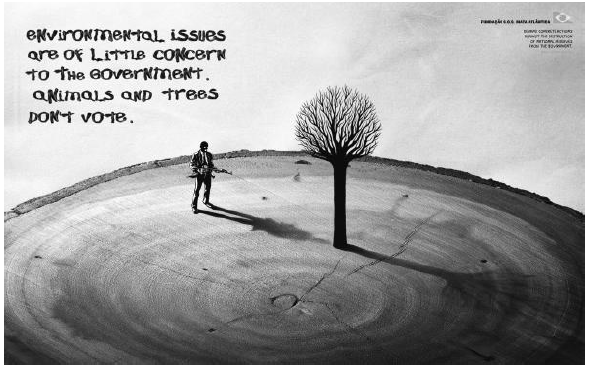
http://www.coloribus.com/adsarchive/prints/nature-preservation-environmental-issues-8175605/
De acordo com as informações oferecidas na gravura acima, podemos dizer que a Fundação Mata
Atlântica nos sugere que:

 Conheça nossos planos