Questões de Vestibular
Comentadas sobre interpretação de texto | reading comprehension em inglês
Foram encontradas 2.293 questões


Observe o cartum.
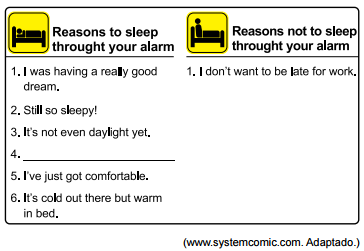
A alternativa que completa corretamente a lacuna do
número 4 do cartum, sem prejuízo de sentido, é
Question: Is there anything I can do to train my body to need less sleep?
Karen Weintraub
June 17, 2016

Many people think they can teach themselves to need less sleep, but they’re wrong, said Dr. Sigrid Veasey, a professor at the Center for Sleep and Circadian Neurobiology at the University of Pennsylvania’s Perelman School of Medicine. We might feel that we’re getting by fine on less sleep, but we’re deluding ourselves, Dr. Veasey said, largely because lack of sleep skews our self-awareness. “The more you deprive yourself of sleep over long periods of time, the less accurate you are of judging your own sleep perception,” she said.
Multiple studies have shown that people don’t functionally adapt to less sleep than their bodies need. There is a range of normal sleep times, with most healthy adults naturally needing seven to nine hours of sleep per night, according to the National Sleep Foundation. Those over 65 need about seven to eight hours, on average, while teenagers need eight to 10 hours, and school-age children nine to 11 hours. People’s performance continues to be poor while they are sleep deprived, Dr. Veasey said.
Health issues like pain, sleep apnea or autoimmune disease can increase people’s need for sleep, said Andrea Meredith, a neuroscientist at the University of Maryland School of Medicine. A misalignment of the clock that governs our sleep-wake cycle can also drive up the need for sleep, Dr. Meredith said. The brain’s clock can get misaligned by being stimulated at the wrong time of day, she said, such as from caffeine in the afternoon or evening, digital screen use too close to bedtime, or even exercise at a time of day when the body wants to be winding down.
(http://well.blogs.nytimes.com. Adaptado.)
Question: Is there anything I can do to train my body to need less sleep?
Karen Weintraub
June 17, 2016
Many people think they can teach themselves to need less sleep, but they’re wrong, said Dr. Sigrid Veasey, a professor at the Center for Sleep and Circadian Neurobiology at the University of Pennsylvania’s Perelman School of Medicine. We might feel that we’re getting by fine on less sleep, but we’re deluding ourselves, Dr. Veasey said, largely because lack of sleep skews our self-awareness. “The more you deprive yourself of sleep over long periods of time, the less accurate you are of judging your own sleep perception,” she said.
Multiple studies have shown that people don’t functionally adapt to less sleep than their bodies need. There is a range of normal sleep times, with most healthy adults naturally needing seven to nine hours of sleep per night, according to the National Sleep Foundation. Those over 65 need about seven to eight hours, on average, while teenagers need eight to 10 hours, and school-age children nine to 11 hours. People’s performance continues to be poor while they are sleep deprived, Dr. Veasey said.
Health issues like pain, sleep apnea or autoimmune disease can increase people’s need for sleep, said Andrea Meredith, a neuroscientist at the University of Maryland School of Medicine. A misalignment of the clock that governs our sleep-wake cycle can also drive up the need for sleep, Dr. Meredith said. The brain’s clock can get misaligned by being stimulated at the wrong time of day, she said, such as from caffeine in the afternoon or evening, digital screen use too close to bedtime, or even exercise at a time of day when the body wants to be winding down.
(http://well.blogs.nytimes.com. Adaptado.)
Question: Is there anything I can do to train my body to need less sleep?
Karen Weintraub
June 17, 2016
Many people think they can teach themselves to need less sleep, but they’re wrong, said Dr. Sigrid Veasey, a professor at the Center for Sleep and Circadian Neurobiology at the University of Pennsylvania’s Perelman School of Medicine. We might feel that we’re getting by fine on less sleep, but we’re deluding ourselves, Dr. Veasey said, largely because lack of sleep skews our self-awareness. “The more you deprive yourself of sleep over long periods of time, the less accurate you are of judging your own sleep perception,” she said.
Multiple studies have shown that people don’t functionally adapt to less sleep than their bodies need. There is a range of normal sleep times, with most healthy adults naturally needing seven to nine hours of sleep per night, according to the National Sleep Foundation. Those over 65 need about seven to eight hours, on average, while teenagers need eight to 10 hours, and school-age children nine to 11 hours. People’s performance continues to be poor while they are sleep deprived, Dr. Veasey said.
Health issues like pain, sleep apnea or autoimmune disease can increase people’s need for sleep, said Andrea Meredith, a neuroscientist at the University of Maryland School of Medicine. A misalignment of the clock that governs our sleep-wake cycle can also drive up the need for sleep, Dr. Meredith said. The brain’s clock can get misaligned by being stimulated at the wrong time of day, she said, such as from caffeine in the afternoon or evening, digital screen use too close to bedtime, or even exercise at a time of day when the body wants to be winding down.
(http://well.blogs.nytimes.com. Adaptado.)

Os documentos descobertos em Vindolanda
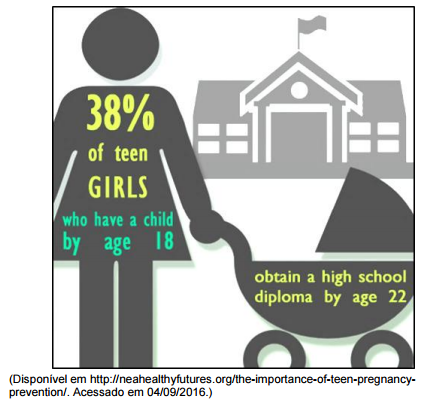
Depreende-se das informações da figura que
Harry Potter is the best selling book series of all time. But it’s had its reproaches. Various Christian groups claimed the books promoted paganism and witchcraft to children. Washington Post book critic Ron Charles called the fact that adults were also hooked on Potter a "bad case of cultural infantilism.” Charles and others also cited a certain artistic banality in massively commercial story-telling, while others criticized Hogwarts, the wizardry academy attended by Potter, for only rewarding innate talents. The Anglo-American writer Christopher Hitchens, on the other hand, praised J. K. Rowling for freeing English children’s literature from dreams of riches and class and snobbery and giving us a world of youthful democracy and diversity. A growing body of evidence suggests that reading Rowling’s work, at least as a youth, might be a good thing. (Adaptado de http://www.scientificamerican.com/article/why-everyone-shouldread-harry-potter/. Acessado em 02/09/2016.)
A leitura do excerto permite concluir adequadamente que:
Ranking Universities by ‘Greenness’
Universities these days are working hard to improve their sustainability credentials, with efforts that include wind power, organic food and competitions to save energy. They are also adding courses related to sustainability and energy. But which university is the greenest?
Several ranking systems have emerged to offer their take. The Princeton Review recently came out with its second annual green ratings. Fifteen colleges earned the highest possible score — including Harvard, Yale and the University of California, Berkeley.
Another group, the Sustainable Endowment Institute’s GreenReportCard.org, rates colleges on several different areas of green compliance, such as recycling, student involvement and green building. Its top grade for overall excellence, an A-, was earned by 15 schools.
(Adaptado de http://green.blogs.nytimes.com/2009/08/20/ranking-universities-bygreenness/?_r=0.
Acessado em 31/08/2016.)
Conforme o texto, universidades norte-americanas estão
se empenhando para
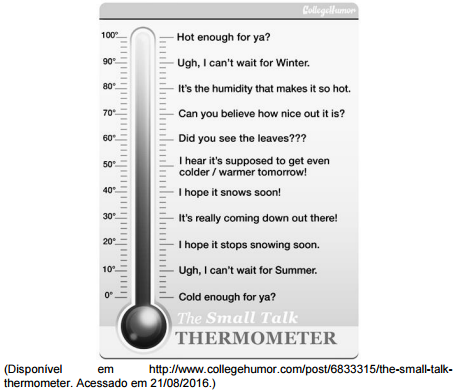
Considerando o nome da figura - “The Small Talk
Thermometer” -, pode-se depreender que a expressão “small
talk” se refere a
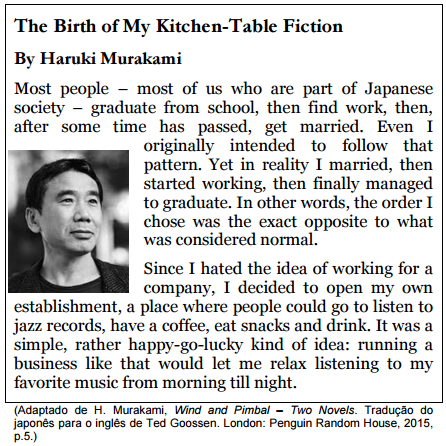
O autor do texto
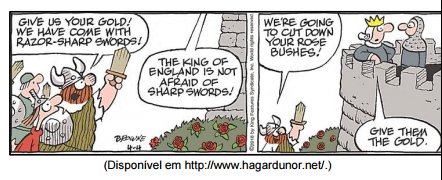
A tirinha ironiza uma suposta característica dos ingleses:
TEXT
Nearly 250 million young children across the world – 43% of under-fives – are unlikely to fulfil their potential as adults because of stunting and extreme poverty, new figures show.
The first three years of life are crucial to a child’s development, according to a series of research papers published in the Lancet medical journal, which says there are also economic costs to the failure to help them grow. Those who do not get the nutrition, care and stimulation they need will earn about 26% less than others as adults.
“The costs of not acting immediately to expand services to improve early childhood development are high for individuals and their families, as well as for societies,” say the researchers. The cost to some countries in GDP (gross domestic product), they estimate, is as much as twice their spending on healthcare.
The figures come as the World Bank prepares for a summit meeting with finance ministers around the globe to discuss how nurturing children in their early years will help their countries’ economic development. The World Bank president, Jim Yong Kim, has told the Guardian that he intends to use the World Economic Forum in Davos each year to name and shame countries that do not reduce their high stunting rates.
The Lancet series says the first 24 months of life are the critical time for avoiding stunting. Undernourished children living in extreme poverty end up small and their brain development is affected, so that they find it hard to learn. “Some catch-up is possible in height-for-age after 24 months, with uncertain cognitive gains,” says one of the papers.
In sub-Saharan Africa, 66% of children are estimated to be at risk of poor development because of stunting and poverty. In south Asia, the figure is 65%, and 18% in the Caribbean and South America.
Mothers need to be well nourished to give their babies a good start in life and be able to breastfeed. Families need help to give children the nutrition and nurturing they need, say researchers. That includes breastfeeding, free pre-school education – which is available in only two-thirds of high-income countries – paid leave for parents and a minimum wage to pull more families out of poverty.
There are children at risk in all countries, rich and poor. The series points to early childhood programs that have been effective, including Sure Start in the UK, Early Head Start in the US, Chile’s Crece Contigo and Grade R in South Africa
In a Comment piece in the journal, Dr Margaret Chan, director general of the World Health Organization, Anthony Lake, executive director of the United Nations Children’s Fund, and Keith Hansen, vice-president for human development at the World Bank, write: “The early childhood agenda is truly global, because the need is not limited to low-income countries. Children living in disadvantaged households in middle-income and wealthy countries are also at risk.
“In targeting our investments, we should give priority to populations in the greatest need, such as families and children in extreme poverty and those who require humanitarian assistance. In addition, we have to build more resilient systems in vulnerable communities to mitigate the disruptive influence of natural disasters, fragility, conflict, and violence.”
Wanda Wyporska, executive director of the Equality Trust, said: “It’s no surprise that the richer you are, the better your health is likely to be”. But the chasm of health inequality between rich and poor has widened in recent years.
“Being born into a poor family shouldn’t mean decades of poorer health and even premature death, but that’s the shameful reality of the UK’s health gap. If you rank neighborhoods in the UK from the richest to the poorest, you have almost perfectly ranked health from the best to the worst.”
https://www.theguardian.com/global-development/2016/oct/04
TEXT
Nearly 250 million young children across the world – 43% of under-fives – are unlikely to fulfil their potential as adults because of stunting and extreme poverty, new figures show.
The first three years of life are crucial to a child’s development, according to a series of research papers published in the Lancet medical journal, which says there are also economic costs to the failure to help them grow. Those who do not get the nutrition, care and stimulation they need will earn about 26% less than others as adults.
“The costs of not acting immediately to expand services to improve early childhood development are high for individuals and their families, as well as for societies,” say the researchers. The cost to some countries in GDP (gross domestic product), they estimate, is as much as twice their spending on healthcare.
The figures come as the World Bank prepares for a summit meeting with finance ministers around the globe to discuss how nurturing children in their early years will help their countries’ economic development. The World Bank president, Jim Yong Kim, has told the Guardian that he intends to use the World Economic Forum in Davos each year to name and shame countries that do not reduce their high stunting rates.
The Lancet series says the first 24 months of life are the critical time for avoiding stunting. Undernourished children living in extreme poverty end up small and their brain development is affected, so that they find it hard to learn. “Some catch-up is possible in height-for-age after 24 months, with uncertain cognitive gains,” says one of the papers.
In sub-Saharan Africa, 66% of children are estimated to be at risk of poor development because of stunting and poverty. In south Asia, the figure is 65%, and 18% in the Caribbean and South America.
Mothers need to be well nourished to give their babies a good start in life and be able to breastfeed. Families need help to give children the nutrition and nurturing they need, say researchers. That includes breastfeeding, free pre-school education – which is available in only two-thirds of high-income countries – paid leave for parents and a minimum wage to pull more families out of poverty.
There are children at risk in all countries, rich and poor. The series points to early childhood programs that have been effective, including Sure Start in the UK, Early Head Start in the US, Chile’s Crece Contigo and Grade R in South Africa
In a Comment piece in the journal, Dr Margaret Chan, director general of the World Health Organization, Anthony Lake, executive director of the United Nations Children’s Fund, and Keith Hansen, vice-president for human development at the World Bank, write: “The early childhood agenda is truly global, because the need is not limited to low-income countries. Children living in disadvantaged households in middle-income and wealthy countries are also at risk.
“In targeting our investments, we should give priority to populations in the greatest need, such as families and children in extreme poverty and those who require humanitarian assistance. In addition, we have to build more resilient systems in vulnerable communities to mitigate the disruptive influence of natural disasters, fragility, conflict, and violence.”
Wanda Wyporska, executive director of the Equality Trust, said: “It’s no surprise that the richer you are, the better your health is likely to be”. But the chasm of health inequality between rich and poor has widened in recent years.
“Being born into a poor family shouldn’t mean decades of poorer health and even premature death, but that’s the shameful reality of the UK’s health gap. If you rank neighborhoods in the UK from the richest to the poorest, you have almost perfectly ranked health from the best to the worst.”
https://www.theguardian.com/global-development/2016/oct/04
TEXT
Nearly 250 million young children across the world – 43% of under-fives – are unlikely to fulfil their potential as adults because of stunting and extreme poverty, new figures show.
The first three years of life are crucial to a child’s development, according to a series of research papers published in the Lancet medical journal, which says there are also economic costs to the failure to help them grow. Those who do not get the nutrition, care and stimulation they need will earn about 26% less than others as adults.
“The costs of not acting immediately to expand services to improve early childhood development are high for individuals and their families, as well as for societies,” say the researchers. The cost to some countries in GDP (gross domestic product), they estimate, is as much as twice their spending on healthcare.
The figures come as the World Bank prepares for a summit meeting with finance ministers around the globe to discuss how nurturing children in their early years will help their countries’ economic development. The World Bank president, Jim Yong Kim, has told the Guardian that he intends to use the World Economic Forum in Davos each year to name and shame countries that do not reduce their high stunting rates.
The Lancet series says the first 24 months of life are the critical time for avoiding stunting. Undernourished children living in extreme poverty end up small and their brain development is affected, so that they find it hard to learn. “Some catch-up is possible in height-for-age after 24 months, with uncertain cognitive gains,” says one of the papers.
In sub-Saharan Africa, 66% of children are estimated to be at risk of poor development because of stunting and poverty. In south Asia, the figure is 65%, and 18% in the Caribbean and South America.
Mothers need to be well nourished to give their babies a good start in life and be able to breastfeed. Families need help to give children the nutrition and nurturing they need, say researchers. That includes breastfeeding, free pre-school education – which is available in only two-thirds of high-income countries – paid leave for parents and a minimum wage to pull more families out of poverty.
There are children at risk in all countries, rich and poor. The series points to early childhood programs that have been effective, including Sure Start in the UK, Early Head Start in the US, Chile’s Crece Contigo and Grade R in South Africa
In a Comment piece in the journal, Dr Margaret Chan, director general of the World Health Organization, Anthony Lake, executive director of the United Nations Children’s Fund, and Keith Hansen, vice-president for human development at the World Bank, write: “The early childhood agenda is truly global, because the need is not limited to low-income countries. Children living in disadvantaged households in middle-income and wealthy countries are also at risk.
“In targeting our investments, we should give priority to populations in the greatest need, such as families and children in extreme poverty and those who require humanitarian assistance. In addition, we have to build more resilient systems in vulnerable communities to mitigate the disruptive influence of natural disasters, fragility, conflict, and violence.”
Wanda Wyporska, executive director of the Equality Trust, said: “It’s no surprise that the richer you are, the better your health is likely to be”. But the chasm of health inequality between rich and poor has widened in recent years.
“Being born into a poor family shouldn’t mean decades of poorer health and even premature death, but that’s the shameful reality of the UK’s health gap. If you rank neighborhoods in the UK from the richest to the poorest, you have almost perfectly ranked health from the best to the worst.”
https://www.theguardian.com/global-development/2016/oct/04
TEXT
Nearly 250 million young children across the world – 43% of under-fives – are unlikely to fulfil their potential as adults because of stunting and extreme poverty, new figures show.
The first three years of life are crucial to a child’s development, according to a series of research papers published in the Lancet medical journal, which says there are also economic costs to the failure to help them grow. Those who do not get the nutrition, care and stimulation they need will earn about 26% less than others as adults.
“The costs of not acting immediately to expand services to improve early childhood development are high for individuals and their families, as well as for societies,” say the researchers. The cost to some countries in GDP (gross domestic product), they estimate, is as much as twice their spending on healthcare.
The figures come as the World Bank prepares for a summit meeting with finance ministers around the globe to discuss how nurturing children in their early years will help their countries’ economic development. The World Bank president, Jim Yong Kim, has told the Guardian that he intends to use the World Economic Forum in Davos each year to name and shame countries that do not reduce their high stunting rates.
The Lancet series says the first 24 months of life are the critical time for avoiding stunting. Undernourished children living in extreme poverty end up small and their brain development is affected, so that they find it hard to learn. “Some catch-up is possible in height-for-age after 24 months, with uncertain cognitive gains,” says one of the papers.
In sub-Saharan Africa, 66% of children are estimated to be at risk of poor development because of stunting and poverty. In south Asia, the figure is 65%, and 18% in the Caribbean and South America.
Mothers need to be well nourished to give their babies a good start in life and be able to breastfeed. Families need help to give children the nutrition and nurturing they need, say researchers. That includes breastfeeding, free pre-school education – which is available in only two-thirds of high-income countries – paid leave for parents and a minimum wage to pull more families out of poverty.
There are children at risk in all countries, rich and poor. The series points to early childhood programs that have been effective, including Sure Start in the UK, Early Head Start in the US, Chile’s Crece Contigo and Grade R in South Africa
In a Comment piece in the journal, Dr Margaret Chan, director general of the World Health Organization, Anthony Lake, executive director of the United Nations Children’s Fund, and Keith Hansen, vice-president for human development at the World Bank, write: “The early childhood agenda is truly global, because the need is not limited to low-income countries. Children living in disadvantaged households in middle-income and wealthy countries are also at risk.
“In targeting our investments, we should give priority to populations in the greatest need, such as families and children in extreme poverty and those who require humanitarian assistance. In addition, we have to build more resilient systems in vulnerable communities to mitigate the disruptive influence of natural disasters, fragility, conflict, and violence.”
Wanda Wyporska, executive director of the Equality Trust, said: “It’s no surprise that the richer you are, the better your health is likely to be”. But the chasm of health inequality between rich and poor has widened in recent years.
“Being born into a poor family shouldn’t mean decades of poorer health and even premature death, but that’s the shameful reality of the UK’s health gap. If you rank neighborhoods in the UK from the richest to the poorest, you have almost perfectly ranked health from the best to the worst.”
https://www.theguardian.com/global-development/2016/oct/04

 Conheça nossos planos