Questões de Vestibular Sobre advérbios e conjunções | adverbs and conjunctions em inglês

Foram encontradas 125 questões

Ano: 2012 Banca: ACAFE Órgão: UNC Prova: ACAFE - 2012 - UNC - Vestibular - Verão - Medicina |
Q1636874 Inglês
Which of the following alternatives for the statement Although this switching system was invented in 1889... (fourth paragraph)is grammatically incorrect?
Alternativas
Ano: 2012 Banca: UEM Órgão: UEM Prova: UEM - 2012 - UEM - Vestibular - PAS - Etapa 1 - Inglês |
Q1364278 Inglês

Texto

Human Rights

BBC Learning English News Word

(Texto adaptado. Disponível em: http://downloads.bbc.co.uk/worldservice/learningenglish/n ewswords/100211_nw_human_rights_text.pdf Acessado em: 16/05/2012) 

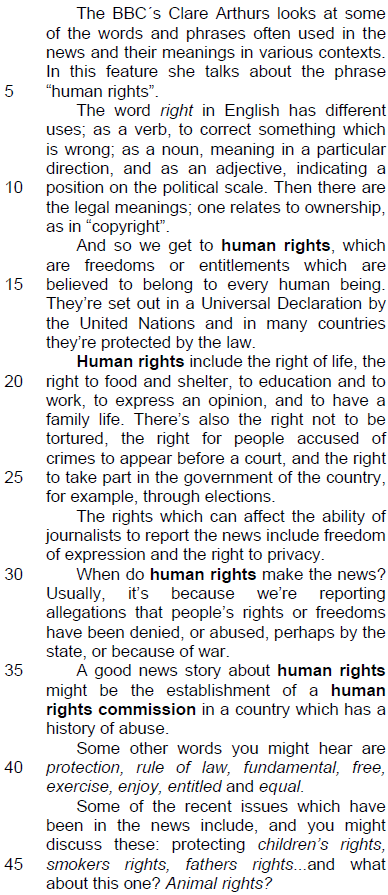
Concerning the vocabulary in the text, it is correct to affirm that


the words “often” (line 2) and “usually” (line 31) are adverbs of frequency.

Alternativas
Ano: 2012 Banca: VUNESP Órgão: UNESP Prova: VUNESP - 2012 - UNESP - Vestibular - Primeiro Semestre |
Q296108 Inglês
Instrução: Examine os anúncios para responder às questões de números 21 a 25.


Imagem 005.jpg

Nos anúncios, as palavras use, you, need, electricity e wisely são exemplos, respectivamente, de

Alternativas
Ano: 2012 Banca: PUC - RJ Órgão: PUC - RJ Prova: PUC - RJ - 2012 - PUC - RJ - Vestibular - Biologia e Inglês 02 |
Q290110 Inglês
The author uses the expression “a matter of fact manner” (L. 24 and L. 31) twice in the text.


Inferring from the context in which it is used, “a matter of fact manner” is

Alternativas
Ano: 2012 Banca: CEV-URCA Órgão: URCA Prova: CEV-URCA - 2012 - URCA - Vestibular - Prova 2 |
Q265533 Inglês
Though (first paragraph) may not be replaced by:

Alternativas
Ano: 2012 Banca: UNICENTRO Órgão: UNICENTRO Prova: UNICENTRO - 2012 - UNICENTRO - Vestibular - Inglês |
Q264529 Inglês
The word (conjunction or preposition) from the text, on the left, expresses what’s stated on the right in

Alternativas
Ano: 2011 Banca: ULBRA Órgão: ULBRA Prova: ULBRA - 2011 - ULBRA - Vestibular - Primeiro Semestre |
Q1376779 Inglês
    As we all know, electricity is a fundamental need. On a daily basis, we consume electricity even without us knowing it. Just a simple task such as listening to your music player consumes electricity. Today, most of our electric generators and power plants are fed with fossil fuels such as petroleum and coal. However, due to the exponential increase of power demand, fossil fuel supplies are slowly being depleted. Not only that, but also burning fossil fuels has given off greenhouse gases and other unwanted byproducts. Because of this, the search for alternative energy sources is now a necessity. One of the most promising alternative energy sources today is Wind Powered Generators. So, what is a wind-powered generator? Basically it is the use of wind as a mechanical force needed to power an electric generator. Utilizing wind as an energy source is not exactly a new idea. The ancient Persians were the first to use wind to pump water, cut wood, and grind food and others by building windmills. Even today you can find windmills still being used on some farms. It was the use of wind as an electric source that came into existence much later. The first practical wind powered generators were built in 1970, but yet we rarely see them in widespread use today, why? Let’s look at the advantages and disadvantages of the wind powered generator.
    The main advantage of wind powered generators is that they have, ideally, zero gas emissions – unlike fossil-fueled power generators. Because of the alarming effects of greenhouse gases and global warming, we want our power generators to be as clean and as environmentally friendly as possible. Since there is no burning process in a wind powered generator that produces toxic gases, it is very safe to build one in residential areas. Also, with proper engineering and enough wind, these generators can provide a high rate of wattage that can go as high as the Megawatt range. Another advantage is that it can be implemented using several small turbines connected together. This is a good thing when there is not enough space for huge structures.
     The major disadvantage of wind powered generators is that wind power varies greatly from one place to another and from day to day and season to season. Sometimes wind may be strong enough to supply energy, but that strength cannot be maintained due to changes in weather patterns. Needing strong, constant wind to most effectively power wind generators is one reason they are often built in coastal areas. Another disadvantage is that the structure of most practical wind powered generators is huge and bulky. Commonly, its size is proportional to the wind power it can collect.
    Research in wind power has now intensified because of its innate advantages over other power generators. With this increase in interest in wind energy and alternative energy sources as a whole, our future will become brighter and more and more remote areas will eventually enjoy the benefits of clean electric energy. In an electricity-dependent world, power supplies must provide the required electricity for communities and businesses. Wind powered generators might just be the solution for power shortages.

Disponível em: http://mysolarcellhome.org/articles/pros-and-cons-of-wind-powered-generators. 
All the statements below, with the exception of one, make use of "that" as a relative pronoun or a conjunction. Select THE EXCEPTION.
Alternativas
Ano: 2011 Banca: UEFS Órgão: UEFS Prova: UEFS - 2011 - UEFS - Vestibular Segundo Semestre - Dia 1 - Inglês |
Q1365145 Inglês


EVANS, Stephen. Disponível em:  <www.bbc.co.uk/worldservice/learningenglish/language/wordsinthenews/2011/05/110518_witn_electric_cars_page.shtml>. Acesso em: 2 jun. 2011.

The word “better” (l. 7) is the irregular comparative degree of
Alternativas
Ano: 2011 Banca: UEFS Órgão: UEFS Prova: UEFS - 2011 - UEFS - Vestibular Segundo Semestre - Dia 1 - Inglês |
Q1365140 Inglês


OXENDEN, Clive; LATHAM-KOENIG, Christina American English File, MultiPack 4A, 2010. p.51

Considering language use in the text, it’s correct to say:
Alternativas
Ano: 2011 Banca: UEFS Órgão: UEFS Prova: UEFS - 2011 - UEFS - Vestibular Segundo Semestre - Dia 1 - Inglês |
Q1365139 Inglês


OXENDEN, Clive; LATHAM-KOENIG, Christina American English File, MultiPack 4A, 2010. p.51

The boldfaced conjunction expresses what is stated in brackets in alternative
Alternativas
Ano: 2011 Banca: UEM Órgão: UEM Prova: UEM - 2011 - UEM - Vestibular - PAS - Etapa 2 - Inglês |
Q1350077 Inglês

Texto

A brief history of Facebook


(Adapted from a text available at http://www.guardian.co.uk/techonolgy/2007/jul/25/media. newmedia. Accessed on 02/6/2011, at 9h10min) 

Assinale a alternativa correta considerando os elementos gramaticais do texto.


The words “originally” (line 11) and “promptly” (line 18) are adverbs.

Alternativas
Ano: 2011 Banca: UEM Órgão: UEM Prova: UEM - 2011 - UEM - Vestibular - EAD - Prova 2 - Inglês |
Q1342141 Inglês
Space hotel to give rich a thrill that’s out of this world


(Texto adaptado. Disponível em <http://wwwguardian.co.uk/science/2011>. Acesso em 31/8/2011 às 10h50min)
Choose the alternative(s) in which the information about the words/fragments from the text is correct.
“newer” (line 24), “clear” (line 35) and “more advanced” (line 66) are comparative forms used to show an increase in size or degree in relation to something else.

Alternativas
Ano: 2011 Banca: Universidade Presbiteriana Mackenzie Órgão: MACKENZIE Prova: Universidade Presbiteriana Mackenzie - 2011 - MACKENZIE - vestibular |
Q1338544 Inglês

Imagem associada para resolução da questão

‘I have always made it __( I )__ every woman feels… special.’ SILVIO BERLUSCONI, Italy’s prime minister, dismissing protests against him shortly before a judge ordered him to stand trial on charges of paying for sex with an underage prostitute. Newsweek

The blank I, in the text, must be correctly completed with
Alternativas
Ano: 2011 Banca: Universidade Presbiteriana Mackenzie Órgão: MACKENZIE Prova: Universidade Presbiteriana Mackenzie - 2011 - MACKENZIE - vestibular |
Q1338543 Inglês


HOW EFFECTIVE IS YOUR TEACHERESE?
By Stephan Hughes
    Why is it that most of our students whine that they are able to almost fully understand what we say in the classroom but when faced with English in a real-life situation, the level of comprehension falls to near bottom, leading to their puzzlement, frustration and despair (in that order)?
    Some reasons for the phenomenon: teachers use a special language called teacherese. It is tailored form of the English language, which allows students to follow and obtain at least a global comprehension of what is being uttered. The speed is toned down somewhat, the lexis is full of Portuguese-like cognates so as to help students make necessary associations and/or simultaneous translations. Its linguistic variation is limited, especially at lower proficiency levels.
    __( I )__ what is most noteworthy of teacherese is that its inability to stretch students’ listening skills may lie more in the fact that teachers, non-native in particular, barely use the rich idiomatic language that is used in magazines, newspapers, TV shows, movies, songs – in short, in real life situations that they usually face. The lexis may not necessarily be second nature to ELT professionals, __( II )__ its absence in everyday use in the classroom.
    Another reason: apart from using teacherese, most teachers don’t have any legitimate speaking opportunities outside of the classroom, __( III )__ reducing their oral skills to instructional and explanatory phrases or typical fixed expressions prescribed in the course book. Giving these educators opportunities to use the language naturally – be it in conversational settings arranged by the institutions or with native speakers in loco or online – may be crucial to whittle away at the problem.
    A third and final reason: familiarity breeds ease, which in turn breeds comprehension. The more time students stay with a said teacher, the easier it might be for them to understand them and get used to their accent, intonation, lexical choice and pace. This is a point that cannot be ignored and is worth looking into.
    __( IV )__ the question we need to ask ourselves is: how effective is the language we use in the classroom and to what extent this effectiveness plays a vital role in helping our students understand the world around them in English? __( V )__, in a communicative context, the teacher is but should not be the ultimate language model for the students, so students should not gauge their listening competence by the teacher. The catch is exposing students to more and more real language in the classroom and fostering effective listening strategies.
Braz-Tesol Newsletter
The words that properly fill in blanks I, II, III, IV and V, in the text, are
Alternativas
Ano: 2011 Banca: COPESE - IF-TM Órgão: IF-TM Prova: COPESE - IF-TM - 2011 - IF-TM - Vestibular - Prova 1 |
Q1272053 Inglês
The price of consumerism

Norman Myers

[...]Moreover, consumption is not an issue for rich countries alone. In developing and transition countries there are well over one billion people with enough income to enjoy an affluent lifestyle. Their aggregate spending in purchasing-power parity (as measured in local terms) already matches that of the United States. Certain effects of their consumerism, such as pollutant emissions from cars, which cause urban smog and global warming, are a salient concern both locally and worldwide. China alone, with 300 million new consumers and possibly twice as many within ten years, could soon exert an environmental impact to rival that of the United States.

http://www.nature.com/nature/journal/v418/n6900/full/418819a.html

O trecho acima refere-se a questão
“Certain effects of their consumerism, such as pollutant emissions from cars, which cause urban smog and global warming, are a salient concern both locally and worldwide”. Such as is a very commonly used expression, in English. What does it indicate in the sentence above?
Alternativas
Ano: 2011 Banca: FATEC Órgão: FATEC Prova: FATEC - 2011 - FATEC - Vestibular - Prova 01 |
Q616765 Inglês
CHINA'S NEW SEX SYMBOLS

BY ISAAC STONE FISH

       ASIA IN THE CATEGORY of the world's sexiest politicians, China's dour communist apparatchiks1 would seem to be far behind America's legendary ladies' men presidents and Europe's bunga-bunga leaders. But a survey released in December by the All-China Women's Federation found that a Middle Kingdom mandarin is the top pick for an ideal partner among Chinese women.

      What's the appeal? (It can't be the ill-fitting suits.) It's money, money, money. While government officials receive a modest salary – well under $1,000 a month- they can usually leverage their position for personal gain, often through shady means. A corrupt vice district head in Beijing was recently arrested for accumulating more than $ 6,5 million; in other cases the perks have reached into the hundreds of millions. And even for officials who aren't skimming off the top, a government job (and the attendant legal perks) provides a level of security that's quite desirable for China's marriage-minded ladies, especially compared with a less stable position at a state-owned or private company.

      There's also the growing reputation of Chinese government officials as a particularly virile lot. China's state-owned press often titillates readers with tales of bureaucratic sex scandals: in one major story last year, a provincial tobacco-bureau chief's diary was leaked online, with page after page of prurient details about his trysts2 with young beauties (including fellow government employees). The public's reaction was generally sympathetic to the cad. One prominent blogger maintained the bureau chief was a good official because he managed to spend some time with his wife despite the womanizing, took less than $10,000 in bribes, and didn't visit prostitutes. In other words, a real catch. In a survey on the blogger's site, almost all the more than 100,000 respondents thought the official should keep his job. That's sex appeal – and popular appeal.

                                                                                       ( Newsweek, February 7, 2011.) 

apparatchiks1 : burocratas do partido comunista chinês
trysts2 : encontros secretos
No último parágrafo do texto, a preposição despite empregada em − despite the womanizing − pode ser substituída por
Alternativas
Ano: 2011 Banca: VUNESP Órgão: UNESP Prova: VUNESP - 2011 - UNESP - Vestibular - Segundo Semestre |
Q577953 Inglês

Instrução: Leia o texto para responder à questão.

      I started to run because I felt desperately unfit. But the biggest pay-off for me was – and still is – the deep relaxation that I achieve by taking exercise. It tires me out but I find that it does calm me down. When I started running seven years ago, I could manage only 400 meters before I had to stop. Breathless and aching, I walked the next quarter of a mile, alternating these two activities for a couple of kilometers.

      When I started to jog I never dreamt of running in a marathon, but a few years later I realized that if I trained for it, the London Marathon, one of the biggest British sporting events, would be within my reach. My story shows that an unfit 39-year-old, as I was when I started running, who had taken no serious exercise for twenty years, can do the marathon – and that this is a sport in which women can beat men. But is it crazy to do it? Does it make sense to run in the expectation of becoming healthier?

      My advice is: if you are under forty, healthy and feel well, you can begin as I did by jogging gently until you are out of breath, then walking, and alternating the two for about three kilometers. Build up the jogging in stages until you can do the whole distance comfortably.

                                          (Headway Intermediate – Student’s Book. Oxford University Press. Adaptado.)

Indique a alternativa composta de duas orações cujas afirmações se opõem.
Alternativas
Ano: 2011 Banca: PUC - RS Órgão: PUC - RS Prova: PUC - RS - 2011 - PUC - RS - Vestibular - Prova 2 |
Q341291 Inglês
De acordo com seu uso no texto, pertencem à mesma categoria gramatical os termos da alternativa

Alternativas
Ano: 2011 Banca: PUC - RJ Órgão: PUC - RJ Prova: PUC - RJ - 2011 - PUC - RJ - Vestibular - Inglês |
Q341042 Inglês
The expression in bold type and the item in parentheses convey equivalent ideas in.

Alternativas
Ano: 2011 Banca: UNICENTRO Órgão: UNICENTRO Prova: UNICENTRO - 2011 - UNICENTRO - Vestibular - Inglês 1 |
Q266591 Inglês
Questões de 6 a 9

Imagem 002.jpg

Considering language use in the text, it’s correct to say:

Alternativas
Respostas
81: A
82: C
83: B
84: A
85: E
86: C
87: C
88: D
89: B
90: C
91: C
92: E
93: C
94: E
95: E
96: D
97: C
98: E
99: B
100: D