Questões de Vestibular Sobre advérbios e conjunções | adverbs and conjunctions em inglês

Foram encontradas 125 questões

Ano: 2025 Banca: CECIERJ Órgão: CEDERJ Prova: CECIERJ - 2025 - CEDERJ - Vestibular - Segundo Semestre |
Q3776532 Inglês
Bill Gates and his vision of the future of jobs with AI

By Clément Pessaux

April 29, 2025


According to Bill Gates, artificial intelligence is about to redefine the job market. Among the professions likely to be widely replaced, Gates directly mentions doctors and teachers. Why these specific sectors? AI has the ability to take on complex tasks such as medical diagnosis or personalized learning, making these services more accessible. In fact, in some developing countries where access to education and healthcare remains limited, such advancements could transform daily life.

But this progress raises concerns. Can we really do without human empathy in these fields? And what about the judgment or sensitivity that a machine can never fully reproduce?

On the other hand, there are professions that AI does not seem ready to replace. Gates specifically mentions energy experts, biologists, and developers. These jobs require specialized expertise, as well as creativity and constant adaptability in the face of environmental or technological challenges.

Creativity, strategic thinking, and empathy remain areas where humans will always have the upper hand. Although he recognizes the immense potential of AI, Gates also emphasizes the limits and the need to think about its deployment by keeping humans at the center of priorities.


Available at: https://3dvf.com/en/bill-gates-predicts-ai-willreplace-humans-in-almost-all-fields-except-these-jobs/ Access: 03 may 2025. Adapted.
In the sentence “But this progress raises concerns.”, the connector “but” expresses:
Alternativas
Ano: 2024 Banca: Aeronáutica Órgão: ITA Prova: Aeronáutica - 2024 - ITA - Vestibular - 1ª Fase |
Q3746322 Inglês

 Leia o texto a seguir para responder à questão.


What links Sir Isaac Newton, alien solar systems, and a new multi-million dollar TV show? The answer is “the three-body problem”: a conundrum in astronomy and mathematics that describes why it’s often difficult to predict the long-term trajectory of planets, moons and stars. So, what exactly is the problem? And how did it end up becoming the title of a TV series?


To understand, you first need to know a bit about the background to the TV show and its premise. The story is based on Liu Cixin’s epic sci-fi trilogy, The Remembrance of Earth’s Past, of which The Three-Body Problem is the first book. The original trilogy is characterised by the author’s attention to scientific detail. The adaptation is less so, but still crammed with scientific ideas.


The TV series focuses on the “Oxford Five”, who all studied under the same professor at the University of Oxford. Some have gone on to become scientists themselves (a postdoctoral physics researcher, a founder and chief scientific officer of a nano-tech company, and a theoretical physics academic), one has become a school physics teacher, while the fifth is now a snack-food entrepreneur. Scientific credentials abound.


The crux of the story is that an alien race — called the Trisolarans or San-Ti Ren — is headed to Earth to colonise it. Through intergalactic communication, these travellers attempt to intimidate human scientists into slowing down our rapid technological advancement, making Earth easier to conquer. But why are these aliens so hell-bent on taking over our planet in the first place? This is where the three-body problem comes in.


Bodies, in this context, is a scientific byword for planets, moons, suns or any other massive astronomical object. The extraterrestrials’ home planet is situated in a solar system with three suns, hence their name in the English translation of the book — the Trisolarans. This three-sun system can be highly unstable, making conditions difficult for life, hence the desire to travel across the Universe in order to inhabit our relatively stable Solar System. We only have one Sun, so Earth’s future is relatively predictable — at least for the next few million years.


Fonte: YATES, Kit. What is the three-body problem? The chaotic, cosmic mathematics behind the Netflix TV show. BBC, 2024. Disponível em: https://www.bbc.com/future/article/20240328-the-science-astronomy-and-mathematics-of-netflixs-3-body-problem-tv-show. Adaptado.

“The extraterrestrials’ home planet is situated in a solar system with three suns, hence their name in the English translation of the book – the Trisolarans. This three-sun system can be highly unstable, making conditions difficult for life, hence the desire to travel across the Universe in order to inhabit our relatively stable Solar System.”, retirado do 5º parágrafo, o termo HENCE pode ser substituído, em ambas as ocorrências e sem alteração de sentido, por:
Alternativas
Ano: 2024 Banca: UFRGS Órgão: UFRGS Prova: UFRGS - 2024 - UFRGS - Vestibular - 2º Dia |
Q3467634 Inglês
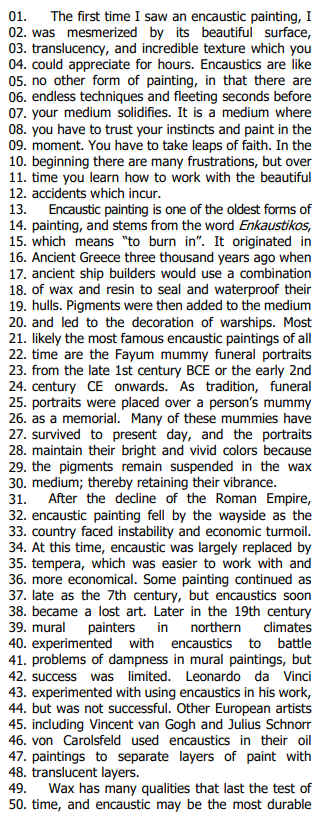
Choose the option in which the word rather has the same meaning and grammatical class as in the fragment Rather, dedicate them solely to work with encaustic (l. 71-72). 
Alternativas
Ano: 2024 Banca: ACAFE Órgão: ACAFE Prova: ACAFE - 2024 - ACAFE - Vestibular - Verão - Medicina |
Q3389979 Inglês
Classify the underlined and bolded words (1 to 4), according to their grammatical category as used in Text 2. 
Alternativas
Ano: 2024 Banca: FUNDEP (Gestão de Concursos) Órgão: EMESCAM Prova: FUNDEP (Gestão de Concursos) - 2024 - EMESCAM - Vestibular - Medicina - Primeiro Semestre 2025 |
Q3353574 Inglês

INSTRUCTION: Read the following text to answer question.


Brachytherapy: A Tool for Fighting Cancer


Imagine you are camping at night, and you are sitting inside a tent. You want to read a book, but it is too dark. If someone outside the tent shines a flashlight at the book, that might help – you might be able to do some reading, especially if the person with the flashlight is not too far away. If the person with the flashlight gets very close to the tent, it will probably be easier to read your book. If you have a flashlight with you inside the tent and you hold your flashlight right up next to the pages of the book, then you are really in business! Brachytherapy is a little like this flashlight, because doctors deliver a dose of radiation right up close to tumor cells instead of treating them from farther away.


There are several ways to treat cancer using radiation. [...] When healthcare providers use beams of radiation from outside the patient, like with the linear accelerator, that is a little like shining the flashlight from outside of the tent. This is a great option, especially if doctors can aim the beam very carefully at the target. Another way to treat cancer with radiation is by using little pieces of radioactive metal. If doctors put the radioactive source right into the tumor that they are trying to treat, the cancer cells will get a high dose of radiation. This is what is done in brachytherapy.


Radiation Seeds and Extra Special Robots


There are several ways healthcare providers can deliver brachytherapy treatments. The first one that we will talk about is to use lots of little capsules, called seeds. Even though they are called seeds, these are a lot different than the kind of seeds you use in your garden! These seeds are pretty small – they are each about the size of a grain of rice. A doctor can surgically implant these seeds directly inside a tumor. The seeds stay in place inside and, because they are radioactive, they release radiation right where the cancer is.


In another type of brachytherapy, healthcare providers can use a robot called an afterloader that controls where the radioactive source is placed in the patient. This robot can move the source through special tubes into the inside of a patient. When the treatment is over, the robot removes the source from the patient. When the radiation source is not being used for treatment, it sits inside a container inside the robot. That container is made of lead so that it blocks radiation. The afterloader can be controlled from outside the treatment room, so the doctor and other members of the healthcare team can be outside of the room while the source is outside of its special container and is being used to treat the patient. This makes delivering radiation safer for the medical team, because they are not exposed to radiation each time they treat a patient.


Available at: https://kids.frontiersin.org/articles/10.3389/ frym.2024.1378550. Accessed on: July 27, 2024.

The idiom even though in “Even though they are called seeds, these are a lot different than the kind of seeds you use in your garden!” is closest in meaning to
Alternativas
Q2064948 Inglês
A Neurologist’s Tips to Protect Your Memory

1_- 6.png (340×105)   
7_- 32.png (355×466)
33_- 67.png (353×627)
68_- 99.png (356×574)
100_- 128.png (360×518)
129_- 138.png (359×178) 

Adapted from: https://www.nytimes.com/2022/07/06/
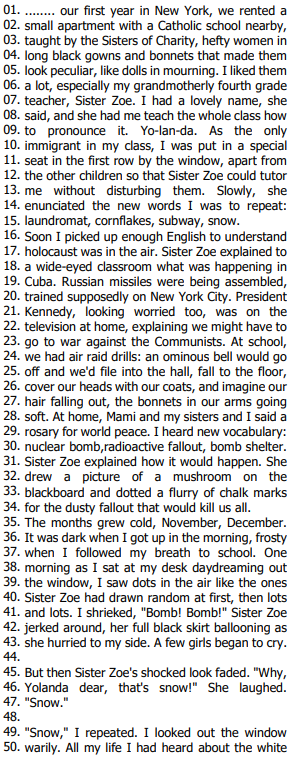
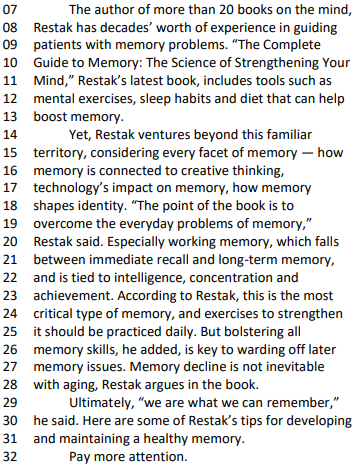
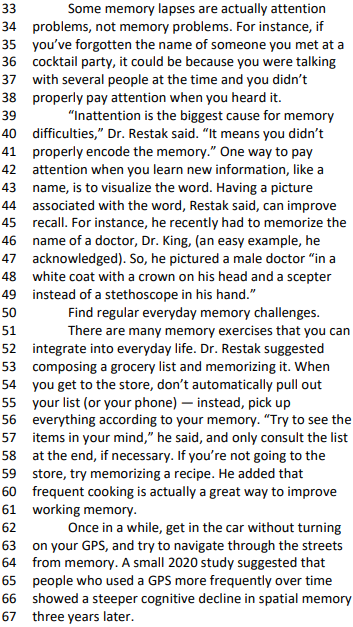
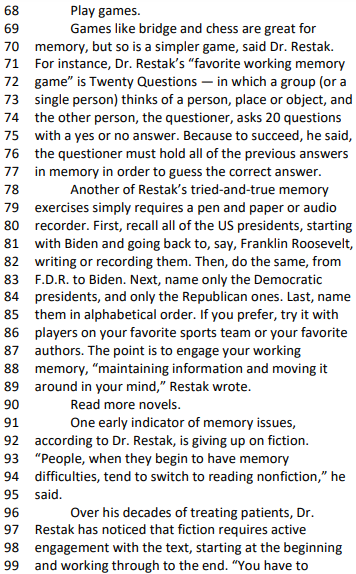
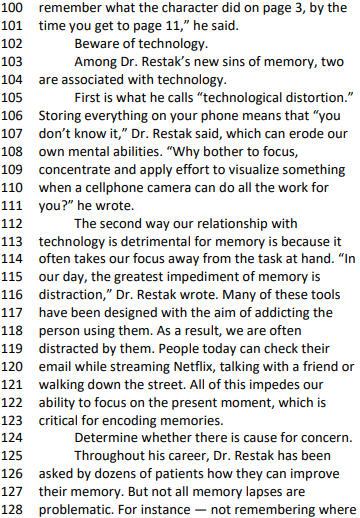
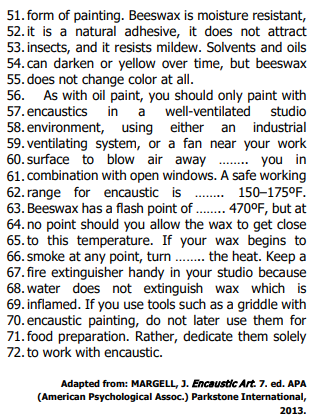
The sentence “When you get to the store, don’t automatically pull out your list.” (lines 53-55) contains an adverbial clause of
Alternativas
Q2064946 Inglês
A Neurologist’s Tips to Protect Your Memory

1_- 6.png (340×105)   
7_- 32.png (355×466)
33_- 67.png (353×627)
68_- 99.png (356×574)
100_- 128.png (360×518)
129_- 138.png (359×178) 

Adapted from: https://www.nytimes.com/2022/07/06/
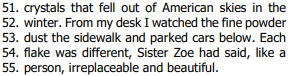
The sentence “The Complete Guide to Memory: The Science of Strengthening Your Mind, Restak’s latest book, includes tools such as mental exercises, sleep habits and diet that can help boost memory.” (lines 09-13) contains a 
Alternativas
Ano: 2022 Banca: CESPE / CEBRASPE Órgão: UNB Prova: CESPE / CEBRASPE - 2022 - UNB - Vestibular - Inglês |
Q2032747 Inglês

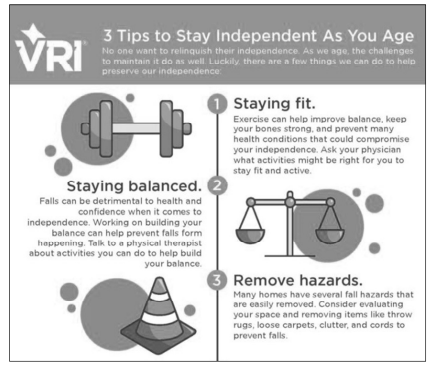
Read the following infographic.


                                                                                                          Internet: <www.vricares.com> (adapted)

Based on the infographic presented, judge the follow item. 


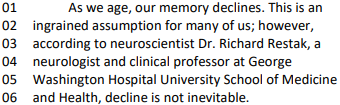
In the expression “As we age”, in the title of the infographic, “As” is used to present a reason or a justification.

Alternativas
Ano: 2022 Banca: CESPE / CEBRASPE Órgão: UNB Prova: CESPE / CEBRASPE - 2022 - UNB - Vestibular - Inglês |
Q2032745 Inglês
  Freedom is a general term, like liberty, independence, autonomy, and equality. In reality, freedom cannot be absolute; no one can be completely free. Your talents, family situation, job, wealth, cultural norms, and laws against murder, for example, constrain and circumscribe your choices. And then there is the freedom of others, which necessarily limits yours.
  Broadly speaking, your rights, whatever they may be, define the limits to your freedom. In the Western tradition of freedom, these are your civil and political rights, including your freedom of speech, religion, and association. Some philosophers see these not only as morally justified rights in themselves, but also as the means for fulfilling other possible rights, like happiness.
  The international justification for your freedom is by reference to human rights, those due to you as a human being and object of international conventions. The most basic of all these rights are those defining what governments cannot do to you. In effect, these human rights define what many mean by democratic freedom. Your freedom of thought, expression, religion, association, is basic, as are the secret ballot, periodic elections, and the right to representation. In short, these rights say that you have a right to be free. This is universal: we all have internationally defined and protected human rights.

Rudolph Joseph Rummel. Why should you be
free?.Internet:<www.hawaii.edu> (adapted). 
Judge the follow item concerning the ideas and linguistic features of the previous text.


In the excerpt “as the means for fulfilling other possible rights, like happiness” (in the last sentence of the second paragraph), the presence of “the” indicates that people’s happiness depends on them having their civil and political rights respected and guaranteed. 
Alternativas
Ano: 2022 Banca: ECONRIO Órgão: USS Prova: ECONRIO - 2022 - USS - Vestibular Medicina - Inglês |
Q1862483 Inglês
Yet, many people with dental disease may not see a dentist until
the process has advanced far beyond the point of saving a tooth. (l. 11-12)

A word with the same semantic value can be found in one of the fragments below:
Alternativas
Q1860176 Inglês

https://www.theguardian.com/environment/ 2021/sep/27/

The underlined words in “extreme heatwaves” (line 13), “current pledges” (lines 14- 15), “polluting countries” (line 32) function respectively as
Alternativas
Q1860171 Inglês

https://www.theguardian.com/environment/ 2021/sep/27/

In the passage “in the global climate strike on Friday” (lines 102-103), there are two examples of
Alternativas
Ano: 2021 Banca: UPENET/IAUPE Órgão: UPE Prova: UPENET/IAUPE - 2021 - UPE - Vestibular - 3º Fase - 1º Dia |
Q1679736 Inglês
In the 1 st paragraph, the word ―meeting‖ is used four times as
Alternativas
Ano: 2021 Banca: UPENET/IAUPE Órgão: UPE Prova: UPENET/IAUPE - 2021 - UPE - Vestibular - 2º Fase - 1º Dia |
Q1675849 Inglês

Text 2

Home


No one leaves

home unless home is the mouth of a shark

you only run for the border

when you see the whole city running as well


Your neighbors running faster than you

breath bloody in their throats

the boy you went to school with

who kissed you dizzy behind the old tin factory

is holding a gun bigger than his body

you only leave homewhen

home won‘t let you stay.


No one leaves home unless home chases you

fire under feet

hot blood in your belly

it‘s not something you ever thought of doing

until the blade burnt threats into

your neck

and even then you carried the anthem under

your breath

only tearing up your passport in an airport toilet

sobbing as each mouthful of paper

made it clear that you wouldn‘t be going back.


You have to understand,

that no one puts their children in a boat

unless the water is safer than the land

no one burns their palms

under trains

beneath carriages (…)


I want to go home,

but home is the mouth of a shark

home is the barrel of the gun

and no one would leave home

unless home chased you to the shore

unless home told you to quicken your legs

leave your clothes behind

crawl through the desert

wade through the oceans (…)


No one leaves home until home is a sweaty voice in your ear

saying –

leave,

run away from me now

I dont know what I‘ve become

but I know that anywhere

is safer than here.


By Warsan Shire. Disponível em: https://www.facinghistory.org/educator-resources/current-events/many-faces-global-migration#8 Excertos. Acesso em: set. 2020.

Considere o gênero textual, o contexto e a gramática da língua inglesa, e assinale a afirmativa INCORRETA para a análise linguística apresentada.
Alternativas
Ano: 2019 Banca: VUNESP Órgão: FAMEMA Prova: VUNESP - 2019 - FAMEMA - Vestibular 2020 - Prova II |
Q1339317 Inglês

               An increasing body of evidence suggests that the time we spend on our smartphones is interfering with our sleep, self-esteem, relationships, memory, attention spans, creativity, productivity and problem-solving and decision-making skills. But there is another reason for us to rethink our relationships with our devices. By chronically raising levels of cortisol, the body’s main stress hormone, our phones may be threatening our health and shortening our lives.

          If they happened only occasionally, phone-induced cortisol spikes might not matter. But the average American spends four hours a day staring at their smartphone and keeps it within arm’s reach nearly all the time, according to a tracking app called Moment.

         “Your cortisol levels are elevated when your phone is in sight or nearby, or when you hear it or even think you hear it,” says David Greenfield, professor of clinical psychiatry at the University of Connecticut School of Medicine and founder of the Center for Internet and Technology Addiction. “It’s a stress response, and it feels unpleasant, and the body’s natural response is to want to check the phone to make the stress go away.”

          But while doing so might soothe you for a second, it probably will make things worse in the long run. Any time you check your phone, you’re likely to find something else stressful waiting for you, leading to another spike in cortisol and another craving to check your phone to make your anxiety go away. This cycle, when continuously reinforced, leads to chronically elevated cortisol levels. And chronically elevated cortisol levels have been tied to an increased risk of serious health problems, including depression, obesity, metabolic syndrome, Type 2 diabetes, fertility issues, high blood pressure, heart attack, dementia and stroke.


(Catherine Price. www.nytimes.com, 24.04.2019. Adaptado.)

No trecho do primeiro parágrafo “But there is another reason for us to rethink our relationships with our devices”, o termo sublinhado introduz uma

Alternativas
Ano: 2019 Banca: UEG Órgão: UEG Prova: UEG - 2019 - UEG - Vestibular - Medicina - Inglês |
Q1300891 Inglês

Leia o texto a seguir para responder à questão. 

Artificial intelligence and the future of medicine

Washington University researchers are working to develop artificial intelligence (AI) systems for health care, which have the potential to transform the diagnosis and treatment of diseases, helping to ensure that patients get the right treatment at the right time.
In health care, artificial intelligence relies on the power of computers to sift through and make sense of reams of electronic data about patients—such as their ages, medical histories, health status, test results, medical images, DNA sequences, and many other sources of health information. AI excels at the complex identification of patterns in these reams of data, and it can do this at a scale and speed beyond human capacity. The hope is that this technology can be harnessed to help doctors and patients make better health-care decisions.


Where are the first places we will start to see AI entering medical practice?

One of the first applications of AI in patient care that we currently see is in imaging, to help improve the diagnosis of cancer or heart problems, for example. There are many types of imaging tests —X-rays, CT scans, MRIs and echocardiograms. But the underlying commonality in all those imaging methods is huge amounts of high-quality data. For AI to work well, it's best to have very complete data sets—no missing numbers, so to speak—and digital images provide that. Plus, the human eye is often blind to some of the patterns that could be present in these images—subtle changes in breast tissue over several years of mammograms, for example. There has been some interesting work done in recognizing early patterns of cancer or early patterns of heart failure that even a highly trained physician would not see.
In many ways, we already have very simple forms of AI in the clinic now. We've had tools for a long time that identify abnormal rhythms in an EKG, for example. An abnormal heartbeat pattern triggers an alert to draw a clinician's attention. This is a computer trying to replicate a human being understanding that data and saying, "This doesn't look normal, you may need to address this problem." Now, we have the capacity to analyze much larger and more complex sources of data, such as the entire electronic health record and perhaps even data pulled from daily life, as more people track their sleep patterns or pulse rates with wearable devices, for example.


What effect will this have on how doctors practice medicine?

It's important to emphasize that these tools are never going to replace clinicians. These technologies will provide assistance, helping care providers see important signals in massive amounts of data that would otherwise remain hidden. But at the same time, there are levels of understanding that computers still can't and may never replicate. To take a treatment recommendation from an AI, even an excellent recommendation, and decide if it's right for the patient is inherently a human decision-making process. What are the patient's preferences? What are the patient's values? What does this mean for the patient's life and for his or her family? That's never going to be an AI function. As these AI systems slowly emerge, we may start to see the roles of physicians changing—in my opinion, in better ways. Doctors' roles may shift from being data collectors and analyzers to being interpreters and councilors for patients as they try to navigate their health. 
Right now, the challenges we need to address as we try to bring AI into medical practice include improving the quality of the data that we feed into AI systems, developing ways to evaluate whether an AI system is actually better than standard of care, ensuring patient privacy and making sure not only that AI doesn't disrupt clinical work flow but in fact improves it. But if doctors do their jobs right and build these systems well, much of what we have described will become so ingrained in the system, people won't even refer to it separately as informatics or AI. It will just be medicine. 

Disponível em: https://medicalxpress.com/news/2018-12-artificial-intelligence-future-medicine.html. Acesso em: 02 maio 2019.
Analisando-se os aspectos linguísticos e estruturais do texto, constata-se que
Alternativas
Ano: 2019 Banca: UNIVESP Órgão: UNIVESP Prova: UNIVESP - 2019 - UNIVESP - Vestibular 1º semestre |
Q1280812 Inglês
Leia o excerto a seguir.
My sister is married _____ she lives in London.
Assinale a alternativa que preencha corretamente a lacuna.

Alternativas
Ano: 2019 Banca: UECE-CEV Órgão: UECE Prova: UECE-CEV - 2019 - UECE - Vestibular - Língua Inglesa 2ªfase |
Q1280297 Inglês

TEXTO

The Future Of Work: 5 Important Ways Jobs

Will Change In The 4th Industrial Revolution


Fonte:

https://www.forbes.com/2019/07/15

In the sentence “Not only will employees want to learn throughout their career, but they will also need to learn new skills.” (lines 54-56), the word but is a(n)
Alternativas
Ano: 2018 Banca: VUNESP Órgão: UNIVESP Prova: VUNESP - 2018 - UNIVESP - Vestibular |
Q1686603 Inglês
Leia o texto para responder a questão.

Modern-day slavery: an explainer
Photograph: Mario Tama/Getty

What is modern-day slavery?
   About 150 years after most countries banned slavery – Brazil was the last to abolish its participation in the transatlantic slave trade, in 1888 – millions of men, women and children are still enslaved. Contemporary slavery takes many forms, from women forced into prostitution, to child slavery in agriculture supply chains or whole families working for nothing to pay off generational debts. Slavery thrives on every continent and in almost every country. Forced labour, people trafficking, debt bondage and child marriage are all forms of modern-day slavery that affect the world’s most vulnerable people.

How is slavery defined?
  Slavery is prohibited under the 1948 Universal Declaration of Human Rights, which states: “No one shall be held in slavery or servitude: slavery and the slave trade shall be prohibited in all their forms.”
  Definitions of modern-day slavery are mainly taken from the 1956 UN supplementary convention, which says: “debt bondage, serfdom, forced marriage and the delivery of a child for the exploitation of that child are all slavery-like practices and require criminalisation and abolishment”. The 1930 Forced Labour Convention defines forced labour as “all work or service which is exacted from any person under the menace of any penalty and for which the said person has not offered himself voluntarily”. As contemporary systems of slavery have evolved, new definitions, including trafficking and distinguishing child slavery from child labour, have developed. 

How many people are enslaved across the world?
  Due to its illegality, data on modern-day slavery is difficult to collate. The UN’s International Labour Organisation (ILO) estimates that about 21 million people are in forced labour at any point in time. The ILO says this estimate includes trafficking and other forms of modern slavery. The only exceptions are trafficking for organ removal, forced marriage and adoption, unless the last two practices result in forced labour. The ILO calculates that 90% of the 21 million are exploited by individuals or companies, while 10% are forced to work by the state, rebel military groups, or in prisons under conditions that violate ILO standards. Sexual exploitation accounts for 22% of slaves.

(www.theguardian.com/global-development/2013/apr/03/modern-day-slavery-explainer. Adaptado)
No trecho do quarto parágrafo unless the last two practices result in forced labour – o termo em destaque indica ideia de
Alternativas
Ano: 2018 Banca: VUNESP Órgão: UNIVESP Prova: VUNESP - 2018 - UNIVESP - Vestibular |
Q1686601 Inglês
Leia o texto para responder a questão.

Modern-day slavery: an explainer
Photograph: Mario Tama/Getty

What is modern-day slavery?
   About 150 years after most countries banned slavery – Brazil was the last to abolish its participation in the transatlantic slave trade, in 1888 – millions of men, women and children are still enslaved. Contemporary slavery takes many forms, from women forced into prostitution, to child slavery in agriculture supply chains or whole families working for nothing to pay off generational debts. Slavery thrives on every continent and in almost every country. Forced labour, people trafficking, debt bondage and child marriage are all forms of modern-day slavery that affect the world’s most vulnerable people.

How is slavery defined?
  Slavery is prohibited under the 1948 Universal Declaration of Human Rights, which states: “No one shall be held in slavery or servitude: slavery and the slave trade shall be prohibited in all their forms.”
  Definitions of modern-day slavery are mainly taken from the 1956 UN supplementary convention, which says: “debt bondage, serfdom, forced marriage and the delivery of a child for the exploitation of that child are all slavery-like practices and require criminalisation and abolishment”. The 1930 Forced Labour Convention defines forced labour as “all work or service which is exacted from any person under the menace of any penalty and for which the said person has not offered himself voluntarily”. As contemporary systems of slavery have evolved, new definitions, including trafficking and distinguishing child slavery from child labour, have developed. 

How many people are enslaved across the world?
  Due to its illegality, data on modern-day slavery is difficult to collate. The UN’s International Labour Organisation (ILO) estimates that about 21 million people are in forced labour at any point in time. The ILO says this estimate includes trafficking and other forms of modern slavery. The only exceptions are trafficking for organ removal, forced marriage and adoption, unless the last two practices result in forced labour. The ILO calculates that 90% of the 21 million are exploited by individuals or companies, while 10% are forced to work by the state, rebel military groups, or in prisons under conditions that violate ILO standards. Sexual exploitation accounts for 22% of slaves.

(www.theguardian.com/global-development/2013/apr/03/modern-day-slavery-explainer. Adaptado)
No trecho do terceiro parágrafo As contemporary systems of slavery have evolved – o termo em destaque equivale, em português, a
Alternativas
Respostas
1: D
2: A
3: D
4: A
5: A
6: B
7: A
8: E
9: C
10: A
11: A
12: A
13: E
14: D
15: A
16: A
17: B
18: C
19: C
20: A