Questões de Concurso
Para pedagogia
Foram encontradas 147.744 questões
Resolva questões gratuitamente!
Junte-se a mais de 4 milhões de concurseiros!


Q4147529
Pedagogia
Texto associado
O letramento literário configura a existência de um repertório textual, a posse de habilidades de trabalho linguístico-formal, o
conhecimento de estratégias de construção de texto e de mundo que permitem a emersão do imaginário no campo simbólico.
PAULINO, G. et al. A formação de professores leitores literários: uma ligação entre infância e idade adulta? Educação em Revista, n. 30, dez. 1999.
Com base no conceito de letramento literário apresentado no texto, qual alternativa apresenta uma atividade de leitura adequada
para promover a construção da autonomia do estudante da Educação Básica?
Q4147527
Pedagogia
Texto associado
Olhos de ressaca? Vá, de ressaca. É o que me dá ideia daquela feição nova. Traziam não sei que fluido misterioso e enérgico, uma
força que arrastava para dentro, como a vaga que se retira da praia, nos dias de ressaca. Para não ser arrastado, agarrei-me às
outras partes.
ASSIS, M. Dom Casmurro. Brasília: Edições Câmara, 2019.
Após a leitura e a discussão do texto, qual proposta coletiva transforma a imagem dos olhos de ressaca em produto artístico
público, com vistas à reflexão social, favorecendo maior autonomia criativa de estudantes da 2ª série do Ensino Médio?
Q4147523
Pedagogia
Texto associado
TEXTO 1
A concepção de linguagem e de gramática que agora
consideramos tem bases fortemente humanistas: todo homem,
sejam quais forem suas condições, nasce dotado de uma
faculdade da linguagem como parte de sua própria capacidade
e dignidade humanas. Mesmo que restem muitos pontos
obscuros quanto à natureza e à extensão dessa faculdade,
isso significa que, sem distinção, todas as crianças desenvolvem
uma gramática interna.
Fica excluída, assim, toda valoração de uma língua ou
modalidade de língua em relação a outra e qualquer forma
de discriminação preconceituosa da modalidade popular.
Não faz sentido contrapor uma linguagem erudita a uma
linguagem vulgar, nem tentar substituir uma pela outra. Trata-
-se de levar a criança a dominar uma outra linguagem, por
razões culturais, sociais e políticas bastante justificáveis.
FRANCHI, C. Mas o que é mesmo gramática?.
São Paulo: Parábola, 2006 (adaptado).
TEXTO 2
Franchi (2006) apresenta a seguinte reflexão de uma professora
acerca de uma redação contendo desvios normativos: “esse
aluno escreve como fala. E isso a gente pode ver na grafia e nos
erros de concordância. Eu não aceito essa onda de que não tem
mais certo e errado. A redação fica horrível nessa linguagem
vulgar. Há regras e normas para tudo e as crianças têm que
aprender a escrever de acordo com o que foi estabelecido pelos
bons escritores e pelos que conhecem a língua. O aluno tem
direito de conhecer as belezas da sua própria língua.”
Considerando os textos 1 e 2, conclui-se que a concepção de
ensino de gramática adotada pela professora revela uma
Q4147519
Pedagogia
Texto associado
Some authors deepen the understanding of scaffolding from the perspective of sociocultural learning theories, highlighting
it as a form of dialogic and adaptive mediation that emerges through interaction between learners and more experienced
interlocutors. Scaffolding is presented as an essential pedagogical tool that enables learners to perform linguistic tasks that are
not yet within their autonomous reach, as long as they fall within the Zone of Proximal Development (ZPD). The support provided
is responsive to the learner’s momentary needs and should be gradually withdrawn as the learner becomes more competent.
What distinguishes these authors’ approach is their view of scaffolding not as mere assisted instruction, but as a dynamic process
of co-constructing meaning in socially situated contexts. They emphasize that in order to foster genuine linguistic development,
teaching must go beyond the transmission of grammatical rules and actively create opportunities for authentic language use,
where error and negotiation are integral to the learning process. Thus, scaffolding becomes a link between participation,
interaction, and development, enabling learners to appropriate language as a cultural tool.
LANTOLF, J. P.; POEHNER, M. E.; THORNE, S. L. Sociocultural Theory and L2 Development. In: VANPATTEN, B.; KEATING, G.; WULFF, S. (Eds.). Theories in Second Language Acquisition: An Introduction. New York: Routledge, 2020 (adapted).
A teacher in middle school wishes to promote the linguistic development of their students based on the learning theory
underlying the text. In this sense, it is coherent for them to develop as a pedagogical practice
Q4147518
Pedagogia
Texto associado
Some authors deepen the understanding of scaffolding from the perspective of sociocultural learning theories, highlighting
it as a form of dialogic and adaptive mediation that emerges through interaction between learners and more experienced
interlocutors. Scaffolding is presented as an essential pedagogical tool that enables learners to perform linguistic tasks that are
not yet within their autonomous reach, as long as they fall within the Zone of Proximal Development (ZPD). The support provided
is responsive to the learner’s momentary needs and should be gradually withdrawn as the learner becomes more competent.
What distinguishes these authors’ approach is their view of scaffolding not as mere assisted instruction, but as a dynamic process
of co-constructing meaning in socially situated contexts. They emphasize that in order to foster genuine linguistic development,
teaching must go beyond the transmission of grammatical rules and actively create opportunities for authentic language use,
where error and negotiation are integral to the learning process. Thus, scaffolding becomes a link between participation,
interaction, and development, enabling learners to appropriate language as a cultural tool.
LANTOLF, J. P.; POEHNER, M. E.; THORNE, S. L. Sociocultural Theory and L2 Development. In: VANPATTEN, B.; KEATING, G.; WULFF, S. (Eds.). Theories in Second Language Acquisition: An Introduction. New York: Routledge, 2020 (adapted).
Considering the learning theory presented in the text, a pedagogically grounded proposal for application in the school context
involves the
Q4147506
Pedagogia
Texto associado

TEXT 1
“The Wolves are a free people,” said Father Wolf. “They take
orders from the Head of the Pack, and not from any striped
cattle-killer. The man’s cub is ours — to kill if we choose.”
“Ye choose and ye do not choose! What talk is this of choosing?
By the bull that I killed, am I to stand nosing into your dog’s
den for my fair dues? It is I, Shere Khan, who speak!”
KIPLING, R. The Jungle Book. S.l.: Project Gutenberg, 1894.
TEXT 2
For an activity involving The Jungle Book and its manga
adaptation to work with characters’ emotions in a 6th-grade
classroom, the teacher is aware that one student in the class is
autistic and prefers structured, visual tasks. Which alternative
supports this student’s engagement with the texts?
Q4147499
Pedagogia
Texto associado
Garcia (2009) é quem expande o conceito de translinguagem, que parte de uma visão heteroglóssica, em que o sujeito possui
um único repertório linguístico e suas práticas linguísticas e dinâmicas semióticas são superiores às línguas convencionais de
países e estados. Liberali (2013) defende esta perspectiva e enfatiza a necessidade de termos que considerar o currículo da
educação multi/bilíngue a partir das atividades e práticas sociais e permitir aos alunos expandirem seu repertório e suas formas
de participação. A educação bilíngue consiste em um programa educacional formal que se faz presente pelo aprendizado de
componentes curriculares pela instrução em duas línguas e não manter o foco apenas no aprendizado da língua. Aqui no
Brasil, podemos distinguir a educação bilíngue em dois grandes grupos: dominante (educação bilíngue de línguas de prestígio,
frequentemente de escolas particulares de elite em que se objetiva o aprendizado de uma segunda língua, como o inglês) e
minoritários (educação indígena, migrantes de crise, educação em regiões de fronteiras, educação de surdos).
Projeto-piloto: escola bilíngue com adequações. Disponível em: www.ibipora.pr.gov.br. Acesso em: 2 maio 2025 (adaptado).
Which interdisciplinary project reflects the bilingual approach described in the text?
Q4147496
Pedagogia

In light of Base Nacional Comum Curricular (BNCC) and Programa Nacional do Livro Didático (PNLD) guidelines for English
language teaching, how does the activity about cyberbullying reflect current educational policies and priorities?
Q4147494
Pedagogia
Which theoretical perspective on language best underpins the pedagogical approach presented in the teacher´s guide to the
textbook excerpt?
Q4147194
Pedagogia
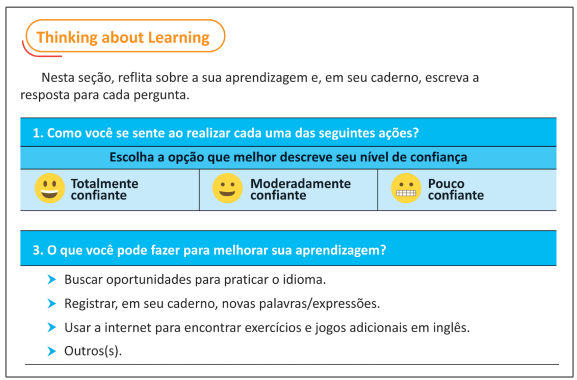
The prompt “O que você pode fazer para melhorar sua aprendizagem?”, from a textbook page, asks students to reflect on their own learning process. From a formative assessment perspective, what justifies the pedagogical purpose of this activity?
Q4147188
Pedagogia
Texto associado
During a writing activity in English, the teacher observes that more than half of the students struggle with the correct use of the
Past Simple and Present Perfect tenses, especially in distinguishing between the two in isolated sentences — e.g., “They have seen
that movie last week” instead of “They saw that movie last week” or “She worked here since 2020” instead of “She has worked
here since 2020”. The teacher notices that the students have no difficulty identifying the two tenses in reading comprehension
activities. This indicates a passive understanding of the structures, but a lack of practice and confidence in their active use. The
students, in late adolescence (16-17 years old), are in Piaget’s formal operations stage, with the ability to abstract, to analyze
critically, and to generalize rules, as long as they are presented clearly, so students have opportunities for practical application.
Their engagement is significantly higher in activities that connect the content to real-world contexts, such as discussions about
personal experiences or global issues. The teacher is then determined to find and implement a strategy to help her students.
Given this scenario, the teacher decides to rethink their assessment practices, adopting strategies that support the students’
learning through meaningful experiences, appropriate to their stage of development according to Piaget. The teacher then
reviews the content covered and decides to
Q4147187
Pedagogia
Texto associado
During a writing activity in English, the teacher observes that more than half of the students struggle with the correct use of the
Past Simple and Present Perfect tenses, especially in distinguishing between the two in isolated sentences — e.g., “They have seen
that movie last week” instead of “They saw that movie last week” or “She worked here since 2020” instead of “She has worked
here since 2020”. The teacher notices that the students have no difficulty identifying the two tenses in reading comprehension
activities. This indicates a passive understanding of the structures, but a lack of practice and confidence in their active use. The
students, in late adolescence (16-17 years old), are in Piaget’s formal operations stage, with the ability to abstract, to analyze
critically, and to generalize rules, as long as they are presented clearly, so students have opportunities for practical application.
Their engagement is significantly higher in activities that connect the content to real-world contexts, such as discussions about
personal experiences or global issues. The teacher is then determined to find and implement a strategy to help her students.
Which research methodology is appropriate to deal with students’ difficulties?
Q4147181
Pedagogia
Texto associado
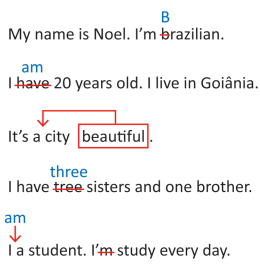
FIGUEIREDO, F. J. Q. Aprendendo com os erros: uma perspectiva comunicativa do ensino de línguas. São Paulo: Parábola, 2023 (adapted).
A student has a composition corrected by her high school teacher with markings as the ones in the text. In order to promote
autonomous learning and content mastery, the student should be able to
Q4147180
Pedagogia
Texto associado
FIGUEIREDO, F. J. Q. Aprendendo com os erros: uma perspectiva comunicativa do ensino de línguas. São Paulo: Parábola, 2023 (adapted).
To encourage students to reflect on their textual production and play an active role in their learning process, what is the
alternative for assessing the presented written activity?
Q4147179
Pedagogia
Texto associado
According to Rojo (2009), literacy involves social practices
of reading and writing that are historically and culturally
situated. Thus, it is understood as a set of practices that enables
individuals to effectively participate in society by interpreting
and producing texts in various social contexts. Additionally, the
Base Nacional Comum Curricular (BNCC) defines multiliteracies
as the practices of reading and producing texts that are
constructed through different languages or semioses.
Due to the alarming rise in hate speech on the internet over the
last years, a teacher wants to promote an opportunity for students
to reflect on hate speech incorporating the concepts of literacy and
multiliteracies. What is the appropriate activity to accomplish that?
Q4147178
Pedagogia
Texto associado
According to Rojo (2009), literacy involves social practices
of reading and writing that are historically and culturally
situated. Thus, it is understood as a set of practices that enables
individuals to effectively participate in society by interpreting
and producing texts in various social contexts. Additionally, the
Base Nacional Comum Curricular (BNCC) defines multiliteracies
as the practices of reading and producing texts that are
constructed through different languages or semioses.
Which of the activities takes into account the concept of
multiliteracies?
Q4147177
Pedagogia
Texto associado
During a 9th-grade English class, the teacher designs a
lesson around the theme Local Heroes. The students begin
by watching a short subtitled documentary about Mestre
João, a capoeira master who offers free classes to children
in the school’s neighborhood. Working in groups, they then
create posters and voice recordings in English to present
other individuals they know who make a difference in their
community. Some students choose sports figures, others
highlight musicians or teachers. In order to support the lesson,
the teacher prepares a didactic sequence that incorporates
elements of digital literacy. Throughout the activities, she
encourages students to express themselves meaningfully
in English, prioritizing authentic communication and social
relevance over grammatical perfection and form-focused drills.
Considering the linguistic orientation which supports the
teaching approach presented in the text, an adequate teaching
activity focuses on
Q4147176
Pedagogia
Texto associado
During a 9th-grade English class, the teacher designs a
lesson around the theme Local Heroes. The students begin
by watching a short subtitled documentary about Mestre
João, a capoeira master who offers free classes to children
in the school’s neighborhood. Working in groups, they then
create posters and voice recordings in English to present
other individuals they know who make a difference in their
community. Some students choose sports figures, others
highlight musicians or teachers. In order to support the lesson,
the teacher prepares a didactic sequence that incorporates
elements of digital literacy. Throughout the activities, she
encourages students to express themselves meaningfully
in English, prioritizing authentic communication and social
relevance over grammatical perfection and form-focused drills.
With reference to the lesson described, which of the following
activities is consistent with the pedagogical principles guiding
the teacher´s actions?
Q4147174
Pedagogia
Texto associado
Some authors deepen the understanding of scaffolding from the perspective of sociocultural learning theories, highlighting
it as a form of dialogic and adaptive mediation that emerges through interaction between learners and more experienced
interlocutors. Scaffolding is presented as an essential pedagogical tool that enables learners to perform linguistic tasks that are
not yet within their autonomous reach, as long as they fall within the Zone of Proximal Development (ZPD). The support provided
is responsive to the learner’s momentary needs and should be gradually withdrawn as the learner becomes more competent.
What distinguishes these authors’ approach is their view of scaffolding not as mere assisted instruction, but as a dynamic process
of co-constructing meaning in socially situated contexts. They emphasize that in order to foster genuine linguistic development,
teaching must go beyond the transmission of grammatical rules and actively create opportunities for authentic language use,
where error and negotiation are integral to the learning process. Thus, scaffolding becomes a link between participation,
interaction, and development, enabling learners to appropriate language as a cultural tool.
LANTOLF, J. P.; POEHNER, M. E.; THORNE, S. L. Sociocultural Theory and L2 Development. In: VANPATTEN, B.; KEATING, G.;
WULFF, S. (Eds.). Theories in Second Language Acquisition: An Introduction. New York: Routledge, 2020 (adapted).
Based on the concept of learning presented in the text, the pedagogical intervention which promotes curricular accessibility
for students with disabilities is the one that
Q4147173
Pedagogia
Texto associado
Some authors deepen the understanding of scaffolding from the perspective of sociocultural learning theories, highlighting
it as a form of dialogic and adaptive mediation that emerges through interaction between learners and more experienced
interlocutors. Scaffolding is presented as an essential pedagogical tool that enables learners to perform linguistic tasks that are
not yet within their autonomous reach, as long as they fall within the Zone of Proximal Development (ZPD). The support provided
is responsive to the learner’s momentary needs and should be gradually withdrawn as the learner becomes more competent.
What distinguishes these authors’ approach is their view of scaffolding not as mere assisted instruction, but as a dynamic process
of co-constructing meaning in socially situated contexts. They emphasize that in order to foster genuine linguistic development,
teaching must go beyond the transmission of grammatical rules and actively create opportunities for authentic language use,
where error and negotiation are integral to the learning process. Thus, scaffolding becomes a link between participation,
interaction, and development, enabling learners to appropriate language as a cultural tool.
LANTOLF, J. P.; POEHNER, M. E.; THORNE, S. L. Sociocultural Theory and L2 Development. In: VANPATTEN, B.; KEATING, G.;
WULFF, S. (Eds.). Theories in Second Language Acquisition: An Introduction. New York: Routledge, 2020 (adapted).
A teacher in middle school wishes to promote the linguistic development of their students based on the learning theory
underlying the text. In this sense, it is coherent for them to develop as a pedagogical practice
 Conheça nossos planos