Foram encontradas 303.450 questões
Resolva questões gratuitamente!
Junte-se a mais de 4 milhões de concurseiros!


O VALOR DAS PALAVRAS
As palavras fazem parte do nosso dia a dia. Com elas, contamos histórias, expressamos sentimentos e compartilhamos ideias. No entanto, nem sempre percebemos o peso que elas carregam. Uma mesma palavra pode ter diferentes significados, dependendo do contexto em que é usada.
Quando alguém diz que está com o “coração pesado”, por exemplo, não quer dizer que o órgão físico mudou de peso, mas sim que está triste ou preocupado. Esse uso mostra como a linguagem pode ir além do sentido literal, criando novas formas de expressão.
Além disso, escolher bem as palavras é importante para evitar mal-entendidos. Uma frase mal construída pode gerar dúvidas ou até conflitos. Por isso, é fundamental conhecer o significado das palavras e saber utilizá-las corretamente.
Aprender a usar a língua não é apenas decorar regras, mas compreender como ela funciona no cotidiano. Quanto mais praticamos a leitura e a escrita, mais ampliamos nossa capacidade de comunicação.
Na frase “As palavras fazem parte do nosso dia a dia”, o sujeito é:
O VALOR DAS PALAVRAS
As palavras fazem parte do nosso dia a dia. Com elas, contamos histórias, expressamos sentimentos e compartilhamos ideias. No entanto, nem sempre percebemos o peso que elas carregam. Uma mesma palavra pode ter diferentes significados, dependendo do contexto em que é usada.
Quando alguém diz que está com o “coração pesado”, por exemplo, não quer dizer que o órgão físico mudou de peso, mas sim que está triste ou preocupado. Esse uso mostra como a linguagem pode ir além do sentido literal, criando novas formas de expressão.
Além disso, escolher bem as palavras é importante para evitar mal-entendidos. Uma frase mal construída pode gerar dúvidas ou até conflitos. Por isso, é fundamental conhecer o significado das palavras e saber utilizá-las corretamente.
Aprender a usar a língua não é apenas decorar regras, mas compreender como ela funciona no cotidiano. Quanto mais praticamos a leitura e a escrita, mais ampliamos nossa capacidade de comunicação.
Assinale a alternativa em que a palavra foi usada no sentido conotativo:
O VALOR DAS PALAVRAS
As palavras fazem parte do nosso dia a dia. Com elas, contamos histórias, expressamos sentimentos e compartilhamos ideias. No entanto, nem sempre percebemos o peso que elas carregam. Uma mesma palavra pode ter diferentes significados, dependendo do contexto em que é usada.
Quando alguém diz que está com o “coração pesado”, por exemplo, não quer dizer que o órgão físico mudou de peso, mas sim que está triste ou preocupado. Esse uso mostra como a linguagem pode ir além do sentido literal, criando novas formas de expressão.
Além disso, escolher bem as palavras é importante para evitar mal-entendidos. Uma frase mal construída pode gerar dúvidas ou até conflitos. Por isso, é fundamental conhecer o significado das palavras e saber utilizá-las corretamente.
Aprender a usar a língua não é apenas decorar regras, mas compreender como ela funciona no cotidiano. Quanto mais praticamos a leitura e a escrita, mais ampliamos nossa capacidade de comunicação.
O texto tem como principal objetivo:
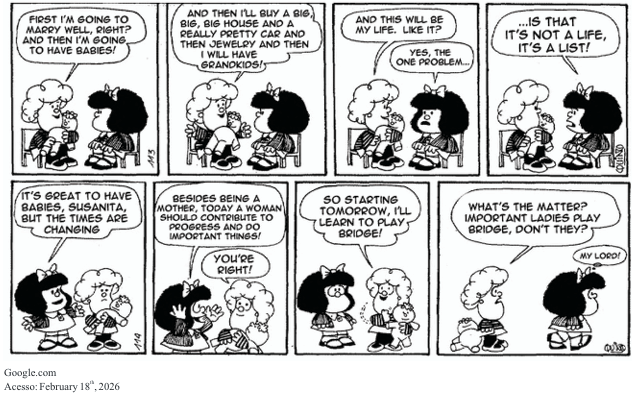
In the comic strip featuring Mafalda and Susanita, the humor and the underlying social commentary arise from the divergent worldviews of the two characters. Based on the dialogue, which of the following statements CORRECTLY interprets the conclusion of their conversation?
Text for question
Hero boy swims for four hours to save his family (9th February 2026)
A 13-year-old Australian boy has been hailed a hero after an epic swim that saved his family. The boy, Austin Appelbee, and his family were on a beach holiday in Western Australia. They were kayaking and paddleboarding in shallow water when strong winds pushed them farther offshore. They ended up over four kilometres away from land, and the daylight was fading. Austin decided to kayak to shore to get help. However, the waves had damaged his kayak, which had taken in water and flipped over. He said he then lost an oar and knew he was in trouble. He decided he had no alternative but to swim back to land. He swam through shark-frequented waters to raise the alarm.
Austin made it to the beach and phoned for help. This sparked a huge rescue operation, which resulted in coastguards finding the teenager's mother and two younger sisters. The boy said: "I hit the bottom of the beach and I just collapsed, and then, after that, I had to “ sprint two kilometres to get to the phone." Rescuers called his efforts "superhuman". One rescuer said Austin's actions could not "be praised highly enough." He added that the teenager's "determination and courage ultimately saved the lives of his mother and siblings." Austin's mother Joanne, 47, told reporters: "The wind picked up. We lost oars, and we drifted out further. It was an absolute nightmare."

Text for question
Hero boy swims for four hours to save his family (9th February 2026)
A 13-year-old Australian boy has been hailed a hero after an epic swim that saved his family. The boy, Austin Appelbee, and his family were on a beach holiday in Western Australia. They were kayaking and paddleboarding in shallow water when strong winds pushed them farther offshore. They ended up over four kilometres away from land, and the daylight was fading. Austin decided to kayak to shore to get help. However, the waves had damaged his kayak, which had taken in water and flipped over. He said he then lost an oar and knew he was in trouble. He decided he had no alternative but to swim back to land. He swam through shark-frequented waters to raise the alarm.
Austin made it to the beach and phoned for help. This sparked a huge rescue operation, which resulted in coastguards finding the teenager's mother and two younger sisters. The boy said: "I hit the bottom of the beach and I just collapsed, and then, after that, I had to “ sprint two kilometres to get to the phone." Rescuers called his efforts "superhuman". One rescuer said Austin's actions could not "be praised highly enough." He added that the teenager's "determination and courage ultimately saved the lives of his mother and siblings." Austin's mother Joanne, 47, told reporters: "The wind picked up. We lost oars, and we drifted out further. It was an absolute nightmare."
“ This sparked a huge rescue operation, which resulted in coastguards finding the teenager s mother and two younger sisters . The boy said: I hit the bottom of the beach and I just collapsed, and then, after that, I had to sprint two kilometres to get to the phone. Rescuers called his efforts ‘superhuman’.”
Select the alternative that presents the CORRECT verbal structure according to formal English grammar, specifically regarding the use of the subjunctive mood in a professional context.
"The candidate possessed all the necessary technical qualifications for the executive position; nevertheless, he was not selected by the board of directors due to a perceived lack of cultural fit."

In the political cartoon provided, the humor and social critique are primarily derived from the rhetorical use of irony. Which of the following statements best explains the underlying message of the dialogue between the two characters?
Text for question
Students using A.I. over humans to learn English (23rd December 2024)
More and more students in Japan are using artificial intelligence (AI) to learn English and other languages. The language learning app Duolingo conducted a survey on how students study languages. More than 4,700 Japanese students answered questions about their language-learning habits. The survey found that the number of people using ChatGPT and other AI tools increased by more than 80 per cent in 2024. AI was particularly popular with younger people. The researchers said more young people used AI than took face-to-face lessons. However, some people in their 20s were not totally happy with AI lessons. They said AI lacked natural responses and was a little boring.
Duolingo said: "We're in the midst of an AI revolution.…Technology has long had an impact on language learning." It found that apps were the most popular method in Japan to learn languages. English was the most studied language, followed by Korean. People are studying Korean "to understand the language as spoken by…favourite artists and celebrities." Duolingo said around 58 per cent of people who took the survey used language-learning apps. This was followed by video streaming platforms like YouTube and Netflix (37%), textbooks (36%) and online lessons (16%). The number of people going to a language school is decreasing. Just 13.8 per cent of people went to classes with a teacher.
https://www.japantimes.co.jp/news/2024/12/19/japan/chatgpt-english-lessons/
https://mainichi.jp/english/articles/20241218/p2a/00m/0li/017000c
https://blog.duolingo.com/2024-duolingo-language-report/
I - Use apenas um pano macio ou esfregão umedecido em solução de água morna e detergente neutro.
II - Use produtos ácidos como vinagre, limão ou removedores.
III - Varra com vassoura macia ou passe um aspirador com ponteira de escova para evitar riscos.
IV - Encharque bem a pedra para facilitar a limpeza.
Estão CORRETAS:

 Conheça nossos planos