Questões de Concurso Para letras

Foram encontradas 302.612 questões

Resolva questões gratuitamente!

Junte-se a mais de 4 milhões de concurseiros!

Q4028354 Inglês
Complete the sentence with the form that correctly expresses a prediction based on present evidence.
Look at the sky. Those dark clouds are gathering quickly. It ______ heavily in a few minutes.
Alternativas
Q4028353 Inglês
In English morphology, derivational suffixes are used to create new words and may change the grammatical class of a base word. For example, the suffix -ness can transform an adjective into a noun.

Select the alternative that presents a correct example of a noun formed through the addition of the suffix -ness.
Alternativas
Q4028352 Inglês
In reading comprehension, certain strategies help readers process texts more efficiently. One widely used strategy involves quickly examining titles, headings, keywords, and the general structure of a text in order to identify its main idea without reading every word.

Which reading strategy is described in this situation? 

Alternativas
Q4028351 Inglês

Imagem associada para resolução da questão

Instagram post. Available at:

https://www.instagram.com/p/DFGuNOIMsUo/t.


In English, the word “change” may have more than one meaning. It can refer to a modification or transformation in a situation. The sign in the image reads: “IF YOU FEAR CHANGE, LEAVE IT HERE.”


In this context, the sentence depends on the fact that the word “change” can also refer to:

Alternativas
Q4028350 Inglês
In English pronunciation, the letter “g” may have two different sounds. For example, it has a hard sound /g/ in go and a soft sound /dʒ/ in giant.
Identify the group in which the letter “g” is pronounced with the soft sound /dʒ/.
Alternativas
Q4028349 Inglês

Brazil floods: 'I saw people trapped in their
homes crying for help'


Heavy rains in the Brazilian state of Minas Gerais have caused severe flooding and landslides, leaving at least 32 people dead. The cities most affected are Juiz de Fora and Ubá.


In Juiz de Fora, twelve homes were swept away by a mudslide. In Ubá, a river burst its banks and flooded several streets. Rescue teams have been searching for at least 38 people who remain missing, while shelters have been set up for thousands of residents who were left homeless.


Meteorologists reported that the amount of rain that fell in the region during the month was already double the average normally expected for February, and additional rainfall was forecast for the following days.


A resident of Ubá, Lucas Gandra, told BBC Brasil that he received the first flood warning early on Tuesday, when a friend called to inform him that the local river was about to overflow. According to him, the situation worsened very quickly.


“At 00:07 the water was overflowing and by 00:20 it was already causing enormous damage. The water rose very quickly,” he said.


The city, located about 300 kilometers north of Rio de Janeiro, had previously experienced flooding in 2019 and 2020, but residents reported that the current disaster was far more destructive.


Lucas Gandra also described dramatic scenes during the flooding, recalling that many residents were trapped in their homes and calling for help.


More than 200 people were rescued by emergency teams, although some of those who died had reportedly attempted to help others during the disaster. Another resident of Ubá, Carolina Magalhães, described the situation as “horrific.” She reported seeing floodwaters carrying debris through the streets, including household items, motorcycles, and gas cylinders.


DINIZ, Iara; BUSCHSCHLÜTER, Vanessa. Brazil floods: “I saw people trapped in their homes crying for help”. BBC News, 25 Feb. 2026. Available at: BBC News article (adapted) Accessed on: 1 Mar. 2026.
In the sentence “a friend called to inform him that the local river was about to overflow,” the expression ‘was about to’ indicates that the river:
Alternativas
Q4028348 Inglês

Brazil floods: 'I saw people trapped in their

homes crying for help'


Heavy rains in the Brazilian state of Minas Gerais have caused severe flooding and landslides, leaving at least 32 people dead. The cities most affected are Juiz de Fora and Ubá.


In Juiz de Fora, twelve homes were swept away by a mudslide. In Ubá, a river burst its banks and flooded several streets. Rescue teams have been searching for at least 38 people who remain missing, while shelters have been set up for thousands of residents who were left homeless.


Meteorologists reported that the amount of rain that fell in the region during the month was already double the average normally expected for February, and additional rainfall was forecast for the following days.


A resident of Ubá, Lucas Gandra, told BBC Brasil that he received the first flood warning early on Tuesday, when a friend called to inform him that the local river was about to overflow. According to him, the situation worsened very quickly.


“At 00:07 the water was overflowing and by 00:20 it was already causing enormous damage. The water rose very quickly,” he said.


The city, located about 300 kilometers north of Rio de Janeiro, had previously experienced flooding in 2019 and 2020, but residents reported that the current disaster was far more destructive.


Lucas Gandra also described dramatic scenes during the flooding, recalling that many residents were trapped in their homes and calling for help.


More than 200 people were rescued by emergency teams, although some of those who died had reportedly attempted to help others during the disaster. Another resident of Ubá, Carolina Magalhães, described the situation as “horrific.” She reported seeing floodwaters carrying debris through the streets, including household items, motorcycles, and gas cylinders.


DINIZ, Iara; BUSCHSCHLÜTER, Vanessa. Brazil floods: “I saw people trapped in their homes crying for help”. BBC News, 25 Feb. 2026. Available at: BBC News article (adapted) Accessed on: 1 Mar. 2026.
In the sentence “The city, located about 300 kilometers north of Rio de Janeiro, had previously experienced flooding in 2019 and 2020, but residents reported that it was far more destructive,” the pronoun “it” refers to:
Alternativas
Q4028347 Inglês

Brazil floods: 'I saw people trapped in their

homes crying for help'


Heavy rains in the Brazilian state of Minas Gerais have caused severe flooding and landslides, leaving at least 32 people dead. The cities most affected are Juiz de Fora and Ubá.


In Juiz de Fora, twelve homes were swept away by a mudslide. In Ubá, a river burst its banks and flooded several streets. Rescue teams have been searching for at least 38 people who remain missing, while shelters have been set up for thousands of residents who were left homeless.


Meteorologists reported that the amount of rain that fell in the region during the month was already double the average normally expected for February, and additional rainfall was forecast for the following days.


A resident of Ubá, Lucas Gandra, told BBC Brasil that he received the first flood warning early on Tuesday, when a friend called to inform him that the local river was about to overflow. According to him, the situation worsened very quickly.


“At 00:07 the water was overflowing and by 00:20 it was already causing enormous damage. The water rose very quickly,” he said.


The city, located about 300 kilometers north of Rio de Janeiro, had previously experienced flooding in 2019 and 2020, but residents reported that the current disaster was far more destructive.


Lucas Gandra also described dramatic scenes during the flooding, recalling that many residents were trapped in their homes and calling for help.


More than 200 people were rescued by emergency teams, although some of those who died had reportedly attempted to help others during the disaster. Another resident of Ubá, Carolina Magalhães, described the situation as “horrific.” She reported seeing floodwaters carrying debris through the streets, including household items, motorcycles, and gas cylinders.


DINIZ, Iara; BUSCHSCHLÜTER, Vanessa. Brazil floods: “I saw people trapped in their homes crying for help”. BBC News, 25 Feb. 2026. Available at: BBC News article (adapted) Accessed on: 1 Mar. 2026.
Read the sentence extracted from the text.
“Lucas Gandra also described dramatic scenes during the flooding, recalling that many residents were trapped in their homes and calling for help.”
Identify the possessive pronoun/adjective used in the sentence. 
Alternativas
Q4028346 Inglês

Brazil floods: 'I saw people trapped in their

homes crying for help'


Heavy rains in the Brazilian state of Minas Gerais have caused severe flooding and landslides, leaving at least 32 people dead. The cities most affected are Juiz de Fora and Ubá.


In Juiz de Fora, twelve homes were swept away by a mudslide. In Ubá, a river burst its banks and flooded several streets. Rescue teams have been searching for at least 38 people who remain missing, while shelters have been set up for thousands of residents who were left homeless.


Meteorologists reported that the amount of rain that fell in the region during the month was already double the average normally expected for February, and additional rainfall was forecast for the following days.


A resident of Ubá, Lucas Gandra, told BBC Brasil that he received the first flood warning early on Tuesday, when a friend called to inform him that the local river was about to overflow. According to him, the situation worsened very quickly.


“At 00:07 the water was overflowing and by 00:20 it was already causing enormous damage. The water rose very quickly,” he said.


The city, located about 300 kilometers north of Rio de Janeiro, had previously experienced flooding in 2019 and 2020, but residents reported that the current disaster was far more destructive.


Lucas Gandra also described dramatic scenes during the flooding, recalling that many residents were trapped in their homes and calling for help.


More than 200 people were rescued by emergency teams, although some of those who died had reportedly attempted to help others during the disaster. Another resident of Ubá, Carolina Magalhães, described the situation as “horrific.” She reported seeing floodwaters carrying debris through the streets, including household items, motorcycles, and gas cylinders.


DINIZ, Iara; BUSCHSCHLÜTER, Vanessa. Brazil floods: “I saw people trapped in their homes crying for help”. BBC News, 25 Feb. 2026. Available at: BBC News article (adapted) Accessed on: 1 Mar. 2026.
In the excerpt “some of those who died had reportedly attempted to help others,” the verb phrase had attempted expresses: 
Alternativas
Q4028345 Inglês

Brazil floods: 'I saw people trapped in their

homes crying for help'


Heavy rains in the Brazilian state of Minas Gerais have caused severe flooding and landslides, leaving at least 32 people dead. The cities most affected are Juiz de Fora and Ubá.


In Juiz de Fora, twelve homes were swept away by a mudslide. In Ubá, a river burst its banks and flooded several streets. Rescue teams have been searching for at least 38 people who remain missing, while shelters have been set up for thousands of residents who were left homeless.


Meteorologists reported that the amount of rain that fell in the region during the month was already double the average normally expected for February, and additional rainfall was forecast for the following days.


A resident of Ubá, Lucas Gandra, told BBC Brasil that he received the first flood warning early on Tuesday, when a friend called to inform him that the local river was about to overflow. According to him, the situation worsened very quickly.


“At 00:07 the water was overflowing and by 00:20 it was already causing enormous damage. The water rose very quickly,” he said.


The city, located about 300 kilometers north of Rio de Janeiro, had previously experienced flooding in 2019 and 2020, but residents reported that the current disaster was far more destructive.


Lucas Gandra also described dramatic scenes during the flooding, recalling that many residents were trapped in their homes and calling for help.


More than 200 people were rescued by emergency teams, although some of those who died had reportedly attempted to help others during the disaster. Another resident of Ubá, Carolina Magalhães, described the situation as “horrific.” She reported seeing floodwaters carrying debris through the streets, including household items, motorcycles, and gas cylinders.


DINIZ, Iara; BUSCHSCHLÜTER, Vanessa. Brazil floods: “I saw people trapped in their homes crying for help”. BBC News, 25 Feb. 2026. Available at: BBC News article (adapted) Accessed on: 1 Mar. 2026.
According to the text, what natural events caused the disaster in Minas Gerais?
Alternativas
Q4028092 Português
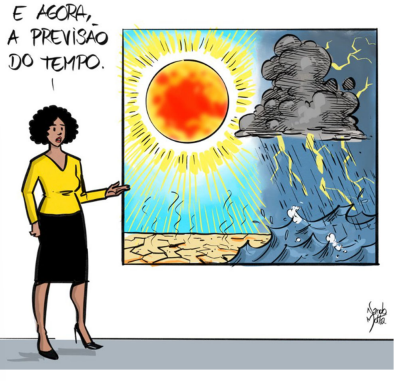
Responda à questão com base no seguinte texto:


Captura_de tela 2026-04-29 134610.png (408×381)

Autor: Nando Motta. 
No enunciado verbal da charge — E agora, a previsão do tempo —, observa-se a presença de diferentes classes gramaticais organizadas em estrutura nominal típica da linguagem jornalística. Considerando o contexto sintático e morfológico da frase, a palavra previsão classifica-se como: 
Alternativas
Q4028091 Português
Responda à questão com base no seguinte texto:


Captura_de tela 2026-04-29 134610.png (408×381)

Autor: Nando Motta. 
A partir da interpretação da charge, analise as assertivas que seguem:

I. O texto tem caráter exclusivamente informativo, sem qualquer traço de crítica ou reflexão.
II. A intenção da charge é instruir o público sobre medidas de prevenção a desastres naturais.

Pode-se afirmar que: 

Alternativas
Q4028059 Português
Texto 02

Disponível em: https://bichinhosdejardim.com/ Acesso em: 14 mar. 2026. 
Nas falas do primeiro e do último quadro, as vírgulas foram usadas, de acordo com a norma, para separar, respectivamente, um(a) 
Alternativas
Q4028058 Português
Texto 02

Disponível em: https://bichinhosdejardim.com/ Acesso em: 14 mar. 2026. 
A fala do segundo quadro revela que a personagem 
Alternativas
Q4028055 Português
Texto 01
Tristeza


Você, que diz que, se pudesse, trocaria seu nome por “Melancolia”, você me pergunta sobre as razões da tristeza. Me pergunta mais: sobre as razões por que há pessoas que se emocionam com coisas pequenas – as outras nem ligam e até se riem da sua sensibilidade –, o que lhe dá uma tristeza ainda maior, a tristeza da solidão.

Olhe, há tristezas de dois tipos. Primeiro, são as tristezas diurnas, quando o mundo está iluminado pelo sol. Tristezas para as quais há razões. Fico triste porque o meu cãozinho morreu, porque o meu filho está doente, porque as crianças esfarrapadas e magras me pedem uma moedinha no semáforo, porque o amor se desfez. Para essas tristezas há razões. Quem não sente essas tristezas está doente e precisaria de terapia para aprender a ficar triste. Tristeza é parte da vida. Ela é a reação natural da alma diante da perda de algo que se ama. O mundo está luminoso e claro – mas há algo, uma perda, que faz tudo ficar triste.

Segundo, são as tristezas de crepúsculo. O crepúsculo é triste, naturalmente. Não, não há perda nenhuma. Tudo está certo. Não há razões para ficar triste. A despeito disso, no crepúsculo, a gente fica. Talvez porque o crepúsculo seja uma metáfora do que é a vida: a beleza efêmera das cores que vão mergulhando no escuro da noite.

A alma é um cenário. Por vezes, ela é como uma manhã brilhante e fresca, inundada de alegria. Por vezes ela é como um pôr de sol, triste e nostálgico. A vida é assim. Mas, se é manhã brilhante o tempo todo, alguma coisa está errada. Tristeza é preciso. A tristeza torna as pessoas mais ternas. Se é crepúsculo o tempo todo, alguma coisa não está bem. Alegria é preciso. Alegria é a chama que dá vontade de viver. [...]

Fonte: ALVES, Rubem. Se eu pudesse viver minha vida novamente... Campinas, SP: Verus Editora, 2004. p. 93. 
No trecho “Não há razões para ficar triste. A despeito disso, no crepúsculo, a gente fica.”, a locução prepositiva “a despeito disso” insere uma ideia de 
Alternativas
Q4028029 Literatura
O Barroco foi um período artístico-literário em que o homem viveu em meio a crises religiosas e financeiras, em estado de tensão e desequilíbrio, o que refletiu no culto exagerado à forma. Na Literatura, tal exagero foi expresso principalmente por meio de figuras, como a metáfora, a antítese, a hipérbole e a alegoria. Com base nesta informação, assinale a alternativa em que o excerto constitui um ícone de tal período literário: 
Alternativas
Q4028028 Literatura

Assinale a alternativa cujo conteúdo da frase corresponde à concepção da literatura como prática social.


Alternativas
Q4028027 Português
Chegamos do trabalho, exaustos, mesmo assim, tomamos banho e nos vestimos e saímos para dançar. Considerando o trecho em destaque, indique a alternativa que melhor compreende a figura de linguagem utilizada: 
Alternativas
Q4028025 Português
Em relação às mudanças implementadas pelo Novo Acordo Ortográfico da Língua Portuguesa, analise os itens abaixo e assinale a alternativa correta.

I. O alfabeto da Língua Portuguesa passa a ter 27 letras, com a incorporação das letras K, W e Y, que se empregam na grafia de nomes próprios, palavras deles derivadas e em abreviações.

II. Cai o acento circunflexo do hiato EE dos verbos LER, DAR, CRER, VER e derivados.

III. Cai o acento diferencial, apesar de permanecer nas palavras PÔDE e PÔR, e facultativamente , poder-se acentuar o substantivo FÔRMA.

Estão corretos: 
Alternativas
Q4027904 Português

Texto para responder às questão.


    Memória é onde se guardam as coisas do passado.

    Há dois tipos de memórias: memórias sem vida própria e memórias com vida própria.

    As memórias sem vida própria são inertes. Não têm vontade. Sua existência é semelhante à das ferramentas guardadas numa caixa. Não se mexem. Ficam imóveis nos seus lugares, à espera. À espera de quê? À espera de que as chamemos. Ao chegar a um hotel, a recepcionista me entrega uma ficha para ser preenchida. Lá estão os espaços em branco onde deverei escrever meu nome, endereço, número da carteira de identidade, do CPF, número do telefone, e-mail. Abro a minha caixa de memórias sem vida própria e encontro as informações pedidas.

    As memórias com vida própria, ao contrário, não ficam quietas dentro de uma caixa. São como pássaros em voo. Vão para onde querem. Viajando, olhando a paisagem com pensamento perdido, vemos um rio. E nos lembramos então do riachinho em que brincávamos quando crianças.


Alves, Rubem. O velho que acordou o menino. São Paulo: Editora Planeta, 2005, com adaptações.
Os sentidos e a concordância verbal do texto seriam mantidos caso o trecho “Há dois tipos de memórias” fosse reescrito da seguinte forma.
Alternativas
Respostas
16981: D
16982: B
16983: C
16984: B
16985: A
16986: C
16987: C
16988: B
16989: A
16990: E
16991: D
16992: B
16993: E
16994: A
16995: D
16996: B
16997: A
16998: A
16999: D
17000: A