Questões de Concurso
Para técnico em tecnologia da informação
Foram encontradas 4.117 questões
Resolva questões gratuitamente!
Junte-se a mais de 4 milhões de concurseiros!


Ano: 2026
Banca:
COPERVE - UFSC
Órgão:
UFSC
Provas:
COPERVE - UFSC - 2026 - UFSC - Assistente em Administração
|
COPERVE - UFSC - 2026 - UFSC - Técnico de Laboratório/Física |
COPERVE - UFSC - 2026 - UFSC - Técnico de Tecnologia da Informação |
COPERVE - UFSC - 2026 - UFSC - Técnico em Enfermagem |
Q4037961
Português
Texto associado
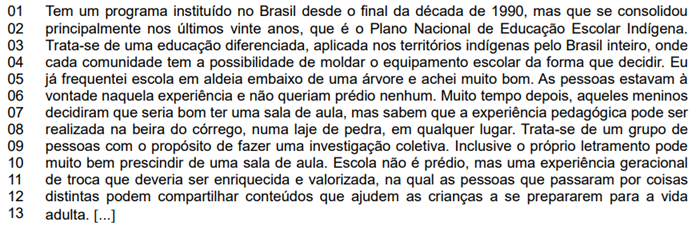
Leia o texto 8 para responder à questão.
Texto 8
O coração no ritmo da terra
KRENAK, Ailton. Futuro Ancestral. 1.ed. São Paulo: Companhia das Letras, 2022. p. 113-114.
Com base no texto 8 e na variedade padrão da língua escrita, assinale a alternativa correta.
Ano: 2026
Banca:
COPERVE - UFSC
Órgão:
UFSC
Provas:
COPERVE - UFSC - 2026 - UFSC - Assistente em Administração
|
COPERVE - UFSC - 2026 - UFSC - Técnico de Laboratório/Física |
COPERVE - UFSC - 2026 - UFSC - Técnico de Tecnologia da Informação |
COPERVE - UFSC - 2026 - UFSC - Técnico em Enfermagem |
Q4037960
Português
Texto associado
Leia o texto 8 para responder à questão.
Texto 8
O coração no ritmo da terra
KRENAK, Ailton. Futuro Ancestral. 1.ed. São Paulo: Companhia das Letras, 2022. p. 113-114.
Com base no texto 8, é correto afirmar que:
Ano: 2026
Banca:
COPERVE - UFSC
Órgão:
UFSC
Provas:
COPERVE - UFSC - 2026 - UFSC - Assistente em Administração
|
COPERVE - UFSC - 2026 - UFSC - Técnico de Laboratório/Física |
COPERVE - UFSC - 2026 - UFSC - Técnico de Tecnologia da Informação |
COPERVE - UFSC - 2026 - UFSC - Técnico em Enfermagem |
Q4037959
Português
Leia o texto 7 para responder à questão.
Texto 7
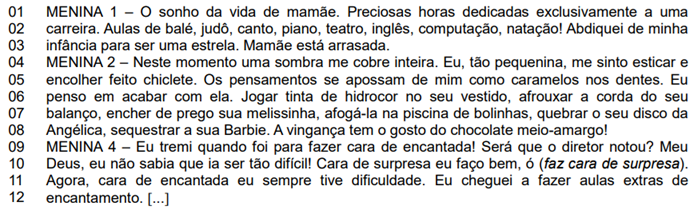
As quatro estações
Cunha, Antônio. Três dramas possíveis. Joinville: Editora Letradágua, 2004. p. 45-46.
Assinale a alternativa correta em relação ao texto 7.
Texto 7
As quatro estações
Cunha, Antônio. Três dramas possíveis. Joinville: Editora Letradágua, 2004. p. 45-46.
Assinale a alternativa correta em relação ao texto 7.
Ano: 2026
Banca:
COPERVE - UFSC
Órgão:
UFSC
Provas:
COPERVE - UFSC - 2026 - UFSC - Assistente em Administração
|
COPERVE - UFSC - 2026 - UFSC - Técnico de Laboratório/Física |
COPERVE - UFSC - 2026 - UFSC - Técnico de Tecnologia da Informação |
COPERVE - UFSC - 2026 - UFSC - Técnico em Enfermagem |
Q4037958
Português
Texto associado
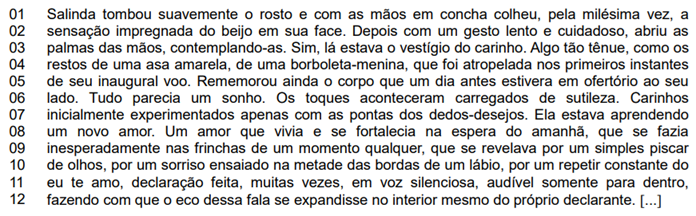
Leia o texto 6 para responder à questão.
Texto 6
Beijo na face
Evaristo, Conceição. Olhos D´Água. Rio de Janeiro: Pallas, 2016. p.51
Com base no texto 6 e na variedade padrão da língua escrita, assinale a alternativa correta.
Ano: 2026
Banca:
COPERVE - UFSC
Órgão:
UFSC
Provas:
COPERVE - UFSC - 2026 - UFSC - Assistente em Administração
|
COPERVE - UFSC - 2026 - UFSC - Técnico de Laboratório/Física |
COPERVE - UFSC - 2026 - UFSC - Técnico de Tecnologia da Informação |
COPERVE - UFSC - 2026 - UFSC - Técnico em Enfermagem |
Q4037957
Português
Texto associado
Leia o texto 6 para responder à questão.
Texto 6
Beijo na face
Evaristo, Conceição. Olhos D´Água. Rio de Janeiro: Pallas, 2016. p.51
Com base no texto 6, é correto afirmar que:
Ano: 2026
Banca:
COPERVE - UFSC
Órgão:
UFSC
Provas:
COPERVE - UFSC - 2026 - UFSC - Assistente em Administração
|
COPERVE - UFSC - 2026 - UFSC - Técnico de Laboratório/Física |
COPERVE - UFSC - 2026 - UFSC - Técnico de Tecnologia da Informação |
COPERVE - UFSC - 2026 - UFSC - Técnico em Enfermagem |
Q4037956
Português
Texto associado
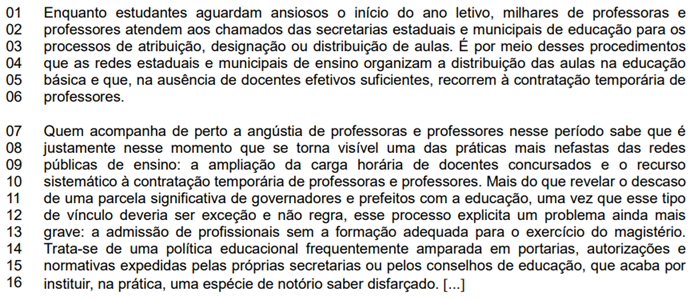
Leia o texto 5 para responder à questão.
Texto 5
‘Notório saber’ e a sala de aula como laboratório do improviso
Por: Thiago Esteves – Carta Capital 02/02/2026
Disponível em: https://www.cartacapital.com.br/opiniao/notorio-saber-e-a-sala-de-aula-como-laboratorio-do-improviso.
Com base no texto 5 e na variedade padrão da língua escrita, assinale a alternativa correta.
Ano: 2026
Banca:
COPERVE - UFSC
Órgão:
UFSC
Provas:
COPERVE - UFSC - 2026 - UFSC - Assistente em Administração
|
COPERVE - UFSC - 2026 - UFSC - Técnico de Laboratório/Física |
COPERVE - UFSC - 2026 - UFSC - Técnico de Tecnologia da Informação |
COPERVE - UFSC - 2026 - UFSC - Técnico em Enfermagem |
Q4037955
Português
Texto associado
Leia o texto 5 para responder à questão.
Texto 5
‘Notório saber’ e a sala de aula como laboratório do improviso
Por: Thiago Esteves – Carta Capital 02/02/2026
Disponível em: https://www.cartacapital.com.br/opiniao/notorio-saber-e-a-sala-de-aula-como-laboratorio-do-improviso.
Com base no texto 5, indique se as afirmativas abaixo são verdadeiras (V) ou falsas (F) e assinale
a alternativa com a sequência correta de cima para baixo.
( ) A ideia principal do texto é a de que há urgência na realização de concursos para contratação de professores efetivos nas redes públicas de ensino.
( ) Na linha 03, o elemento anafórico “desses procedimentos” retoma os seguintes termos mencionados na linha 03: “processos de atribuição, designação ou distribuição de aulas”.
( ) As redes de ensino recorrem à contratação temporária de professores, pois não há docentes efetivos suficientes.
( ) A contratação temporária de professores revela a preocupação de muitos governadores e prefeitos com a educação no país.
( ) A contratação temporária de professores deve se tornar regra nas redes de ensino municipais e estaduais no país.
( ) Na linha 16, o texto refere-se à instituição de “uma espécie de notório saber disfarçado” que se relaciona à falta de formação adequada de professoras e professores contratados temporariamente.
( ) A ideia principal do texto é a de que há urgência na realização de concursos para contratação de professores efetivos nas redes públicas de ensino.
( ) Na linha 03, o elemento anafórico “desses procedimentos” retoma os seguintes termos mencionados na linha 03: “processos de atribuição, designação ou distribuição de aulas”.
( ) As redes de ensino recorrem à contratação temporária de professores, pois não há docentes efetivos suficientes.
( ) A contratação temporária de professores revela a preocupação de muitos governadores e prefeitos com a educação no país.
( ) A contratação temporária de professores deve se tornar regra nas redes de ensino municipais e estaduais no país.
( ) Na linha 16, o texto refere-se à instituição de “uma espécie de notório saber disfarçado” que se relaciona à falta de formação adequada de professoras e professores contratados temporariamente.
Ano: 2026
Banca:
COPERVE - UFSC
Órgão:
UFSC
Provas:
COPERVE - UFSC - 2026 - UFSC - Assistente em Administração
|
COPERVE - UFSC - 2026 - UFSC - Técnico de Laboratório/Física |
COPERVE - UFSC - 2026 - UFSC - Técnico de Tecnologia da Informação |
COPERVE - UFSC - 2026 - UFSC - Técnico em Enfermagem |
Q4037954
Português
Numere a ordem dos períodos, de modo que assegure coesão e coerência ao parágrafo. Em
seguida, assinale a alternativa com a sequência numérica correta de cima para baixo.
( ) No entanto, não digo que a descobri e que, por isso, quero possuí-la. Assim como não digo que descobri o céu, ou os animais de caça! Sempre estiveram aí, desde antes de eu nascer.
( ) Mas esse é um pensamento cheio de esquecimento! Omama nos criou, com o céu e a floresta, lá onde nossos ancestrais têm vivido desde sempre.
( ) Contam os brancos que um português disse ter descoberto o Brasil há muito tempo. Pensam mesmo, até hoje, que foi ele o primeiro a ver nossa terra.
( ) Contento-me em olhar para o céu e caçar os animais da floresta. E só. E é esse o único pensamento direito.
( ) Nossas palavras estão presentes nesta terra desde o primeiro tempo, do mesmo modo que as montanhas onde moram os xapiri. Nasci na floresta e sempre vivi nela.
Davi Kopenawa. A queda do céu: palavras de um xamã yanomami [2010]. São Paulo: Companhia das Letras, 2015.
( ) No entanto, não digo que a descobri e que, por isso, quero possuí-la. Assim como não digo que descobri o céu, ou os animais de caça! Sempre estiveram aí, desde antes de eu nascer.
( ) Mas esse é um pensamento cheio de esquecimento! Omama nos criou, com o céu e a floresta, lá onde nossos ancestrais têm vivido desde sempre.
( ) Contam os brancos que um português disse ter descoberto o Brasil há muito tempo. Pensam mesmo, até hoje, que foi ele o primeiro a ver nossa terra.
( ) Contento-me em olhar para o céu e caçar os animais da floresta. E só. E é esse o único pensamento direito.
( ) Nossas palavras estão presentes nesta terra desde o primeiro tempo, do mesmo modo que as montanhas onde moram os xapiri. Nasci na floresta e sempre vivi nela.
Davi Kopenawa. A queda do céu: palavras de um xamã yanomami [2010]. São Paulo: Companhia das Letras, 2015.
Ano: 2026
Banca:
COPERVE - UFSC
Órgão:
UFSC
Provas:
COPERVE - UFSC - 2026 - UFSC - Assistente em Administração
|
COPERVE - UFSC - 2026 - UFSC - Técnico de Laboratório/Física |
COPERVE - UFSC - 2026 - UFSC - Técnico de Tecnologia da Informação |
COPERVE - UFSC - 2026 - UFSC - Técnico em Enfermagem |
Q4037953
Português
Texto associado
Leia o texto 4 para responder à questão
Texto 4
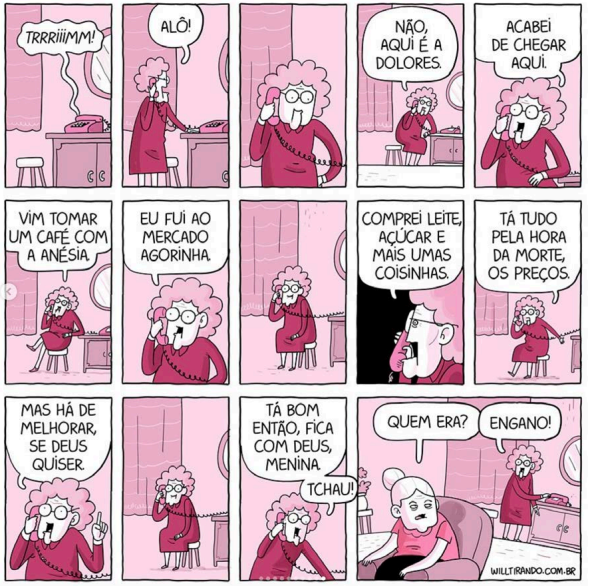
Legenda: Uma vez a Dolores atendeu uma vendedora de plano de telefonia. A moça ficou 40 minutos presa na ligação com a Dolores. Nunca mais ela ligou. Dona Anésia, Instagram, @dona.anesia, 05 set. 2025. Disponível em: https://www.instagram.com/p/DOPe1hAjHwB/?img_index=10.
Com base no texto 4, indique se as afirmativas abaixo são verdadeiras (V) ou falsas (F) e assinale
a alternativa com a sequência correta de cima para baixo.
( ) O humor da tirinha pode ser explicado pela quebra de expectativa do leitor, já que a personagem Dolores trata a pessoa ao telefone com intimidade, mesmo sem conhecê-la.
( ) No quarto quadrinho, a partir do enunciado “Não, aqui é a Dolores”, o leitor já pode ter certeza de que a ligação recebida é de uma pessoa desconhecida e se trata de um engano.
( ) No quinto quadrinho, a palavra “aqui” refere-se à casa de Dona Anésia e pode ser classificada como uma conjunção locativa.
( ) No penúltimo quadrinho, a vírgula antes de “menina” é empregada em razão de um vocativo.
( ) No sexto quadrinho, a expressão “tomar um café” pode ser entendida como um encontro entre amigas, o que confere sentido conotativo ao enunciado.
( ) O humor da tirinha pode ser explicado pela quebra de expectativa do leitor, já que a personagem Dolores trata a pessoa ao telefone com intimidade, mesmo sem conhecê-la.
( ) No quarto quadrinho, a partir do enunciado “Não, aqui é a Dolores”, o leitor já pode ter certeza de que a ligação recebida é de uma pessoa desconhecida e se trata de um engano.
( ) No quinto quadrinho, a palavra “aqui” refere-se à casa de Dona Anésia e pode ser classificada como uma conjunção locativa.
( ) No penúltimo quadrinho, a vírgula antes de “menina” é empregada em razão de um vocativo.
( ) No sexto quadrinho, a expressão “tomar um café” pode ser entendida como um encontro entre amigas, o que confere sentido conotativo ao enunciado.
Ano: 2026
Banca:
COPERVE - UFSC
Órgão:
UFSC
Provas:
COPERVE - UFSC - 2026 - UFSC - Assistente em Administração
|
COPERVE - UFSC - 2026 - UFSC - Técnico de Laboratório/Física |
COPERVE - UFSC - 2026 - UFSC - Técnico de Tecnologia da Informação |
COPERVE - UFSC - 2026 - UFSC - Técnico em Enfermagem |
Q4037952
Português
Texto associado
Leia o texto 4 para responder à questão
Texto 4
Legenda: Uma vez a Dolores atendeu uma vendedora de plano de telefonia. A moça ficou 40 minutos presa na ligação com a Dolores. Nunca mais ela ligou. Dona Anésia, Instagram, @dona.anesia, 05 set. 2025. Disponível em: https://www.instagram.com/p/DOPe1hAjHwB/?img_index=10.
Com base no texto 4 e na variedade padrão da língua escrita, assinale a alternativa correta.
Ano: 2026
Banca:
COPERVE - UFSC
Órgão:
UFSC
Provas:
COPERVE - UFSC - 2026 - UFSC - Assistente em Administração
|
COPERVE - UFSC - 2026 - UFSC - Técnico de Laboratório/Física |
COPERVE - UFSC - 2026 - UFSC - Técnico de Tecnologia da Informação |
COPERVE - UFSC - 2026 - UFSC - Técnico em Enfermagem |
Q4037951
Português
Leia o texto 3 para responder à questão.
Texto 3
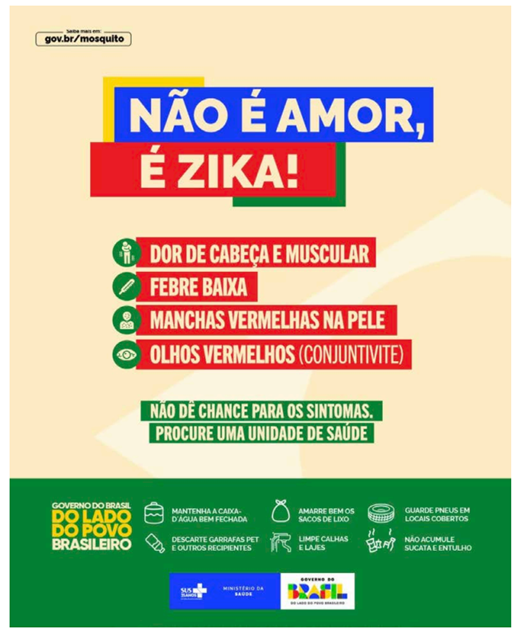
BRASIL. Ministério da Saúde, Instagram, @minsaude, 12 dez. 2025. Disponível em: https://www.instagram.com/minsaude.
Com base no texto 3, considere as seguintes afirmativas e assinale a alternativa correta.
I. O texto tem como objetivo principal alertar a população sobre a necessidade de procurar ajuda médica diante dos sintomas do vírus da zika.
II. Trata-se de um texto do tipo instrucional que apresenta características como o uso de verbos no imperativo e linguagem objetiva.
III. Trata-se de um texto argumentativo, pois tenta convencer o leitor a procurar ajuda médica a partir de exemplos reais.
IV. O texto tem como um de seus objetivos orientar a população a prevenir a doença, já que contém dicas de como evitar a proliferação do mosquito transmissor da doença.
Texto 3
BRASIL. Ministério da Saúde, Instagram, @minsaude, 12 dez. 2025. Disponível em: https://www.instagram.com/minsaude.
Com base no texto 3, considere as seguintes afirmativas e assinale a alternativa correta.
I. O texto tem como objetivo principal alertar a população sobre a necessidade de procurar ajuda médica diante dos sintomas do vírus da zika.
II. Trata-se de um texto do tipo instrucional que apresenta características como o uso de verbos no imperativo e linguagem objetiva.
III. Trata-se de um texto argumentativo, pois tenta convencer o leitor a procurar ajuda médica a partir de exemplos reais.
IV. O texto tem como um de seus objetivos orientar a população a prevenir a doença, já que contém dicas de como evitar a proliferação do mosquito transmissor da doença.
Ano: 2026
Banca:
COPERVE - UFSC
Órgão:
UFSC
Provas:
COPERVE - UFSC - 2026 - UFSC - Assistente em Administração
|
COPERVE - UFSC - 2026 - UFSC - Técnico de Laboratório/Física |
COPERVE - UFSC - 2026 - UFSC - Técnico de Tecnologia da Informação |
COPERVE - UFSC - 2026 - UFSC - Técnico em Enfermagem |
Q4037950
Português
Texto associado
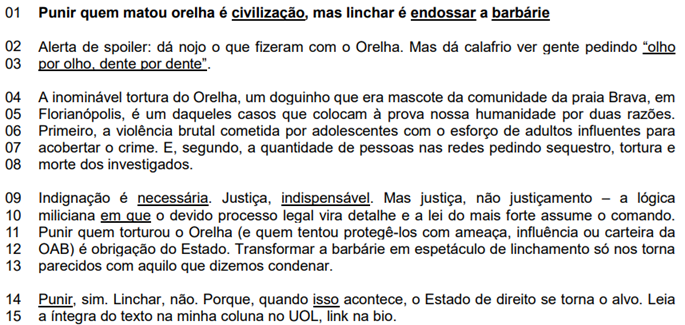
Leia o texto 2 para responder à questão.
Texto 2
SAKAMOTO, Leonardo. Punir quem matou orelha é civilização, mas linchar é endossar a barbárie. Instagram, @leosakamoto, 27 jan. 2026. Disponível em:
https://www.instagram.com/p/DUB0NHuFHQZ/?igsh=d29ibmU2cGk0YWdy.
Com base no texto 2 e na variedade padrão da língua escrita, assinale a alternativa correta.
Ano: 2026
Banca:
COPERVE - UFSC
Órgão:
UFSC
Provas:
COPERVE - UFSC - 2026 - UFSC - Assistente em Administração
|
COPERVE - UFSC - 2026 - UFSC - Técnico de Laboratório/Física |
COPERVE - UFSC - 2026 - UFSC - Técnico de Tecnologia da Informação |
COPERVE - UFSC - 2026 - UFSC - Técnico em Enfermagem |
Q4037949
Português
Texto associado
Leia o texto 2 para responder à questão.
Texto 2
SAKAMOTO, Leonardo. Punir quem matou orelha é civilização, mas linchar é endossar a barbárie. Instagram, @leosakamoto, 27 jan. 2026. Disponível em:
https://www.instagram.com/p/DUB0NHuFHQZ/?igsh=d29ibmU2cGk0YWdy.
Assinale a alternativa correta em relação ao texto 2.
Ano: 2026
Banca:
COPERVE - UFSC
Órgão:
UFSC
Provas:
COPERVE - UFSC - 2026 - UFSC - Assistente em Administração
|
COPERVE - UFSC - 2026 - UFSC - Técnico de Laboratório/Física |
COPERVE - UFSC - 2026 - UFSC - Técnico de Tecnologia da Informação |
COPERVE - UFSC - 2026 - UFSC - Técnico em Enfermagem |
Q4037948
Português
Texto associado
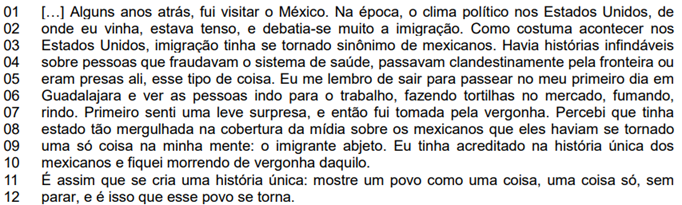
Leia o texto 1 para responder à questão.
Texto 1
ADICHIE, Chimamanda Ngozi. O perigo de uma história única. Tradução de Júlia Romeu. São Paulo: Companhia das Letras, 2019. p. 21-22.
Com base no texto 1 e na variedade padrão da língua escrita, assinale a alternativa correta.
Ano: 2026
Banca:
COPERVE - UFSC
Órgão:
UFSC
Provas:
COPERVE - UFSC - 2026 - UFSC - Assistente em Administração
|
COPERVE - UFSC - 2026 - UFSC - Técnico de Laboratório/Física |
COPERVE - UFSC - 2026 - UFSC - Técnico de Tecnologia da Informação |
COPERVE - UFSC - 2026 - UFSC - Técnico em Enfermagem |
Q4037947
Português
Texto associado
Leia o texto 1 para responder à questão.
Texto 1
ADICHIE, Chimamanda Ngozi. O perigo de uma história única. Tradução de Júlia Romeu. São Paulo: Companhia das Letras, 2019. p. 21-22.
Assinale a alternativa correta em relação ao texto 1.
Ano: 2026
Banca:
CONSULPAM
Órgão:
Prefeitura de Eusébio - CE
Prova:
CONSULPAM - 2026 - Prefeitura de Eusébio - CE - Técnico em Tecnologia da Informação |
Q3917582
Gerência de Projetos
Uma fundação pública está conduzindo um projeto de
modernização de sistemas com cronograma crítico e
múltiplas integrações. Na fase de planejamento, foi
exigido ao Técnico de TI o desenvolvimento de um
processo formal para identificar ameaças à execução
do projeto, qualificar o impacto e a probabilidade
dessas ameaças, bem como definir respostas. O
projeto segue práticas do PMBOK. Nesse contexto a
área de conhecimento do PMBOK, envolvida nesta
atividade, é denominada como:
Ano: 2026
Banca:
CONSULPAM
Órgão:
Prefeitura de Eusébio - CE
Prova:
CONSULPAM - 2026 - Prefeitura de Eusébio - CE - Técnico em Tecnologia da Informação |
Q3917581
Modelagem de Processos de Negócio (BPM)
Uma universidade pretende reduzir o tempo de
tramitação de solicitações internas, tais como diárias
e passagens, que atualmente dependem de aprovações
sequenciais, documentos anexos e registros em
diferentes sistemas. Foi solicitado ao Técnico de TI o
mapeamento do fluxo, a padronização das etapas, a
proposta de indicadores e a automação de tarefas
repetitivas com encaminhamentos e validações,
garantindo rastreabilidade do processo. De acordo
com o enunciado, assinale a alternativa que indica o
nome da disciplina e abordagem associadas ao
objetivo descrito nesse cenário.
Ano: 2026
Banca:
CONSULPAM
Órgão:
Prefeitura de Eusébio - CE
Prova:
CONSULPAM - 2026 - Prefeitura de Eusébio - CE - Técnico em Tecnologia da Informação |
Q3917580
Banco de Dados
Uma secretaria municipal implantou um Data
Warehouse para consolidar dados de atendimento de
vários sistemas legados. Em reuniões com a área de
negócio, foi solicitado ao Técnico de TI que os
relatórios permitam analisar “quantidade de
atendimentos” e “tempo médio de atendimento” por
tempo, unidade e tipo de serviço, com boa
performance para agregações e filtros. Para isso, o
Técnico de TI e sua equipe de dados adotaram a
modelagem dimensional. Diante do exposto, assinale
a alternativa que apresenta CORRETAMENTE o
papel da tabela fato nesse cenário.
Ano: 2026
Banca:
CONSULPAM
Órgão:
Prefeitura de Eusébio - CE
Prova:
CONSULPAM - 2026 - Prefeitura de Eusébio - CE - Técnico em Tecnologia da Informação |
Q3917579
Banco de Dados
Uma entidade pública deseja um novo sistema de
relatórios gerenciais consolidados com histórico,
apresentando questões como tendência por mês,
comparativo por unidade e tipo de serviço. Esta nova
solução não pode impactar o desempenho dos
sistemas transacionais atuais. Nesse caso, é uma
solução CORRETA ao objetivo do cenário
apresentado:
Ano: 2026
Banca:
CONSULPAM
Órgão:
Prefeitura de Eusébio - CE
Prova:
CONSULPAM - 2026 - Prefeitura de Eusébio - CE - Técnico em Tecnologia da Informação |
Q3917578
Sistemas Operacionais
No Microsoft IIS, um Técnico de TI precisa isolar
aplicações para reduzir impacto de falhas para que
uma aplicação travando não derrube as demais em
execução, bem como controlar a reciclagem. Com
relação ao enunciado, assinale a alternativa que indica
CORRETAMENTE o nome do recurso do IIS que
permite atender o cenário apresentado.

 Conheça nossos planos