Questões de Concurso
Para especialista
Foram encontradas 1.276 questões
Resolva questões gratuitamente!
Junte-se a mais de 4 milhões de concurseiros!


Ano: 2024
Banca:
FUVEST
Órgão:
USP
Prova:
FUVEST - 2024 - USP - Especialista em Pesquisa/Apoio de Museu (Especialidade: Conservação e Restauro) – Edital nº 13 |
Q3545388
Física
A imagem a seguir representa o espectro magnético com a indicação do espectro de luz visível.
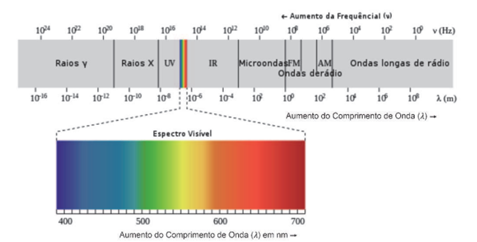
A luz é um dos fatores que pode causar alterações extremamente danosas aos materiais, principalmente aos de natureza orgânica. Entretanto, ela é indispensável para que possamos ver, consultar e usufruir dos objetos. Com base nessas informações, assinale a alternativa correta.
A luz é um dos fatores que pode causar alterações extremamente danosas aos materiais, principalmente aos de natureza orgânica. Entretanto, ela é indispensável para que possamos ver, consultar e usufruir dos objetos. Com base nessas informações, assinale a alternativa correta.
Ano: 2024
Banca:
FUVEST
Órgão:
USP
Prova:
FUVEST - 2024 - USP - Especialista em Pesquisa/Apoio de Museu (Especialidade: Conservação e Restauro) – Edital nº 13 |
Q3545387
Museologia
Um dos tratamentos profiláticos mais frequentes e
necessários para os acervos é a higienização. Longe de ser
uma tarefa simples que requer somente habilidades manuais
como muitas vezes é entendida, a higienização é um processo
que requer vasto conhecimento do conservador restaurador
para a análise do estado de conservação do objeto bem como
para a escolha de materiais e métodos compatíveis. Assinale
a alternativa que apresenta um procedimento adequado
para higienização.
Ano: 2024
Banca:
FUVEST
Órgão:
USP
Prova:
FUVEST - 2024 - USP - Especialista em Pesquisa/Apoio de Museu (Especialidade: Conservação e Restauro) – Edital nº 13 |
Q3545386
Museologia
Os agentes físicos são responsáveis por danos verificados com
muita frequência em acervos de suporte papel. Excetuando-se o roubo e o vandalismo, que são atos intencionais, o
manuseio e acondicionamento incorretos podem resultar em
danos para um documento ou artefato em suporte de papel.
Assinale a alternativa que apresenta corretamente a situação
na qual o tipo de acondicionamento poderá gerar danos para
o acervo.
Ano: 2024
Banca:
FUVEST
Órgão:
USP
Prova:
FUVEST - 2024 - USP - Especialista em Pesquisa/Apoio de Museu (Especialidade: Conservação e Restauro) – Edital nº 13 |
Q3545385
Museologia
As condições climáticas tropicais favorecem sensivelmente a
proliferação de insetos xilófagos e bibliófagos, bem como o
crescimento de fungos e bolores, quando estes encontram
condições propícias. Essa problemática é verificada já nos
primeiros trabalhos publicados no Brasil acerca dos
problemas de conservação dos acervos em papel enfrentados
por bibliotecários e de outros profissionais envolvidos no
estudo das espécies e de formas de contenção das infestações
costumeiras. Assinale a alternativa que apresenta medidas de
prevenção e controle efetivas contra o crescimento de fungos
nos acervos em suporte papel.
Ano: 2024
Banca:
FUVEST
Órgão:
USP
Prova:
FUVEST - 2024 - USP - Especialista em Pesquisa/Apoio de Museu (Especialidade: Conservação e Restauro) – Edital nº 13 |
Q3545384
Museologia
Entre os procedimentos de restauração de papel utilizados no
projeto “Coleção Alberto Lamego do Instituto de Estudos
Brasileiros da Universidade de São Paulo (IEB-USP):
recuperação, formação, digitalização e acesso”, está a
velatura. Assinale a alternativa que descreve no que consiste
este procedimento.
Ano: 2024
Banca:
FUVEST
Órgão:
USP
Prova:
FUVEST - 2024 - USP - Especialista em Pesquisa/Apoio de Museu (Especialidade: Conservação e Restauro) – Edital nº 13 |
Q3545383
Museologia
A qualidade do ar nos ambientes de arquivos, museus e
bibliotecas tem recebido cada vez mais atenção por parte dos
pesquisadores e conservadores, pois os poluentes presentes
no ar podem causar reações danosas para os materiais
constituintes dos acervos. Assinale a alternativa correta em
relação à qualidade do ar nos ambientes museológicos.
Ano: 2024
Banca:
FUVEST
Órgão:
USP
Prova:
FUVEST - 2024 - USP - Especialista em Pesquisa/Apoio de Museu (Especialidade: Conservação e Restauro) – Edital nº 13 |
Q3545382
Museologia
Um dos procedimentos em tratamentos de restauração de
papel é a reencolagem. Assinale a alternativa que melhor
descreve este processo.
Ano: 2024
Banca:
FUVEST
Órgão:
USP
Prova:
FUVEST - 2024 - USP - Especialista em Pesquisa/Apoio de Museu (Especialidade: Conservação e Restauro) – Edital nº 13 |
Q3545381
Museologia
“O estabelecimento de um programa de conservação para
acervos bibliográficos, documentais e museológicos exige
conhecimentos multidisciplinares e diálogo constante com os
vários setores institucionais, pois deve levar em consideração
os múltiplos aspectos que interferem na preservação e
segurança de um acervo. Atualmente, por exemplo, é
impossível pensar em preservação sem considerar as
tecnologias digitais, todavia, a estruturação de um acervo
digital vai além da compra de equipamentos.”
LANNA, Ana Lúcia Duarte. Guia do IEB: o acervo do Instituto de Estudos Brasileiros. São Paulo: Instituto de Estudos Brasileiros, 2010. Pág. 41.
Assinale a alternativa que relaciona corretamente a digitalização com a preservação dos acervos:
LANNA, Ana Lúcia Duarte. Guia do IEB: o acervo do Instituto de Estudos Brasileiros. São Paulo: Instituto de Estudos Brasileiros, 2010. Pág. 41.
Assinale a alternativa que relaciona corretamente a digitalização com a preservação dos acervos:
Ano: 2024
Banca:
FUVEST
Órgão:
USP
Prova:
FUVEST - 2024 - USP - Especialista em Pesquisa/Apoio de Museu (Especialidade: Conservação e Restauro) – Edital nº 13 |
Q3545380
Museologia
“As flutuações de temperatura e umidade relativa do ar
são muito mais nocivas do que os índices superiores aos
considerados ideais, desde que estáveis e constantes. Todos
os materiais encontrados nos acervos são higroscópicos, isto
é, absorvem e liberam umidade muito facilmente e, portanto,
se expandem e se contraem com as variações de temperatura
e umidade relativa do ar”.
CASSARES, Norma Cianflone. Como fazer conservação preventiva em arquivos e bibliotecas. São Paulo: Arquivo do Estado, Imprensa Oficial: 2000.
Assinale a alternativa que exemplifica corretamente os danos indicados pela autora
CASSARES, Norma Cianflone. Como fazer conservação preventiva em arquivos e bibliotecas. São Paulo: Arquivo do Estado, Imprensa Oficial: 2000.
Assinale a alternativa que exemplifica corretamente os danos indicados pela autora
Ano: 2024
Banca:
FUVEST
Órgão:
USP
Prova:
FUVEST - 2024 - USP - Especialista em Pesquisa/Apoio de Museu (Especialidade: Conservação e Restauro) – Edital nº 13 |
Q3545379
Química
Em tratamentos aquosos aplicados em obras de arte ou
documentos de suporte papel, um procedimento comumente
adotado é adicionar partes de álcool etílico absoluto à água.
Isso é possível após a realização de testes que certifiquem que
nenhuma técnica presente reaja com a solução formada. Em
qual propriedade dos materiais este procedimento se baseia?
Ano: 2024
Banca:
FUVEST
Órgão:
USP
Prova:
FUVEST - 2024 - USP - Especialista em Pesquisa/Apoio de Museu (Especialidade: Conservação e Restauro) – Edital nº 13 |
Q3545378
Química
O pH é uma medida que indica, em meio aquoso, o quanto
uma solução é ácida ou básica. Em um tratamento aquoso
hipotético, a primeira medição de pH indicou que o
documento estava ácido. Foi preparada solução para
neutralização dos ácidos com Ca(OH)2
. Em seguida foi medido
o pH da solução preparada. Após o término do tratamento, foi
feita nova medição no documento e verificado que o pH
estava alcalino. Assinale a alternativa que apresenta as
possibilidades que estariam corretas para valores de pH nas
três medições, respectivamente.
Ano: 2024
Banca:
FUVEST
Órgão:
USP
Prova:
FUVEST - 2024 - USP - Especialista em Pesquisa/Apoio de Museu (Especialidade: Conservação e Restauro) – Edital nº 13 |
Q3545377
Museologia
Observe os gráficos a seguir:
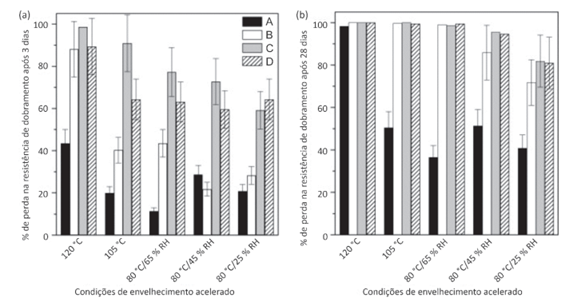
Adaptado de The effect of heat and humidity on original wood-pulp papers, de HAVLÍNOVÁ, Bohuslava et al. A study of mechanical properties of papers exposed to various methods of accelerated ageing. Part I. Journal of Cultural Heritage, v. 10, n. 2, 2009.
Os gráficos representam os resultados obtidos em testes de envelhecimento acelerado realizados com quatro amostras de diferentes tipos de papel e mostram o percentual de perda de resistência à dobra. O eixo x mostra as condições de temperatura e Umidade Relativa a que as amostras foram submetidas e o eixo y mostra a porcentagem de perda de resistência à dobra depois de 3 dias (a) e depois de 28 dias (b). A amostra A corresponde ao papel alcalino, enquanto as outras três amostras foram produzidas com diferentes porcentagens de polpa mecânica e química e apresentavam pH ácido. Com base nos dados apresentados, pode-se afirmar:
Adaptado de The effect of heat and humidity on original wood-pulp papers, de HAVLÍNOVÁ, Bohuslava et al. A study of mechanical properties of papers exposed to various methods of accelerated ageing. Part I. Journal of Cultural Heritage, v. 10, n. 2, 2009.
Os gráficos representam os resultados obtidos em testes de envelhecimento acelerado realizados com quatro amostras de diferentes tipos de papel e mostram o percentual de perda de resistência à dobra. O eixo x mostra as condições de temperatura e Umidade Relativa a que as amostras foram submetidas e o eixo y mostra a porcentagem de perda de resistência à dobra depois de 3 dias (a) e depois de 28 dias (b). A amostra A corresponde ao papel alcalino, enquanto as outras três amostras foram produzidas com diferentes porcentagens de polpa mecânica e química e apresentavam pH ácido. Com base nos dados apresentados, pode-se afirmar:
Ano: 2024
Banca:
FUVEST
Órgão:
USP
Prova:
FUVEST - 2024 - USP - Especialista em Pesquisa/Apoio de Museu (Especialidade: Conservação e Restauro) – Edital nº 13 |
Q3545376
Química
De acordo com o estudo desenvolvido por Robert Feller e
Myron H. Wilt, no Getty Conservation Institute sobre os éteres
de celulose utilizados nos tratamentos de conservação e
restauração, os que apresentam melhor estabilidade a longo
prazo em relação à mudança de cor e perda de grau de
polimerização foram:
Ano: 2024
Banca:
FUVEST
Órgão:
USP
Prova:
FUVEST - 2024 - USP - Especialista em Pesquisa/Apoio de Museu (Especialidade: Conservação e Restauro) – Edital nº 13 |
Q3545375
História
O papel faz parte da história da humanidade há cerca de 2000
anos, tendo passado por inúmeras transformações em seu
processo de produção. Do início das primeiras folhas obtidas
pelos chineses através da maceração de restos de tecido,
seguido pelo uso de outras fibras vegetais como o cânhamo,
bambu e a amoreira, essa manufatura viajou através do
oriente adquirindo características próprias pelas localidades
por onde passava, de acordo com a disponibilidade de matéria
prima. Chegou à Espanha em meados do século XI, e de lá
espalhou-se por toda a Europa. Sobre o processo histórico da
fabricação do papel é correto afirmar:
Ano: 2024
Banca:
FUVEST
Órgão:
USP
Prova:
FUVEST - 2024 - USP - Especialista em Pesquisa/Apoio de Museu (Especialidade: Conservação e Restauro) – Edital nº 13 |
Q3545374
Museologia
As definições, nomenclaturas e alcance das medidas
relacionadas a conservação êem sido objeto de constante
discussão nos fóruns e associações ligadas à preservação do
patrimônio cultural. A definição mais utilizada atualmente
decorre da resolução "Terminology to characterize the
conservation of tangible cultural heritage”, divulgada pelos
membros do Comitê de Conservação do International Council
of Museums (ICOM-CC), durante a Assembleia Geral da
Conferência Trienal do ICOM-CC, ocorrida em Nova Deli em
setembro de 2008. De acordo com esta definição:
Ano: 2024
Banca:
FUVEST
Órgão:
USP
Prova:
FUVEST - 2024 - USP - Especialista em Pesquisa/Apoio de Museu (Especialidade: Conservação e Restauro) – Edital nº 13 |
Q3545351
Inglês
Texto associado
Among my fellow punctuation nerds, I have a
reputation as someone who does not see any use for
semicolons. Cecelia Watson, who teaches at Bard College, has
written a whole book about them: “Semicolon: The Past,
Present, and Future of a Misunderstood Mark.”
Watson, a historian and philosopher of science and a
teacher of writing and the humanities—in other words, a
Renaissance woman—gives us a deceptively playful-looking
book that turns out to be a scholarly treatise on a
sophisticated device that has contributed eloquence and
mystery to Western civilization.
The semicolon itself was a Renaissance invention. It
first appeared in 1494, in a book published in Venice by Aldus
Manutius. “De Aetna,” Watson explains, was “an essay,
written in dialogue form,” about climbing Mt. Etna. The mark
was a hybrid between a comma and a colon, and its purpose
was to prolong a pause or create a more distinct separation
between parts of a sentence.
The problem with the semicolon is not how it looks but
what it does and how that has changed over time. In the old
days, punctuation simply indicated a pause. Comma, colon:
semicolon; period. Eventually, grammarians and copy editors
came along and made themselves indispensable by
punctuating (“pointing”) a writer’s prose “to delineate clauses
properly, such that punctuation served syntax.” That is,
commas, semicolons, and colons were included in a sentence
in order to highlight, subordinate, or otherwise conduct its
elements, connecting them syntactically. One of the rules is
that, unless you are composing a list, a semicolon is supposed
to be followed by a complete clause, capable of standing on
its own. The semicolon can take the place of a conjunction,
like “and” or “but,” but it should not be used in addition to it.
https://www.newyorker.com/culture/comma-queen/sympathy-for-thesemicolon. July 15, 2019. Adaptado.
No texto, a expressão “deceptively playful-looking” (2º
parágrafo) indica que o livro de Cecelia Watson
Ano: 2024
Banca:
FUVEST
Órgão:
USP
Prova:
FUVEST - 2024 - USP - Especialista em Pesquisa/Apoio de Museu (Especialidade: Herpetologia) – Edital nº 13 |
Q3544095
Zoologia
Dois modos de retração do pescoço caracterizam os
quelônios: os Pleurodira, cuja retração é lateral, e os
Cryptodira que o retraem verticalmente. Assinale a
alternativa que apresenta apenas famílias de Pleurodira.
Ano: 2024
Banca:
FUVEST
Órgão:
USP
Prova:
FUVEST - 2024 - USP - Especialista em Pesquisa/Apoio de Museu (Especialidade: Herpetologia) – Edital nº 13 |
Q3544094
Zoologia
Sabe-se hoje que os lagartos formam um grupo parafilético,
pois não incluem as serpentes e anfisbenas, grupos com os
quais partilham um ancestral comum. Do ponto de vista
evolutivo, assinale a alternativa que apresenta a família que
partilha parentesco mais próximo com as serpentes.
Ano: 2024
Banca:
FUVEST
Órgão:
USP
Prova:
FUVEST - 2024 - USP - Especialista em Pesquisa/Apoio de Museu (Especialidade: Herpetologia) – Edital nº 13 |
Q3544093
Zoologia
Entre os anfíbios brasileiros várias espécies apresentam
hábitos subterrâneos. Assinale a alternativa onde todas as
famílias apresentam adultos com este modo de vida.
Ano: 2024
Banca:
FUVEST
Órgão:
USP
Prova:
FUVEST - 2024 - USP - Especialista em Pesquisa/Apoio de Museu (Especialidade: Herpetologia) – Edital nº 13 |
Q3544092
Zoologia
Os Testudines são um grupo répteis caracterizados, entre
outros caracteres, pela presença de carapaça e plastrão.
Assinale a alternativa que reúne corretamente outras
características típicas dos quelônios atuais.

 Conheça nossos planos