Questões de Concurso
Para analista de tecnologia da informação - ambiente operacional
Foram encontradas 54 questões
Resolva questões gratuitamente!
Junte-se a mais de 4 milhões de concurseiros!


Ano: 2009
Banca:
COSEAC
Órgão:
DATAPREV
Provas:
COSEAC - 2009 - DATAPREV - Analista de Tecnologia da Informação - Ambiente Operacional
|
COSEAC - 2009 - DATAPREV - Analista de Tecnologia da Informação - Banco de Dados |
COSEAC - 2009 - DATAPREV - Analista de Tecnologia da Informação - Desenvolvimento de Sistemas |
COSEAC - 2009 - DATAPREV - Analista de Tecnologia da Informação - Análise de Informações |
Q112898
Inglês
Texto associado
GadgetDesigners Push the Limits of Size, Safety
By Brian X. Chen, August 28, 2008
Just as small, fast-moving mammals replaced lumbering
dinosaurs, pocketable gadgets are evolving to fill niches that
larger, deskbound computers can't reach. But as they shrink,
these gadgets are faced with problems mammals face, too,
such as efficiently dissipating heat.
The recent example of Apple's first-generation iPod nanos
causing fires in Japan raises the question of whether
increasingly innovative product designs are impinging on
safety. The nano incident illustrates how risk can increase as
devices decrease in size, says Roger Kay, an analyst at
EndpointTechnologies.
"As [gadgets] get smaller, the tradeoffs become more difficult,
the balance becomes more critical and there's less room for
error," Kay said. "I'm not surprised it's happening to the nano
because that's the small one. You're asking it to do a lot in a
very, very small package and that's pushing the envelope.”
There's no question that industrial designers' jobs have
become much more difficult as the industry demands ever
more powerful and smaller gadgets. With paper-thin
subnotebooks, ultrasmall MP3 players, and pinkie finger-
sized Bluetooth headsets becoming increasingly popular, it's
questionable where exactly designers draw the line between
innovation and safety.
By Brian X. Chen, August 28, 2008
Just as small, fast-moving mammals replaced lumbering
dinosaurs, pocketable gadgets are evolving to fill niches that
larger, deskbound computers can't reach. But as they shrink,
these gadgets are faced with problems mammals face, too,
such as efficiently dissipating heat.
The recent example of Apple's first-generation iPod nanos
causing fires in Japan raises the question of whether
increasingly innovative product designs are impinging on
safety. The nano incident illustrates how risk can increase as
devices decrease in size, says Roger Kay, an analyst at
EndpointTechnologies.
"As [gadgets] get smaller, the tradeoffs become more difficult,
the balance becomes more critical and there's less room for
error," Kay said. "I'm not surprised it's happening to the nano
because that's the small one. You're asking it to do a lot in a
very, very small package and that's pushing the envelope.”
There's no question that industrial designers' jobs have
become much more difficult as the industry demands ever
more powerful and smaller gadgets. With paper-thin
subnotebooks, ultrasmall MP3 players, and pinkie finger-
sized Bluetooth headsets becoming increasingly popular, it's
questionable where exactly designers draw the line between
innovation and safety.
The reason given in the third paragraph of the text for the problemwith smaller gadgets is that…
Ano: 2009
Banca:
COSEAC
Órgão:
DATAPREV
Provas:
COSEAC - 2009 - DATAPREV - Analista de Tecnologia da Informação - Ambiente Operacional
|
COSEAC - 2009 - DATAPREV - Analista de Tecnologia da Informação - Banco de Dados |
COSEAC - 2009 - DATAPREV - Analista de Tecnologia da Informação - Desenvolvimento de Sistemas |
COSEAC - 2009 - DATAPREV - Analista de Tecnologia da Informação - Análise de Informações |
Q112897
Inglês
Texto associado
GadgetDesigners Push the Limits of Size, Safety
By Brian X. Chen, August 28, 2008
Just as small, fast-moving mammals replaced lumbering
dinosaurs, pocketable gadgets are evolving to fill niches that
larger, deskbound computers can't reach. But as they shrink,
these gadgets are faced with problems mammals face, too,
such as efficiently dissipating heat.
The recent example of Apple's first-generation iPod nanos
causing fires in Japan raises the question of whether
increasingly innovative product designs are impinging on
safety. The nano incident illustrates how risk can increase as
devices decrease in size, says Roger Kay, an analyst at
EndpointTechnologies.
"As [gadgets] get smaller, the tradeoffs become more difficult,
the balance becomes more critical and there's less room for
error," Kay said. "I'm not surprised it's happening to the nano
because that's the small one. You're asking it to do a lot in a
very, very small package and that's pushing the envelope.”
There's no question that industrial designers' jobs have
become much more difficult as the industry demands ever
more powerful and smaller gadgets. With paper-thin
subnotebooks, ultrasmall MP3 players, and pinkie finger-
sized Bluetooth headsets becoming increasingly popular, it's
questionable where exactly designers draw the line between
innovation and safety.
By Brian X. Chen, August 28, 2008
Just as small, fast-moving mammals replaced lumbering
dinosaurs, pocketable gadgets are evolving to fill niches that
larger, deskbound computers can't reach. But as they shrink,
these gadgets are faced with problems mammals face, too,
such as efficiently dissipating heat.
The recent example of Apple's first-generation iPod nanos
causing fires in Japan raises the question of whether
increasingly innovative product designs are impinging on
safety. The nano incident illustrates how risk can increase as
devices decrease in size, says Roger Kay, an analyst at
EndpointTechnologies.
"As [gadgets] get smaller, the tradeoffs become more difficult,
the balance becomes more critical and there's less room for
error," Kay said. "I'm not surprised it's happening to the nano
because that's the small one. You're asking it to do a lot in a
very, very small package and that's pushing the envelope.”
There's no question that industrial designers' jobs have
become much more difficult as the industry demands ever
more powerful and smaller gadgets. With paper-thin
subnotebooks, ultrasmall MP3 players, and pinkie finger-
sized Bluetooth headsets becoming increasingly popular, it's
questionable where exactly designers draw the line between
innovation and safety.
The title of the text let us know that there must be a close relation between…
Ano: 2009
Banca:
COSEAC
Órgão:
DATAPREV
Provas:
COSEAC - 2009 - DATAPREV - Analista de Tecnologia da Informação - Ambiente Operacional
|
COSEAC - 2009 - DATAPREV - Analista de Tecnologia da Informação - Banco de Dados |
COSEAC - 2009 - DATAPREV - Analista de Tecnologia da Informação - Desenvolvimento de Sistemas |
Q112890
Conhecimentos Gerais
O Programa Piloto para a Proteção das Florestas Tropicais do Brasil (PPG7) é uma iniciativa do governo e da sociedade brasileira, em parceria com a comunidade internacional. Tem como finalidade o desenvolvimento de estratégias inovadoras para a proteção e o uso sustentável da Floresta Amazônica e da Mata Atlântica, associadas a melhorias na qualidade de vida das populações locais. (...) Para tanto, foram definidos os seguintes objetivos específicos:
I. demonstrar a viabilidade da harmonização dos objetivos ambientais e econômicos nas florestas tropicais;
II. ajudar a preservar os enormes recursos genéticos de que estas dispõem;
III. reduzir a contribuição das florestas brasileiras na emissão de gás carbônico;
IV. fornecer um exemplo de cooperação entre os países desenvolvidos e em desenvolvimento nas questões ambientais globais.
(Disponível em: http://www.mct.gov.br/index.php/content/view/ 43656.html)
Dentre os objetivos específicos do PPG7, aquele(s) que diretamente favorece(m) a preservação da biodiversidade local é(são) o(s):
I. demonstrar a viabilidade da harmonização dos objetivos ambientais e econômicos nas florestas tropicais;
II. ajudar a preservar os enormes recursos genéticos de que estas dispõem;
III. reduzir a contribuição das florestas brasileiras na emissão de gás carbônico;
IV. fornecer um exemplo de cooperação entre os países desenvolvidos e em desenvolvimento nas questões ambientais globais.
(Disponível em: http://www.mct.gov.br/index.php/content/view/ 43656.html)
Dentre os objetivos específicos do PPG7, aquele(s) que diretamente favorece(m) a preservação da biodiversidade local é(são) o(s):
Ano: 2009
Banca:
COSEAC
Órgão:
DATAPREV
Provas:
COSEAC - 2009 - DATAPREV - Analista de Tecnologia da Informação - Ambiente Operacional
|
COSEAC - 2009 - DATAPREV - Analista de Tecnologia da Informação - Banco de Dados |
COSEAC - 2009 - DATAPREV - Analista de Tecnologia da Informação - Desenvolvimento de Sistemas |
Q112889
Conhecimentos Gerais
Veja o gráfico a seguir:
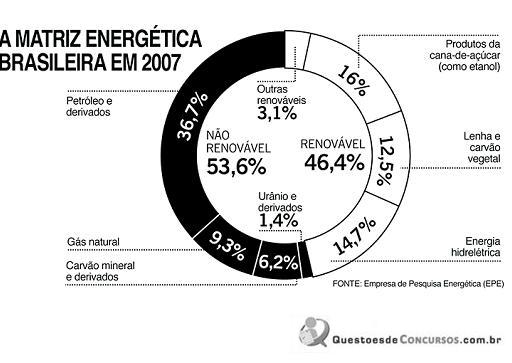
Sobre amatriz energética brasileira pode-se afirmar que:
Sobre amatriz energética brasileira pode-se afirmar que:
Q1213621
Redes de Computadores
No tocante a servidores e aplicações web, julgue o item subsequente.
O Jboss pode ser utilizado em qualquer sistema operacional que suporte Java. As fábricas e os destinos de conexão são objetos administrados e configurados pelo administrador de JMS
O Jboss pode ser utilizado em qualquer sistema operacional que suporte Java. As fábricas e os destinos de conexão são objetos administrados e configurados pelo administrador de JMS
Q1213458
Sistemas Operacionais
Acerca de conceitos relacionados a sistemas operacionais, julgue o próximo item.
Espera passiva é o teste contínuo de uma variável até que aconteça alguma mudança de valor.
Espera passiva é o teste contínuo de uma variável até que aconteça alguma mudança de valor.
Q1213334
Programação
No tocante a servidores e aplicações web, julgue o item subsequente.
No Jboss, em uma sessão com transações, vários envios e recebimentos de mensagens são agrupados em uma única transação. Enquanto o método Session.commit () confirma todas as mensagens em uma transação, o método session.rollback () as descarta.
No Jboss, em uma sessão com transações, vários envios e recebimentos de mensagens são agrupados em uma única transação. Enquanto o método Session.commit () confirma todas as mensagens em uma transação, o método session.rollback () as descarta.
Q1205896
Segurança da Informação
Com respeito à segurança da informação, julgue o item abaixo.
Os algoritmos criptográficos, simétricos ou assimétricos, provêm confidencialidade, integridade, autenticidade, não-repúdio e disponibilidade.
Os algoritmos criptográficos, simétricos ou assimétricos, provêm confidencialidade, integridade, autenticidade, não-repúdio e disponibilidade.
Q1205854
Segurança da Informação
Com respeito à segurança da informação, julgue o item abaixo.
Uma política de segurança deve definir o que se deve proteger, de forma que se possa identificar as ações a serem realizadas e avaliar a eficácia dessas ações.
Uma política de segurança deve definir o que se deve proteger, de forma que se possa identificar as ações a serem realizadas e avaliar a eficácia dessas ações.
Q1205852
Sistemas Operacionais
Com respeito à segurança da informação, julgue o item abaixo.
Firewalls embasados em filtragem de tráfego, com ou sem inspeção de estado, são eficazes contra ataques de buffer overflow.
Firewalls embasados em filtragem de tráfego, com ou sem inspeção de estado, são eficazes contra ataques de buffer overflow.
Q1205849
Segurança da Informação
Com respeito à segurança da informação, julgue o item abaixo.
Normalmente uma política de segurança permite tudo, a menos que seja explicitamente proibido.
Normalmente uma política de segurança permite tudo, a menos que seja explicitamente proibido.
Q1205794
Segurança da Informação
Com respeito à segurança da informação, julgue o item abaixo.
Uma das principais medidas para se proteger uma rede de computadores é o estabelecimento de um perímetro de segurança, que pode incluir roteadores de borda, firewalls, sistemas de detecção ou prevenção de intrusão, servidores de VPN, proxies, zonas desmilitarizadas e subredes filtradas.
Uma das principais medidas para se proteger uma rede de computadores é o estabelecimento de um perímetro de segurança, que pode incluir roteadores de borda, firewalls, sistemas de detecção ou prevenção de intrusão, servidores de VPN, proxies, zonas desmilitarizadas e subredes filtradas.
Ano: 2006
Banca:
CESPE / CEBRASPE
Órgão:
DATAPREV
Provas:
CESPE - 2006 - DATAPREV - Analista de Tecnologia da Informação - Desenvolvimento de Sistemas
|
CESPE - 2006 - DATAPREV - Analista de Tecnologia da Informação - Análise de Informações |
CESPE - 2006 - DATAPREV - Analista de Tecnologia da Informação - Ambiente Operacional |
CESPE - 2006 - DATAPREV - Analista de Tecnologia da Informação - Redes |
CESPE - 2006 - DATAPREV - Analista de Tecnologia da Informação - Banco de Dados |
Q113418
Inglês

Based on the text above, judge the following items.
Virus writers know more about computers than hackers.
Virus writers know more about computers than hackers.
Ano: 2006
Banca:
CESPE / CEBRASPE
Órgão:
DATAPREV
Provas:
CESPE - 2006 - DATAPREV - Analista de Tecnologia da Informação - Desenvolvimento de Sistemas
|
CESPE - 2006 - DATAPREV - Analista de Tecnologia da Informação - Análise de Informações |
CESPE - 2006 - DATAPREV - Analista de Tecnologia da Informação - Ambiente Operacional |
CESPE - 2006 - DATAPREV - Analista de Tecnologia da Informação - Redes |
CESPE - 2006 - DATAPREV - Analista de Tecnologia da Informação - Banco de Dados |
CESPE - 2006 - DATAPREV - Analista de Tecnologia da Informação - Análise de Produção |
Q113412
Inglês
Based on the text above, judge the following items.
Sarah Gordon’s research main focus was on stereotypes.
Sarah Gordon’s research main focus was on stereotypes.

 Conheça nossos planos