Questões de Concurso
Para professor - inglês
Foram encontradas 31.342 questões
Resolva questões gratuitamente!
Junte-se a mais de 4 milhões de concurseiros!


1. Literacy Cycle 2. Interdisciplinary Cycle 3. Authoring Cycle
( ) Recognize instructions that indicate body movements (EF01LI09; p. 75); ( ) Recognize the difference between layouts of texts from various media, according to the context (EF07LI06, p.85); ( ) Recognize words in English looking at images in games such as bingo and tic-tac-toe (EF04LI10, p.80); ( ) Recognize narrative elements such as characters, plot, time and space in a group work situation (EF03LI04; p.77); ( ) Recognize language variation as a manifestation of different ways of thinking and expressing the world (EF07LI25, p.87).
The item with the correct sequence is:
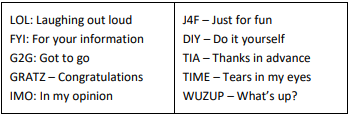
Adapted from: https://preply.com/en/blog/the-most-used-internet-abbreviationsfor-texting-and-tweeting/
If a person is in a hurry, the abbreviation that will be used will be
Text II
Hi, did two shifts tonite and am off to bed. But still fancy the film tomoz. Ur still ok for this right? How about meet up at I dunno 6 or something outside the Chinese take away.
Adapted from Carter, R. & Goddard, A. How to Analyse Texts. A toolkit for students
of English. London: Routledge, 2016, p. 154.
Text II
Hi, did two shifts tonite and am off to bed. But still fancy the film tomoz. Ur still ok for this right? How about meet up at I dunno 6 or something outside the Chinese take away.
Adapted from Carter, R. & Goddard, A. How to Analyse Texts. A toolkit for students
of English. London: Routledge, 2016, p. 154.
Text I
Nurturing Multimodalism
[…]
New learning collaborations call on the teacher as learner, and the learner as teacher. The teacher is a lifelong learner; this is simply more apparent in the Information Age. In instances of best practice, collaborative learning partnerships are forged between and among teachers for strategic, bottom-up, in-house professional development. This allows teachers to share in reflective, on-going, contextualized learning, tailored to their collective knowledge. This sharing also includes the learner as teacher. ELT typically employs learner-centered activities: these can include learners sharing their knowledge of strategic digital literacies with others in the classrooms.
The digital universe, so threatening to adult notions of socially sanctioned literacies, is intuitive to children, who have been socialized into it, and for whom digital literacies are exploratory play. Adults may find new ways of communicating digitally to be quite baffling and confronting of our communicative expertise; children do not. Instant messaging systems, such as MSN, AOL, ICQ, for example, provide as natural a medium for communicating to them as telephones did for the baby-boomer generation. It is not fair for the teacher to treat Information and Communication Technologies as auxiliary communication with learners for whom it is mainstream and primary.
Learning spaces are important. Although teachers seldom have much individual say in the layout of teaching spaces, collaborative relationships may help to encourage integrated digitization, where computers are not segregated in laboratories but are interspersed throughout the school environment. In digitally infused curricula, postmodern literacies do not supplant but complement modern literacies, so that access to information is driven by purpose and content rather than by the media available.
Adapted from: LOTHERINGTON, H. From literacy to multiliteracies in ELT. In:
CUMMINS, J.; DAVISON, C. (Eds.) International Handbook of English Language
Teaching. New York: Springer, 2007, p. 820. Available at:
https://www.researchgate.net/publication/226802846_From_Literacy_to_Multiliter
acies_in_ELT
Text I
Nurturing Multimodalism
[…]
New learning collaborations call on the teacher as learner, and the learner as teacher. The teacher is a lifelong learner; this is simply more apparent in the Information Age. In instances of best practice, collaborative learning partnerships are forged between and among teachers for strategic, bottom-up, in-house professional development. This allows teachers to share in reflective, on-going, contextualized learning, tailored to their collective knowledge. This sharing also includes the learner as teacher. ELT typically employs learner-centered activities: these can include learners sharing their knowledge of strategic digital literacies with others in the classrooms.
The digital universe, so threatening to adult notions of socially sanctioned literacies, is intuitive to children, who have been socialized into it, and for whom digital literacies are exploratory play. Adults may find new ways of communicating digitally to be quite baffling and confronting of our communicative expertise; children do not. Instant messaging systems, such as MSN, AOL, ICQ, for example, provide as natural a medium for communicating to them as telephones did for the baby-boomer generation. It is not fair for the teacher to treat Information and Communication Technologies as auxiliary communication with learners for whom it is mainstream and primary.
Learning spaces are important. Although teachers seldom have much individual say in the layout of teaching spaces, collaborative relationships may help to encourage integrated digitization, where computers are not segregated in laboratories but are interspersed throughout the school environment. In digitally infused curricula, postmodern literacies do not supplant but complement modern literacies, so that access to information is driven by purpose and content rather than by the media available.
Adapted from: LOTHERINGTON, H. From literacy to multiliteracies in ELT. In:
CUMMINS, J.; DAVISON, C. (Eds.) International Handbook of English Language
Teaching. New York: Springer, 2007, p. 820. Available at:
https://www.researchgate.net/publication/226802846_From_Literacy_to_Multiliter
acies_in_ELT
Text I
Nurturing Multimodalism
[…]
New learning collaborations call on the teacher as learner, and the learner as teacher. The teacher is a lifelong learner; this is simply more apparent in the Information Age. In instances of best practice, collaborative learning partnerships are forged between and among teachers for strategic, bottom-up, in-house professional development. This allows teachers to share in reflective, on-going, contextualized learning, tailored to their collective knowledge. This sharing also includes the learner as teacher. ELT typically employs learner-centered activities: these can include learners sharing their knowledge of strategic digital literacies with others in the classrooms.
The digital universe, so threatening to adult notions of socially sanctioned literacies, is intuitive to children, who have been socialized into it, and for whom digital literacies are exploratory play. Adults may find new ways of communicating digitally to be quite baffling and confronting of our communicative expertise; children do not. Instant messaging systems, such as MSN, AOL, ICQ, for example, provide as natural a medium for communicating to them as telephones did for the baby-boomer generation. It is not fair for the teacher to treat Information and Communication Technologies as auxiliary communication with learners for whom it is mainstream and primary.
Learning spaces are important. Although teachers seldom have much individual say in the layout of teaching spaces, collaborative relationships may help to encourage integrated digitization, where computers are not segregated in laboratories but are interspersed throughout the school environment. In digitally infused curricula, postmodern literacies do not supplant but complement modern literacies, so that access to information is driven by purpose and content rather than by the media available.
Adapted from: LOTHERINGTON, H. From literacy to multiliteracies in ELT. In:
CUMMINS, J.; DAVISON, C. (Eds.) International Handbook of English Language
Teaching. New York: Springer, 2007, p. 820. Available at:
https://www.researchgate.net/publication/226802846_From_Literacy_to_Multiliter
acies_in_ELT
Text I
Nurturing Multimodalism
[…]
New learning collaborations call on the teacher as learner, and the learner as teacher. The teacher is a lifelong learner; this is simply more apparent in the Information Age. In instances of best practice, collaborative learning partnerships are forged between and among teachers for strategic, bottom-up, in-house professional development. This allows teachers to share in reflective, on-going, contextualized learning, tailored to their collective knowledge. This sharing also includes the learner as teacher. ELT typically employs learner-centered activities: these can include learners sharing their knowledge of strategic digital literacies with others in the classrooms.
The digital universe, so threatening to adult notions of socially sanctioned literacies, is intuitive to children, who have been socialized into it, and for whom digital literacies are exploratory play. Adults may find new ways of communicating digitally to be quite baffling and confronting of our communicative expertise; children do not. Instant messaging systems, such as MSN, AOL, ICQ, for example, provide as natural a medium for communicating to them as telephones did for the baby-boomer generation. It is not fair for the teacher to treat Information and Communication Technologies as auxiliary communication with learners for whom it is mainstream and primary.
Learning spaces are important. Although teachers seldom have much individual say in the layout of teaching spaces, collaborative relationships may help to encourage integrated digitization, where computers are not segregated in laboratories but are interspersed throughout the school environment. In digitally infused curricula, postmodern literacies do not supplant but complement modern literacies, so that access to information is driven by purpose and content rather than by the media available.
Adapted from: LOTHERINGTON, H. From literacy to multiliteracies in ELT. In:
CUMMINS, J.; DAVISON, C. (Eds.) International Handbook of English Language
Teaching. New York: Springer, 2007, p. 820. Available at:
https://www.researchgate.net/publication/226802846_From_Literacy_to_Multiliter
acies_in_ELT
Text I
Nurturing Multimodalism
[…]
New learning collaborations call on the teacher as learner, and the learner as teacher. The teacher is a lifelong learner; this is simply more apparent in the Information Age. In instances of best practice, collaborative learning partnerships are forged between and among teachers for strategic, bottom-up, in-house professional development. This allows teachers to share in reflective, on-going, contextualized learning, tailored to their collective knowledge. This sharing also includes the learner as teacher. ELT typically employs learner-centered activities: these can include learners sharing their knowledge of strategic digital literacies with others in the classrooms.
The digital universe, so threatening to adult notions of socially sanctioned literacies, is intuitive to children, who have been socialized into it, and for whom digital literacies are exploratory play. Adults may find new ways of communicating digitally to be quite baffling and confronting of our communicative expertise; children do not. Instant messaging systems, such as MSN, AOL, ICQ, for example, provide as natural a medium for communicating to them as telephones did for the baby-boomer generation. It is not fair for the teacher to treat Information and Communication Technologies as auxiliary communication with learners for whom it is mainstream and primary.
Learning spaces are important. Although teachers seldom have much individual say in the layout of teaching spaces, collaborative relationships may help to encourage integrated digitization, where computers are not segregated in laboratories but are interspersed throughout the school environment. In digitally infused curricula, postmodern literacies do not supplant but complement modern literacies, so that access to information is driven by purpose and content rather than by the media available.
Adapted from: LOTHERINGTON, H. From literacy to multiliteracies in ELT. In:
CUMMINS, J.; DAVISON, C. (Eds.) International Handbook of English Language
Teaching. New York: Springer, 2007, p. 820. Available at:
https://www.researchgate.net/publication/226802846_From_Literacy_to_Multiliter
acies_in_ELT
Text I
Nurturing Multimodalism
[…]
New learning collaborations call on the teacher as learner, and the learner as teacher. The teacher is a lifelong learner; this is simply more apparent in the Information Age. In instances of best practice, collaborative learning partnerships are forged between and among teachers for strategic, bottom-up, in-house professional development. This allows teachers to share in reflective, on-going, contextualized learning, tailored to their collective knowledge. This sharing also includes the learner as teacher. ELT typically employs learner-centered activities: these can include learners sharing their knowledge of strategic digital literacies with others in the classrooms.
The digital universe, so threatening to adult notions of socially sanctioned literacies, is intuitive to children, who have been socialized into it, and for whom digital literacies are exploratory play. Adults may find new ways of communicating digitally to be quite baffling and confronting of our communicative expertise; children do not. Instant messaging systems, such as MSN, AOL, ICQ, for example, provide as natural a medium for communicating to them as telephones did for the baby-boomer generation. It is not fair for the teacher to treat Information and Communication Technologies as auxiliary communication with learners for whom it is mainstream and primary.
Learning spaces are important. Although teachers seldom have much individual say in the layout of teaching spaces, collaborative relationships may help to encourage integrated digitization, where computers are not segregated in laboratories but are interspersed throughout the school environment. In digitally infused curricula, postmodern literacies do not supplant but complement modern literacies, so that access to information is driven by purpose and content rather than by the media available.
Adapted from: LOTHERINGTON, H. From literacy to multiliteracies in ELT. In:
CUMMINS, J.; DAVISON, C. (Eds.) International Handbook of English Language
Teaching. New York: Springer, 2007, p. 820. Available at:
https://www.researchgate.net/publication/226802846_From_Literacy_to_Multiliter
acies_in_ELT
Text I
Nurturing Multimodalism
[…]
New learning collaborations call on the teacher as learner, and the learner as teacher. The teacher is a lifelong learner; this is simply more apparent in the Information Age. In instances of best practice, collaborative learning partnerships are forged between and among teachers for strategic, bottom-up, in-house professional development. This allows teachers to share in reflective, on-going, contextualized learning, tailored to their collective knowledge. This sharing also includes the learner as teacher. ELT typically employs learner-centered activities: these can include learners sharing their knowledge of strategic digital literacies with others in the classrooms.
The digital universe, so threatening to adult notions of socially sanctioned literacies, is intuitive to children, who have been socialized into it, and for whom digital literacies are exploratory play. Adults may find new ways of communicating digitally to be quite baffling and confronting of our communicative expertise; children do not. Instant messaging systems, such as MSN, AOL, ICQ, for example, provide as natural a medium for communicating to them as telephones did for the baby-boomer generation. It is not fair for the teacher to treat Information and Communication Technologies as auxiliary communication with learners for whom it is mainstream and primary.
Learning spaces are important. Although teachers seldom have much individual say in the layout of teaching spaces, collaborative relationships may help to encourage integrated digitization, where computers are not segregated in laboratories but are interspersed throughout the school environment. In digitally infused curricula, postmodern literacies do not supplant but complement modern literacies, so that access to information is driven by purpose and content rather than by the media available.
Adapted from: LOTHERINGTON, H. From literacy to multiliteracies in ELT. In:
CUMMINS, J.; DAVISON, C. (Eds.) International Handbook of English Language
Teaching. New York: Springer, 2007, p. 820. Available at:
https://www.researchgate.net/publication/226802846_From_Literacy_to_Multiliter
acies_in_ELT
I. In recent collaborative teaching, learners and teachers may exchange roles. II. The goals of digitally oriented curricula should conform to the media at hand. III. It is quite straining for children to get a grasp of digital communication.
Choose the correct answer:
Text I
Nurturing Multimodalism
[…]
New learning collaborations call on the teacher as learner, and the learner as teacher. The teacher is a lifelong learner; this is simply more apparent in the Information Age. In instances of best practice, collaborative learning partnerships are forged between and among teachers for strategic, bottom-up, in-house professional development. This allows teachers to share in reflective, on-going, contextualized learning, tailored to their collective knowledge. This sharing also includes the learner as teacher. ELT typically employs learner-centered activities: these can include learners sharing their knowledge of strategic digital literacies with others in the classrooms.
The digital universe, so threatening to adult notions of socially sanctioned literacies, is intuitive to children, who have been socialized into it, and for whom digital literacies are exploratory play. Adults may find new ways of communicating digitally to be quite baffling and confronting of our communicative expertise; children do not. Instant messaging systems, such as MSN, AOL, ICQ, for example, provide as natural a medium for communicating to them as telephones did for the baby-boomer generation. It is not fair for the teacher to treat Information and Communication Technologies as auxiliary communication with learners for whom it is mainstream and primary.
Learning spaces are important. Although teachers seldom have much individual say in the layout of teaching spaces, collaborative relationships may help to encourage integrated digitization, where computers are not segregated in laboratories but are interspersed throughout the school environment. In digitally infused curricula, postmodern literacies do not supplant but complement modern literacies, so that access to information is driven by purpose and content rather than by the media available.
Adapted from: LOTHERINGTON, H. From literacy to multiliteracies in ELT. In:
CUMMINS, J.; DAVISON, C. (Eds.) International Handbook of English Language
Teaching. New York: Springer, 2007, p. 820. Available at:
https://www.researchgate.net/publication/226802846_From_Literacy_to_Multiliter
acies_in_ELT
( ) In the digital era, modern literacies have been swept away by postmodern perspectives. ( ) Learners are to be stimulated to share their digital knowledge with teacher and peers. ( ) A digitally infused curriculum requires a restricted area in the school for working with computers.
The statements are, respectively,
“Para evitar fraudes, ou golpes, como a cópia, ou duplicação de moedas, além de falsas transações e outros tipos de crimes, há um poderoso sistema de segurança e controle. Basicamente, quando há uma troca comercial entre duas carteiras virtuais, ela é publicada no site da blockchain em forma de código, que é verificado por softwares específicos voltados para essa função”.
Disponível em: https://mundoeducacao.uol.com.br/geografia/bitcoin.htm
Os excertos referem-se:
O pai de uma mulher iraniana que morreu sob custódia policial na semana passada, acusou as autoridades do Irã, de mentir sobre da morte filha, em meio aos protestos que acontecem em todo o país, apesar da tentativa do governo de conter as manifestações com um apagão da internet. Amjad Amini, cuja filha, Mahsa morreu após ser presa na Capital do País, Teerã, pela polícia da moralidade, disse que os médicos se recusaram a deixá-lo ver sua filha após a morte dela.
Disponível em: https://www.cnnbrasil.com.br/internacional/pai-de-iraniana-morta-por-mau-uso-do-veu-diz-quegoverno-mente/
Referente ao Irã assinale a alternativa correta:

[...] A árvore mais alta da Amazônia – um angelim-vermelho de aproximadamente 400 anos, 9,9 metros de circunferência e _____ metros de altura, o equivalente a um prédio de 30 andares – “corre perigo” por causa da ação ilegal de grileiros e garimpeiros, alertam ambientalistas. Ela é maior, por exemplo, do que alguns dos principais cartões postais do mundo, como a Grande Esfinge de Gizé (20 metros), no Egito, o Cristo Redentor (38 metros), no Rio de Janeiro e a Torre de Pisa (57 metros), na Itália. Por pouco não ultrapassa o Big Ben (96 metros), em Londres, na Inglaterra e a Estátua da Liberdade (93 metros), em Nova York, nos EUA.
A altura da árvore em questão é:
“A campanha do Setembro Amarelo foi inspirada na história de Mike Emme, que cometeu suicídio, aos 17 anos, em setembro de 1994, nos Estados Unidos. Ele tinha um carro amarelo e, no dia do seu velório, os pais e amigos distribuíram cartões com fitas amarelas e frases motivacionais para pessoas que pudessem estar enfrentando transtornos mentais e emocionais”.
Segundo a referida notícia, a campanha de conscientização pela vida ganha força com a chegada do Setembro Amarelo. O dia 10 é lembrado como:
https://www.mg.gov.br/pagina/historia
A alternativa que completa corretamente as lacunas é:

 Conheça nossos planos