Questões de Concurso Para professor - inglês

Foram encontradas 31.245 questões

Resolva questões gratuitamente!

Junte-se a mais de 4 milhões de concurseiros!

Q3482602 Inglês
O texto seguinte servirá de base para responder à questão.


Gigantic skull of prehistoric sea monster found on England's 'Jurassic Coast' 


The remarkably well-preserved skull of a gigantic pliosaur, a prehistoric sea monster, has been discovered on a beach in the county of Dorset in southern England, and it could reveal secrets about these awe-inspiring creatures.


Pliosaurs dominated the oceans at a time when dinosaurs roamed the land. The unearthed fossil is about 150 million years old, almost 3 million years younger than any other pliosaur fins. Researchers are analyzing the specimen to determine whether it could even be a species new to science.


Originally spotted in spring 2022, the fossil, along with its complicated excavation and ongoing scientific investigation, are now detailed in the upcoming BBC documentary "Attenborough and the Jurassic Sea Monster" presented by legendary naturalist Sir David Attenborough, that will air February 14 on PBS.


Such was the enormous size of the carnivorous marine reptile that the skull, excavated from a cliff along Dorset's "Jurassic Coast", is almost 2 meters (6.6 feet) ling. In its fossilized form, the specimen weighs over half a metric ton. Pliosaurs species could grow to 15 meters (50 feet) in length, according to Encyclopaedia Britannica.


The fossil was buried deep in the cliff, about 11 meters (36 feet) above the ground and 15 meters (49 feet) down the cliff, local paleontologist Steve Etches, who helped uncover it, told the CNN in a video call.


Extracting it proved a perilous task, one fraught with danger as a crew raced against the clock during a window of good weather before summer storms closed in and the cliff eroded, possibly taking the rare and significant fossil with it.


Etches first learned of the fossil's existence when his friend Philip Jacobs called him after coming across the pliosaur's snout on the beach. Right from the start, they were "quite excited, because its jaws closed together which indicates (the fossil) is complete," Etches said. 


After using drones to map the cliff and identify the rest of the pliosaur's precise position, Etches and his team embarked on a three-week operation, chiseling into the cliff while suspended in midair.


"It's a miracle we got it out," he said, "because we had one last day to get this thing out, which we did at 9:30 p.m."


Etches took on the task of painstakingly restoring the skull. There was a time he found "very disillusioning" as the mud, and bone, had cracked, but "over the following days and weeks, it was a case of ..., like a jigsaw, putting it all back. It took a long time but every bit of bone we got back in."


It's a "freak of nature" that this fossil remains in such good condition, Etches added. "It died in the right environment, there was a lot of sedimentation ... so when it died and went down to the seafloor, it got buried quite quickly."


Fearsome top predator of the seas


The nearly intact fossil illuminates the characteristics that made the pliosaur a truly fearsome predator, hunting prey such as the dolphinlike ichthyosaur. The apex predator with huge razor-sharp teeth used as a variety of senses, including sensory pits still visible on its skull that may have allowed it to detect changes in water pressure, according to the documentary.


The pliosaur had a bite twice as powerful as a saltwater crocodile, which has the world's most powerful jaws today, according to Emily Rayfield, a professor of paleobiology at the University of Bristol in the United Kingdom who appeared in the documentary. The prehistoric marine predator would have been able to cut into a car, she said.


Andre Rowe, a postdoctoral research associate of paleobiology at the University of Bristol, added that "the animal would have been so massive that I think it would have been able to prey effectively on anything that was unfortunate enough to be in its space."


By Issy Ronald, CNN

Published December 11, 2023

Available on https://edition.cnn.com/2023/12/11/world/skull-pliosaur-fo
Look at the following conjunctions and sort them in the right categories, as seen on the article. Mark the alternative with the CORRECT order of answers.

I.Because.
II.But.
III.When.
Alternativas
Q3482595 Pedagogia
Além de recursos, metodologia e currículos, a formação dos professores para o ensino na diversidade, é essencial para o desenvolvimento do trabalho em equipe e efetivação da inclusão. Diante disso, o professor deverá ter alguns atributos, dentre eles, julgue os itens como Verdadeiros (V) ou Falsos (F):

I.(__)Perceber as necessidades educacionais especiais dos alunos.
II.(__)Enrijecer a ação pedagógica nas diferentes áreas de conhecimento.
III.(__)Avaliar continuamente a eficácia do processo educativo.

Assinale a alternativa CORRETA.
Alternativas
Q3466854 Inglês


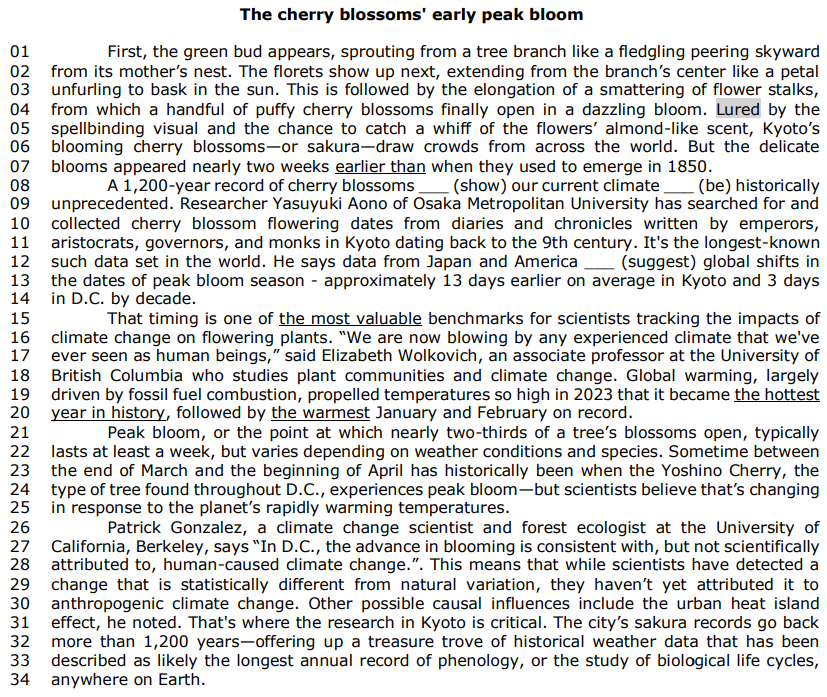
(Available at: www.nationalgeographic.com/environment/article/cherry-blossom-peak-bloom-climate-change - text specially adapted for this test)

In the context presentes in the text, the Imagem associada para resolução da questãoword “Lured” (l. 04) could be replaced by all the alternatives bellow with no significant changes in meaning, EXCEPT for: 
Alternativas
Q3466853 Inglês


(Available at: www.nationalgeographic.com/environment/article/cherry-blossom-peak-bloom-climate-change - text specially adapted for this test)

Mark the INCORRECT alternative about the underlined words throughout the text.
Alternativas
Q3466852 Inglês


(Available at: www.nationalgeographic.com/environment/article/cherry-blossom-peak-bloom-climate-change - text specially adapted for this test)

Mark the alternative that fills in, correctly and respectively, the gaps in the second paragraph with the simple present form of the verbs indicated in the parenthesis.
Alternativas
Q3466851 Inglês


(Available at: www.nationalgeographic.com/environment/article/cherry-blossom-peak-bloom-climate-change - text specially adapted for this test)

Which of the following questions is NOT answered by the article?
Alternativas
Q3466850 Inglês


(Available at: www.nationalgeographic.com/environment/article/cherry-blossom-peak-bloom-climate-change - text specially adapted for this test)

Analyse the statements below about the text and mark T, if true, or F, if false.
( ) Scientists are certain the early cheery blossoming in Washington D.C. is happening due to global warming.
( ) In the “peak bloom”, most of the cherry trees’ flowers are open.
( ) Data suggests that in Washington D.C. the cheery blossoming is brought forward by 3 days every 10 years.
The correct order of filling the parentheses, from top to bottom, is:
Alternativas
Q3465526 Inglês

Match the alternative which respectively matches the sequence of teacher’s intention with the methods of correction below.


Imagem associada para resolução da questão

Alternativas
Q3465525 Pedagogia
Check the alternative which exemplifies the teacher’s role of source of knowledge: 
Alternativas
Q3465524 Inglês

Read the billboard below and answer the question.


Text 03


Source: www.passiton.com

About question based on text 03:
Alternativas
Q3465523 Inglês

Read the billboard below and answer the question.


Text 03


Source: www.passiton.com

Check the alternative containing an accurate statement about the billboard on text 03.
Alternativas
Q3465522 Inglês

Read the billboard below and answer the question.


Text 03


Source: www.passiton.com

The present visual cues from the picture above suggest that: 
Alternativas
Q3465521 Inglês

Read the billboard below and answer the question.


Text 03


Source: www.passiton.com

The alternative which best describes the communicative intention of the billboard above is:
Alternativas
Q3465520 Inglês

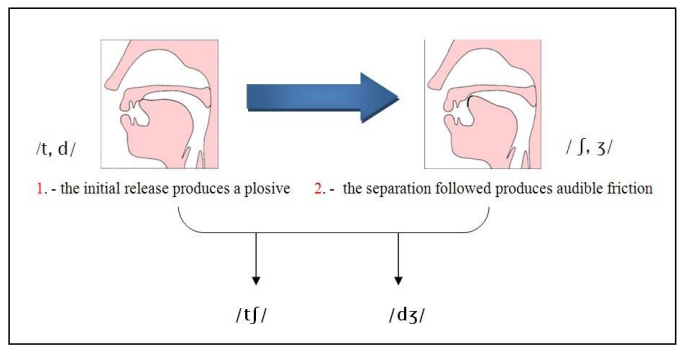
The picture below shows us:


Imagem associada para resolução da questão

Source: https://karlita2012pedagogiaingles.blogspot.com/. 

Alternativas
Q3465519 Inglês
Knowing that the main difference between affricate and fricative sounds lies in the way airflow is managed: affricates involve a stop followed by a release into a fricative, while fricatives are produced by forcing air through a narrow channel in the vocal tract, the alternative that brings only examples of words with affricate sounds in English is: 
Alternativas
Q3465518 Inglês

Attention: the question is about text 02.


Text 02
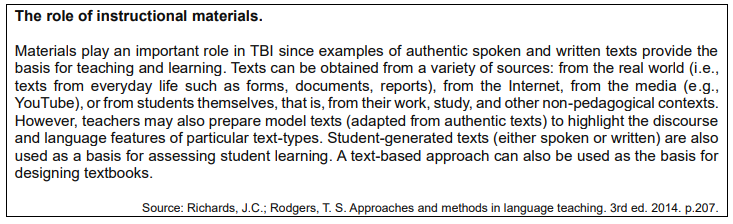
In text 02: 
Alternativas
Q3465517 Inglês

Attention: the question is about text 02.


Text 02

According to text 02, in TBI, student-generated texts...
Alternativas
Q3465516 Inglês

Attention: the question is about text 02.


Text 02

Based on text 02, the alternative below that best describes the role of instructional materials in Task-Based Instruction (TBI) is:
Alternativas
Q3465515 Inglês

Attention: the question is related to Text 01 below.
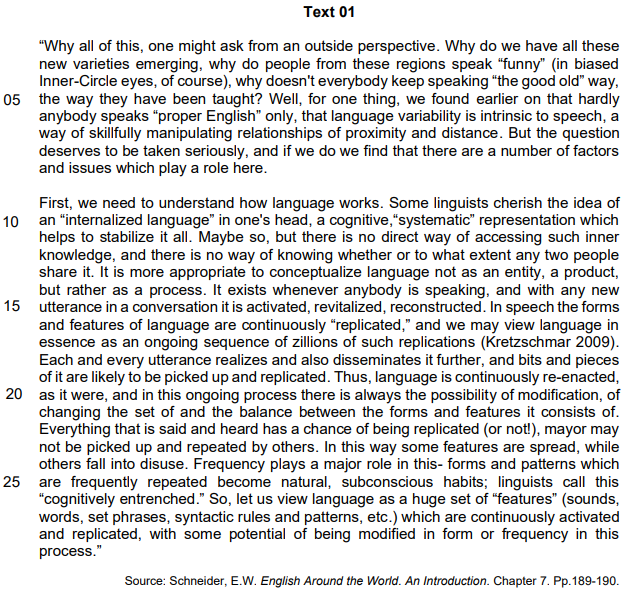

In "Why all of this, one might ask from an outside perspective. Why do we have all these new varieties emerging, why do people from these regions speak 'funny' (in biased Inner-Circle eyes, of course), why doesn't everybody keep speaking 'the good old' way, the way they have been taught? Well, for one thing, we found earlier on that hardly anybody speaks 'proper English' only, that language variability is intrinsic to speech, a way of skillfully manipulating relationships of proximity and distance", what grammatical role does "for one thing" serve?
Alternativas
Q3465514 Inglês

Attention: the question is related to Text 01 below.


According to text 01, why do new varieties of English emerge?
Alternativas
Respostas
8781: D
8782: A
8783: D
8784: E
8785: C
8786: A
8787: B
8788: B
8789: D
8790: B
8791: A
8792: C
8793: C
8794: B
8795: C
8796: B
8797: D
8798: D
8799: A
8800: D