Foram encontradas 4.311 questões
Resolva questões gratuitamente!
Junte-se a mais de 4 milhões de concurseiros!


I - Savoirs (knowledge) is primarily defined as deep declarative knowledge regarding the core cultural values and historical traditions specific to the target-language country, disregarding social groups and processes.
II - Savoir comprendre (skills of interpreting and relating) requires a learner to interpret a document or event from another culture, explain it, and relate it to documents or events from their own culture, without relying on real-time interaction with a target-culture interlocutor.
III - Savoir s’engager (critical cultural awareness) posits that language teachers should remain politically neutral and guide students to evaluate cultural practices using purely subjective, personal moral codes.
IV - The primary distinction between savoir comprendre and savoir apprendre/faire is that the former operates on existing knowledge and documents, whereas the latter involves acquiring new cultural knowledge and operating it in real-time constraints of social interaction.
V - According to Byram, a speaker who possesses high linguistic competence (fluency, native-like accent, advanced syntax) automatically fulfills the prerequisites for Intercultural Communicative Competence (ICC).
Which statements are correct?
“Identities can be held together by narratives, in short, without essences: you don’t get to be called ‘English’ because there’s an essence this label follows; you’re English because our rules determine that you are entitled to the label—that you are connected in the right way with a place called England. […] The story of the golden nugget suggests that we can’t help caring about the traditions of ‘the West’ because they are ours: in fact, the opposite is true. They are ours only if we care about them. A culture of liberty, tolerance, and rational inquiry: that would be a good idea. But these values represent choices to make, not tracks laid down by a Western destiny.”
(Adapted from: APPIAH, Kwame Anthony. The lies that bind: rethinking identity. New York: Liveright Publishing Corporation, 2018. p. 151-159)
Based on Kwame Anthony Appiah’s excerpts, which statement best reflects the author’s understanding of identity?
Question refer to the text below.
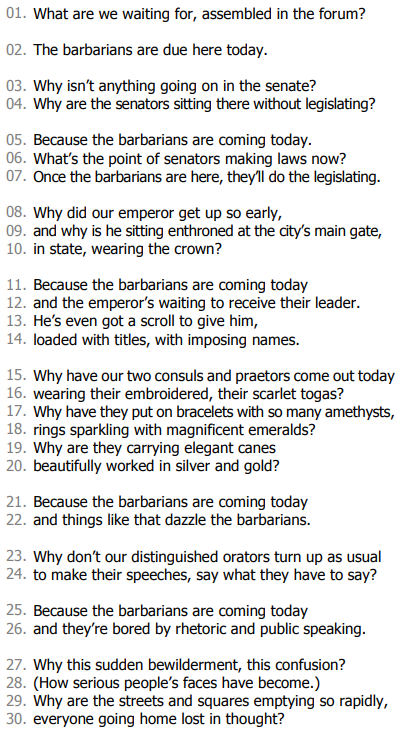
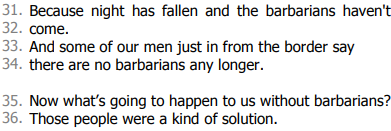
“Identities can be held together by narratives, in short, without essences: you don’t get to be called ‘English’ because there’s an essence this label follows; you’re English because our rules determine that you are entitled to the label—that you are connected in the right way with a place called England. […] The story of the golden nugget suggests that we can’t help caring about the traditions of ‘the West’ because they are ours: in fact, the opposite is true. They are ours only if we care about them. A culture of liberty, tolerance, and rational inquiry: that would be a good idea. But these values represent choices to make, not tracks laid down by a Western destiny.”
(Adapted from: APPIAH, Kwame Anthony. The lies that bind: rethinking identity. New York: Liveright Publishing Corporation, 2018. p. 151-159)
Which statement is NOT consistent with Appiah’s interpretation of Cavafy’s poem “Waiting for the Barbarians” mentioned above?
(1) Continuous verbs
(2) Gerunds acting as nouns
(3) Adjectives
( ) “Why are the senators sitting there without legislating?” (l. 4)
( ) “Once the barbarians are here, they’ll do the legislating” (l. 7)
( ) “Why have they put on bracelets with so many amethysts, rings sparkling with magnificent emeralds?” (l. 17-18)
( ) “Now what’s going to happen to us without barbarians?” (l. 35)
( ) “loaded with titles, with imposing names.” (l. 14)
( ) “and they’re bored by rhetoric and public speaking” (l. 26)
Select the alternative with the correct sequence from top to bottom.
a. ___________ creates anticipation and gets students thinking about previous experiences they may have had about the topic before they read about it. b. It is important that readers be able to get the main idea of a text, and ___________ can help as the reader restates the meaning in his or her own words. c. The main idea of a paragraph is sometimes stated in the ___________ of a paragraph. d. ___________ are words and phrases that join parts of a text together just like the bands in a watch strap. e. ___________ is to look rapidly for specific information. f. ___________ — for gist or overview.
(Adapted from: FARRELL, T. S. C. Teaching reading to English language learners: a reflective guide. Thousand Oaks: Corwin Press, 2009)
Identify the correct sequence of the missing words in the text from top to bottom.
Which of Kumaravadivelu’s (2001) three core Postmethod parameters best explains the teacher’s decision?
I - The concept of ELF problematizes the notion of language “ownership”—historically attributed to the native speaker—and decenters Anglo-American standards. From the perspective of Critical Literacy, this entails the teacher problematizing the very erasure of non-hegemonic varieties.
II - Understanding English as an AL implies recognizing that the new language integrates into the student’s plurilingual repertoire in an additive, rather than subtractive, manner. However, for Critical Literacy to occur, pedagogical practice must go beyond the affirmation of identity, equipping the student to unveil how mastery of a global language reproduces or challenges geopolitical and class-based asymmetries.
III - Critical pedagogy applied to ELT presupposes the adoption of a “didactics of tolerance,” in which an exclusive focus on mutual intelligibility suspends the need to reflect on local linguistic norms, thereby legitimizing any discursive output based on the argument of cultural hybridization.
IV - Within the framework of Critical Literacy, pedagogical practice adopting ELF must abandon the teaching of the standard norm or prestige varieties. This is because the focus on social emancipation demands the rejection of any hegemonic linguistic conventions, which are viewed purely as instruments of oppression and linguistic colonization.
V - The connection between AL and Critical Literacy presupposes that the process of meaning-making in a new language is a space of agency and contestation. Thus, classroom language practices must equip the student to “rewrite” and subvert hegemonic discourses, using English not as a code to be imitated, but as a resource for social performativity and the creation of new meanings.
The correct statements are
I - Deve-se desenhar o esboço do perfil da rosca num plano perpendicular ao início da hélice.
II - Basta selecionar um plano-base desejado e executar a ferramenta hélice para criar o caminho do perfil da rosca.
III - O perfil da rosca deve ter uma relação de perfuração com a hélice (caminho).
IV - A base do triângulo perfil da rosca deve ter exatamente a mesma dimensão do passo da hélice para que resulte numa rosca perfeita.
Quais estão corretas?
Sobre essa alteração na árvore de recursos, assinale a alternativa correta.
 =0,05 (baixo amortecimento).
O nível de vibração medido é 10 mm. As especificações
da fábrica exigem que a vibração seja reduzida para no
máximo 2 mm.
De acordo com esta máquina, assinale a alternativa que responde, correta e respectivamente:
Qual é o novo fator de amortecimento para satisfazer a norma? Após a atualização do sistema com o novo amortecimento, como se forma o sistema quanto à sensibilidade da amplitude em relação a pequenas variações do amortecimento ao redor da condição ressonante? Em um cenário alternativo com alta frequência na operação (r =4,0), qual o efeito na Transmissibilidade de Força (TR) transmitida à fundação sobre a qual a máquina está localizada, caso o amortecimento
 seja aumentado?
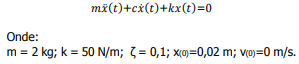
Sobre este sistema, considere as afirmações abaixo.
I - O amortecimento é de 20 [N.s/m].
II - A frequência natural não amortecida é de 5 [rad/s].
III - O período amortecido é aproximadamente de 0,4.π [s].
Quais estão corretas?
I - Os critérios básicos para seleção de rolamentos são: espaço disponível, cargas (intensidade e direção), desalinhamento, precisão, velocidade, atrito, rigidez, operação silenciosa, deslocamento axial, montagem e desmontagem e tipo de vedações.
II - O rolamento é selecionado com base na sua capacidade de carga em relação às cargas aplicadas e aos requisitos de vida do rolamento e de confiabilidade. Ambas as condições de cargas de rolamento dinâmicas e estáticas devem ser verificadas independentemente e devem incluir quaisquer cargas de choque pesadas e de curta duração que possam ocorrer em raras ocasiões.
III - A série de um rolamento designa o nível de carga que o rolamento é capaz de suportar. Aumentar a série eleva a vida útil à fadiga, suporta cargas maiores, exigindo mancais maiores e velocidades reduzidas. Reduzir a série significa economia de espaço radial e peso, reduz a inércia do conjunto e permite maiores rotações, mas reduz drasticamente a capacidade de carga.
Quais estão corretas?
Analise o gráfico abaixo.
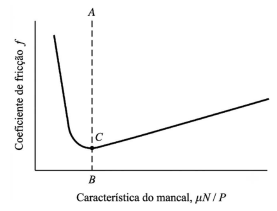
MCKEE, S. A.; MCKEE, T. R. Journal bearing friction in the region of thin film lubrication. SAE Journal, v. 31, p. 371-377, 1932.
Considere as afirmações abaixo sobre o gráfico acima.
I - Petroff, com base na hipótese de um eixo concêntrico, definiu grupo de parâmetros adimensionais muito importantes para lubrificação de mancais de deslizamento, como o número característico do mancal (μN / P) e a razão de folga radial (r/c).
II - O lado direito representa o filme espesso estável onde, caso haja um aumento de temperatura do lubrificante, a viscosidade diminui, haverá menos calor produzido pela fricção, o lubrificante recebe menos calor, diminui a temperatura do lubrificante e a viscosidade aumenta.
III - O ponto “C” no gráfico especifica o ponto ideal de trabalho de um mancal de deslizamento, situações à esquerda provocariam um aquecimento do lubrificante devido à fricção, reduzindo a lubrificação e consequentemente aumentando o atrito até o rompimento do filme. Situações extremas à direita provocariam um atrito viscoso elevado.
Quais estão corretas?
I - Porcas KM são utilizadas em conjunto com arruela de trava HN, atuando como um sistema de travamento positivo, o que impede que as porcas se soltem com o tempo devido a vibrações do equipamento.
II - Porcas KM têm uma alta capacidade de carga devido a seu projeto robusto e volumoso comparado às porcas sextavadas comuns.
III - Porcas KM são utilizadas para prender rolamentos diretamente em eixos rosqueados ou sobre buchas de fixação; e também para calibrar a folga interna de rolamentos de rolo cônicos ou de esferas de contato angular.
Quais estão corretas?
I - No que tange a uma análise CAE, estruturas reticuladas são um tipo de modelo discretizado e elementos estruturais conectados continuamente são um tipo de modelo contínuo.
II - Numa análise estrutural linear simples, utilizando apenas o elemento mola, o número de graus de liberdade na matriz rigidez corresponde ao número de nós da análise.
III - Na mecânica estrutural um problema é não linear quando a rigidez da estrutura depende dos deslocamentos.
Quais estão corretas?

 Conheça nossos planos