Questões de Concurso
Para prefeitura de jundiaí - sp
Foram encontradas 2.095 questões
Resolva questões gratuitamente!
Junte-se a mais de 4 milhões de concurseiros!


Leia o texto a seguir para responder à questão:
Um vídeo do reencontro entre o cantor João Gomes e a sua ex-professora de Petrolina, no sertão pernambucano, viralizou nas redes sociais e emocionou muita gente. “Professora minha ali no canto, que eu sei que sente orgulho, porque foi com vocês que aprendi a ser um rapaz direito”, disse o cantor do palco, onde fazia um show beneficente para reverter fundos para um hospital da cidade. Verlandia Fernandes, 48 anos, deu aulas para o cantor por quatro anos no ensino fundamental. João Gomes, natural de Serrita (PE), cresceu na cidade de Petrolina.
A disciplina preferida de João na escola era literatura, o que foi a base para ele seguir a carreira de compositor. Hoje ele tem números impressionantes para um artista de 23 anos: já liderou a lista de artistas mais ouvidos do Brasil no YouTube, no Spotify e acumula mais de 16 milhões de seguidores somente no Instagram. “Fazia bastante tempo eu tinha ido a um show dele, só que eu resolvi ir neste final de semana por ser beneficente”. Graduada em Pedagogia, ela dá aulas há 25 anos. “Encontrei também outros alunos: uma aluna que agora é pediatra, outro que é advogado. Quando eu vejo que deu certo, que eles estão felizes e que encontraram seu caminho na vida, me dá muito orgulho”.
A homenagem de João Gomes, que não teve planejamento, aconteceu justamente dias antes do Dia dos Professores. “Fui para homenagear o menino João e a homenageada fui eu”, brinca Verlandia. “Foi um incentivo lindo para nós, professores. É um elogio para que os outros sigam e façam igual, para que as pessoas entendam que o professor realmente tem valor e faz toda a diferença na vida das crianças”, afirma.
(Rute Pina, “A história por trás da homenagem à professora em show de João Gomes em Petrolina”, www.bbc.com/ portuguese/articles/c78z1ygd93xo, 15.10.2025. Adaptado)
Leia o texto a seguir para responder à questão:
Um vídeo do reencontro entre o cantor João Gomes e a sua ex-professora de Petrolina, no sertão pernambucano, viralizou nas redes sociais e emocionou muita gente. “Professora minha ali no canto, que eu sei que sente orgulho, porque foi com vocês que aprendi a ser um rapaz direito”, disse o cantor do palco, onde fazia um show beneficente para reverter fundos para um hospital da cidade. Verlandia Fernandes, 48 anos, deu aulas para o cantor por quatro anos no ensino fundamental. João Gomes, natural de Serrita (PE), cresceu na cidade de Petrolina.
A disciplina preferida de João na escola era literatura, o que foi a base para ele seguir a carreira de compositor. Hoje ele tem números impressionantes para um artista de 23 anos: já liderou a lista de artistas mais ouvidos do Brasil no YouTube, no Spotify e acumula mais de 16 milhões de seguidores somente no Instagram. “Fazia bastante tempo eu tinha ido a um show dele, só que eu resolvi ir neste final de semana por ser beneficente”. Graduada em Pedagogia, ela dá aulas há 25 anos. “Encontrei também outros alunos: uma aluna que agora é pediatra, outro que é advogado. Quando eu vejo que deu certo, que eles estão felizes e que encontraram seu caminho na vida, me dá muito orgulho”.
A homenagem de João Gomes, que não teve planejamento, aconteceu justamente dias antes do Dia dos Professores. “Fui para homenagear o menino João e a homenageada fui eu”, brinca Verlandia. “Foi um incentivo lindo para nós, professores. É um elogio para que os outros sigam e façam igual, para que as pessoas entendam que o professor realmente tem valor e faz toda a diferença na vida das crianças”, afirma.
(Rute Pina, “A história por trás da homenagem à professora em show de João Gomes em Petrolina”, www.bbc.com/ portuguese/articles/c78z1ygd93xo, 15.10.2025. Adaptado)
Leia a tirinha a seguir para responder à questão
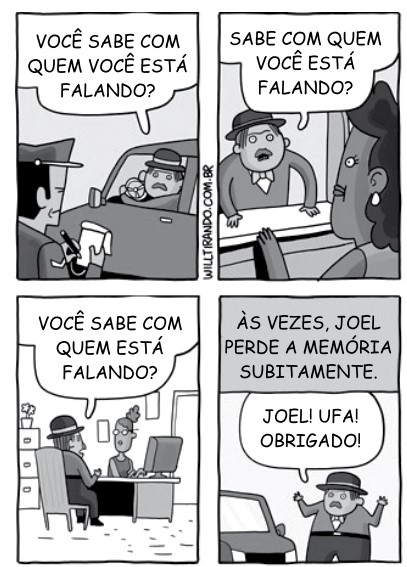
(Will Tirando, willtirando.com.br/ category/quadrinhos/page/2/, 21.06.2025)
Leia a tirinha a seguir para responder à questão
(Will Tirando, willtirando.com.br/ category/quadrinhos/page/2/, 21.06.2025)
Observe a charge a seguir:

(Blog do AFTM. https://blogdoaftm.com.br/ charge-halloween-5/, 01.11.2025)
Na charge, pode-se afirmar que há
Leia o texto a seguir para responder à questão:
O Brasil conquistou, novamente, um lugar de destaque no cenário internacional ao deixar o Mapa da Fome, pela segunda vez, e se consolidar como um dos maiores produtores de alimentos do mundo. O país teria condições de alimentar a própria população e se organizar para exportar. Se exportasse, poderia matar a fome de populações sofridas de outras regiões do mundo que possuem carência alimentar. No entanto, o Brasil convive com uma dura contradição: embora o país seja uma potência agrícola, milhões de brasileiros ainda enfrentam a incerteza sobre o que pôr na mesa.
O acesso a uma alimentação saudável, adequada e nutritiva permanece restrito a uma parcela privilegiada da população brasileira — classe média e alta — enquanto a grande maioria, especialmente periferias urbanas pobres e comunidades vulneráveis, sofrem com a insegurança alimentar. Não fazem sequer três refeições ao dia. Essa situação de penúria não se configura apenas nos dias correntes, conforme escreve Josué de Castro em suas obras como Geografia da Fome (1946) e Fome: um tema proibido (1996). Nessa segunda obra o autor escreve: “Nas terras pobres famintas do Nordeste brasileiro, onde nasci, é hábito servir-se um pedacinho de carne seca com um prato bem cheio de farofa” (Castro, p. 23, 1996).
Por isso, torna-se imprescindível serem fortalecidos os programas de proteção social e de combate com rigor à influência da indústria dos alimentos ultraprocessados, que substituem refeições saudáveis e comprometem a saúde dos mais vulneráveis. A garantia de uma alimentação saudável é um passo indispensável para a construção de uma sociedade mais justa e igualitária, longe da fome e da injustiça nutricional.
(Correio Braziliense, “A fome e a produção de alimentos no Brasil”, www.correiobraziliense.com.br/opiniao/2025/10/7276849-a-fomee-a-producao-de-alimentos-no-brasil.html, 23.10.2025. Adaptado)
Leia o texto a seguir para responder à questão:
O Brasil conquistou, novamente, um lugar de destaque no cenário internacional ao deixar o Mapa da Fome, pela segunda vez, e se consolidar como um dos maiores produtores de alimentos do mundo. O país teria condições de alimentar a própria população e se organizar para exportar. Se exportasse, poderia matar a fome de populações sofridas de outras regiões do mundo que possuem carência alimentar. No entanto, o Brasil convive com uma dura contradição: embora o país seja uma potência agrícola, milhões de brasileiros ainda enfrentam a incerteza sobre o que pôr na mesa.
O acesso a uma alimentação saudável, adequada e nutritiva permanece restrito a uma parcela privilegiada da população brasileira — classe média e alta — enquanto a grande maioria, especialmente periferias urbanas pobres e comunidades vulneráveis, sofrem com a insegurança alimentar. Não fazem sequer três refeições ao dia. Essa situação de penúria não se configura apenas nos dias correntes, conforme escreve Josué de Castro em suas obras como Geografia da Fome (1946) e Fome: um tema proibido (1996). Nessa segunda obra o autor escreve: “Nas terras pobres famintas do Nordeste brasileiro, onde nasci, é hábito servir-se um pedacinho de carne seca com um prato bem cheio de farofa” (Castro, p. 23, 1996).
Por isso, torna-se imprescindível serem fortalecidos os programas de proteção social e de combate com rigor à influência da indústria dos alimentos ultraprocessados, que substituem refeições saudáveis e comprometem a saúde dos mais vulneráveis. A garantia de uma alimentação saudável é um passo indispensável para a construção de uma sociedade mais justa e igualitária, longe da fome e da injustiça nutricional.
(Correio Braziliense, “A fome e a produção de alimentos no Brasil”, www.correiobraziliense.com.br/opiniao/2025/10/7276849-a-fomee-a-producao-de-alimentos-no-brasil.html, 23.10.2025. Adaptado)
Leia o texto a seguir para responder à questão:
O Brasil conquistou, novamente, um lugar de destaque no cenário internacional ao deixar o Mapa da Fome, pela segunda vez, e se consolidar como um dos maiores produtores de alimentos do mundo. O país teria condições de alimentar a própria população e se organizar para exportar. Se exportasse, poderia matar a fome de populações sofridas de outras regiões do mundo que possuem carência alimentar. No entanto, o Brasil convive com uma dura contradição: embora o país seja uma potência agrícola, milhões de brasileiros ainda enfrentam a incerteza sobre o que pôr na mesa.
O acesso a uma alimentação saudável, adequada e nutritiva permanece restrito a uma parcela privilegiada da população brasileira — classe média e alta — enquanto a grande maioria, especialmente periferias urbanas pobres e comunidades vulneráveis, sofrem com a insegurança alimentar. Não fazem sequer três refeições ao dia. Essa situação de penúria não se configura apenas nos dias correntes, conforme escreve Josué de Castro em suas obras como Geografia da Fome (1946) e Fome: um tema proibido (1996). Nessa segunda obra o autor escreve: “Nas terras pobres famintas do Nordeste brasileiro, onde nasci, é hábito servir-se um pedacinho de carne seca com um prato bem cheio de farofa” (Castro, p. 23, 1996).
Por isso, torna-se imprescindível serem fortalecidos os programas de proteção social e de combate com rigor à influência da indústria dos alimentos ultraprocessados, que substituem refeições saudáveis e comprometem a saúde dos mais vulneráveis. A garantia de uma alimentação saudável é um passo indispensável para a construção de uma sociedade mais justa e igualitária, longe da fome e da injustiça nutricional.
(Correio Braziliense, “A fome e a produção de alimentos no Brasil”, www.correiobraziliense.com.br/opiniao/2025/10/7276849-a-fomee-a-producao-de-alimentos-no-brasil.html, 23.10.2025. Adaptado)
Leia o texto a seguir para responder à questão:
O Brasil conquistou, novamente, um lugar de destaque no cenário internacional ao deixar o Mapa da Fome, pela segunda vez, e se consolidar como um dos maiores produtores de alimentos do mundo. O país teria condições de alimentar a própria população e se organizar para exportar. Se exportasse, poderia matar a fome de populações sofridas de outras regiões do mundo que possuem carência alimentar. No entanto, o Brasil convive com uma dura contradição: embora o país seja uma potência agrícola, milhões de brasileiros ainda enfrentam a incerteza sobre o que pôr na mesa.
O acesso a uma alimentação saudável, adequada e nutritiva permanece restrito a uma parcela privilegiada da população brasileira — classe média e alta — enquanto a grande maioria, especialmente periferias urbanas pobres e comunidades vulneráveis, sofrem com a insegurança alimentar. Não fazem sequer três refeições ao dia. Essa situação de penúria não se configura apenas nos dias correntes, conforme escreve Josué de Castro em suas obras como Geografia da Fome (1946) e Fome: um tema proibido (1996). Nessa segunda obra o autor escreve: “Nas terras pobres famintas do Nordeste brasileiro, onde nasci, é hábito servir-se um pedacinho de carne seca com um prato bem cheio de farofa” (Castro, p. 23, 1996).
Por isso, torna-se imprescindível serem fortalecidos os programas de proteção social e de combate com rigor à influência da indústria dos alimentos ultraprocessados, que substituem refeições saudáveis e comprometem a saúde dos mais vulneráveis. A garantia de uma alimentação saudável é um passo indispensável para a construção de uma sociedade mais justa e igualitária, longe da fome e da injustiça nutricional.
(Correio Braziliense, “A fome e a produção de alimentos no Brasil”, www.correiobraziliense.com.br/opiniao/2025/10/7276849-a-fomee-a-producao-de-alimentos-no-brasil.html, 23.10.2025. Adaptado)
Observe as palavras destacadas nas passagens a seguir:
“O Brasil conquistou, novamente, um lugar de destaque no cenário internacional ao deixar o Mapa da Fome, pela segunda vez, e se consolidar como um dos maiores produtores de alimentos do mundo.” (1º parágrafo)
“Por isso torna-se imprescindível serem fortalecidos os programas de proteção social...” (3º parágrafo)
Essas palavras podem ser substituídas, sem alteração de sentido, respectivamente por
O esquema mostrado a seguir representa algumas reações realizadas, nas condições adequadas com o composto 1. O teste de uma amostra do composto 3 isolado e purificado revelou que, sua solução aquosa apresenta pH = 3.
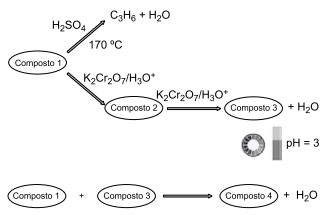
A reação, em condições adequadas, entre o composto 1 e o composto 3 resulta no composto 4, que tem fórmula molecular igual a
O radioisótopo ferro-59 (⁵⁹Fe) é empregado para estudos bioquímicos de células sanguíneas, as hemácias. Esse radioisótopo decai com emissão de partículas beta ( β) e radiação gama (γ), que são detectadas e fornecem informações a respeito do funcionamento dessas células. O decaimento radioativo do ferro-59 é representado por meio da equação:
 Fe ⟶
Fe ⟶  X + β + γ
A tabela apresenta dados de atividade (em megabecquerel, MBq) de uma amostra de ferro-59.
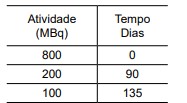
O elemento que se forma nesse decaimento radioativo e a meia-vida do radioisótopo ferro-59 são:
Para estudar a cinética da reação entre o cloreto de metila (CH₃Cl) e o cloro (Cl₂), representada pela equação:
CH₃Cl(g) + 3Cl₂(g) → CCl₄(g) + 3HCl (g)
foram realizados experimentos, e os dados de concentração e rapidez (velocidade inicial) da reação em relação à formação dos reagentes são mostrados na tabela a seguir:
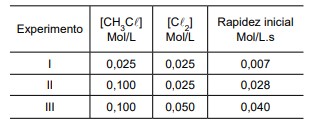
Considerando 2√2 = 1,4, as ordens de reação para o cloreto de metila e para o cloro são, respectivamente,
Considere a equação 1, que representa a reação de um dos processos de obtenção de ferro (Fe) metálico a partir do óxido de ferro (III) (Fe₂O₃).
Equação 1
Fe₂O₃(s) + 3CO(g) → 2Fe(s) + 3CO₂(g)
A partir do dado de entalpia padrão de formação do óxido de ferro (III), ΔHºformação Fe2O3(s) = – 824 kJ/mol, e da informação da entalpia da reação representada pela equação 2:
Equação 2
CO(g) + ½ O₂(g) → CO₂(g) ΔH°reação = −283 kJ/mol
A entalpia da reação representada pela equação 1 é igual a
A verificação do efeito de diferentes solutos na temperatura de ebulição (TE) de soluções foi feita em um experimento de química com as soluções 1, 2 e 3 mostradas na figura. Utilizou-se água destilada na preparação das soluções e todas foram submetidas ao aquecimento nas mesmas condições. Iniciada a ebulição, anotaram-se os respectivos valores da temperatura de ebulição para a solução 1 (TE1), para a solução 2 (TE2) e para a solução 3 (TE3).
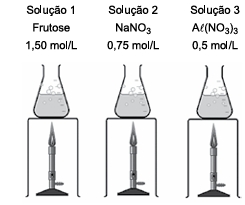
(Arquivo pessoal; imagem usada com autorização)
Ao final do experimento, é possível estabelecer a seguinte relação entre as temperaturas de ebulição das soluções 1, 2 e 3:
A análise elementar é uma técnica empregada para determinação da fórmula empírica de compostos orgânicos e se baseia na reação de combustão de composto, em excesso de oxigênio. Um composto orgânico, que é formado por carbono, oxigênio e hidrogênio foi analisado por meio dessa técnica. Uma amostra com massa correspondente a 0,050 mol do composto foi empregada nessa análise e foram formados 0,80 mol de dióxido de carbono e 0,30 mol de água. O teor de oxigênio da amostra (O) foi calculado e correspondeu a 6,4 g.
A fórmula mínima do composto analisado é:
A substância AyXbZw é um sólido cristalino, e a sua célula unitária está representada na figura.
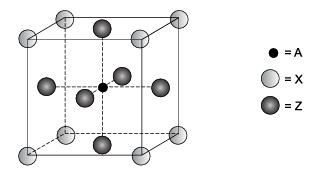
(Arquivo pessoal; imagem usada com autorização)
A fórmula unitária da substância AyXbZw é:
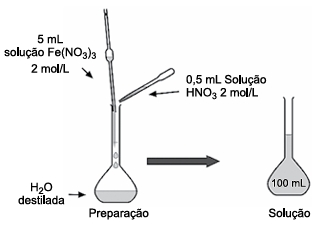
(Arquivo pessoal; imagem usada com autorização)
A concentração de íons nitrato na solução preparada é igual a
A Teoria da Ligação de Valência considera que a ligação covalente resulta da sobreposição de orbitais atômicos semipreenchidos, com formação de pares eletrônicos compartilhados.
Com base nessa teoria, o conjunto de orbitais híbridos do átomo central que participam na formação das ligações químicas nas moléculas BCl3 e PCl5 são, respectivamente,
Um diagrama de célula galvânica elaborado a partir das convenções da IUPAC é representado a seguir:
Sn (s) | Sn²⁺ (aq) || NO (g) | NO₃⁻ (aq), H⁺ (aq) | Pt (s)
As equações das semirreações de redução e os potenciais padrão de redução, E°, referentes a essa célula galvânica, são:
Nas condições padrão, o potencial dessa célula galvânica (ddp) e a espécie que é oxidada sã
Em um experimento de química, uma solução contendo íons oxalato (C2 O4 2– ) em meio ácido foi misturada a uma solução contendo íons permanganato (MnO4 – ) que tem coloração violeta. A interação entre essas duas soluções resultou em desprendimento de gás carbônico (CO2 ) e desaparecimento da cor violeta, com a formação de uma solução incolor contendo íons manganês (II). A reação foi equacionada, empregando-se o método íon-elétron e verificou-se que para cada 2 mol de íons permanganato, _________mol de íons H+ reagiram e foram formados __________ mol de gás carbônico.
Assinale a alternativa que completa, correta e respectivamente, as lacunas.

 Conheça nossos planos