Foram encontradas 667 questões
Resolva questões gratuitamente!
Junte-se a mais de 4 milhões de concurseiros!



Escolha a alternativa cuja oração possui o mesmo emprego da voz verbal presente na tirinha de Laerte.
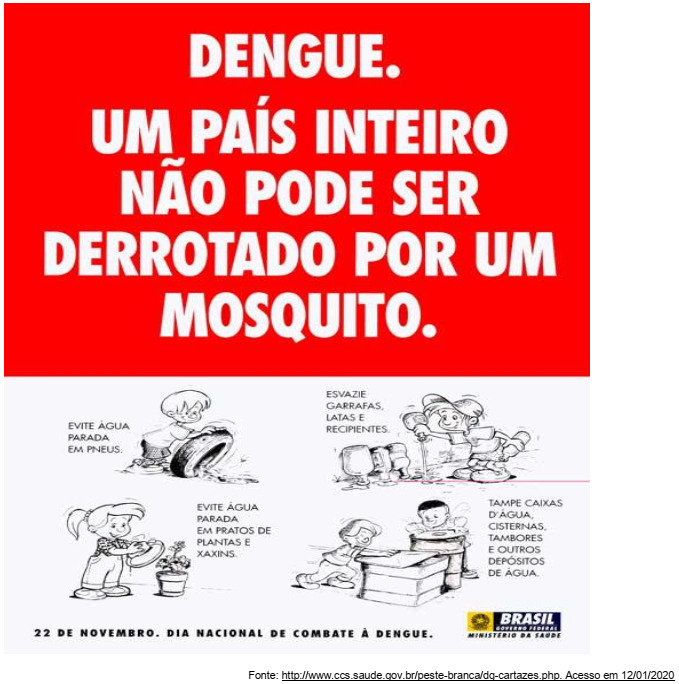
Na chamada do anúncio publicitário, excetuando-se a palavra “Dengue”, qual a função, respectivamente, dos
termos “Um país inteiro” e “por um mosquito”?
Analise os diferentes textos abaixo:

Texto II:
“Silêncio, paciência e atenção nos apontam o caminho da escuta atenta”.
Texto III:

Fonte: http://www.dobradinhacomics.com/2014/11/tirinha-nao-rpg-136-sabio.html. Acesso em 06/01/2020
Considere as seguintes proposições abaixo:
I. O vocábulo “escuta” não exerce a mesma função sintática no texto I e II.
II. No texto I, o vocábulo “sábio” exerce a função de predicativo do sujeito.
III. No texto III (1º quadrinho), “sábio” é sujeito.
IV. O texto I é composto por três orações, já o texto II é composto, apenas, por uma oração.
Estão corretas:
Analise os dois textos abaixo:
Texto 1:
Aracy Pereira S. BALBANI1 Doutora em Medicina pela Universidade de São Paulo (USP); Médica Otorrinolaringologista, Tatuí, SP, Brasil
A expansão da rede de telefonia móvel, a praticidade desse meio de comunicação e a redução do preço dos aparelhos fizeram do Brasil o quinto maior mercado consumidor de celulares no mundo. Com o custo elevado da assinatura da linha residencial fixa, o celular passou, inclusive, a ser o único telefone em muitos lares brasileiros. Os celulares são atraentes para crianças e adolescentes e influenciam seu padrão de comportamento. Segundo pesquisa do Instituto WCF-Brasil, numa amostra de 66 meninas brasileiras de dez a 17 anos vítimas de exploração sexual, 65 % gastam o dinheiro que recebem pela prostituição em bens de consumo como roupas, telefone celular e tênis. Uma das meninas afirmou que “sem celular você não é ninguém”.
Fragmento retirado da Revista Paul Pediatr Nº3. Volume 1 – Jan/2013.
Texto 2:

Considere:
I. Os dois textos dialogam em algum aspecto
quanto ao assunto abordado.
II. Ambos os textos utilizam-se da função Referencial da linguagem.
III. O texto II utiliza-se da função Conativa da linguagem.
IV. No texto II, os verbos entrar, baixar e atualizar pertencem à 1ª conjugação e estão empregados no presente do modo indicativo.
V. Em “os celulares são atraentes para crianças e adolescentes...” temos uma oração com predicado nominal.
Está correta a alternativa:
Dado o texto abaixo, transcrito de uma entrevista, atente-se para a norma culta da língua e complete as lacunas com os conectivos adequados ao contexto:
“A Universidade é muito mais eficiente __________ a indústria __________ ela é o único organismo da sociedade __________ pode especular sem grande ônus. A Universidade é o único organismo __________ você pode abandonar uma pesquisa sem nenhum trauma [...]”.
A alternativa que preenche as lacunas deixando o texto coerente e coeso é:
Analise o fragmento oracional abaixo:
Emengarda, a forasteira deixou a família para trás e seguiu estrada afora.
Em relação à oração, considera-se INADEQUADO:
TERNURA
Rio de Janeiro, 1938
Eu te peço perdão por te amar de repente
Embora o meu amor seja uma velha canção nos teus ouvidos
Das horas que passei à sombra dos teus gestos
Bebendo em tua boca o perfume dos sorrisos
Das noites que vivi acalentado
Pela graça indizível dos teus passos eternamente fugindo
Trago a doçura dos que aceitam melancolicamente.
E posso te dizer que o grande afeto que te deixo
Não traz o exaspero das lágrimas nem a fascinação das promessas
Nem as misteriosas palavras dos véus da alma...
É um sossego, uma unção, um transbordamento de carícias E só te pede que te repouses quieta, muito quieta
E deixes que as mãos cálidas da noite encontrem sem fatalidade o olhar extático da aurora.
(Vinícius de Moraes)
Quanto aos termos acessórios da oração considere as nomenclaturas abaixo:
1. Adjunto Adverbial de Tempo
2. Adjunto Adverbial de lugar
3. Adjuntos Adverbiais.
4. Adjuntos Adnominais.
Atente-se às expressões em destaque:
– Têm a mesma função sintática: “dos sorrisos”, “das lágrimas”, “das promessas”, “da noite” e “da aurora”.
– “Eu te peço perdão por te amar de repente”.
– “Pela graça indizível dos teus passos eternamente fugindo / Trago a doçura dos que aceitam melancolicamente”.
– “Das horas que passei à sombra dos teus gestos”.
A correlação com as nomenclaturas deve ser, respectivamente:
Canção Amiga
(Carlos Drummond de Andrade)
Eu preparo uma canção
Em que minha mãe se reconheça
Todas as mães se reconheçam
E que fale como dois olhos
Caminho por uma rua
Que passa em muitos países
Se não me veem, eu vejo
E saúdo velhos amigos
Eu distribuo um segredo
Como quem ama ou sorri
No jeito mais natural
Dois carinhos se procuram
Minha vida, nossas vidas
Formam um só diamante
Aprendi novas palavras
E tornei outras mais belas
Eu preparo uma canção
Que faça acordar os homens
E adormecer as crianças.
Considere as proposições abaixo:
I. O primeiro verso da primeira estrofe é oração principal da oração que está no segundo verso.
II. O segundo verso da primeira estrofe classifica-se como oração subordinada adjetiva restritiva.
III. O segundo verso da terceira estrofe é uma oração subordinada adverbial causal.
É INCORRETO o que se afirma em:
After reading the text “ Coronavirus: who is most at risk?”, it is correct to state that:
Coronavirus: Who is most at-risk?
After the initial outbreak of the coronavirus in the Chinese city of Wuhan, medical professionals have examined what physiological archetypes and age groups might have a greater risk of contracting the disease, in an effort to educate the public.
Fox News spoke with Dr. Debra Chew, Assistant Professor of Medicine at Rutgers New Jersey Medical School, to gain a better understanding of the virus and how it behaves.
"Risks of contracting disease is based on epidemiologic exposure -- and therefore exposure to persons infected with the Wuhan Coronavirus, and those ill with respiratory symptoms who have travelled to Wuhan or neighbouring cities," she said. "This may expand with more cases and global travel.
(https://www.foxnews.com/health/coronavirus-who-is-most-atrisk)
“Atticus told me to delete the adjectives
and I'd have the facts” was removed from the book
“To Kill a Mockingbird” by Harper Lee.
Based on the quote from exercise 38, it is possible to state that:
– Atticus believes that adjectives are a disguise for the truth.
– Atticus believes that the facts are misled by the use of adjectives.
– Atticus suggested that, if you are looking for accuracy, adjectives should be taken into account.
– Once you acknowledge adjectives used to describe an event, you will have a raw understanding of the facts.
Which figure of speech is represented on the sentence:
"I think our country sinks beneath the yoke;
It weeps, it bleeds. IV. iii 39-40. (Macbeth, Shakespeare)
Australia fires: What's being done to fight the flames?
Large parts of Australia __________ (devastate) by the worst wildfires the country __________ (see) in decades, with huge blazes tearing through bush, woodland and national parks. Record-breaking temperatures and months of drought __________ (help) the fires burn an estimated 10 million hectares (100,000 sq km) of land since 1 July.
Bushfire conditions EASED over the weekend, giving fire crews a period of temporary respite. But authorities __________ (say) the huge fires will persist until there is substantial rainfall. More hot weather is __________ (expect) next week and the risk was far from over, they said. Thousands of firefighters are still battling blazes across large swathes of Australia - ranging in size from small fires to infernos burning across hectares of land. Entire towns have been engulfed and residents across several states have lost their homes. At least 28 people have died.
State and federal authorities have been working together to try to stem the spread. While they have managed to contain some within a matter of days, the biggest blazes have been burning for months.
At least 3,700 firefighters are on the ground at any one time across the country during the worst periods, according to the country's state fire services. Most are in the worst-hit states of New South Wales (NSW) and Victoria. When fires have been at their worst, about 2,700 firefighters have been battling the blazes at any one time in NSW alone. Ben Shepherd, of the NSW Rural Fire Service, said his colleagues had dealt with 4.2m hectares of burning land this season, compared with the typical 300,000 hectares. "It's been an incredibly long campaign," he said.
Fire crews across the country have been joined by 3,000 army, navy and air force reservists who are assisting with search and rescue and clean-up efforts. Further support coming from the US, Canada, and New Zealand, who have sent additional teams and equipment to help.
(https://www.bbc.com/news/world-australia-51008051 )
Australia fires: What's being done to fight the flames?
Large parts of Australia __________ (devastate) by the worst wildfires the country __________ (see) in decades, with huge blazes tearing through bush, woodland and national parks. Record-breaking temperatures and months of drought __________ (help) the fires burn an estimated 10 million hectares (100,000 sq km) of land since 1 July.
Bushfire conditions EASED over the weekend, giving fire crews a period of temporary respite. But authorities __________ (say) the huge fires will persist until there is substantial rainfall. More hot weather is __________ (expect) next week and the risk was far from over, they said. Thousands of firefighters are still battling blazes across large swathes of Australia - ranging in size from small fires to infernos burning across hectares of land. Entire towns have been engulfed and residents across several states have lost their homes. At least 28 people have died.
State and federal authorities have been working together to try to stem the spread. While they have managed to contain some within a matter of days, the biggest blazes have been burning for months.
At least 3,700 firefighters are on the ground at any one time across the country during the worst periods, according to the country's state fire services. Most are in the worst-hit states of New South Wales (NSW) and Victoria. When fires have been at their worst, about 2,700 firefighters have been battling the blazes at any one time in NSW alone. Ben Shepherd, of the NSW Rural Fire Service, said his colleagues had dealt with 4.2m hectares of burning land this season, compared with the typical 300,000 hectares. "It's been an incredibly long campaign," he said.
Fire crews across the country have been joined by 3,000 army, navy and air force reservists who are assisting with search and rescue and clean-up efforts. Further support coming from the US, Canada, and New Zealand, who have sent additional teams and equipment to help.
(https://www.bbc.com/news/world-australia-51008051 )
Australia fires: What's being done to fight the flames?
Large parts of Australia __________ (devastate) by the worst wildfires the country __________ (see) in decades, with huge blazes tearing through bush, woodland and national parks. Record-breaking temperatures and months of drought __________ (help) the fires burn an estimated 10 million hectares (100,000 sq km) of land since 1 July.
Bushfire conditions EASED over the weekend, giving fire crews a period of temporary respite. But authorities __________ (say) the huge fires will persist until there is substantial rainfall. More hot weather is __________ (expect) next week and the risk was far from over, they said. Thousands of firefighters are still battling blazes across large swathes of Australia - ranging in size from small fires to infernos burning across hectares of land. Entire towns have been engulfed and residents across several states have lost their homes. At least 28 people have died.
State and federal authorities have been working together to try to stem the spread. While they have managed to contain some within a matter of days, the biggest blazes have been burning for months.
At least 3,700 firefighters are on the ground at any one time across the country during the worst periods, according to the country's state fire services. Most are in the worst-hit states of New South Wales (NSW) and Victoria. When fires have been at their worst, about 2,700 firefighters have been battling the blazes at any one time in NSW alone. Ben Shepherd, of the NSW Rural Fire Service, said his colleagues had dealt with 4.2m hectares of burning land this season, compared with the typical 300,000 hectares. "It's been an incredibly long campaign," he said.
Fire crews across the country have been joined by 3,000 army, navy and air force reservists who are assisting with search and rescue and clean-up efforts. Further support coming from the US, Canada, and New Zealand, who have sent additional teams and equipment to help.
(https://www.bbc.com/news/world-australia-51008051 )
Off to 'big school'? Some pupils need extra support, says Ofsted
Primary schools should identify pupils whose behaviour may be at risk of deteriorating when they reach secondary school, a report for Ofsted suggests. Head teachers told Ofsted some pupils could struggle more than others with the move to "big school" and might benefit from extra support. This could be offered to help minimise the risk of such pupils misbehaving when they arrive, they said. It comes as thousands of pupils have just started secondary school. England's education watchdog, Ofsted, has announced a new push on behaviour management for teachers.
Ofsted says it will be adopting a new focus on behaviour management when it inspects teacher training providers. Its aim is to ensure that teachers are well trained in principles of behaviour management, so that all pupils can be offered quality education. Poor behaviour is increasingly seen as a communication of need, rather than a child simply being badly behaved.
Ofsted chief inspector Amanda Spielman said: "Positive behaviour needs to be taught as early on as possible, and expectations raised as children get older. “For some pupils, going from a relatively small primary community, where you're known by everyone and where you have a close relationship with a small number of teachers, to a much larger secondary school with several teachers, will be particularly challenging," she added. "The schools in our sample felt that it was important to identify pupils who were particularly at risk well before they started secondary school, so that they could provide appropriate support and prepare them for life in the 'big school'. "
The aim is to prevent pupils from falling behind as they struggle with the transition, which head teachers said could lead to a SPIKE in challenging behaviour. But the report was keen to point out that early identification of potential issues should not result in secondary schools discouraging entries from certain pupils. Ms Spielman is clear that good behaviour benefits everyone, by providing a positive setting for learning.
( hdttps://www.bbc.com/news/education-49661576 )
Off to 'big school'? Some pupils need extra support, says Ofsted
Primary schools should identify pupils whose behaviour may be at risk of deteriorating when they reach secondary school, a report for Ofsted suggests. Head teachers told Ofsted some pupils could struggle more than others with the move to "big school" and might benefit from extra support. This could be offered to help minimise the risk of such pupils misbehaving when they arrive, they said. It comes as thousands of pupils have just started secondary school. England's education watchdog, Ofsted, has announced a new push on behaviour management for teachers.
Ofsted says it will be adopting a new focus on behaviour management when it inspects teacher training providers. Its aim is to ensure that teachers are well trained in principles of behaviour management, so that all pupils can be offered quality education. Poor behaviour is increasingly seen as a communication of need, rather than a child simply being badly behaved.
Ofsted chief inspector Amanda Spielman said: "Positive behaviour needs to be taught as early on as possible, and expectations raised as children get older. “For some pupils, going from a relatively small primary community, where you're known by everyone and where you have a close relationship with a small number of teachers, to a much larger secondary school with several teachers, will be particularly challenging," she added. "The schools in our sample felt that it was important to identify pupils who were particularly at risk well before they started secondary school, so that they could provide appropriate support and prepare them for life in the 'big school'. "
The aim is to prevent pupils from falling behind as they struggle with the transition, which head teachers said could lead to a SPIKE in challenging behaviour. But the report was keen to point out that early identification of potential issues should not result in secondary schools discouraging entries from certain pupils. Ms Spielman is clear that good behaviour benefits everyone, by providing a positive setting for learning.
( hdttps://www.bbc.com/news/education-49661576 )

 Conheça nossos planos