Foram encontradas 488 questões
Resolva questões gratuitamente!
Junte-se a mais de 4 milhões de concurseiros!


Para responder à questão, leia o texto abaixo.
How Will You Get from How Things Are to How Things "Should" Be?
A lot of people get fixated on things that they think "should" happen, but fail to address substantial obstacles in the way. I may even agree with them about what I think "should" happen. But that doesn't mean that it's going to happen. If you're thinking that there is also a danger in being overly cautious or waiting to work out the perfect plan, you're right. That can become a form of procrastination. Acting on an imperfect plan is usually better than waiting until you've worked out every last detail. But at least have some kind of plan that doesn't require a miracle to happen.
The plan that works will also probably not be the plan you started with. You will have to update the plan as you proceed and the situation evolves.
A good model for this process is John Boyd's OODA decision making loop. OODA stands for Observe, Orient, Decide, Act. Actions produce responses that provide new information. New information requires reorientation and new decisions will have to be made that lead to new actions, and the loop repeats.
No big changes happened because a bunch of people sat around complaining about how things "should be."
That's like saying "l should be a millionaire." You could be, but you're going to need some kind of plan to get there that realistically acknowledges the obstacles in your way.
Many of the problems we face today took years to create.
We have inherited a big mess. A lot of things happened that "should not" have happened. Mistakes were made.
But that's life. It's going to throw all kinds of things at you that are sub-optimal. Things you didn't "deserve" or ask for. Cleaning up messes you didn't create is as normal as dealing with bad weather.
Some messes only require a dustpan.
But if you want to clean up a really big mess, you're going to need a plan.
Fonte: https://mrjackdonovan.substack.com/p/the-flow-chart
Para responder à questão, leia o texto abaixo.
How Will You Get from How Things Are to How Things "Should" Be?
A lot of people get fixated on things that they think "should" happen, but fail to address substantial obstacles in the way. I may even agree with them about what I think "should" happen. But that doesn't mean that it's going to happen. If you're thinking that there is also a danger in being overly cautious or waiting to work out the perfect plan, you're right. That can become a form of procrastination. Acting on an imperfect plan is usually better than waiting until you've worked out every last detail. But at least have some kind of plan that doesn't require a miracle to happen.
The plan that works will also probably not be the plan you started with. You will have to update the plan as you proceed and the situation evolves.
A good model for this process is John Boyd's OODA decision making loop. OODA stands for Observe, Orient, Decide, Act. Actions produce responses that provide new information. New information requires reorientation and new decisions will have to be made that lead to new actions, and the loop repeats.
No big changes happened because a bunch of people sat around complaining about how things "should be."
That's like saying "l should be a millionaire." You could be, but you're going to need some kind of plan to get there that realistically acknowledges the obstacles in your way.
Many of the problems we face today took years to create.
We have inherited a big mess. A lot of things happened that "should not" have happened. Mistakes were made.
But that's life. It's going to throw all kinds of things at you that are sub-optimal. Things you didn't "deserve" or ask for. Cleaning up messes you didn't create is as normal as dealing with bad weather.
Some messes only require a dustpan.
But if you want to clean up a really big mess, you're going to need a plan.
Fonte: https://mrjackdonovan.substack.com/p/the-flow-chart
Para responder à questão, leia o texto abaixo.
How Will You Get from How Things Are to How Things "Should" Be?
A lot of people get fixated on things that they think "should" happen, but fail to address substantial obstacles in the way. I may even agree with them about what I think "should" happen. But that doesn't mean that it's going to happen. If you're thinking that there is also a danger in being overly cautious or waiting to work out the perfect plan, you're right. That can become a form of procrastination. Acting on an imperfect plan is usually better than waiting until you've worked out every last detail. But at least have some kind of plan that doesn't require a miracle to happen.
The plan that works will also probably not be the plan you started with. You will have to update the plan as you proceed and the situation evolves.
A good model for this process is John Boyd's OODA decision making loop. OODA stands for Observe, Orient, Decide, Act. Actions produce responses that provide new information. New information requires reorientation and new decisions will have to be made that lead to new actions, and the loop repeats.
No big changes happened because a bunch of people sat around complaining about how things "should be."
That's like saying "l should be a millionaire." You could be, but you're going to need some kind of plan to get there that realistically acknowledges the obstacles in your way.
Many of the problems we face today took years to create.
We have inherited a big mess. A lot of things happened that "should not" have happened. Mistakes were made.
But that's life. It's going to throw all kinds of things at you that are sub-optimal. Things you didn't "deserve" or ask for. Cleaning up messes you didn't create is as normal as dealing with bad weather.
Some messes only require a dustpan.
But if you want to clean up a really big mess, you're going to need a plan.
Fonte: https://mrjackdonovan.substack.com/p/the-flow-chart
Analyze the sentence below:
Instead of waiting _________ the perfect strategy you should act ________ an imperíect one and reorient based ________ the results.
Which combination CORRECTLY completes the following summary of the author's advice?
Para responder à questão, leia o texto abaixo.
How Will You Get from How Things Are to How Things "Should" Be?
A lot of people get fixated on things that they think "should" happen, but fail to address substantial obstacles in the way. I may even agree with them about what I think "should" happen. But that doesn't mean that it's going to happen. If you're thinking that there is also a danger in being overly cautious or waiting to work out the perfect plan, you're right. That can become a form of procrastination. Acting on an imperfect plan is usually better than waiting until you've worked out every last detail. But at least have some kind of plan that doesn't require a miracle to happen.
The plan that works will also probably not be the plan you started with. You will have to update the plan as you proceed and the situation evolves.
A good model for this process is John Boyd's OODA decision making loop. OODA stands for Observe, Orient, Decide, Act. Actions produce responses that provide new information. New information requires reorientation and new decisions will have to be made that lead to new actions, and the loop repeats.
No big changes happened because a bunch of people sat around complaining about how things "should be."
That's like saying "l should be a millionaire." You could be, but you're going to need some kind of plan to get there that realistically acknowledges the obstacles in your way.
Many of the problems we face today took years to create.
We have inherited a big mess. A lot of things happened that "should not" have happened. Mistakes were made.
But that's life. It's going to throw all kinds of things at you that are sub-optimal. Things you didn't "deserve" or ask for. Cleaning up messes you didn't create is as normal as dealing with bad weather.
Some messes only require a dustpan.
But if you want to clean up a really big mess, you're going to need a plan.
Fonte: https://mrjackdonovan.substack.com/p/the-flow-chart
Para responder à questão, leia o texto abaixo.
How Will You Get from How Things Are to How Things "Should" Be?
A lot of people get fixated on things that they think "should" happen, but fail to address substantial obstacles in the way. I may even agree with them about what I think "should" happen. But that doesn't mean that it's going to happen. If you're thinking that there is also a danger in being overly cautious or waiting to work out the perfect plan, you're right. That can become a form of procrastination. Acting on an imperfect plan is usually better than waiting until you've worked out every last detail. But at least have some kind of plan that doesn't require a miracle to happen.
The plan that works will also probably not be the plan you started with. You will have to update the plan as you proceed and the situation evolves.
A good model for this process is John Boyd's OODA decision making loop. OODA stands for Observe, Orient, Decide, Act. Actions produce responses that provide new information. New information requires reorientation and new decisions will have to be made that lead to new actions, and the loop repeats.
No big changes happened because a bunch of people sat around complaining about how things "should be."
That's like saying "l should be a millionaire." You could be, but you're going to need some kind of plan to get there that realistically acknowledges the obstacles in your way.
Many of the problems we face today took years to create.
We have inherited a big mess. A lot of things happened that "should not" have happened. Mistakes were made.
But that's life. It's going to throw all kinds of things at you that are sub-optimal. Things you didn't "deserve" or ask for. Cleaning up messes you didn't create is as normal as dealing with bad weather.
Some messes only require a dustpan.
But if you want to clean up a really big mess, you're going to need a plan.
Fonte: https://mrjackdonovan.substack.com/p/the-flow-chart
Para responder à questão, leia o texto abaixo.
How Will You Get from How Things Are to How Things "Should" Be?
A lot of people get fixated on things that they think "should" happen, but fail to address substantial obstacles in the way. I may even agree with them about what I think "should" happen. But that doesn't mean that it's going to happen. If you're thinking that there is also a danger in being overly cautious or waiting to work out the perfect plan, you're right. That can become a form of procrastination. Acting on an imperfect plan is usually better than waiting until you've worked out every last detail. But at least have some kind of plan that doesn't require a miracle to happen.
The plan that works will also probably not be the plan you started with. You will have to update the plan as you proceed and the situation evolves.
A good model for this process is John Boyd's OODA decision making loop. OODA stands for Observe, Orient, Decide, Act. Actions produce responses that provide new information. New information requires reorientation and new decisions will have to be made that lead to new actions, and the loop repeats.
No big changes happened because a bunch of people sat around complaining about how things "should be."
That's like saying "l should be a millionaire." You could be, but you're going to need some kind of plan to get there that realistically acknowledges the obstacles in your way.
Many of the problems we face today took years to create.
We have inherited a big mess. A lot of things happened that "should not" have happened. Mistakes were made.
But that's life. It's going to throw all kinds of things at you that are sub-optimal. Things you didn't "deserve" or ask for. Cleaning up messes you didn't create is as normal as dealing with bad weather.
Some messes only require a dustpan.
But if you want to clean up a really big mess, you're going to need a plan.
Fonte: https://mrjackdonovan.substack.com/p/the-flow-chart
Analyze the sentence below
Once an action ________, it _________feedback that ________ the next deciston.
Regarding this, select the sequence that CORRECTLY fills the blanks in this OODA loop description.
Para responder à questão, leia o texto abaixo.
How Will You Get from How Things Are to How Things "Should" Be?
A lot of people get fixated on things that they think "should" happen, but fail to address substantial obstacles in the way. I may even agree with them about what I think "should" happen. But that doesn't mean that it's going to happen. If you're thinking that there is also a danger in being overly cautious or waiting to work out the perfect plan, you're right. That can become a form of procrastination. Acting on an imperfect plan is usually better than waiting until you've worked out every last detail. But at least have some kind of plan that doesn't require a miracle to happen.
The plan that works will also probably not be the plan you started with. You will have to update the plan as you proceed and the situation evolves.
A good model for this process is John Boyd's OODA decision making loop. OODA stands for Observe, Orient, Decide, Act. Actions produce responses that provide new information. New information requires reorientation and new decisions will have to be made that lead to new actions, and the loop repeats.
No big changes happened because a bunch of people sat around complaining about how things "should be."
That's like saying "l should be a millionaire." You could be, but you're going to need some kind of plan to get there that realistically acknowledges the obstacles in your way.
Many of the problems we face today took years to create.
We have inherited a big mess. A lot of things happened that "should not" have happened. Mistakes were made.
But that's life. It's going to throw all kinds of things at you that are sub-optimal. Things you didn't "deserve" or ask for. Cleaning up messes you didn't create is as normal as dealing with bad weather.
Some messes only require a dustpan.
But if you want to clean up a really big mess, you're going to need a plan.
Fonte: https://mrjackdonovan.substack.com/p/the-flow-chart
Analyze the sentence below:
If you _______ to become a millionaire, you _________ to develop a plan that accounts for realíty, rather than just comp/aining.
Choose the alternative that CORRECTLY completes the logic of the millionaire analogy.
Para responder à questão, leia o texto abaixo.
How Will You Get from How Things Are to How Things "Should" Be?
A lot of people get fixated on things that they think "should" happen, but fail to address substantial obstacles in the way. I may even agree with them about what I think "should" happen. But that doesn't mean that it's going to happen. If you're thinking that there is also a danger in being overly cautious or waiting to work out the perfect plan, you're right. That can become a form of procrastination. Acting on an imperfect plan is usually better than waiting until you've worked out every last detail. But at least have some kind of plan that doesn't require a miracle to happen.
The plan that works will also probably not be the plan you started with. You will have to update the plan as you proceed and the situation evolves.
A good model for this process is John Boyd's OODA decision making loop. OODA stands for Observe, Orient, Decide, Act. Actions produce responses that provide new information. New information requires reorientation and new decisions will have to be made that lead to new actions, and the loop repeats.
No big changes happened because a bunch of people sat around complaining about how things "should be."
That's like saying "l should be a millionaire." You could be, but you're going to need some kind of plan to get there that realistically acknowledges the obstacles in your way.
Many of the problems we face today took years to create.
We have inherited a big mess. A lot of things happened that "should not" have happened. Mistakes were made.
But that's life. It's going to throw all kinds of things at you that are sub-optimal. Things you didn't "deserve" or ask for. Cleaning up messes you didn't create is as normal as dealing with bad weather.
Some messes only require a dustpan.
But if you want to clean up a really big mess, you're going to need a plan.
Fonte: https://mrjackdonovan.substack.com/p/the-flow-chart
Reconstruct the following segments into a logically and grammatically sound sentence that aligns with the author's argument:
a / realistic / you / if / want,/ success / need / plan / that / acknowledges / obstacles
Regarding this, mark the alternative that presents the CORRECT sentence structure.
Para responder à questão, leia o texto abaixo.
How Will You Get from How Things Are to How Things "Should" Be?
A lot of people get fixated on things that they think "should" happen, but fail to address substantial obstacles in the way. I may even agree with them about what I think "should" happen. But that doesn't mean that it's going to happen. If you're thinking that there is also a danger in being overly cautious or waiting to work out the perfect plan, you're right. That can become a form of procrastination. Acting on an imperfect plan is usually better than waiting until you've worked out every last detail. But at least have some kind of plan that doesn't require a miracle to happen.
The plan that works will also probably not be the plan you started with. You will have to update the plan as you proceed and the situation evolves.
A good model for this process is John Boyd's OODA decision making loop. OODA stands for Observe, Orient, Decide, Act. Actions produce responses that provide new information. New information requires reorientation and new decisions will have to be made that lead to new actions, and the loop repeats.
No big changes happened because a bunch of people sat around complaining about how things "should be."
That's like saying "l should be a millionaire." You could be, but you're going to need some kind of plan to get there that realistically acknowledges the obstacles in your way.
Many of the problems we face today took years to create.
We have inherited a big mess. A lot of things happened that "should not" have happened. Mistakes were made.
But that's life. It's going to throw all kinds of things at you that are sub-optimal. Things you didn't "deserve" or ask for. Cleaning up messes you didn't create is as normal as dealing with bad weather.
Some messes only require a dustpan.
But if you want to clean up a really big mess, you're going to need a plan.
Fonte: https://mrjackdonovan.substack.com/p/the-flow-chart
Based on a rigorous critical appraisal of the text's argumentative framework and logical progression, analyze the assertions below:
I. The OODA decision-making loop functions as a permanent, static mechanism where a single isolated action definitively concludes the operational cycle.
II. The author draws a direct analogy to assert that clearing away messes for which one bears no direct responsibility is a routine, inescapable reality of existence.
III. The author warns that prioritizing extreme caution while waiting to craft a flawless blueprint can deteriorate into counterproductive procrastination.
Which of the following statements islare CORRECT?
Para responder à questão, leia o texto abaixo.
How Will You Get from How Things Are to How Things "Should" Be?
A lot of people get fixated on things that they think "should" happen, but fail to address substantial obstacles in the way. I may even agree with them about what I think "should" happen. But that doesn't mean that it's going to happen. If you're thinking that there is also a danger in being overly cautious or waiting to work out the perfect plan, you're right. That can become a form of procrastination. Acting on an imperfect plan is usually better than waiting until you've worked out every last detail. But at least have some kind of plan that doesn't require a miracle to happen.
The plan that works will also probably not be the plan you started with. You will have to update the plan as you proceed and the situation evolves.
A good model for this process is John Boyd's OODA decision making loop. OODA stands for Observe, Orient, Decide, Act. Actions produce responses that provide new information. New information requires reorientation and new decisions will have to be made that lead to new actions, and the loop repeats.
No big changes happened because a bunch of people sat around complaining about how things "should be."
That's like saying "l should be a millionaire." You could be, but you're going to need some kind of plan to get there that realistically acknowledges the obstacles in your way.
Many of the problems we face today took years to create.
We have inherited a big mess. A lot of things happened that "should not" have happened. Mistakes were made.
But that's life. It's going to throw all kinds of things at you that are sub-optimal. Things you didn't "deserve" or ask for. Cleaning up messes you didn't create is as normal as dealing with bad weather.
Some messes only require a dustpan.
But if you want to clean up a really big mess, you're going to need a plan.
Fonte: https://mrjackdonovan.substack.com/p/the-flow-chart
No planeta, ocorrem diferenças de temperatura e de pressão. Isso gera os movimentos de ar, isto é, os ventos que sopram das áreas mais f rias, chamadas anticiclonais, para as mais quentes, denominadas ciclonais. Com base no tema, da circulação geral da atmosfera, analise as assertivas abaixo e julgue-as em Verdadeiras (V) ou Falsas (F):
( ) A medida que a altitude aumenta em relação ao nível do mar, a pressão atmosférica também aumenta e o ar se torna mais denso e concentrado.
( ) Os ventos alísios são correntes de ar que sopram na atmosfera, em baixas altitudes das proximidades dos trópicos (região de anticiclone subtropical) para o Equador (região ciclonal de baixa pressão), levando umidade e provocando chuvas nessas áreas.
( ) A célula de Ferrel, situada entre as células de Hadley e Polar, apresenta circulação predominantemente indireta, ou seja, é impulsionada mecanicamente pelas células adjacentes, e não por convecção térmica direta como ocorre na célula de Hadley.
Qual alternativa preenche, CORRETAMENTE, de cima para baixo, os parênteses acima?
As categorias de análise da Geografia expressam diferentes formas de compreender a relação entre sociedade e a natureza, cada uma com um referencial teórico- metodológico próprio. Acerca do tema, associe corretamente os termos da Coluna 1 às suas respectivas definições, elencados na Coluna 2:
Coluna 1:
1. Espaço Geográfico.
2. Paisagem.
3. Lugar.
4. Território. 5. Região.
Coluna 2:
( ) Conjunto indissociável de sistemas de objetos (redes técnicas, prédios, ruas) e de sistemas de ações (organização do trabalho, produção, circulação, consumo de mercadorias, relações familiares e cotidianas) que procura revelar as práticas sociais dos diferentes grupos que nele produzem, lutam, sonham, vivem e fazem a vida caminhar.
( ) Porção do espaço definida pelas relações de poder, passando, assim, da delimitação natural e econômica para a de divisa social.
( ) Unidade visível do arranjo espacial, alcançado por nossa visão.
( ) Porção do espaço individualizada por um critério de homogeneidade natural, econômica ou cultural, que possibilita a comparação e a diferenciação entre áreas.
( ) Porção do espaço apropriável para a vida, que é vivido, reconhecido e cria identidade.
Qual alternativa preenche, CORRETAMENTE, de cima para baixo, os parênteses acima?
A Revolução Verde foi um movimento agrícola que transformou a produção alimentar no século XX e buscava combater a miséria e a fome nos países subdesenvolvidos. A ideia era introduzir novas técnicas agrícolas, como a utilização de insumos, fertilizantes e agrotóxicos, além da mecanização da produção. Com base nas principais características e objetivos associados à Revolução Verde, analise as seguintes assertivas:
I. A Revolução Verde, por concentrar-se na modernização de pequenas propriedades familiares e no fortalecimento da agricultura de subsistência, contribuiu para reduzir a concentração fundiária nos países.
II. Combater a fome no mundo, sendo também uma importante ferramenta para desfazer o ideal de que o número excessivo de pessoas no mundo poderia resultar na ausência de alimentos, que não aumentaria conforme o volume populacional.
III. As transformações geradas pela Revolução Verde basearam-se em melhoramento genético convencional de sementes e de produtos agrícolas para a obtenção de uma maior resistência a elementos externos, tais como o clima.
Das assertivas, pode-se afirmar que está(ão) CORRETA(S):
Preenche CORRETAMENTE a lacuna:
Representação gráfica em escala grande, destinada a fornecer informações detalhadas de uma determinada área suficientemente pequena para que a curvatura da Terra não seja considerada.
A descrição acima trata de qual conceito associado à Cartografia?
O desenvolvimento humano vai além do crescimento econômico, abrangendo condições essenciais da vida em sociedade, como saúde, educação, cidadania e meio ambiente. Para avaliar a qualidade de vida em escala global, utiliza-se um indicador estruturado em três dimensões principais: uma vida longa e saudável, o acesso ao conhecimento e um padrão de vida digno, conforme apresenta a imagem abaixo:
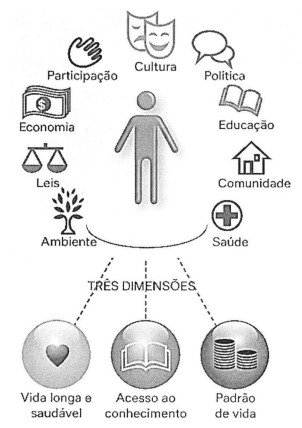
Com base na imagem e na descrição das três dimensões apresentadas acima, qual é o índice demográfico/socioeconômico associado a essas características?

 Conheça nossos planos