Foram encontradas 515 questões
Resolva questões gratuitamente!
Junte-se a mais de 4 milhões de concurseiros!


Ao traçar os gráficos das funções  é CORRETO que o valor da área em metros quadrado da figura hachurada abaixo
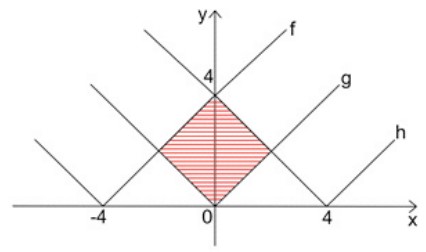
É igual a:
Um arquiteto constrói uma praça em forma de um triângulo ABC, de modo que o ângulo  satisfaz a relação
cos2 Â = sen2 Â + sen Â.
Se  > 30°, então, o ângulo  é igual a:
Deseja-se encher um tanque de água em forma de uma pirâmide, cuja a área da base da pirâmide é igual a 64m2 e uma seção transversal 2 feita a 3 metros da base, tem área igual a 16m2 Considerando-se que o volume V de água que cabe no tanque é exatamente igual ao volume da pirâmide, é CORRETO que o volume de água V em litros é igual a:
Sejam A e B conjuntos numéricos, com A possuindo 10 elementos e B possuindo x elementos. Denotando por P(A) e P(B) o número de subconjuntos de A e B, respectivamente, e por n(P(A)) e n(P(B)) o número de elementos de P(A) e P(B),se
n(P(B)) = n(P(A)) – 512,
É CORRETO afirmar que o valor de x é igual a:
Dadas as funções f(x) = x2 + 5x + 2, g (x) = ax + b, com  . Se f(g (x)) = g (f(x)), podemos afirmar que g (x) é igual a:
Seja S = 1/2 + 1/4 + 1/8 + ... e Y a soma das raízes da equação 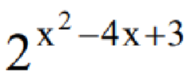 = S
= S
Determine o valor de a e b para que os sistemas (I) e (II), abaixo sejam equivalentes:

A resposta CORRETA é
A circunferência C2 de centro em (0,0) e raio 2cm é tangente a circunferência C1 no ponto A = (-2,0) e tangente a circunferência C3 no 2 1 3 ponto B = (2,0). A circunferência C1 possui centro em (-4,0) e a circunferência C3 tem centro em (4,0). Se denotarmos por S a soma das áreas dos três círculos, sendo que cada círculo é determinado pela circunferência C1 , C2 e C3 respectivamente, é CORRETO afirmar que o valor de S é igual a:
Um projetista faz uma maquete de um anel circular C, compreendido entre C1 e C2 sendo  e
e 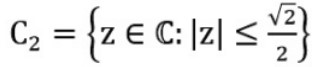 . Se as distâncias em C1 e C2 são calculadas em metros, é correto afirmar que a área do anel circular C é igual a:
Os irmãos João, José e Josué, abriram uma empresa de equipamentos eletrônicos e decidiram que o lucro seria proporcional a quantia que cada um investisse. João investiu R$ 30.000,00, José R$ 40.000,00 e Josué R$ 50.000,00. Se o lucro da empresa foi de R$ 90.000,00, quanto recebeu João, José e Josué, nessa ordem sabendo que a divisão foi proporcional a quantia investida.
Deseja-se colocar pedra em um jardim de forma retangular, no qual a altura do retângulo que representa esse jardim é igual 8m e o lado é igual a medida do lado de um quadrado de área igual a 144m2. No que se refere a pedra, se um metro quadrado da pedra custa R$ 25,00, 2 quanto será gasto para colocar pedra no jardim?
Um supermercado premia cada cliente que indique qual a porcentagem correspondente ao valor de R$ 384,00 do total de R$ 3.200,00. Receberá o prêmio quem apresentar como resposta:
Um casal gastou R$300,00 em um jantar, mas ainda lhes sobrou 3/5 do dinheiro que possuíam. Desse modo, quanto em dinheiro eles tinham inicialmente?
Sabendo que o determinante de uma matriz A = (aij)3x3 é igual a 16 e que o determinante de uma matriz C = (cij)3x3 é igual a 144, onde C = AB, se o detB = 3k, sendo 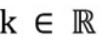 , então o valor de k é igual a:
Um fabricante de cervejas deseja armazenar a produção em um tanque em forma de um cubo, de lados medindo x metros. Se neste tanque o fabricante armazenou 27.000 litros de cervejas, é CORRETO afirmar que o valor de x é igual a:
TEXTV- Text for question.
What is blended learning and how does it work?
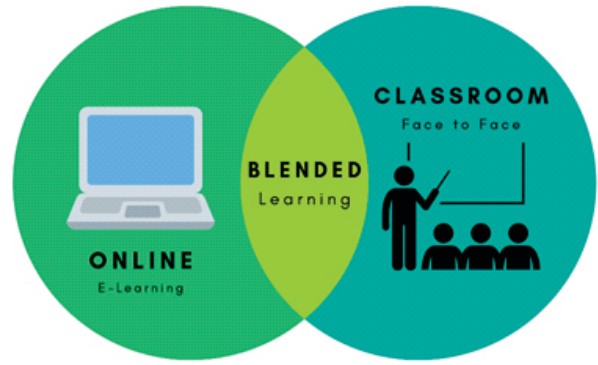
Image: https://www.tp.edu.sg/sii/individuals/blended-learning
Blended learning as an approach is not new. Indeed, the practice of combining (blending) different learning approaches and strategies is not new. Distance learning courses have long combined blended learning through a mix of self-access content (print/video/TV/ radio) and face-to-face/telephone support. 'Traditional' courses have always combined (and some still do) a variety of delivery modes that combine content such as lectures, seminars, tutorials, workshops and group work to give learners a range of learning opportunities. And of course, 'good teachers will always use more than one method or approach in their teaching, and good learners will always combine different strategies in their learning' (Marsh, 2012:3*).
So we could say that the term 'blended learning' refers to every time teachers mix different media (e.g. print, audio, and video) with classroom interaction, maximising authentic input in order to support learners' output and skills development. As such, blended learning has more or less always existed, although the term itself is a mere 15 years old at most, and is now understood to mean a rich, supportive learner-centred learning environment where the 'right blend' is synonymous with effective learning (and teaching).
What is new is that today, technology combines all the different media within one environment: online. The online space facilitates learner–learner interaction, encourages incidental and exploratory learning and allows learners and teachers to stay connected outside the classroom, if they so wish. Learners can benefit from the fact that space and distance do not matter any more. Teachers and educationalists are now understanding more and more that, with the 'right blend', teachers can offer a much richer, supportive learning environment, learning opportunities increase, learning becomes more effective and the learning process becomes more enjoyable.
There are many definitions for blended learning, but they all have the following in common: they refer to two different learning environments — face-to-face (synchronous) and online (asynchronous); and they refer to combining those two learning environments in a complementary way to deliver a programme of study so that learners can be supported both within the classroom environment and outside of it. In other words, the term blended learning refers to any programme of study that is delivered by appropriately combining both synchronous interactive study (usually face-to-face) and asynchronous (individual) study (usually online).
We could go further and say, 'It's in the blend!' That is, the key to a successful blended learning approach is to use the strengths of each medium appropriately, combining the two different learning environments in an integrated way so that each medium complements one another: the classroom environment being used for what it does best, such as introducing new topics, explaining important language points or for meaningful communicative activities, and the online environment being used for what it does best, such as preparing for the next topic (by watching a video/reading a text, etc.), and/or practising and consolidating what has been learnt in class or for extra practice. Both modes of delivery put the learner at the centre of the learning process.
(...)
*Marsh, D. Blended Learning: Creating Learning Opportunities for Language Learners. Cambridge: Cambridge University Press, 2012. (Adapted from: KING, A. Blended language learning: Part of the Cambridge Papers in ELTseries. [pdf] Cambridge: Cambridge University Press, 2016, p. 2.Available st at: http://languageresearch.cambridge.org/cambridge-papers-in-elt Accessed on October 31 , 2019).
In the first paragraph of the text, the verb tenses used are:
TEXTV- Text for question.
What is blended learning and how does it work?
Image: https://www.tp.edu.sg/sii/individuals/blended-learning
Blended learning as an approach is not new. Indeed, the practice of combining (blending) different learning approaches and strategies is not new. Distance learning courses have long combined blended learning through a mix of self-access content (print/video/TV/ radio) and face-to-face/telephone support. 'Traditional' courses have always combined (and some still do) a variety of delivery modes that combine content such as lectures, seminars, tutorials, workshops and group work to give learners a range of learning opportunities. And of course, 'good teachers will always use more than one method or approach in their teaching, and good learners will always combine different strategies in their learning' (Marsh, 2012:3*).
So we could say that the term 'blended learning' refers to every time teachers mix different media (e.g. print, audio, and video) with classroom interaction, maximising authentic input in order to support learners' output and skills development. As such, blended learning has more or less always existed, although the term itself is a mere 15 years old at most, and is now understood to mean a rich, supportive learner-centred learning environment where the 'right blend' is synonymous with effective learning (and teaching).
What is new is that today, technology combines all the different media within one environment: online. The online space facilitates learner–learner interaction, encourages incidental and exploratory learning and allows learners and teachers to stay connected outside the classroom, if they so wish. Learners can benefit from the fact that space and distance do not matter any more. Teachers and educationalists are now understanding more and more that, with the 'right blend', teachers can offer a much richer, supportive learning environment, learning opportunities increase, learning becomes more effective and the learning process becomes more enjoyable.
There are many definitions for blended learning, but they all have the following in common: they refer to two different learning environments — face-to-face (synchronous) and online (asynchronous); and they refer to combining those two learning environments in a complementary way to deliver a programme of study so that learners can be supported both within the classroom environment and outside of it. In other words, the term blended learning refers to any programme of study that is delivered by appropriately combining both synchronous interactive study (usually face-to-face) and asynchronous (individual) study (usually online).
We could go further and say, 'It's in the blend!' That is, the key to a successful blended learning approach is to use the strengths of each medium appropriately, combining the two different learning environments in an integrated way so that each medium complements one another: the classroom environment being used for what it does best, such as introducing new topics, explaining important language points or for meaningful communicative activities, and the online environment being used for what it does best, such as preparing for the next topic (by watching a video/reading a text, etc.), and/or practising and consolidating what has been learnt in class or for extra practice. Both modes of delivery put the learner at the centre of the learning process.
(...)
*Marsh, D. Blended Learning: Creating Learning Opportunities for Language Learners. Cambridge: Cambridge University Press, 2012. (Adapted from: KING, A. Blended language learning: Part of the Cambridge Papers in ELTseries. [pdf] Cambridge: Cambridge University Press, 2016, p. 2.Available st at: http://languageresearch.cambridge.org/cambridge-papers-in-elt Accessed on October 31 , 2019).
To King (2012), a successful blended learning approach mainly entails
TEXTV- Text for question.
What is blended learning and how does it work?
Image: https://www.tp.edu.sg/sii/individuals/blended-learning
Blended learning as an approach is not new. Indeed, the practice of combining (blending) different learning approaches and strategies is not new. Distance learning courses have long combined blended learning through a mix of self-access content (print/video/TV/ radio) and face-to-face/telephone support. 'Traditional' courses have always combined (and some still do) a variety of delivery modes that combine content such as lectures, seminars, tutorials, workshops and group work to give learners a range of learning opportunities. And of course, 'good teachers will always use more than one method or approach in their teaching, and good learners will always combine different strategies in their learning' (Marsh, 2012:3*).
So we could say that the term 'blended learning' refers to every time teachers mix different media (e.g. print, audio, and video) with classroom interaction, maximising authentic input in order to support learners' output and skills development. As such, blended learning has more or less always existed, although the term itself is a mere 15 years old at most, and is now understood to mean a rich, supportive learner-centred learning environment where the 'right blend' is synonymous with effective learning (and teaching).
What is new is that today, technology combines all the different media within one environment: online. The online space facilitates learner–learner interaction, encourages incidental and exploratory learning and allows learners and teachers to stay connected outside the classroom, if they so wish. Learners can benefit from the fact that space and distance do not matter any more. Teachers and educationalists are now understanding more and more that, with the 'right blend', teachers can offer a much richer, supportive learning environment, learning opportunities increase, learning becomes more effective and the learning process becomes more enjoyable.
There are many definitions for blended learning, but they all have the following in common: they refer to two different learning environments — face-to-face (synchronous) and online (asynchronous); and they refer to combining those two learning environments in a complementary way to deliver a programme of study so that learners can be supported both within the classroom environment and outside of it. In other words, the term blended learning refers to any programme of study that is delivered by appropriately combining both synchronous interactive study (usually face-to-face) and asynchronous (individual) study (usually online).
We could go further and say, 'It's in the blend!' That is, the key to a successful blended learning approach is to use the strengths of each medium appropriately, combining the two different learning environments in an integrated way so that each medium complements one another: the classroom environment being used for what it does best, such as introducing new topics, explaining important language points or for meaningful communicative activities, and the online environment being used for what it does best, such as preparing for the next topic (by watching a video/reading a text, etc.), and/or practising and consolidating what has been learnt in class or for extra practice. Both modes of delivery put the learner at the centre of the learning process.
(...)
*Marsh, D. Blended Learning: Creating Learning Opportunities for Language Learners. Cambridge: Cambridge University Press, 2012. (Adapted from: KING, A. Blended language learning: Part of the Cambridge Papers in ELTseries. [pdf] Cambridge: Cambridge University Press, 2016, p. 2.Available st at: http://languageresearch.cambridge.org/cambridge-papers-in-elt Accessed on October 31 , 2019).
Blended learning refers to
TEXT IV-
Answer question according to TEXT IV.
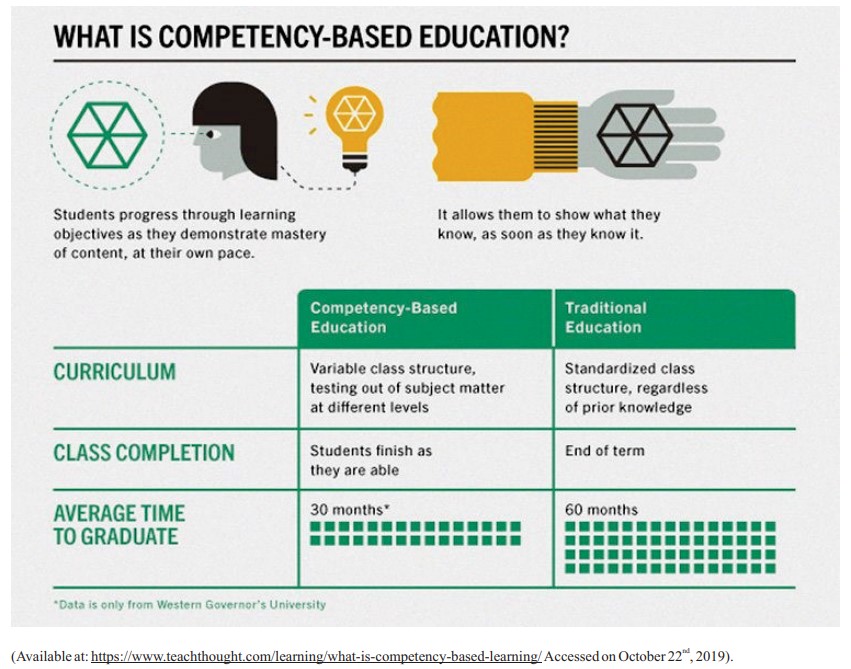
In the sentence “It allows them to show what they know, as soon as they know it”, the pronouns “It”, “them”, “they” and “it” (in bold) refer, respectively, to
TEXT IV-
Answer question according to TEXT IV.
According to the infographic, which of the sentences below is the CORRECT one?

 Conheça nossos planos