Questões de Concurso
Para prefeitura de areia - pb
Foram encontradas 512 questões
Resolva questões gratuitamente!
Junte-se a mais de 4 milhões de concurseiros!


TEXTIV- Text forquestion
QUOTATION
“Another important characteristic of the [National Curricular] Parameters that should not be overlooked is their emphasis on teacher's autonomy. This emphasis can be seen clearly in the fact that no content or method is imposed upon the teachers. What one can find are suggestions and relevant information for teachers to make their own decisions, taking into consideration the context within which they work. In other words, the Parameters do not force any teacher to limit their focus on the teaching of reading, if they believe they can go further than that” (ALMEIDA, 2012, p. 334).
(Source: ALMEIDA, Ricardo Luiz Teixeira de. The teaching of English as a foreign language in the context of Brazilian regular schools: a retrospective and prospective view of policies and practices. In: Revista Brasileira de Linguística Aplicada, Belo Horizonte, v. 12, nº 2, June, 2012, p. 331-348. Available at: th https://www.scielo.br/j/rbla/a/nNz3Jtj85xmms8MnNfwRpMn/?format=pdf&lang=en. Accessed on April 20 , 2022).
The adverb in the clause “This emphasis can be seen clearly […]” functions as a marker of:
TEXTIV- Text forquestion
QUOTATION
“Another important characteristic of the [National Curricular] Parameters that should not be overlooked is their emphasis on teacher's autonomy. This emphasis can be seen clearly in the fact that no content or method is imposed upon the teachers. What one can find are suggestions and relevant information for teachers to make their own decisions, taking into consideration the context within which they work. In other words, the Parameters do not force any teacher to limit their focus on the teaching of reading, if they believe they can go further than that” (ALMEIDA, 2012, p. 334).
(Source: ALMEIDA, Ricardo Luiz Teixeira de. The teaching of English as a foreign language in the context of Brazilian regular schools: a retrospective and prospective view of policies and practices. In: Revista Brasileira de Linguística Aplicada, Belo Horizonte, v. 12, nº 2, June, 2012, p. 331-348. Available at: th https://www.scielo.br/j/rbla/a/nNz3Jtj85xmms8MnNfwRpMn/?format=pdf&lang=en. Accessed on April 20 , 2022).
The word “overlooked” in the passage “Another important characteristic of the [National Curricular] Parameters that should not be overlooked is their emphasis on teacher's autonomy” is a SYNONYM of:
TEXTIV- Text forquestion
QUOTATION
“Another important characteristic of the [National Curricular] Parameters that should not be overlooked is their emphasis on teacher's autonomy. This emphasis can be seen clearly in the fact that no content or method is imposed upon the teachers. What one can find are suggestions and relevant information for teachers to make their own decisions, taking into consideration the context within which they work. In other words, the Parameters do not force any teacher to limit their focus on the teaching of reading, if they believe they can go further than that” (ALMEIDA, 2012, p. 334).
(Source: ALMEIDA, Ricardo Luiz Teixeira de. The teaching of English as a foreign language in the context of Brazilian regular schools: a retrospective and prospective view of policies and practices. In: Revista Brasileira de Linguística Aplicada, Belo Horizonte, v. 12, nº 2, June, 2012, p. 331-348. Available at: th https://www.scielo.br/j/rbla/a/nNz3Jtj85xmms8MnNfwRpMn/?format=pdf&lang=en. Accessed on April 20 , 2022).
Based on the quotation by Almeida (2012), we may state that:
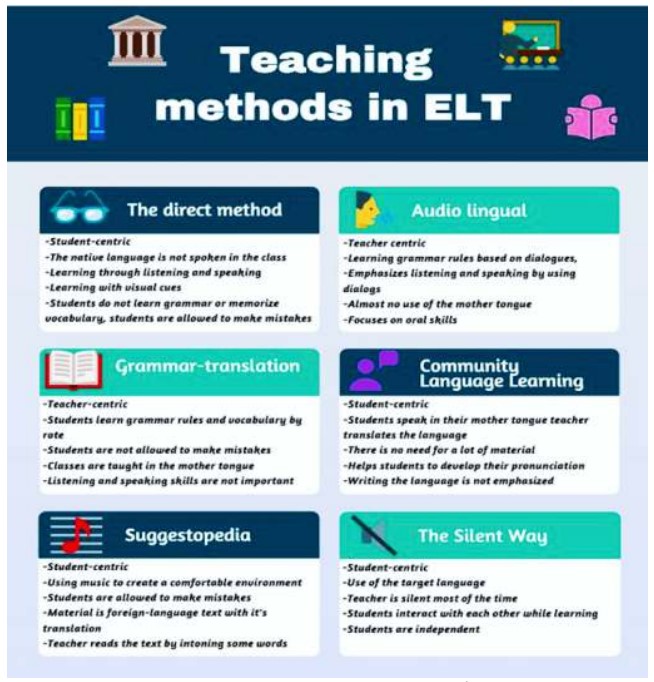
TEXTIII -
(Available at: https://br.pinterest.com/pin/251286854200451292/. Accessed on April 6 , 2022)
Answer question according to TEXTIII.
The expression “by rote” means:
TEXTIII -
(Available at: https://br.pinterest.com/pin/251286854200451292/. Accessed on April 6 , 2022)
Answer question according to TEXTIII.
The term “Suggestopedia” is an example of:
TEXTIII -
(Available at: https://br.pinterest.com/pin/251286854200451292/. Accessed on April 6 , 2022)
Answer question according to TEXTIII.
Mark the following statements as true (T) or false (F).
( ) Both Suggestopedia and Silent Way are examples of humanistic approaches to language learning.
( ) In Grammar-translation method, mistakes are considered part of the process of discovering the rules.
( ) Language alternation is a typical practice of CLL.
Choose the alternative with the CORRECT sequence:
TEXTIII -
(Available at: https://br.pinterest.com/pin/251286854200451292/. Accessed on April 6 , 2022)
Answer question according to TEXTIII.
In agreement with the infographic, we may state that:
TEXTII – Text forquestion.
Foreign Language Teaching in Brazil: interfaces of the CLIL (Content and Language Integrated Learning) approach in remote teaching
(Ana Lúcia Farias da Silva - 01/12/2021)
FINAL CONSIDERATIONS
English Language Teaching, in the modality of remote teaching, with the full use of Virtual Learning Environments (VLE) has advanced and can be efficient with the development of language skills associated with these technological and didactic resources appropriate to each objective in foreign language teaching. However, the teacher should have good planning, carefully reflecting and analyzing the tool that best suited to his/her goal.
Moreover, we postulate as indispensable the teaching of the English Language (EL), as a way of access to universal cultural goods, academic and professional environments of the globalized world, also considering an inclusive formation that leads the student to expand their readings of the world.
Moreover, classes, in real time, help in the cognitive process in relation to playing, dialoguing, in addition to awakening sensitivities such as visual and auditory perceptions, necessary for learning. Despite some flexibility, the use of English contributed to welcoming students in the mother tongue, which did not impair the learning of the proposed contents, on the contrary, it brought the students closer to the teacher-researcher, enabling a better work in language teaching. The results were perceived in the formal evaluations and in the engagement of the students during the classes, corroborating the pedagogical work that goes beyond teaching the contents and also goes through the ability of the educator to welcome and relate to his students.
Despite a pandemic moment, extremely challenging, especially for foreign language teaching, especially English, this research emphasized the need to follow the advancement of digital technologies and transform new challenges into knowledge, to optimize the adaptability of individuals, in view of the emerging educational contexts that have already been configured as a new reality at this time.
It is concluded, therefore, that according to the study presented and the current readings on foreign language teaching, in interface with multiple methods and possibilities in VLE, the new technological resources contribute and stimulate new didactic-pedagogical perspectives, in this panorama of remote teaching, driven by the pandemic. That said, it is possible to offer a teaching of the EL, in bilingual programs, in primary schools in Brazil today, even in elementary school, distance and quality, with priority to the development of all the language skills that an apprentice must activate, for significant and efficient foreign language learning.
(Adapted from: https://www.nucleodoconhecimento.com.br/education/interfaces-of-the-content. th Accessed on April 10 , 2022).
In the sentences “[…] the teacher should have good planning […]” and “[…] with priority to the development of all the language skills that an apprentice must activate […]”, the modal verbs express, respectively,
TEXTII – Text forquestion.
Foreign Language Teaching in Brazil: interfaces of the CLIL (Content and Language Integrated Learning) approach in remote teaching
(Ana Lúcia Farias da Silva - 01/12/2021)
FINAL CONSIDERATIONS
English Language Teaching, in the modality of remote teaching, with the full use of Virtual Learning Environments (VLE) has advanced and can be efficient with the development of language skills associated with these technological and didactic resources appropriate to each objective in foreign language teaching. However, the teacher should have good planning, carefully reflecting and analyzing the tool that best suited to his/her goal.
Moreover, we postulate as indispensable the teaching of the English Language (EL), as a way of access to universal cultural goods, academic and professional environments of the globalized world, also considering an inclusive formation that leads the student to expand their readings of the world.
Moreover, classes, in real time, help in the cognitive process in relation to playing, dialoguing, in addition to awakening sensitivities such as visual and auditory perceptions, necessary for learning. Despite some flexibility, the use of English contributed to welcoming students in the mother tongue, which did not impair the learning of the proposed contents, on the contrary, it brought the students closer to the teacher-researcher, enabling a better work in language teaching. The results were perceived in the formal evaluations and in the engagement of the students during the classes, corroborating the pedagogical work that goes beyond teaching the contents and also goes through the ability of the educator to welcome and relate to his students.
Despite a pandemic moment, extremely challenging, especially for foreign language teaching, especially English, this research emphasized the need to follow the advancement of digital technologies and transform new challenges into knowledge, to optimize the adaptability of individuals, in view of the emerging educational contexts that have already been configured as a new reality at this time.
It is concluded, therefore, that according to the study presented and the current readings on foreign language teaching, in interface with multiple methods and possibilities in VLE, the new technological resources contribute and stimulate new didactic-pedagogical perspectives, in this panorama of remote teaching, driven by the pandemic. That said, it is possible to offer a teaching of the EL, in bilingual programs, in primary schools in Brazil today, even in elementary school, distance and quality, with priority to the development of all the language skills that an apprentice must activate, for significant and efficient foreign language learning.
(Adapted from: https://www.nucleodoconhecimento.com.br/education/interfaces-of-the-content. th Accessed on April 10 , 2022).
The word “impair” in the passage “[…] which did not impair the learning of the proposed contents […]” is the OPPOSITE of:
TEXTII – Text forquestion.
Foreign Language Teaching in Brazil: interfaces of the CLIL (Content and Language Integrated Learning) approach in remote teaching
(Ana Lúcia Farias da Silva - 01/12/2021)
FINAL CONSIDERATIONS
English Language Teaching, in the modality of remote teaching, with the full use of Virtual Learning Environments (VLE) has advanced and can be efficient with the development of language skills associated with these technological and didactic resources appropriate to each objective in foreign language teaching. However, the teacher should have good planning, carefully reflecting and analyzing the tool that best suited to his/her goal.
Moreover, we postulate as indispensable the teaching of the English Language (EL), as a way of access to universal cultural goods, academic and professional environments of the globalized world, also considering an inclusive formation that leads the student to expand their readings of the world.
Moreover, classes, in real time, help in the cognitive process in relation to playing, dialoguing, in addition to awakening sensitivities such as visual and auditory perceptions, necessary for learning. Despite some flexibility, the use of English contributed to welcoming students in the mother tongue, which did not impair the learning of the proposed contents, on the contrary, it brought the students closer to the teacher-researcher, enabling a better work in language teaching. The results were perceived in the formal evaluations and in the engagement of the students during the classes, corroborating the pedagogical work that goes beyond teaching the contents and also goes through the ability of the educator to welcome and relate to his students.
Despite a pandemic moment, extremely challenging, especially for foreign language teaching, especially English, this research emphasized the need to follow the advancement of digital technologies and transform new challenges into knowledge, to optimize the adaptability of individuals, in view of the emerging educational contexts that have already been configured as a new reality at this time.
It is concluded, therefore, that according to the study presented and the current readings on foreign language teaching, in interface with multiple methods and possibilities in VLE, the new technological resources contribute and stimulate new didactic-pedagogical perspectives, in this panorama of remote teaching, driven by the pandemic. That said, it is possible to offer a teaching of the EL, in bilingual programs, in primary schools in Brazil today, even in elementary school, distance and quality, with priority to the development of all the language skills that an apprentice must activate, for significant and efficient foreign language learning.
(Adapted from: https://www.nucleodoconhecimento.com.br/education/interfaces-of-the-content. th Accessed on April 10 , 2022).
Based on Text II, analyze the following sentences and check True (T) or False (F).
( ) Asynchronous classes facilitate the cognitive process regarding some tasks which are necessary for learning.
( ) Through ELlearning, in which students might expand their readings of the world, an inclusive formation may also take place.
( ) As final remarks, the author defends the positive aspects of new digital technologies developed during the pandemic as a way of fostering meaningful foreign language learning.
Choose the alternative with the CORRECTsequence:
TEXTII – Text forquestion.
Foreign Language Teaching in Brazil: interfaces of the CLIL (Content and Language Integrated Learning) approach in remote teaching
(Ana Lúcia Farias da Silva - 01/12/2021)
FINAL CONSIDERATIONS
English Language Teaching, in the modality of remote teaching, with the full use of Virtual Learning Environments (VLE) has advanced and can be efficient with the development of language skills associated with these technological and didactic resources appropriate to each objective in foreign language teaching. However, the teacher should have good planning, carefully reflecting and analyzing the tool that best suited to his/her goal.
Moreover, we postulate as indispensable the teaching of the English Language (EL), as a way of access to universal cultural goods, academic and professional environments of the globalized world, also considering an inclusive formation that leads the student to expand their readings of the world.
Moreover, classes, in real time, help in the cognitive process in relation to playing, dialoguing, in addition to awakening sensitivities such as visual and auditory perceptions, necessary for learning. Despite some flexibility, the use of English contributed to welcoming students in the mother tongue, which did not impair the learning of the proposed contents, on the contrary, it brought the students closer to the teacher-researcher, enabling a better work in language teaching. The results were perceived in the formal evaluations and in the engagement of the students during the classes, corroborating the pedagogical work that goes beyond teaching the contents and also goes through the ability of the educator to welcome and relate to his students.
Despite a pandemic moment, extremely challenging, especially for foreign language teaching, especially English, this research emphasized the need to follow the advancement of digital technologies and transform new challenges into knowledge, to optimize the adaptability of individuals, in view of the emerging educational contexts that have already been configured as a new reality at this time.
It is concluded, therefore, that according to the study presented and the current readings on foreign language teaching, in interface with multiple methods and possibilities in VLE, the new technological resources contribute and stimulate new didactic-pedagogical perspectives, in this panorama of remote teaching, driven by the pandemic. That said, it is possible to offer a teaching of the EL, in bilingual programs, in primary schools in Brazil today, even in elementary school, distance and quality, with priority to the development of all the language skills that an apprentice must activate, for significant and efficient foreign language learning.
(Adapted from: https://www.nucleodoconhecimento.com.br/education/interfaces-of-the-content. th Accessed on April 10 , 2022).
According to these final remarks, it is RIGHTto say that:
TEXTI –
Pandemic Language Teaching: insights from Brazilian and international teachers on the pivot to emergency remote instruction
(Sevilla-Pavon, A.; Finardi, K. R.)
ABSTRACT
This article reflects on the experiences of language teachers from Brazil, Spain, France, Cyprus, Costa Rica and Taiwan during the pivot to emergency remote/online instruction during the 2020 pandemic. The research question motivating the study was what language teachers' perceptions regarding online teaching during the pandemic were. Data were analyzed qualitatively, contrasting data from a questionnaire shared in an asynchronous online form with data from focus group interviews carried out via videoconferencing. The analysis of the questionnaire data showed that the vast majority of respondents used different digital technologies to teach online, both synchronously and asynchronously, but felt unprepared to work in this modality, mostly because of lack of institutional support and training. The analysis of the focus group interviews suggested that most teachers expressed concerns as to the limitations of online teaching for interaction and exams. In addition, some teachers displayed negative attitudes towards online teaching due to the lack of preparation and institutional support. This was aggravated by political implications of migrating to online education that could result in precariousness of the teacher profession. The positive aspects highlighted were the possibility of developing more self-directed and autonomous learning, as well as experimenting with different technologies and approaches. Overall, the analysis of the data suggests that, after the pandemic and with due preparation and support, some of the digital technologies and approaches experimented with will be incorporated into pedagogical practices in blended approaches, which represent a real trend and possibility for language teaching in the post-pandemic context.
Keywords: Online Language Teaching and Learning; Covid-19 pandemic; teachers' perceptions; Education & Educational Research; Linguistics. th
(Available at: https://pesquisa.bvsalud.org/global-literature-on-novel-coronavirus-2019-ncov/resource/pt/covidwho-1614384. Accessed on April 6 , 2022).
Answer question according to TEXTI.
“[…] some of the digital technologies and approaches experimented with will be incorporated into pedagogical practices in blended approaches, which represent a real trend and possibility for language teaching in the post-pandemic context”. The relative pronoun which
TEXTI –
Pandemic Language Teaching: insights from Brazilian and international teachers on the pivot to emergency remote instruction
(Sevilla-Pavon, A.; Finardi, K. R.)
ABSTRACT
This article reflects on the experiences of language teachers from Brazil, Spain, France, Cyprus, Costa Rica and Taiwan during the pivot to emergency remote/online instruction during the 2020 pandemic. The research question motivating the study was what language teachers' perceptions regarding online teaching during the pandemic were. Data were analyzed qualitatively, contrasting data from a questionnaire shared in an asynchronous online form with data from focus group interviews carried out via videoconferencing. The analysis of the questionnaire data showed that the vast majority of respondents used different digital technologies to teach online, both synchronously and asynchronously, but felt unprepared to work in this modality, mostly because of lack of institutional support and training. The analysis of the focus group interviews suggested that most teachers expressed concerns as to the limitations of online teaching for interaction and exams. In addition, some teachers displayed negative attitudes towards online teaching due to the lack of preparation and institutional support. This was aggravated by political implications of migrating to online education that could result in precariousness of the teacher profession. The positive aspects highlighted were the possibility of developing more self-directed and autonomous learning, as well as experimenting with different technologies and approaches. Overall, the analysis of the data suggests that, after the pandemic and with due preparation and support, some of the digital technologies and approaches experimented with will be incorporated into pedagogical practices in blended approaches, which represent a real trend and possibility for language teaching in the post-pandemic context.
Keywords: Online Language Teaching and Learning; Covid-19 pandemic; teachers' perceptions; Education & Educational Research; Linguistics. th
(Available at: https://pesquisa.bvsalud.org/global-literature-on-novel-coronavirus-2019-ncov/resource/pt/covidwho-1614384. Accessed on April 6 , 2022).
Answer question according to TEXTI.
TEXTI –
Pandemic Language Teaching: insights from Brazilian and international teachers on the pivot to emergency remote instruction
(Sevilla-Pavon, A.; Finardi, K. R.)
ABSTRACT
This article reflects on the experiences of language teachers from Brazil, Spain, France, Cyprus, Costa Rica and Taiwan during the pivot to emergency remote/online instruction during the 2020 pandemic. The research question motivating the study was what language teachers' perceptions regarding online teaching during the pandemic were. Data were analyzed qualitatively, contrasting data from a questionnaire shared in an asynchronous online form with data from focus group interviews carried out via videoconferencing. The analysis of the questionnaire data showed that the vast majority of respondents used different digital technologies to teach online, both synchronously and asynchronously, but felt unprepared to work in this modality, mostly because of lack of institutional support and training. The analysis of the focus group interviews suggested that most teachers expressed concerns as to the limitations of online teaching for interaction and exams. In addition, some teachers displayed negative attitudes towards online teaching due to the lack of preparation and institutional support. This was aggravated by political implications of migrating to online education that could result in precariousness of the teacher profession. The positive aspects highlighted were the possibility of developing more self-directed and autonomous learning, as well as experimenting with different technologies and approaches. Overall, the analysis of the data suggests that, after the pandemic and with due preparation and support, some of the digital technologies and approaches experimented with will be incorporated into pedagogical practices in blended approaches, which represent a real trend and possibility for language teaching in the post-pandemic context.
Keywords: Online Language Teaching and Learning; Covid-19 pandemic; teachers' perceptions; Education & Educational Research; Linguistics. th
(Available at: https://pesquisa.bvsalud.org/global-literature-on-novel-coronavirus-2019-ncov/resource/pt/covidwho-1614384. Accessed on April 6 , 2022).
Answer question according to TEXTI.
TEXTI –
Pandemic Language Teaching: insights from Brazilian and international teachers on the pivot to emergency remote instruction
(Sevilla-Pavon, A.; Finardi, K. R.)
ABSTRACT
This article reflects on the experiences of language teachers from Brazil, Spain, France, Cyprus, Costa Rica and Taiwan during the pivot to emergency remote/online instruction during the 2020 pandemic. The research question motivating the study was what language teachers' perceptions regarding online teaching during the pandemic were. Data were analyzed qualitatively, contrasting data from a questionnaire shared in an asynchronous online form with data from focus group interviews carried out via videoconferencing. The analysis of the questionnaire data showed that the vast majority of respondents used different digital technologies to teach online, both synchronously and asynchronously, but felt unprepared to work in this modality, mostly because of lack of institutional support and training. The analysis of the focus group interviews suggested that most teachers expressed concerns as to the limitations of online teaching for interaction and exams. In addition, some teachers displayed negative attitudes towards online teaching due to the lack of preparation and institutional support. This was aggravated by political implications of migrating to online education that could result in precariousness of the teacher profession. The positive aspects highlighted were the possibility of developing more self-directed and autonomous learning, as well as experimenting with different technologies and approaches. Overall, the analysis of the data suggests that, after the pandemic and with due preparation and support, some of the digital technologies and approaches experimented with will be incorporated into pedagogical practices in blended approaches, which represent a real trend and possibility for language teaching in the post-pandemic context.
Keywords: Online Language Teaching and Learning; Covid-19 pandemic; teachers' perceptions; Education & Educational Research; Linguistics. th
(Available at: https://pesquisa.bvsalud.org/global-literature-on-novel-coronavirus-2019-ncov/resource/pt/covidwho-1614384. Accessed on April 6 , 2022).
Answer question according to TEXTI.
De acordo com Fazenda (2011, p. 89), a Interdisciplinaridade é uma forma de compreender e modificar o mundo. Devido ao fato de a realidade do mundo ser múltipla e não una, a possibilidade mais imediata que nos afigura para sua efetivação no ensino seria a eliminação das barreiras entre as disciplinas. Anterior a esta necessidade básica, é óbvia a necessidade da eliminação das barreiras entre as pessoas. Nesta perspectiva, sobre interdisciplinaridade, podemos afirmar que:
I- A Interdisciplinaridade surge como nova organização das disciplinas científicas, agregando a elas as diversas visões de mundo, conhecimentos não científicos e, principalmente, a pessoa.
II- O ser humano e suas relações estão no centro da atividade interdisciplinar, que busca compreendê-los em sua totalidade e desenvolver concepções e ações que os promovam e os tornem cada vez mais humanizados, humanizadores e sustentáveis em prol da pessoa e do mundo.
III- A Interdisciplinaridade é compreendida como possibilidade de uma reflexão mais adequada sobre o homem e suas relações, seja consigo, com o outro, com o conhecimento e com o mundo. É condição de volta ao mundo vivido e recuperação da unidade pessoal.
A alternativa que responde CORRETAMENTE é:
A Base Nacional Comum Curricular (BNCC) é um documento normativo que se aplica exclusivamente à educação escolar, tal como a define o § 1º do Artigo 1º da Lei de Diretrizes e Bases da Educação Nacional (LDB, Lei nº 9.394/1996), e está orientado pelos princípios éticos, políticos e estéticos que visam à formação humana integral e à construção de uma sociedade justa, democrática e inclusiva, como fundamentado nas Diretrizes Curriculares Nacionais da Educação Básica (DCN). Na BNCC, a área de Ciências Humanas contribui para que os alunos desenvolvam a cognição in situ, ou seja, sem prescindir da contextualização marcada pelas noções de tempo e espaço, conceitos fundamentais da área. Analise as proposições e coloque (V) para verdadeiro e (F) para falso, em relação a algumas das competências específicas de Ciências Humanas para o ensino fundamental previstas na BNCC.
( ) Compreender a si e ao outro como identidades diferentes, de forma a exercitar o respeito à diferença em uma sociedade plural e promover os direitos humanos.
( ) Analisar o mundo social, cultural e digital e o meio técnico-científico-informacional com base nos conhecimentos das Ciências Humanas, considerando suas variações de significado no tempo e no espaço, para intervir em situações do cotidiano e se posicionar diante de problemas do mundo contemporâneo.
( ) Identificar, comparar e explicar a intervenção do ser humano na natureza e na sociedade, exercitando a curiosidade e propondo ideias e ações que contribuam para a transformação espacial, social e cultural, de modo a participar efetivamente das dinâmicas da vida social.
Marque a alternativa que contém a sequência CORRETA de preenchimento dos parênteses:
O Plano Nacional de Educação (PNE) para o decênio 2014/2024, instituído pela Lei nº 13.005/2014, definiu 10 diretrizes que devem guiar a educação brasileira neste período e estabeleceu 20 metas a serem cumpridas na vigência. Entre as metas do PNE, estão:
I- Fomentar a qualidade da educação básica em todas as etapas e modalidades, com melhoria do fluxo escolar e da aprendizagem de modo a atingir as médias nacionais para o Ideb.
II- Universalizar, para a população de 4 (quatro) a 17 (dezessete) anos com deficiência, transtornos globais do desenvolvimento e altas habilidades ou superdotação, o acesso à educação básica e ao atendimento educacional especializado, preferencialmente na rede regular de ensino, com a garantia de sistema educacional inclusivo, de salas de recursos multifuncionais, classes, escolas ou serviços especializados, públicos ou conveniados.
III- Alfabetizar todas as crianças, no máximo, até o final do 4° (quarto) ano do Ensino Fundamental.
A alternativa que responde CORRETAMENTE é:
A Emenda Constitucional n° 108/2020 passou a regular o Fundeb permanente, enquanto uma política de Estado, compondo as Disposições Permanentes da Constituição Federal de 1988. Analise as proposições e coloque (V) para verdadeiro e (F) para falso, em relação ao que preconiza a Emenda Constitucional nº 108/2020.
( ) A distribuição dos recursos e de responsabilidades entre o Distrito Federal, os Estados e seus Municípios é assegurada mediante a instituição, no âmbito de cada Estado e do Distrito Federal, de um Fundo de Manutenção e Desenvolvimento da Educação Básica e de Valorização dos Profissionais da Educação (Fundeb), de natureza contábil.
( ) Os Estados, o Distrito Federal e os Municípios destinarão parte dos recursos a que se refere o caput do art. 212 desta Constituição à manutenção e ao desenvolvimento do ensino na educação básica e à remuneração condigna de seus profissionais.
( ) Os recursos referidos no inciso II do caput deste artigo serão distribuídos entre cada Estado e seus Municípios, proporcionalmente ao número de alunos das diversas etapas e modalidades da educação básica presencial matriculados nas respectivas redes, nos âmbitos de atuação prioritária, conforme estabelecido nos §§ 2º e 3º do art. 211 desta Constituição.
( ) A complementação da União será equivalente a, no mínimo, 30% (trinta por cento) do total de recursos a que se refere o inciso II do caput deste artigo.
Marque a alternativa que contém a sequência CORRETA de preenchimento dos parênteses:

 Conheça nossos planos