Questões de Concurso
Para epe
Foram encontradas 3.141 questões
Resolva questões gratuitamente!
Junte-se a mais de 4 milhões de concurseiros!


Ano: 2022
Banca:
FGV
Órgão:
EPE
Prova:
FGV - 2022 - EPE - Analista de Pesquisa Energética - Petróleo - Gás e Bioenergia |
Q1912926
Engenharia Civil
Um dado produto de uma empresa pública possui preço de
venda igual a R$ 2.000,00.
Sabendo-se que o custo direto desse produto é de R$ 1.500,00, o BDI, de acordo com o Art. 2º, inciso VI, do Decreto nº 7.983/13, deve ser igual a
Sabendo-se que o custo direto desse produto é de R$ 1.500,00, o BDI, de acordo com o Art. 2º, inciso VI, do Decreto nº 7.983/13, deve ser igual a
Ano: 2022
Banca:
FGV
Órgão:
EPE
Prova:
FGV - 2022 - EPE - Analista de Pesquisa Energética - Petróleo - Gás e Bioenergia |
Q1912925
Engenharia de Petróleo
A respeito da etapa de análise de um projeto de expansão de
energia elétrica, analise as afirmativas a seguir.
I. A possibilidade de utilização da geração distribuída em conjunto com outras fontes. II. A complementariedade das diversas fontes de geração deve ser levantada. III. A possibilidade de alocar as unidades térmicas prioritariamente na base de geração.
Está correto o que se afirma em
I. A possibilidade de utilização da geração distribuída em conjunto com outras fontes. II. A complementariedade das diversas fontes de geração deve ser levantada. III. A possibilidade de alocar as unidades térmicas prioritariamente na base de geração.
Está correto o que se afirma em
Ano: 2022
Banca:
FGV
Órgão:
EPE
Prova:
FGV - 2022 - EPE - Analista de Pesquisa Energética - Petróleo - Gás e Bioenergia |
Q1912924
Engenharia de Petróleo
A hidroeletricidade é uma fonte renovável de energia, uma vez
que utiliza a água como força motriz.
Em relação às usinas hidrelétricas, analise os itens a seguir.
I. As hidrelétricas, em geral, apresentam baixa emissão de gases de efeito estufa (CO2 e CH4) quando comparadas às usinas termelétricas que utilizam combustíveis fósseis.
II. As hidrelétricas não possuem flexibilidade operativa, já que não são capazes de assumir, de forma rápida e eficaz, as oscilações de tensão e frequência decorrentes de eventuais desbalanços entre oferta e demanda.
III. As hidrelétricas destacam-se por sua capacidade de suporte à expansão de fontes renováveis variáveis no sistema elétrico (eólica e solar) e por sua eficiência no armazenamento de energia na forma de volume de água, especificamente para os empreendimentos dotados de reservatórios de acumulação.
IV. O aumento da capacidade do sistema causa impactos socioambientais significativos, uma vez que para o aumento da capacidade do sistema é necessária a construção de novos projetos e implantação de reservatórios.
Está correto o que se afirma em
Em relação às usinas hidrelétricas, analise os itens a seguir.
I. As hidrelétricas, em geral, apresentam baixa emissão de gases de efeito estufa (CO2 e CH4) quando comparadas às usinas termelétricas que utilizam combustíveis fósseis.
II. As hidrelétricas não possuem flexibilidade operativa, já que não são capazes de assumir, de forma rápida e eficaz, as oscilações de tensão e frequência decorrentes de eventuais desbalanços entre oferta e demanda.
III. As hidrelétricas destacam-se por sua capacidade de suporte à expansão de fontes renováveis variáveis no sistema elétrico (eólica e solar) e por sua eficiência no armazenamento de energia na forma de volume de água, especificamente para os empreendimentos dotados de reservatórios de acumulação.
IV. O aumento da capacidade do sistema causa impactos socioambientais significativos, uma vez que para o aumento da capacidade do sistema é necessária a construção de novos projetos e implantação de reservatórios.
Está correto o que se afirma em
Ano: 2022
Banca:
FGV
Órgão:
EPE
Prova:
FGV - 2022 - EPE - Analista de Pesquisa Energética - Petróleo - Gás e Bioenergia |
Q1912923
Engenharia de Petróleo
A respeito de eficiência energética, analise as afirmativas a seguir
e assinale (V) para a verdadeira e (F) para a falsa.
( ) As tecnologias e medidas adotadas para maior eficiência dos usos finais de energia representam apenas benefícios monetários para os países que as adotam acarretando desenvolvimento industrial e, consequentemente, o aumento do processo de urbanização.
( ) O conceito de eficiência energética representa, pelo lado da oferta, o fornecimento da mesma quantidade de energia com menos recursos naturais ou, pelo lado da demanda, consumir o mesmo bem com menos energia a custos acessíveis.
( ) Uma das formas de medir a eficiência na utilização dos recursos energéticos do país é por meio do indicador de intensidade energética (IIE). O IIE define o grau de eficiência da utilização energética em relação à riqueza do país, desta forma quanto menor o uso de energia por unidades monetárias, maior a eficiência da economia.
As afirmativas são, na ordem apresentada, respectivamente,
( ) As tecnologias e medidas adotadas para maior eficiência dos usos finais de energia representam apenas benefícios monetários para os países que as adotam acarretando desenvolvimento industrial e, consequentemente, o aumento do processo de urbanização.
( ) O conceito de eficiência energética representa, pelo lado da oferta, o fornecimento da mesma quantidade de energia com menos recursos naturais ou, pelo lado da demanda, consumir o mesmo bem com menos energia a custos acessíveis.
( ) Uma das formas de medir a eficiência na utilização dos recursos energéticos do país é por meio do indicador de intensidade energética (IIE). O IIE define o grau de eficiência da utilização energética em relação à riqueza do país, desta forma quanto menor o uso de energia por unidades monetárias, maior a eficiência da economia.
As afirmativas são, na ordem apresentada, respectivamente,
Ano: 2022
Banca:
FGV
Órgão:
EPE
Prova:
FGV - 2022 - EPE - Analista de Pesquisa Energética - Petróleo - Gás e Bioenergia |
Q1912922
Engenharia de Petróleo
A EPE elabora estudos com o objetivo de subsidiar planos e
programas de desenvolvimento energético visando ao
estabelecimento de metas voltadas para a utilização racional e
conservação de energia. Para tanto, é fundamental diagnosticar a
situação atual da eficiência energética, sendo o conhecimento
dos potenciais de eficiência energética fundamental para que
sejam identificadas e direcionadas as ações apropriadas para que
esses potenciais possam ser efetivamente aproveitados.
Relacione o potencial de eficiência energética à sua respectiva
aplicação nos estudos de eficiência energética.
I. Potencial Técnico II. Potencial Econômico III. Potencial de Mercado
( ) considera apenas as medidas que apresentam viabilidade econômica para implementação. Verifica até que ponto seria interessante investir em evitar o uso da energia antes de expandir o sistema.
( ) analisa as medidas que seriam introduzidas “por si mesmas”, ou seja, aquelas cuja adoção traria redução de custos ao usuário. Inclui a identificação de barreiras que dificultem a adoção das medidas de eficiência energética no consumidor final.
( ) estabelece um limite de penetração das medidas, dado pela substituição de todos os usos da energia considerados por equivalentes com a tecnologia mais eficiente disponível.
Assinale a opção que indica a relação correta, na ordem apresentada.
I. Potencial Técnico II. Potencial Econômico III. Potencial de Mercado
( ) considera apenas as medidas que apresentam viabilidade econômica para implementação. Verifica até que ponto seria interessante investir em evitar o uso da energia antes de expandir o sistema.
( ) analisa as medidas que seriam introduzidas “por si mesmas”, ou seja, aquelas cuja adoção traria redução de custos ao usuário. Inclui a identificação de barreiras que dificultem a adoção das medidas de eficiência energética no consumidor final.
( ) estabelece um limite de penetração das medidas, dado pela substituição de todos os usos da energia considerados por equivalentes com a tecnologia mais eficiente disponível.
Assinale a opção que indica a relação correta, na ordem apresentada.
Ano: 2022
Banca:
FGV
Órgão:
EPE
Prova:
FGV - 2022 - EPE - Analista de Pesquisa Energética - Petróleo - Gás e Bioenergia |
Q1912921
Engenharia Ambiental e Sanitária
A teoria ambiental neoclássica surgiu a partir do momento em
que o setor econômico se viu pressionado a incorporar, em sua
análise, considerações relativas à problemática ambiental.
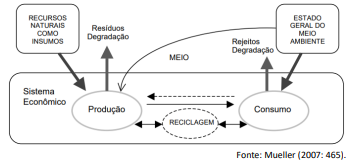
A figura a seguir representa, de forma sucinta, as relações do sistema econômico com o meio ambiente.
Em relação à teoria ambiental neoclássica, assinale a afirmativa correta.
A figura a seguir representa, de forma sucinta, as relações do sistema econômico com o meio ambiente.
Em relação à teoria ambiental neoclássica, assinale a afirmativa correta.
Ano: 2022
Banca:
FGV
Órgão:
EPE
Prova:
FGV - 2022 - EPE - Analista de Pesquisa Energética - Petróleo - Gás e Bioenergia |
Q1912920
Economia
O consumo de energia é um dos principais indicadores do
desenvolvimento econômico e social de qualquer sociedade. Ele
reflete tanto o ritmo de atividade nos setores industrial,
comercial e de serviços, quanto a capacidade da população em
adquirir bens e serviços tecnologicamente mais avançados. Entre
os setores que mais consomem energia, destaca-se a indústria.
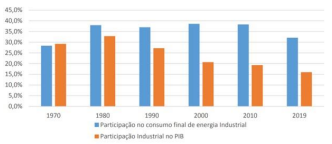
No Brasil, de acordo com o Balanço Energético Nacional (BEN) de
2019, a participação era de 28,4%, em 1970, e passou para
32,0%, em 2019 (EPE, 2019). Por outro lado, a indústria vem
perdendo participação no PIB brasileiro, como pode ser
constatado por dados do IBGE (2019), passando de 29,2% do PIB,
em 1970, para 16%, em 2019.
A evolução da participação da indústria no consumo de energia e no PIB pode ser vista na figura a seguir.
A esse respeito, analise as afirmativas a seguir e assinale (V) para a verdadeira e (F) para a falsa
( ) No período avaliado houve diminuição da intensidade energética na indústria.
( ) Por intensidade energética pode-se entender como a razão entre o consumo agregado de energia e o Produto Interno Bruto.
( ) A dinâmica dos subsetores que compõem o segmento industrial contribuiu para as modificações na estrutura de consumo de energia no período. Setores mais intensivos em energia apresentaram forte expansão no período. São exemplos dessa expansão os segmentos de ferro-gusa e aço, papel e celulose, não ferrosos e outros da metalurgia, e ferro-ligas.
As afirmativas são, na ordem apresentada, respectivamente,
A evolução da participação da indústria no consumo de energia e no PIB pode ser vista na figura a seguir.
A esse respeito, analise as afirmativas a seguir e assinale (V) para a verdadeira e (F) para a falsa
( ) No período avaliado houve diminuição da intensidade energética na indústria.
( ) Por intensidade energética pode-se entender como a razão entre o consumo agregado de energia e o Produto Interno Bruto.
( ) A dinâmica dos subsetores que compõem o segmento industrial contribuiu para as modificações na estrutura de consumo de energia no período. Setores mais intensivos em energia apresentaram forte expansão no período. São exemplos dessa expansão os segmentos de ferro-gusa e aço, papel e celulose, não ferrosos e outros da metalurgia, e ferro-ligas.
As afirmativas são, na ordem apresentada, respectivamente,
Ano: 2022
Banca:
FGV
Órgão:
EPE
Prova:
FGV - 2022 - EPE - Analista de Pesquisa Energética - Petróleo - Gás e Bioenergia |
Q1912919
Economia
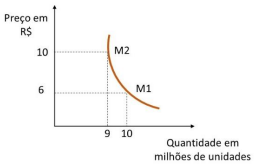
A Elasticidade-Preço da Demanda compara a variação percentual na quantidade demandada com a variação percentual do preço, conforme apresentado na curva da demanda a seguir.
A partir da observação da curva acima, é correto afirmar que
Ano: 2022
Banca:
FGV
Órgão:
EPE
Prova:
FGV - 2022 - EPE - Analista de Pesquisa Energética - Petróleo - Gás e Bioenergia |
Q1912918
Economia
A macroeconomia analisa, mede e tira conclusões em larga escala
sobre fenômenos que alteram a situação econômica de uma
cidade, estado, região ou país.
A macroeconomia acompanha o movimento de cinco mercados. Relacione os mercados acompanhados pela macroeconomia às suas respectivas atribuições.
I. Mercado de Bens e Serviços II. Mercado de Trabalho III. Mercado Monetário IV. Mercado de Títulos V. Mercado de Divisas
( ) Admite a existência de um tipo de mão-de-obra independente de características, determinando a taxa de salários e o nível de emprego.
( ) avalia a balança comercial do país, ou seja, os volumes de importações e exportações, além das transferências de dinheiro associado a essas transações.
( ) Analisa a demanda da moeda e a oferta da mesma pelo Banco Central que determina a taxa de juros.
( ) Determina o nível de produção agregada bem como o nível de preços.
( ) Analisa os agentes econômicos superavitários que possuem um nível de gastos inferior a sua renda e deficitários que possuem gastos superiores ao seu nível de renda.
Assinale a opção que indica a relação correta, na ordem apresentada.
A macroeconomia acompanha o movimento de cinco mercados. Relacione os mercados acompanhados pela macroeconomia às suas respectivas atribuições.
I. Mercado de Bens e Serviços II. Mercado de Trabalho III. Mercado Monetário IV. Mercado de Títulos V. Mercado de Divisas
( ) Admite a existência de um tipo de mão-de-obra independente de características, determinando a taxa de salários e o nível de emprego.
( ) avalia a balança comercial do país, ou seja, os volumes de importações e exportações, além das transferências de dinheiro associado a essas transações.
( ) Analisa a demanda da moeda e a oferta da mesma pelo Banco Central que determina a taxa de juros.
( ) Determina o nível de produção agregada bem como o nível de preços.
( ) Analisa os agentes econômicos superavitários que possuem um nível de gastos inferior a sua renda e deficitários que possuem gastos superiores ao seu nível de renda.
Assinale a opção que indica a relação correta, na ordem apresentada.
Ano: 2022
Banca:
FGV
Órgão:
EPE
Prova:
FGV - 2022 - EPE - Analista de Pesquisa Energética - Petróleo - Gás e Bioenergia |
Q1912917
Economia
A Teoria do Consumidor, ou Teoria da Escolha, é uma teoria
microeconômica, que busca descrever como os consumidores
tomam decisões de compra e como eles enfrentam os tradeoffs e
as mudanças em seu ambiente.
Relacione os termos da Teoria do Consumidor às suas respectivas definições.
I. Excedente do consumidor II. Escolha Intertemporal III. Preferências IV. Utilidade
( ) é a decisão de usar a renda, retratada na curva de restrição orçamentária, no consumo presente ou adiar a decisão de consumir optando pelo consumo futuro.
( ) é o nome dado a uma teoria microeconômica que estuda como os consumidores fazem suas escolhas. Cada consumidor tem conhecimento exato de toda informação relevante para as suas decisões de consumo, conhece os bens e serviços disponíveis e de seu potencial de satisfazer suas necessidades.
( ) é normalmente aplicada pelos economistas em construções como a curva de indiferença que apresenta, para um determinado nível de satisfação, a quantidade de bens que um indivíduo ou uma sociedade aceitariam ter.
( ) é a diferença entre o montante que o consumidor estaria disposto a pagar por determinada quantidade de um bem e o montante que efetivamente paga.
Assinale a opção que indica a relação correta, na ordem apresentada.
Relacione os termos da Teoria do Consumidor às suas respectivas definições.
I. Excedente do consumidor II. Escolha Intertemporal III. Preferências IV. Utilidade
( ) é a decisão de usar a renda, retratada na curva de restrição orçamentária, no consumo presente ou adiar a decisão de consumir optando pelo consumo futuro.
( ) é o nome dado a uma teoria microeconômica que estuda como os consumidores fazem suas escolhas. Cada consumidor tem conhecimento exato de toda informação relevante para as suas decisões de consumo, conhece os bens e serviços disponíveis e de seu potencial de satisfazer suas necessidades.
( ) é normalmente aplicada pelos economistas em construções como a curva de indiferença que apresenta, para um determinado nível de satisfação, a quantidade de bens que um indivíduo ou uma sociedade aceitariam ter.
( ) é a diferença entre o montante que o consumidor estaria disposto a pagar por determinada quantidade de um bem e o montante que efetivamente paga.
Assinale a opção que indica a relação correta, na ordem apresentada.
Ano: 2022
Banca:
FGV
Órgão:
EPE
Prova:
FGV - 2022 - EPE - Analista de Pesquisa Energética - Petróleo - Gás e Bioenergia |
Q1912916
Química
Um mol de gás ideal sofre uma transformação isotérmica, na qual
seu volume passa de 10 L (estado inicial: 1) para 25 L (estado
final: 2).
O gráfico que melhor representa a variação de entalpia (H) em função da pressão (P) neste processo é:
O gráfico que melhor representa a variação de entalpia (H) em função da pressão (P) neste processo é:
Ano: 2022
Banca:
FGV
Órgão:
EPE
Prova:
FGV - 2022 - EPE - Analista de Pesquisa Energética - Petróleo - Gás e Bioenergia |
Q1912915
Química
Silicato de sódio, um composto químico de fórmula Na2SiO3, atua
como um agente ligante na produção de cimentos refratários.
Também é utilizado na produção de cimentos antiácidos, na
produção de isolantes térmicos e na fabricação de
impermeabilizantes de paredes e lajes.
O processo de obtenção consiste na calcinação da mistura de sílica (SiO2) com carbonato de sódio (Na2CO3), produzindo o silicato de sódio e gás carbônico. Este processo apresenta rendimento de 70%.
A massa de silicato de sódio que poderá ser obtida por este processo, a partir de 3,0 kg de sílica, é: Dados: Massas molares em g.mol–1 Si = 28; O = 16; Na = 23; C = 12.
O processo de obtenção consiste na calcinação da mistura de sílica (SiO2) com carbonato de sódio (Na2CO3), produzindo o silicato de sódio e gás carbônico. Este processo apresenta rendimento de 70%.
A massa de silicato de sódio que poderá ser obtida por este processo, a partir de 3,0 kg de sílica, é: Dados: Massas molares em g.mol–1 Si = 28; O = 16; Na = 23; C = 12.
Ano: 2022
Banca:
FGV
Órgão:
EPE
Prova:
FGV - 2022 - EPE - Analista de Pesquisa Energética - Petróleo - Gás e Bioenergia |
Q1912914
Engenharia Mecânica
A ideia de que a massa específica do ar é proporcional à pressão
atmosférica prevê que a pressão diminui exponencialmente com
a altitude.
Nessas condições, a altitude na qual a pressão atmosférica é a metade de seu valor no nível do mar é de, aproximadamente,
(Pressão atmosférica ao nível do mar: 1 atm ≈ 105 N/m2 . Massa específica do ar à pressão atmosférica = 1,3 kg/m3 , g = 10 m/s2 e ln 2 ≈ 0,69)
Nessas condições, a altitude na qual a pressão atmosférica é a metade de seu valor no nível do mar é de, aproximadamente,
(Pressão atmosférica ao nível do mar: 1 atm ≈ 105 N/m2 . Massa específica do ar à pressão atmosférica = 1,3 kg/m3 , g = 10 m/s2 e ln 2 ≈ 0,69)
Ano: 2022
Banca:
FGV
Órgão:
EPE
Prova:
FGV - 2022 - EPE - Analista de Pesquisa Energética - Petróleo - Gás e Bioenergia |
Q1912913
Engenharia Ambiental e Sanitária
Um tanque de grandes dimensões possui água até uma altura de
5m. Em sua base, existe um orifício circular, com 2cm de
diâmetro. O fator de via líquida que sai do orifício tem fator de
contração de 0,7.
Para que o nível do tanque seja mantido, é necessário que ele seja alimentado continuamente com água à vazão, em L/s, de (Considere: g = 10 m/s2 e π ≈ 3)
Para que o nível do tanque seja mantido, é necessário que ele seja alimentado continuamente com água à vazão, em L/s, de (Considere: g = 10 m/s2 e π ≈ 3)
Ano: 2022
Banca:
FGV
Órgão:
EPE
Prova:
FGV - 2022 - EPE - Analista de Pesquisa Energética - Petróleo - Gás e Bioenergia |
Q1912912
Estatística
Acerca de uma variável aleatória X com distribuição normal, com média μ e variância σ2 ,avalie as afirmativas a seguir.
I. Se m é a mediana de X então m = μ
II. A probabilidade de que X seja maior do que μ + 0,1σ é maior do que 0,5.
III. A variável Z = (X - μ)/ σ tem distribuição normal com média 0 e variância 1.
Está correto o que se afirma em
Ano: 2022
Banca:
FGV
Órgão:
EPE
Prova:
FGV - 2022 - EPE - Analista de Pesquisa Energética - Petróleo - Gás e Bioenergia |
Q1912911
Matemática
Em uma população, 50% das pessoas já tiveram diagnóstico de
Covid-19. Se oito pessoas dessa população forem sorteadas com
reposição, (ou seja, uma mesma pessoa pode ser sorteada mais
de uma vez), a probabilidade de que, das oito, ao menos seis já
tenham sido diagnosticadas com Covid-19 é, aproximadamente,
igual a
Ano: 2022
Banca:
FGV
Órgão:
EPE
Prova:
FGV - 2022 - EPE - Analista de Pesquisa Energética - Petróleo - Gás e Bioenergia |
Q1912910
Estatística
Uma variável aleatória discreta X tem função de probabilidade dada por
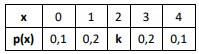
em que k é uma constante.
A variância de X é igual a
Ano: 2022
Banca:
FGV
Órgão:
EPE
Prova:
FGV - 2022 - EPE - Analista de Pesquisa Energética - Petróleo - Gás e Bioenergia |
Q1912909
Matemática
Doze pessoas, representantes de torcidas organizadas, estão
reunidas numa sala: quatro flamenguistas, quatro tricolores e
quatro vascaínos. Elas decidem formar um grupo de trabalho
composto por dois flamenguistas, dois tricolores e dois vascaínos.
O número de diferentes grupos que podem ser formados é igual a
O número de diferentes grupos que podem ser formados é igual a
Ano: 2022
Banca:
FGV
Órgão:
EPE
Prova:
FGV - 2022 - EPE - Analista de Pesquisa Energética - Petróleo - Exploração e Produção |
Q1912863
Engenharia de Petróleo
Na prospecção de petróleo é importante a identificação da
pressão das formações. A relação entre a pressão do fluido nas
diferentes formações, inclusive reservatório, e a profundidade,
pode ser utilizada para definição de interface entre fluidos ou
para confirmar observações realizadas diretamente por
perfilagem.
A pressão exercida pela coluna de rochas, que combina a pressão exercida pelos fluidos nos poros e a tensão entre os grãos da matriz da rocha, e que em condições normais é de, aproximadamente, 1 psi/ft, é denominada
A pressão exercida pela coluna de rochas, que combina a pressão exercida pelos fluidos nos poros e a tensão entre os grãos da matriz da rocha, e que em condições normais é de, aproximadamente, 1 psi/ft, é denominada
Ano: 2022
Banca:
FGV
Órgão:
EPE
Prova:
FGV - 2022 - EPE - Analista de Pesquisa Energética - Petróleo - Exploração e Produção |
Q1912862
Engenharia de Petróleo
No processo de produção de petróleo, em poços que tenham
diferentes pressões de fluxo, pode ser necessária a utilização de
vários estágios de separação.
Sobre os problemas operacionais nos separadores, assinale a opção que indica o nome daquele que se dá quando o nível de líquido está muito alto ou muito baixo.
Sobre os problemas operacionais nos separadores, assinale a opção que indica o nome daquele que se dá quando o nível de líquido está muito alto ou muito baixo.

 Conheça nossos planos